






Planning a Polyclonal Antibody Sequencing Project: Sample Requirements, Reference Data, and Validation Strategy
Introduction
A research group may hold a polyclonal antibody reagent that works reliably in Western blot but has no documented sequence. A biotech team may need to convert a polyclonal serum into recombinant candidates and cannot proceed without sequence data from the original material. A core facility manager may be asked to obtain antibody sequences from an immunized animal but lack clarity on what the service needs from the client before analysis begins.
Polyclonal antibody sequencing projects are more complex than monoclonal projects because the sample contains many clonotypes rather than a single dominant sequence. Success depends on sample preparation that preserves clonal diversity, reference data that supports sequence assembly, and a validation strategy that confirms whether the derived sequences are functional. Planning these elements before submission reduces repreparation, ambiguous results, and wasted validation effort.
This article covers the sample requirements, reference data considerations, and validation strategies that should be resolved before starting a polyclonal antibody sequencing project.
Why Polyclonal Antibody Sequencing Requires More Planning
Monoclonal antibody sequencing starts from a homogeneous source. One hybridoma produces one dominant heavy chain and one dominant light chain. Polyclonal samples contain many coexisting immunoglobulin clonotypes from the same immunization or production run. CDR peptides from different clones overlap in the LC-MS/MS data, framework peptides are shared across clonotypes, and low-abundance clones compete for detection against high-abundance ones.
Without adequate planning, a sequencing project may return incomplete CDR coverage, ambiguous clonotype assignments, or sequences that cannot be confirmed by recombinant expression. Defining sample form, available reference information, and intended validation use before submission allows the analytical workflow to be designed around the specific project challenge.
Sample Requirements
Sample Purity and Immunoglobulin Content
Mass spectrometry-based polyclonal antibody sequencing works best on purified IgG fractions. Crude serum contains albumin, complement proteins, and other high-abundance components that suppress antibody peptide detection.
Protein A or Protein G affinity purification is typically required before submission. Some projects benefit from antigen-specific affinity enrichment when the goal is to recover clonotypes targeting a defined antigen rather than characterizing the entire polyclonal pool.
Confirm whether the sample is whole serum, Protein A/G-purified IgG, or antigen-enriched antibody before requesting a quote. Each form determines preparation strategy and expected sequencing depth.
Sample Amount
Polyclonal antibody sequencing by mass spectrometry typically requires more starting material than monoclonal projects because multiple digestion and fractionation steps may be needed to resolve clonal diversity.
Exact amounts depend on the workflow, but projects should plan for multi-enzyme digestion across replicate preparations. Reserve additional material for repeat analysis or orthogonal confirmation if possible. Limited samples can be analyzed, but reduced material may limit the number of clonotypes recovered or the CDR coverage achieved.
Sample Integrity and Storage
Antibody degradation, aggregation, or repeated freeze-thaw cycling can reduce sequence coverage and introduce artifactual modifications. Store purified IgG at recommended conditions and document freeze-thaw history before submission.
SDS-PAGE or intact mass profiling before sequencing provides a useful quality checkpoint. Visible degradation bands or unexpected mass heterogeneity should be discussed with the service team before committing the sample to full sequencing.
Species and Isotype Considerations
Polyclonal sequencing relies on immunoglobulin gene databases and framework knowledge specific to the source species. Rabbit, mouse, goat, sheep, and chicken antibodies each have different variable gene segment structures. Confirm the species and expected IgG subclass so the appropriate database and search strategy are applied.
Mixtures of isotypes within the same polyclonal preparation may require separation before sequencing if the goal is subclass-specific clonotype recovery.
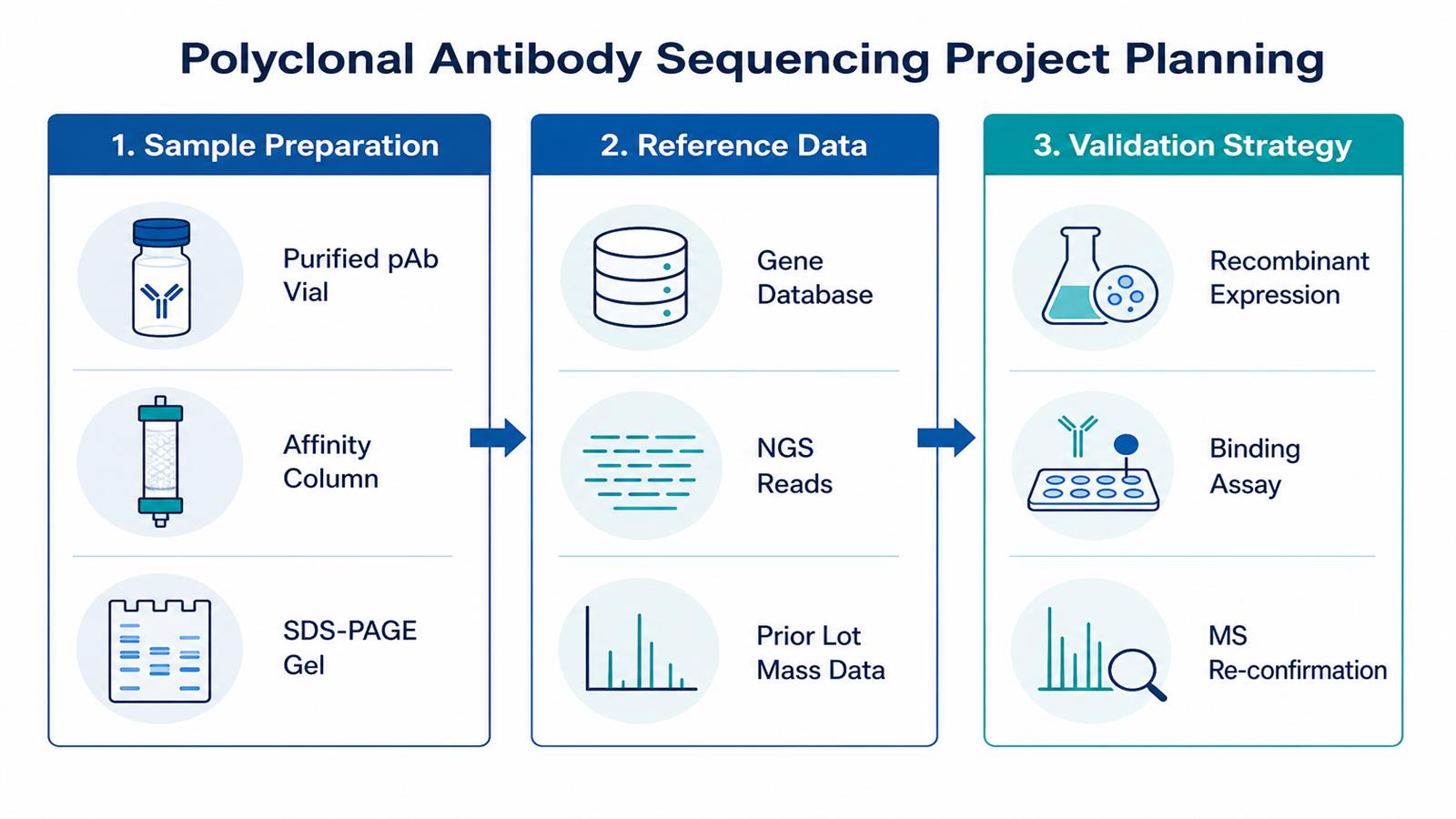
Figure 1. Polyclonal antibody sequencing project planning addresses sample preparation, reference data, and validation strategy before analysis begins.
Reference Data That Supports Sequence Assembly
Why Reference Data Matters
De novo mass spectrometry sequencing assembles amino acid sequences from fragment ion spectra without requiring a prior template. However, polyclonal mixtures produce overlapping peptide signals from multiple clonotypes, and CDR regions are hypervariable. Reference data provides assembly anchors that improve clonotype resolution and reduce ambiguity in sequence reconstruction.
Reference data does not replace de novo sequencing. It supports the assembly process by constraining which framework-CDR junctions and V-gene assignments are biologically plausible for the source species and immunization.
Types of Useful Reference Data
Immunoglobulin germline gene databases for the source species provide framework templates and V/D/J segment boundaries. Species-specific databases (IMGT, custom collections) improve assembly accuracy compared to generic vertebrate references.
NGS B-cell repertoire data from the immunized animal, when available, provides a clonotype catalog that MS peptide evidence can be mapped against. Paired heavy-light chain data from single-cell approaches is especially valuable when correct chain pairing is required.
Prior lot characterization data such as intact mass profiles or peptide maps from earlier production batches provides comparability context when the project goal is batch-to-batch documentation.
Antigen sequence and epitope information can guide post-sequencing review by helping prioritize clonotypes whose CDRs are consistent with the intended target recognition.
When Reference Data Is Not Available
Projects without NGS or prior characterization data can still proceed through de novo MS sequencing alone, but coverage depth, clonotype count, and assembly confidence may be lower. The project plan should acknowledge these limitations and set expectations accordingly.
Related Services
De Novo Antibody Sequencing Service
PCR Based Antibody Sequencing Service
Protein Sequence Analysis Service
Protein Molecular Weight Determination Service
Researchers planning a polyclonal antibody sequencing project can discuss sample readiness, available reference data, and validation goals with MtoZ Biolabs before submission.
Validation Strategy
Why Validation Is Essential for Polyclonal Sequences
Mass spectrometry-derived sequences represent the best peptide-supported reconstruction of antibody variable regions from a heterogeneous mixture. Sequence candidates require validation before they should be treated as confirmed functional antibodies. Validation confirms that the assembled sequence encodes a protein that folds correctly, binds the intended target, and retains expected activity.
Without validation, a polyclonal sequencing project delivers candidate sequences with MS-level evidence but unknown functional status.
Validation Tiers
Validation effort should match the intended downstream use of the sequence.
|
Validation Tier |
What It Confirms |
Typical Method |
When Required |
|---|---|---|---|
|
MS-level confirmation |
Peptide evidence supports the assembled sequence |
Re-analysis, coverage review, spectral annotation |
All projects (baseline confidence) |
|
Recombinant expression |
The sequence encodes a full-length antibody that can be produced |
Gene synthesis and transient expression |
Projects moving toward recombinant reagent production |
|
Functional validation |
The expressed antibody binds target with expected specificity |
ELISA, SPR, Western blot, or cell-based assay |
Projects requiring confirmed activity for downstream use |
Not every polyclonal sequencing project requires all three tiers. Lot documentation projects may stop at MS-level confirmation. Recombinant conversion projects require all three.
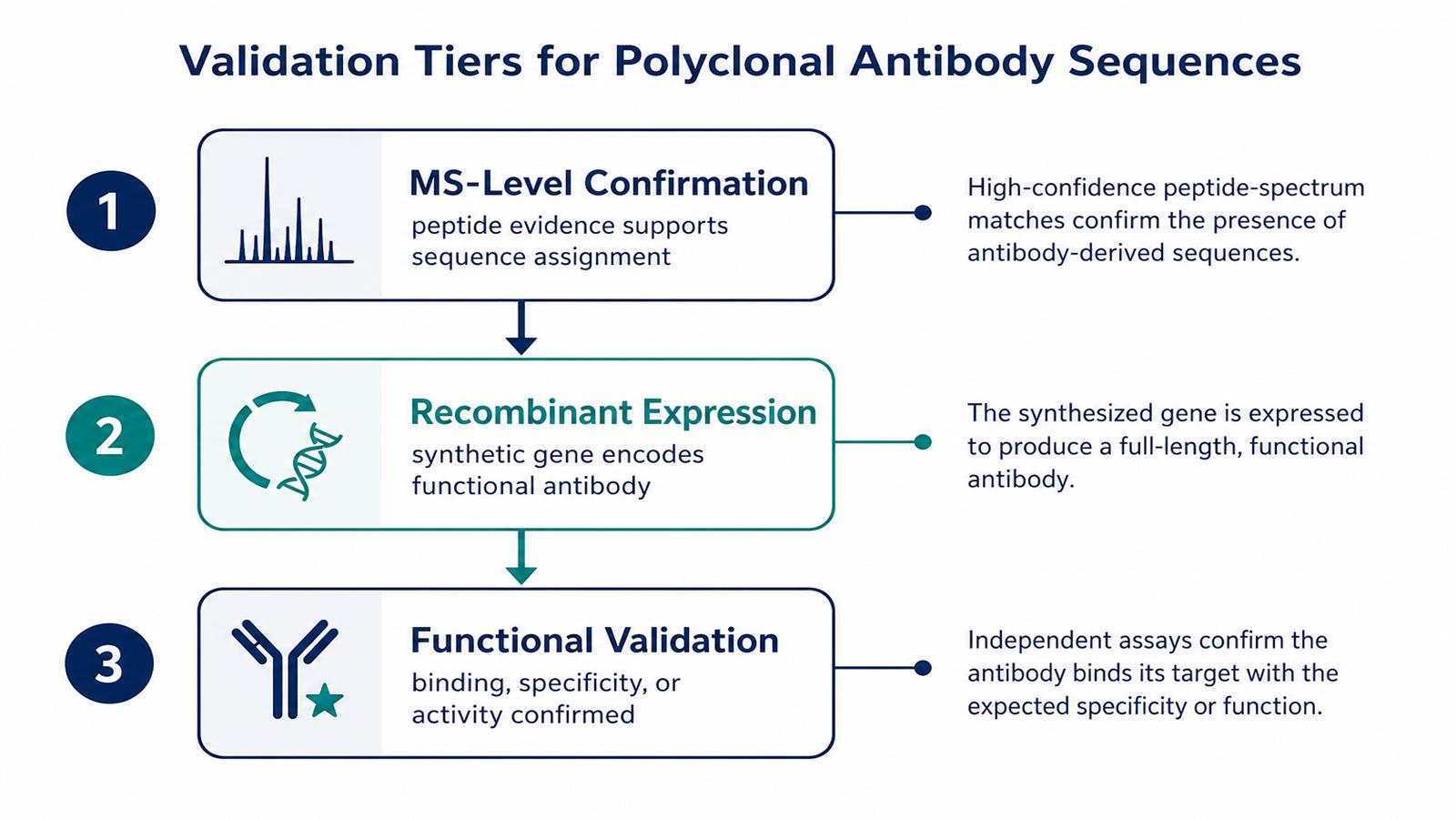
Figure 2. Validation tiers for polyclonal antibody sequences move from MS-level confirmation through recombinant expression to functional activity testing.
Planning Validation Before Sequencing Begins
Validation strategy should be defined before sequencing starts because it affects how many candidate sequences the project aims to recover, how deep the CDR coverage must be, and whether paired heavy-light chain assignment is required.
A project that only needs batch documentation can accept broader coverage thresholds. A project that plans to express top candidates recombinantly should prioritize high-confidence full-length assemblies with paired chain evidence.
Common Planning Gaps That Increase Project Risk
Submitting crude serum rather than purified IgG wastes sequencing depth on non-antibody proteins.
Omitting species or isotype information prevents the service team from selecting the correct germline database and framework search space.
Expecting monoclonal-level completeness from a polyclonal sample sets unrealistic confidence targets. Polyclonal sequencing recovers dominant or enriched clonotypes, not a complete enumeration of every clone present.
Skipping validation planning leads to sequences that cannot be acted upon when the downstream goal is recombinant production or functional testing.
Not reserving sample for repeat analysis removes the option to confirm ambiguous regions or run orthogonal workflows on the same material.
Information to Prepare Before Requesting a Quote
- Sample form: crude serum, Protein A/G-purified IgG, or antigen-enriched fraction
- Source species and expected IgG subclass
- Immunization antigen identity if known
- Available reference data: germline database, NGS repertoire, prior lot MS data
- Approximate sample amount and storage history
- Project goal: lot documentation, clonotype discovery, or recombinant conversion
- Validation plan: MS confirmation only, expression testing, or functional assays
- Number of candidate sequences desired if recombinant expression is planned
Frequently Asked Questions
Can polyclonal antibody sequencing recover every clonotype in the sample?
Not typically. The method recovers dominant and moderately abundant clonotypes with sufficient MS evidence for sequence assembly. Very low-abundance clones may remain below detection, especially without antigen enrichment or paired NGS data. The practical goal is to identify high-confidence candidates rather than exhaustively enumerate all clones.
Is NGS data required for polyclonal antibody sequencing?
NGS data is not strictly required. De novo mass spectrometry sequencing can generate candidate sequences without prior template. However, NGS B-cell repertoire data from the immunized animal significantly improves assembly confidence, clonotype resolution, and heavy-light chain pairing when available.
How does antigen-specific enrichment improve sequencing results?
Antigen-specific enrichment concentrates antibodies that bind the target antigen, reducing the background of irrelevant clonotypes. Sequencing enriched material focuses MS analysis on functional clones rather than the entire polyclonal pool, improving CDR coverage and reducing assembly ambiguity for target-relevant sequences.
What if only a small amount of polyclonal antibody is available?
Limited sample can be analyzed, but reduced starting material may limit digestion replicates, fractionation depth, or the number of clonotypes recovered. Discuss sample constraints with the service team before submission so the workflow can be adapted to maximize information from available material.
Closing Summary
Planning a polyclonal antibody sequencing project requires attention to sample form, reference data availability, and validation strategy before the first LC-MS/MS run. Unlike monoclonal projects, polyclonal sequencing must resolve or prioritize multiple clonotypes from a heterogeneous mixture, making upfront preparation decisions directly consequential for result quality.
For polyclonal antibody sequencing projects, MtoZ Biolabs provides pre-project consultation covering sample readiness, reference data integration, clonotype recovery expectations, and validation planning. Share your sample type, species, project goal, and available reference data through the inquiry form to begin scope review.
How to order?




