






Polyclonal Antibody Sequencing: How Complex Antibody Mixtures Can Be Resolved by MS-Based and Sequence-Guided Analysis
Introduction
Complex antibody mixtures are common in polyclonal sera, antigen-affinity-purified IgG, and immune repertoire samples, yet they are difficult to characterize at sequence level. Many clonotypes may bind the same antigen through different epitopes. Framework regions may produce shared peptides across clones, while CDR regions carry the clonotype-specific information needed for assignment. Low-abundance clones may be hidden beneath dominant signals, and closely related sequences may differ by only a few residues.
Polyclonal antibody sequencing must therefore do more than generate peptides. It must resolve mixed MS data into clonotype-level sequence evidence that can be reviewed, compared, and used for redevelopment. MS-based de novo analysis provides peptide-level sequence tags from LC-MS/MS data. Sequence-guided analysis groups those tags into heavy and light chain variable region candidates using assembly logic, database support, and mass constraints.
This article explains how complex antibody mixtures can be resolved by MS-based and sequence-guided analysis, including the deconvolution workflow, key technical steps, and reporting outputs.
Why Complex Antibody Mixtures Are Hard to Sequence
Complex mixtures create three main analytical problems.
Peptide overlap occurs when multiple clonotypes share framework sequences or similar CDR motifs, producing redundant peptide evidence that is difficult to assign to one clone. Abundance imbalance allows dominant clonotypes to saturate MS/MS coverage while low-abundance clones remain under-sampled. Clonal similarity means near-identical variable regions may differ by only one or a few amino acids, requiring high-confidence fragment evidence rather than single peptide calls.
Standard monoclonal sequencing workflows assume one dominant sequence and therefore fail when these mixture problems are ignored. Resolving complex polyclonal samples requires deliberate enrichment, MS strategy, and sequence-guided assembly.
Overview of the Resolution Strategy
Complex antibody mixtures are usually resolved through a linked strategy rather than a single experiment.
First, sample complexity is reduced through enrichment or fractionation so dominant clonotypes become analytically accessible. Second, MS-based analysis generates peptide or middle-down fragment sequences from the mixture. Third, sequence-guided assembly groups compatible peptide evidence into clonotype contigs for heavy and light chains. Fourth, mass constraints and database comparison support filtering of incompatible assignments. Fifth, confidence tiers separate high-confidence clonotypes from provisional or exploratory sequence calls.
The goal is not always to define every clone in the mixture. The goal is to resolve the clonotypes that are biologically or practically relevant to the project.
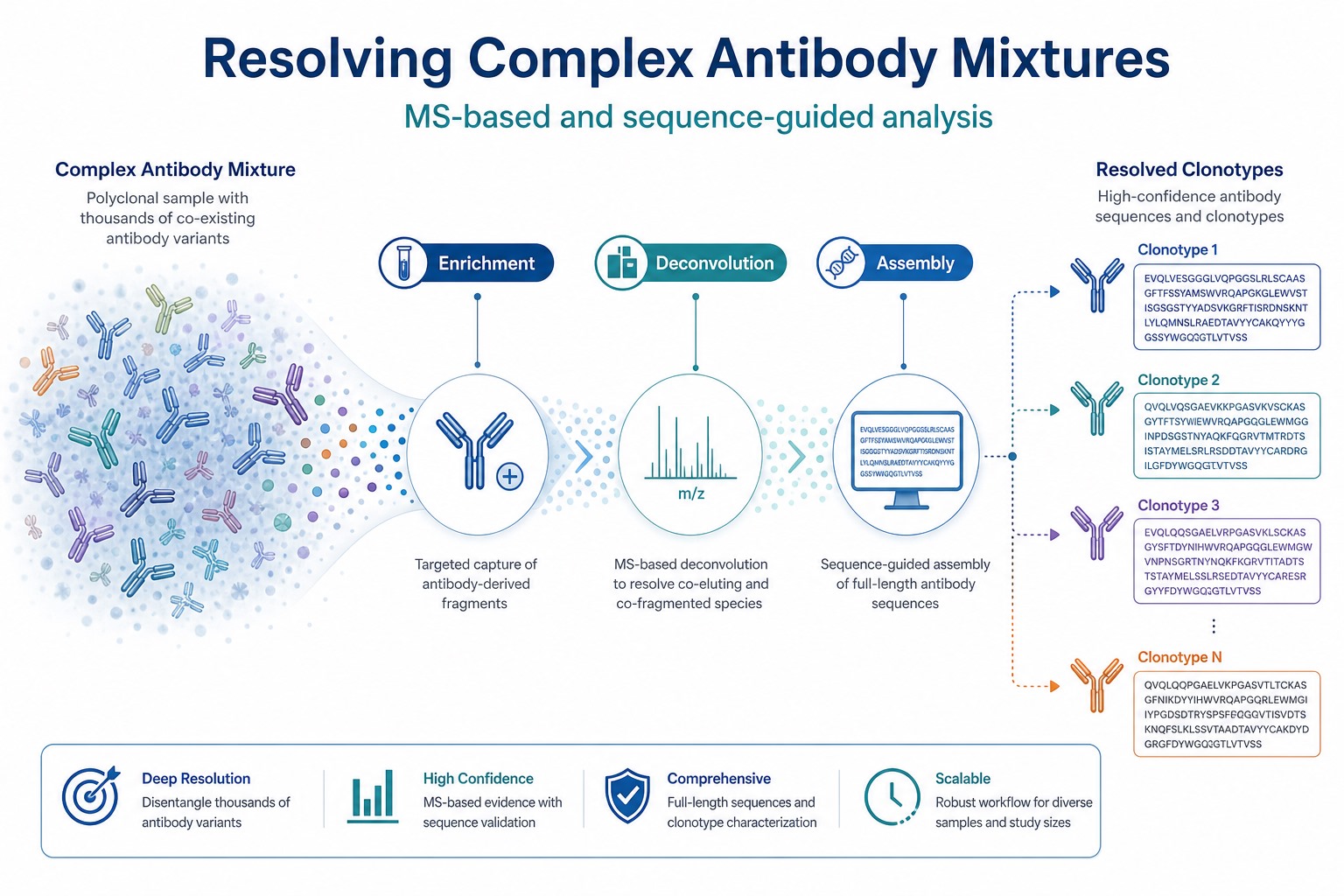
Figure 1. Complex antibody mixtures are resolved by combining MS-based peptide sequencing with sequence-guided clonotype assembly and filtering.
Step 1: Reduce Mixture Complexity Before MS
Resolution begins before the mass spectrometer run.
Antigen-affinity purification concentrates immunoglobulins targeting the relevant antigen and removes much of the unrelated serum background. Class or subclass enrichment reduces diversity when the project focuses on IgG rather than total immunoglobulin. Buffer exchange and cleanup remove contaminants that suppress peptide identification. Sample amount and purity review prevent wasted MS time on material that is too complex or too dilute.
This step does not create a monoclonal sample, but it often converts an intractable mixture into one where dominant clonotypes can be resolved.
Step 2: Choose MS Layer for Mixture Complexity
Different mixture complexities favor different MS layers.
Intact mass profiling provides a fast overview of major mass components and is useful when the first question is batch similarity rather than CDR-level sequence. Middle-down MS reduces peptide overlap by analyzing larger fragments that retain variable region information with less spectral congestion than full bottom-up digestion. De novo bottom-up LC-MS/MS remains the core method for amino acid-level sequence recovery when clonotype resolution is the primary goal.
Complex mixtures often require middle-down plus bottom-up support rather than one layer alone.
Step 3: Generate De Novo Peptide Evidence
MS-based resolution depends on high-quality de novo peptide sequencing.
Antibody samples are digested into peptides or larger fragments and analyzed by LC-MS/MS. Fragmentation spectra are interpreted into sequence tags and full peptide sequences without relying on a predefined monoclonal template. CDR-proximal peptides are especially valuable because they carry clonotype-specific information. Repeated observation of the same peptide across runs strengthens assignment confidence.
In complex mixtures, raw peptide lists are intermediate products rather than final answers. The critical step is grouping peptides that belong to the same clonotype.
Related Services
Mass Spectrometry Based Antibody Sequencing Service
Antibody De Novo Sequencing Service
Mono Poly Clonal Antibody De Novo Sequencing for Drug R&D
Antibody Sequence Analysis Service
Researchers resolving complex polyclonal mixtures can consult MtoZ Biolabs to review enrichment design, MS layer selection, and sequence-guided reporting options.
Step 4: Apply Sequence-Guided Assembly Logic
Sequence-guided analysis converts peptide evidence into clonotype candidates.
Compatible peptides are grouped into heavy and light chain contigs based on overlap, logical continuity, and consistency with immunoglobulin domain structure. Germline database comparison helps place variable region sequences in plausible framework context without forcing incorrect clone merging. Mass constraints from intact or middle-down data can exclude contigs inconsistent with observed subunit masses. Manual expert review remains important when clones are closely related or when peptide coverage is uneven across the variable region.
Sequence-guided assembly is the deconvolution step that transforms a mixed peptide list into interpretable clonotype output.
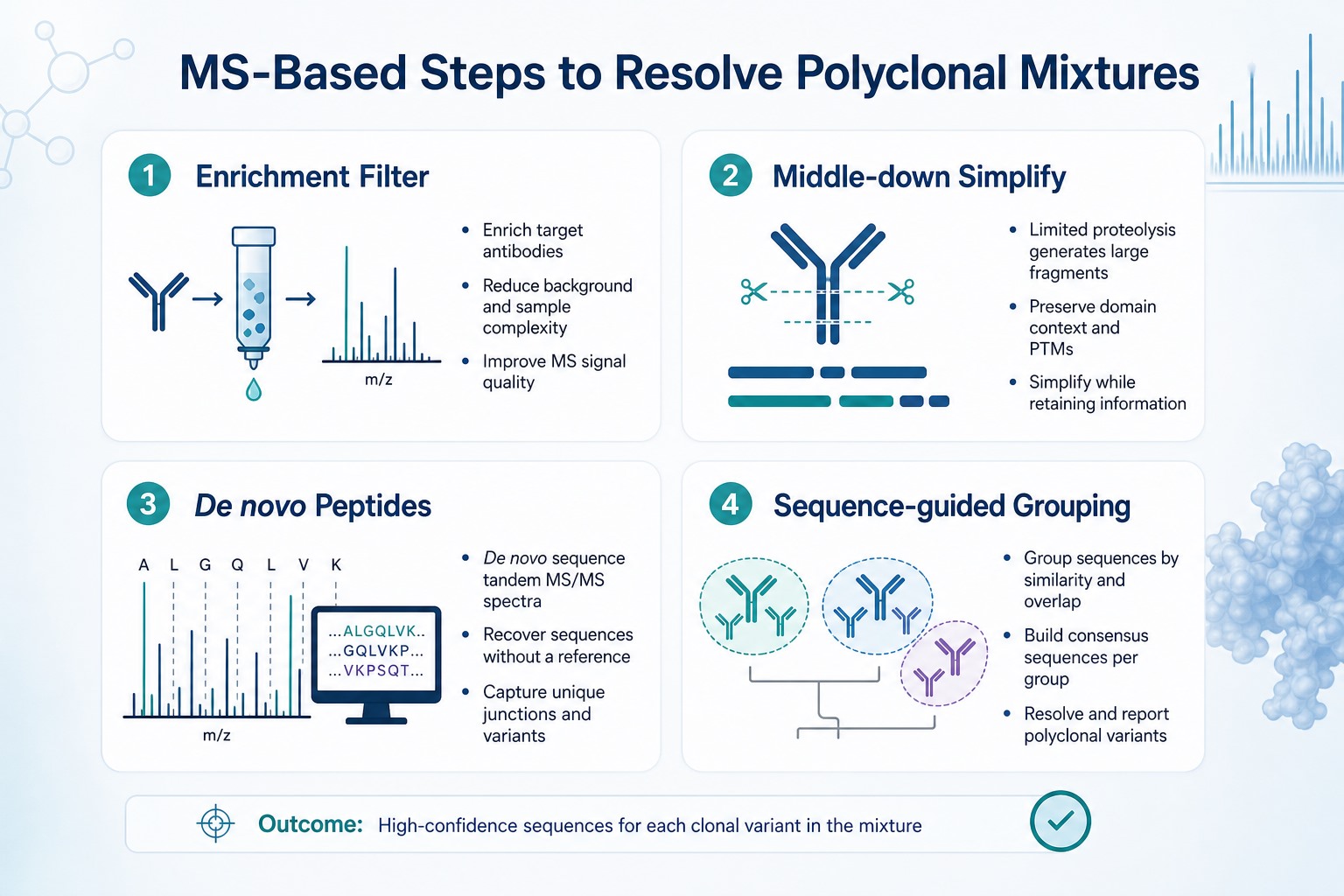
Figure 2. Mixture resolution combines enrichment, middle-down simplification, de novo peptide sequencing, and sequence-guided clonotype grouping.
Step 5: Use Mass Constraints to Filter Assignments
Mass constraints add an independent filter during deconvolution.
Intact mass analysis of reduced heavy and light chains can confirm whether assembled contigs fit observed subunit masses. Middle-down fragment masses can support or reject peptide groupings when multiple clonotypes have similar sequences. Mass disagreement is a useful flag for over-merged contigs or weak peptide assignments.
Mass data rarely replace peptide sequencing in complex mixtures, but they strengthen sequence-guided filtering when used together.
Step 6: Assign Confidence Tiers and Report Clonotypes
The final resolution step assigns each clonotype to a confidence tier.
High-confidence clonotypes show strong peptide coverage, repeat observation, consistent mass support, and plausible independent heavy-light pairing. Provisional clonotypes show promising but incomplete evidence and may require additional MS runs or enrichment. Exploratory calls remain documented but should not drive major redevelopment decisions without further validation.
Reporting should clearly separate resolved high-confidence clonotypes from lower-confidence sequence suggestions.
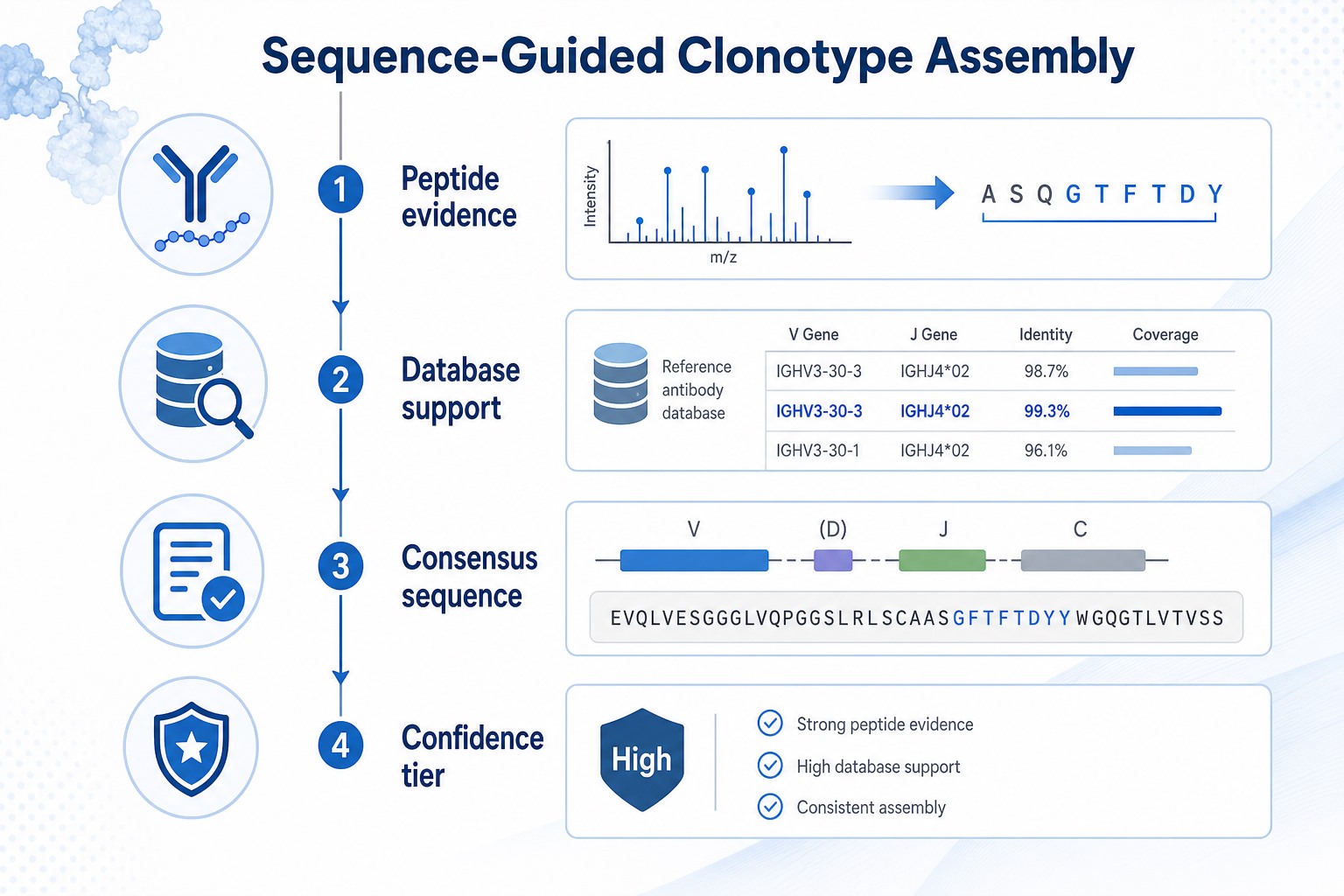
Figure 3. Sequence-guided assembly moves from peptide evidence and database support to consensus clonotype sequences with confidence tier assignment.
Resolution Strategy by Mixture Type
Different mixture types require different resolution emphasis.
|
Mixture Type |
Main Challenge |
Recommended Resolution Emphasis |
|---|---|---|
|
Antigen-purified polyclonal IgG |
Several dominant binders |
Enrichment plus de novo MS with assembly |
|
Unfractionated immune serum |
High background and diversity |
Strong enrichment before MS |
|
Closely related clonotypes |
Peptide overlap and ambiguity |
Middle-down plus sequence-guided review |
|
Lot comparison sample pair |
Detect drift between batches |
Intact mass plus targeted peptide comparison |
|
Redevelopment-focused sample |
Need lead clonotype sequences |
Integrated MS with confidence-tier reporting |
Resolution depth should match the decision the sequence output must support.
Core Technical Advantages and Current Limitations
Core Technical Advantages
Clonotype resolution from mixed samples.
MS-based and sequence-guided analysis can recover dominant sequences without a monoclonal template.
Layered deconvolution strategy.
Enrichment, middle-down, bottom-up, and mass filtering work together rather than in isolation.
Confidence-tier reporting.
Complex mixtures can be reported without overstating low-confidence calls.
Support for redevelopment and lot comparison.
Resolved clonotypes provide actionable sequence evidence for downstream decisions.
Current Limitations
Full repertoire coverage is usually not achieved.
Low-abundance clones may remain unresolved.
Closely related sequences remain challenging.
Single-residue differences require strong fragment evidence.
Success depends on enrichment quality.
Poorly enriched mixtures produce ambiguous peptide pools.
Functional validation is still required.
Sequence resolution does not by itself prove binding performance.
Expected Outputs from Mixture Resolution
A resolved complex mixture project typically delivers several outputs.
Dominant clonotype sequences for heavy and light chain variable regions are the primary deliverable when redevelopment is the goal. Peptide support tables document which MS evidence underpins each contig. Mass comparison summaries show whether contigs fit intact or middle-down observations. Confidence-tiered clonotype lists separate high-confidence, provisional, and exploratory assignments. Method notes describe enrichment, MS layers, and assembly logic for internal review.
These outputs allow teams to use polyclonal sequencing results without treating every peptide hit as a confirmed clonotype.
Frequently Asked Questions
1. Can complex polyclonal mixtures be fully sequenced?
Usually not completely. Most workflows resolve dominant or most relevant clonotypes rather than every low-abundance clone.
2. What role does sequence-guided analysis play?
It groups de novo peptide evidence into clonotype contigs using overlap logic, database support, and mass constraints.
3. Is bottom-up MS enough by itself?
Often no for complex mixtures. Middle-down data, enrichment, and assembly review usually improve resolution.
4. How are closely related clones separated?
By combining CDR-proximal peptide evidence, middle-down fragments, mass filtering, and expert manual review.
5. What should be expected in the final report?
Confidence-tiered clonotype sequences, peptide support evidence, and clear separation of high-confidence and provisional calls.
Conclusion
Complex antibody mixtures can be resolved by combining MS-based de novo sequencing with sequence-guided clonotype assembly. Enrichment reduces sample complexity, middle-down and bottom-up MS generate peptide evidence, and assembly logic groups that evidence into heavy and light chain candidates supported by mass constraints and confidence scoring. Full repertoire sequencing is rarely the goal. The practical value lies in resolving dominant clonotypes that support documentation, lot comparison, and recombinant redevelopment.
Programs that define resolution depth and reporting tiers before analysis obtain clearer polyclonal sequencing outcomes. Researchers facing complex antibody mixtures can contact MtoZ Biolabs to review enrichment strategy, MS workflow design, and sequence-guided reporting suited to their sample. For teams moving from resolved clonotypes toward recombinant expression, MtoZ Biolabs can also help connect deconvolution output with downstream antibody development planning.
How to order?




