






Planning an Affinity Purification Mass Spectrometry Project: Bait Design, Controls, Sample Preparation, and Validation Strategy
Introduction
Affinity purification-mass spectrometry projects often fail before the first LC-MS/MS run. A tagged bait is expressed at non-physiological levels. Empty-tag controls are omitted. Lysis chemistry is copied from an unrelated protocol. Validation is postponed until a long candidate list appears and no one knows which proteins deserve follow-up.
Planning an affinity purification mass spectrometry project means locking four decisions early: bait design, controls, sample preparation, and validation strategy. These choices determine whether the dataset supports interactome discovery, mutant comparison, or condition-dependent enrichment, or whether it mainly reports resin binders and overexpression artifacts.
This article provides a project-preparation framework for AP-MS. It is written for teams that already know they need tagged-bait enrichment MS and now need a decision-ready experimental plan.
Start with a One-Sentence Project Objective
Before construct design, write the decision the AP-MS dataset must support.
Examples of clear objectives include identifying candidate partners of a tagged signaling protein under stimulation, comparing interactomes of wild-type and binding-deficient mutants, or ranking condition-enriched proteins for orthogonal validation. Vague objectives such as mapping everything that binds the bait usually produce unfocused controls and weak candidate filters.
A useful planning test is whether the objective defines:
- the bait and biological system
- the contrast that matters
- the action that will follow from the candidate list
If those elements are missing, refine the question before ordering plasmids or reserving instrument time.
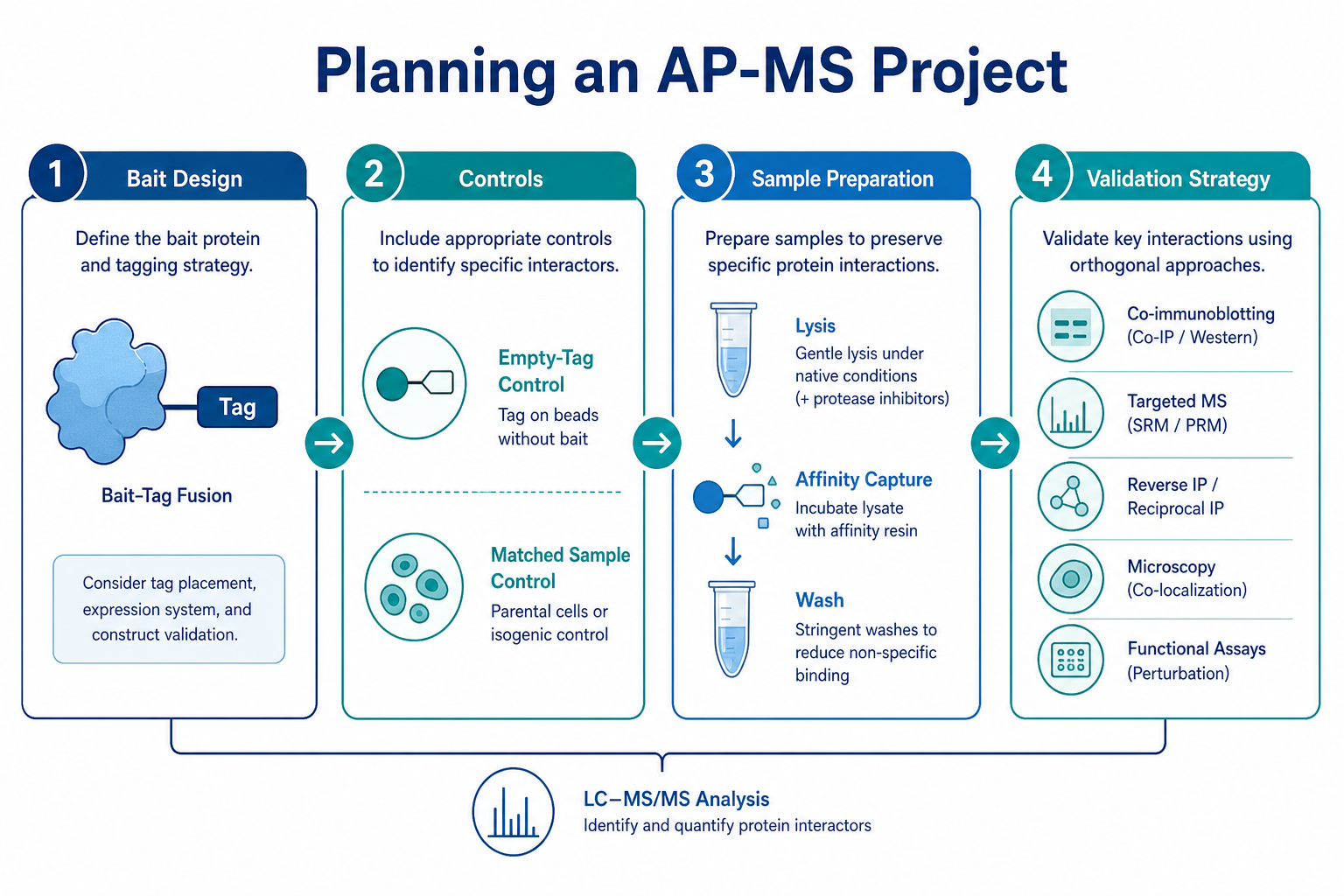
Figure 1. AP-MS project planning rests on bait design, controls, sample preparation, and a predefined validation strategy.
Bait Design Decisions
Bait design is the first quality gate in an AP-MS project.
Tag Selection and Position
Common tags include FLAG, HA, His, Strep, and GFP-related systems. Choose a tag based on purification chemistry, background profile in the host system, and compatibility with downstream detection. Tag position matters. N-terminal and C-terminal fusions can alter localization, folding, or partner access, so position should be justified by prior functional evidence when available.
Expression Strategy
Decide whether the bait will be expressed transiently, stably, or under inducible control. Expression level should be high enough for recovery, but not so high that nonspecific associations dominate. Inducible systems often help when overexpression artifacts are a known risk.
Functional Integrity Checks
Before full AP-MS, confirm that the tagged bait retains key activities or localization features relevant to the study. A construct that is expressed but mislocalized can generate reproducible yet biologically misleading enrichments.
Construct Series Planning
If mutants, truncations, or domain swaps are part of the project, design them as a matched series under the same tag and expression framework. Matched construct chemistry is one of the strongest advantages of AP-MS over antibody-limited IP-MS designs.
Affinity Purification-Mass Spectrometry Service
Control Strategy That Must Be Locked Early
Controls are not a late bioinformatics correction. They are part of sample generation.
Empty-Tag Controls
Empty-tag expressing lines identify proteins that bind the affinity handle or purification system rather than the bait. Process them with the same lysis, wash, and MS depth as bait samples.
Parental or Untagged Controls
Untagged parental lines help separate host-cell background from tag-associated background. They are especially useful when expression systems contribute abundant sticky proteins.
Matched Handling Across Groups
All groups should share bead type, wash volumes, incubation times, and elution chemistry. Procedural asymmetry between bait and control samples creates false enrichment.
Replicate Structure
Biological replicates support stable ranking of candidates. Single unreplicated enrichments can be exploratory, but they are weak support for interaction claims or project go-forward decisions.
Optional Functional Contrasts
Binding-deficient mutants, localization mutants, or pathway-inactive variants can strengthen interpretation when available. These contrasts help distinguish functional partners from proteins that co-purify merely because the bait is abundant or sticky.
Sample Preparation Planning
Sample preparation determines which complexes survive into the mass spectrometer.
Lysis Chemistry
Define detergent strength, salt concentration, and inhibitor panels according to the bait biology. Membrane, nuclear, and labile signaling complexes often need different extraction conditions. The goal is not the cleanest gel. The goal is bait recovery with partner preservation that still allows control-based filtering.
Wash Stringency
Wash planning is a deliberate trade-off. Mild washes retain weak or transient partners and increase background. Harsh washes reduce contaminants and may remove biologically relevant associations. Set the target stringency before the main cohort so bait and control samples remain comparable.
Input Amount and Clarification
Plan protein input for the full replicate and control matrix, not for a single tube. Incomplete clarification increases debris-related background and can destabilize affinity capture reproducibility.
Condition or Treatment Timing
If the project includes stimulation, stress, drug exposure, or time points, lock treatment windows and harvest timing in the preparation plan. Condition contrasts added after purification chemistry is fixed are harder to interpret.
|
Planning Item |
Decision to Lock |
Why It Matters |
|---|---|---|
|
Tag and position |
Which tag, N- or C-terminal |
Affects localization and partner access |
|
Expression mode |
Transient, stable, or inducible |
Controls overexpression artifacts |
|
Empty-tag line |
Yes or no, matched system |
Separates tag binders from bait partners |
|
Replicates |
Number and biological source |
Stabilizes enrichment ranking |
|
Lysis and wash |
Buffer family and stringency target |
Balances partner retention and background |
|
Validation shortlist rule |
How candidates enter follow-up |
Prevents endless unprioritized lists |
Validation Strategy Before Candidate Lists Appear
A strong AP-MS project defines validation rules before MS acquisition.
Predefine What Counts as a Priority Candidate
Examples include significant enrichment over empty-tag controls across replicates, coherence with bait biology, and recurrence across related mutants or conditions. Without predefined rules, teams often overinterpret long identification tables.
Choose Orthogonal Methods by Question Type
Reciprocal enrichment, targeted Western blot, proximity assays, or recombinant pull-down-MS can confirm different aspects of an interaction hypothesis. Direct binding questions are not answered by co-enrichment alone.
Sequence Validation Against Project Objective
If the objective is pathway hypothesis generation, a small validated hub set may be enough. If the objective is mechanism support for a mutant phenotype, validation should focus on partners that differ between wild-type and mutant baits.
Decide What Will Not Be Validated
Explicitly park low-priority contaminants and weakly enriched proteins. This keeps resources aligned with the decision the project was designed to support.
Pull Down based Protein Analysis Service with Mass Spectrometry
When AP-MS Planning Should Trigger a Method Switch
Reconsider AP-MS if tagging is incompatible with the biology, if endogenous context is mandatory and an antibody validated for IP-MS is available, or if the real need is direct binding confirmation with a recombinant bait.
In those cases, IP-MS, classical Co-IP, or pull-down-MS may be a better primary route. Method switching is a planning success when it happens before large sample cohorts are generated.
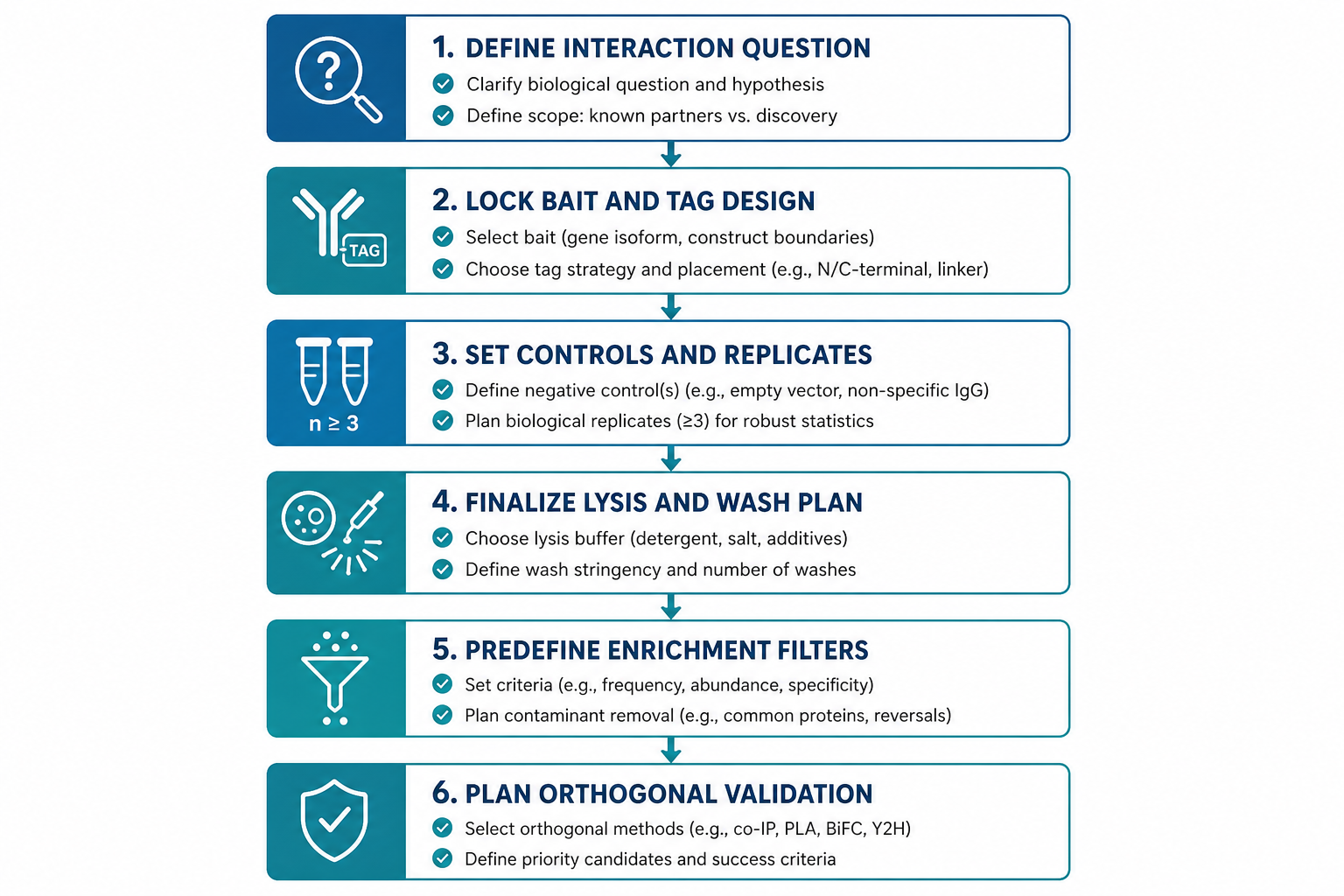
Figure 2. A readiness checklist helps teams lock bait design, controls, sample preparation, filters, and validation before AP-MS acquisition.
Related Services
Protein-Protein Interaction Analysis Service
MS-Based Protein-Protein Interaction Analysis Service
Co Immunoprecipitation (Co-IP) Service
Pre-Submission Project Checklist
Before requesting AP-MS support, assemble:
- one-sentence interaction objective and intended decision
- bait identity, tag system, tag position, and expression plan
- mutant or condition contrasts, if any
- empty-tag and matched control design
- replicate number and sample type
- lysis and wash priorities
- candidate filtering rules
- orthogonal validation methods for the expected shortlist
MtoZ Biolabs supports affinity purification-mass spectrometry and related protein interaction analysis for tagged-bait discovery projects. The technical team can review bait design, control architecture, sample preparation choices, and whether AP-MS remains the right primary method for the stated objective.
To plan an AP-MS project, contact MtoZ Biolabs with your bait construct details, control options, sample groups, preparation constraints, and the validation endpoint required for decision-making.
Frequently Asked Questions
What should be decided first in an AP-MS project plan?
The interaction objective should come first. Bait design, controls, and validation methods only become coherent after the decision supported by the dataset is clear.
Are empty-tag controls optional if the bait purifies cleanly?
No. Clean purification by gel appearance does not identify which co-enriched proteins are tag- or resin-associated. Empty-tag controls remain central to AP-MS interpretation.
How early should validation methods be chosen?
Before the main cohort is run. Preselected orthogonal assays prevent unfocused follow-up after long candidate lists appear.
Can one AP-MS plan cover both discovery and direct binding proof?
Usually not with equal strength. AP-MS is a discovery and enrichment framework. Direct binding typically needs a separate validation tier such as targeted pull-down or biophysical assays.
When should a team choose IP-MS instead during planning?
Choose IP-MS when endogenous bait context is required and an antibody validated for IP-MS is available. Choose AP-MS when tagging is acceptable and antibody performance is limiting.
Conclusion
Planning an affinity purification mass spectrometry project is a design exercise, not a scheduling exercise. Bait design determines what biology enters the purification. Controls determine what can be called enrichment. Sample preparation determines which associations survive. Validation strategy determines which candidates become decisions rather than unresolved lists.
Teams that lock these four elements before sample generation obtain clearer AP-MS outputs and faster follow-up. For tagged-bait interactome studies, disciplined project planning remains the most effective way to convert enrichment MS into usable biological evidence.
How to order?




