






Phage Immunoprecipitation Sequencing Service: How PhIP-Seq Profiles Antibody-Peptide Binding
A phage immunoprecipitation sequencing (PhIP-Seq) service profiles antibody-peptide binding by capturing antibody-bound, phage-displayed peptides and measuring which library members become enriched by sequencing. The result is a comparative reactivity profile defined by the peptide library, samples, controls, and analysis—not a direct measurement of native-protein affinity, structure, or biological function.
For a research team, the central service decision is therefore not simply whether PhIP-Seq can detect binding. It is whether the proposed library represents the peptide space relevant to the question, whether the experimental controls can distinguish meaningful enrichment from background, and whether the planned follow-up can test conclusions that extend beyond peptide reactivity.
What Is PhIP-Seq, and What Does Its Signal Mean?
PhIP-Seq combines phage display, immunoprecipitation, next-generation sequencing, and enrichment analysis. A peptide library is encoded by DNA and displayed on phage particles. When the library is incubated with a sample containing antibodies, some displayed peptides are recognized by those antibodies. Immunoprecipitation isolates antibody-associated phage, and sequencing identifies the peptide-encoding DNA recovered from the pull-down.
This encoding is what makes the workflow scalable. Instead of identifying each captured peptide through a separate binding measurement, the analysis maps sequencing reads back to the known library. The observed read counts support a relative estimate of which represented peptides were recovered more often in a sample than expected from the selected reference or control condition.
An enrichment signal is not equivalent to an affinity constant. It reflects the complete measurement system: peptide representation in the starting library, accessibility of the displayed sequence, antibody abundance and binding behavior under the assay conditions, immunoprecipitation efficiency, sequencing sampling, and the statistical comparison. Two peptides with different enrichment values cannot automatically be ranked as though PhIP-Seq were a purified-protein kinetic assay.
The word “epitope” also needs care. Overlapping enriched peptides may help localize a linear sequence motif or a candidate antibody-recognition region. However, short displayed peptides may not reproduce a native protein's folding, post-translational modifications, molecular partners, or conformational surface. PhIP-Seq can support peptide-level epitope mapping, but it does not by itself define three-dimensional epitope geometry.
How Does a PhIP-Seq Service Convert Binding into a Profile?
The service workflow is an ordered chain. Decisions made at the library and control stages determine what later enrichment statistics can mean, so analysis cannot compensate for a design that does not represent the biological question.
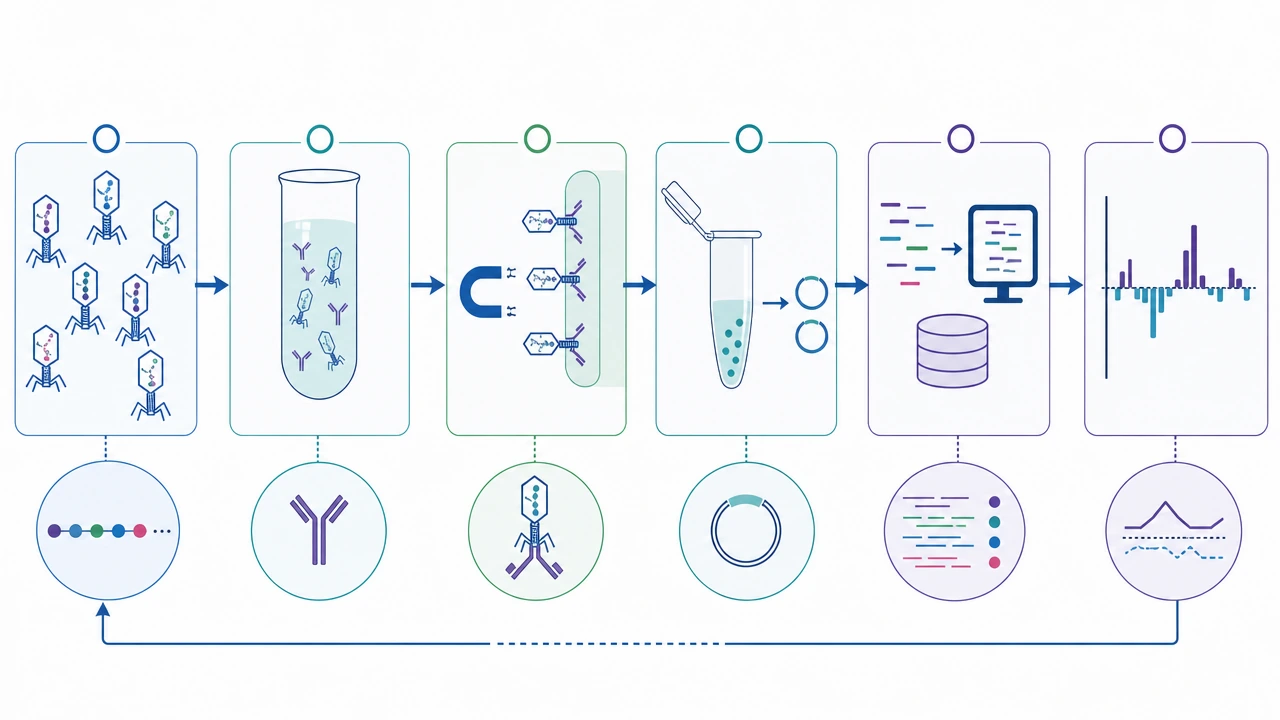
- Define the decision question and represented peptide space.
- Specify samples, replicates, and controls.
- Incubate the library and immunoprecipitate antibody-bound phage.
- Sequence the recovered peptide-encoding inserts.
- Calculate enrichment relative to the planned reference.
- Interpret the bounded profile and select appropriate follow-up.
1. Define the question and the represented peptide space
The project begins with a decision question, such as discovering candidate peptide reactivities, comparing antibody profiles between defined groups, or examining reactivity across selected proteins. That question guides library selection or design. Relevant considerations include the source sequences represented, peptide length and overlap, sequence variants of interest, and whether the expected recognition mechanism is compatible with linear displayed peptides.
The library is a measurement boundary, not just a reagent. A peptide absent from the library cannot produce a corresponding signal. A peptide that is present but poorly displayed may also be difficult to evaluate. Before samples are processed, the service plan should document what the library covers and which scientifically important features it cannot represent.
2. Specify samples, replicates, and controls
Sample and control planning should precede immunoprecipitation. The appropriate design depends on the intended comparison, but the general objective is to separate sample-associated recovery from library abundance, nonspecific capture, technical variation, and other background. The plan should identify the comparison groups, relevant negative or reference controls, replicate strategy, and criteria for excluding compromised samples.
Controls must match the claim. A control suitable for detecting nonspecific bead or reagent capture may not answer whether enrichment differs between biological groups. Likewise, a baseline library measurement informs starting abundance but cannot substitute for all sample-level comparisons. Each control should have a stated role in the final interpretation.
3. Incubate the library and immunoprecipitate antibody-bound phage
The displayed library is incubated with the antibody-containing sample under defined conditions. Antibody-associated phage are then isolated by immunoprecipitation. Washing removes a portion of unbound and nonspecifically associated material, while the retained phage population carries the DNA identifiers for recovered peptides.
This stage creates the physical selection that sequencing later measures. Conditions that influence binding or recovery can alter the resulting profile, so consistency across comparison groups matters. The analytical record should preserve the relevant sample handling, incubation, capture, wash, and batch information needed to assess technical comparability.
4. Sequence peptide-encoding inserts
DNA from the recovered phage population is prepared for sequencing. Reads are assigned to the library sequences that encode displayed peptides, producing count data for recovered library members. Quality assessment should consider whether the data support reliable comparison across samples, rather than treating total read production as the only indicator of success.
Sequencing depth and count distribution affect sampling, but no universal read threshold can be selected without the library, experimental design, and analysis model. A service proposal should explain what quality summaries and count-level outputs will be provided without promising an unsupported threshold as sufficient for every project.
5. Calculate enrichment relative to the planned reference
Analysis compares peptide-level recovery with the appropriate reference or control and accounts for the design used to generate the data. The output may include peptide counts, normalized values, enrichment estimates, quality summaries, and ranked or filtered candidates. The exact deliverables should be defined before execution so the team knows which output addresses each original question.
Enrichment must remain tied to its comparison. A peptide enriched relative to one control is not automatically enriched in every biological or technical context. Analysis choices, filtering rules, replicate consistency, and the behavior of related or overlapping peptides all influence how a candidate is prioritized.
Service Routes to Consider
For this project scenario, these closely related service routes may help teams compare scope, supporting analysis, validation, and alternatives.
6. Interpret the profile and plan follow-up
The final step translates peptide-level results into bounded conclusions. Patterns across overlapping sequences can support motif or region-level hypotheses. Comparisons across samples can identify reactivities that warrant additional study. The interpretation should also state what remains unknown and which orthogonal method could address it.
When Does PhIP-Seq Fit the Research Question?
PhIP-Seq is a reasonable fit when the project asks about antibody reactivity across many peptides represented in a defined library. It can be useful for discovery-oriented screening, comparative antibody profiling, candidate linear-epitope localization, and prioritization of peptide signals for focused validation. Its value is strongest when broad coverage of a relevant peptide space is more important than obtaining a direct physical binding constant for a small number of purified targets.
The method is less direct when the main question depends on conformational epitopes, intact multiprotein assemblies, native post-translational modifications, membrane context, or functional consequences in cells. A negative PhIP-Seq result does not establish that an antibody cannot recognize the native protein; the relevant epitope may be absent, displayed in an unsuitable form, or dependent on features outside the library design.
A positive result also has boundaries. Enrichment supports reactivity under the assay and comparison conditions. It does not alone prove specificity against all related sequences, clinical association, disease causation, neutralization, receptor activation, or another biological effect. Those questions require evidence designed for those endpoints.
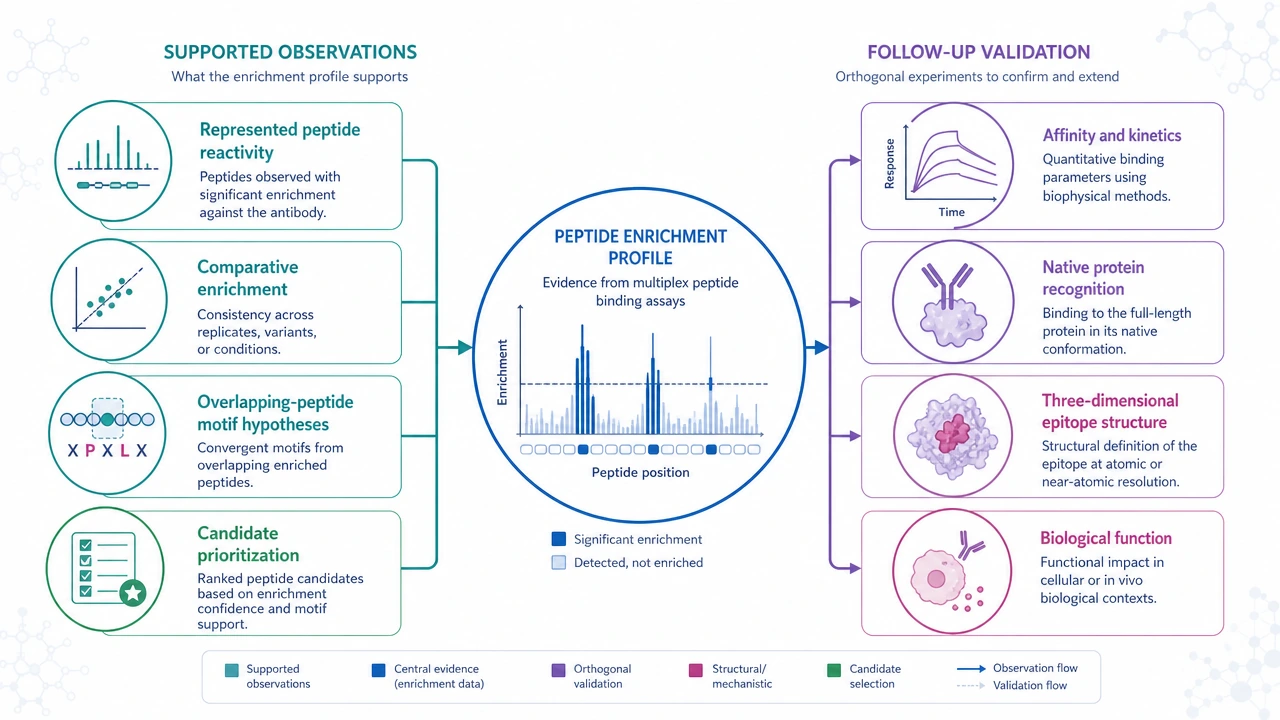
Before selecting a workflow, a team should be able to answer four practical questions:
- Does the library contain the proteins, variants, or sequence regions central to the hypothesis?
- Can the sample groups and controls support the intended comparison?
- Are peptide-level enrichment and related quality outputs sufficient for the immediate decision?
- Is there a feasible validation route for the strongest candidates?
If any answer is no, the team may need a modified library, a different primary assay, or a staged design in which PhIP-Seq is used only for candidate generation.
What Are the Main Benefits and Trade-Offs?
PhIP-Seq can examine many represented peptides in a shared assay framework and connects each displayed sequence to a DNA identifier. This supports broad profiling and comparative analysis without requiring an independent assay for every peptide. The same feature, however, means that the output is only as relevant as the encoded library and the design used to compare recovered counts.
Peptide coverage
Many defined sequences can be assessed within one library-based workflow, but unrepresented or poorly displayed sequences remain unobservable. Coverage should therefore be judged against the project's priority proteins and sequence features, not only by the total number of library members.
Profile breadth and interpretation
Samples can be compared through peptide-level enrichment patterns, while the apparent differences remain dependent on controls, assay conditions, antibody abundance, and analysis choices. Broad profiling increases the number of hypotheses that can be considered; it does not remove the need to define which comparisons are valid.
Epitope localization and native context
Overlapping reactive peptides may narrow a candidate linear region or motif. The corresponding trade-off is that conformational geometry and native molecular context are not established. The result can guide a focused next experiment without being presented as a structural determination.
Sequencing readout and direct binding measurements
DNA encoding links recovered phage to known peptide identities, making a large represented library analytically accessible. The resulting counts remain relative observations rather than direct affinity or kinetic measurements. Candidate discovery and quantitative binding characterization are related but separate tasks.
The broad readout can be especially helpful when a project begins with many possible peptide targets. Yet broad coverage can produce a long candidate list whose biological relevance is uncertain. A useful service plan therefore specifies how candidates will be ranked, how replicate behavior will be considered, and what evidence is required before a peptide is carried into validation.
Library design creates another balance. Dense overlapping coverage can improve localization of sequence-level patterns, while choices about peptide length and overlap also affect cost, complexity, and the form in which a sequence is presented. These parameters should follow the biological question; they should not be selected only because a larger library appears more comprehensive.
How Should Controls, Quality, and Validation Be Planned?
Validation begins in study design. A project should define the intended claim, the evidence PhIP-Seq will provide for that claim, and the additional evidence needed if the claim goes beyond relative peptide enrichment. This prevents an exploratory signal from being treated later as though it were a definitive endpoint.
At the analytical level, the team should document the peptide library version, sample assignments, relevant processing batches, control roles, sequencing and mapping approach, normalization or enrichment method, candidate-selection logic, and any exclusion criteria. Replicate agreement should be evaluated in relation to the planned comparison. A candidate that appears in one measurement but not in comparable replicates deserves a different interpretation from a consistently recovered pattern.
Quality review should connect observations to decisions. For example, library representation summaries help determine whether relevant peptide space was available for selection. Control behavior helps assess background and the validity of comparisons. Read assignment and count distributions help determine whether the recovered population was measured consistently. None of these checks alone establishes biological truth, but together they define whether the enrichment profile is technically interpretable.
Orthogonal validation should match the next claim:
- A focused peptide-binding assay can test whether selected peptide reactivity reproduces outside the discovery workflow.
- Competition or sequence-variant experiments can examine whether a proposed motif contributes to recognition.
- Assays using a native or recombinant protein can evaluate whether peptide-level reactivity extends to a more complete molecular context.
- Biophysical methods are needed when the objective is affinity, kinetics, or another direct binding parameter.
- Cell-based or organism-level studies are needed for functional or causal conclusions.
The validation sequence does not need to be identical for every project. It should be agreed before execution at a level sufficient to avoid selecting candidates solely because they rank highly in one analysis. The strongest plan links each deliverable to a decision: continue, reject, redesign, or validate.
For service evaluation, request both the planned outputs and their interpretation boundaries. Useful questions include how library coverage will be summarized, how controls enter the comparison, which intermediate quality metrics will be reported, how enrichment candidates will be prioritized, and whether the final report distinguishes observations from hypotheses. These details are more informative than an unqualified promise of high sensitivity or comprehensive coverage.
Frequently Asked Questions
What sample information should be provided before a PhIP-Seq project starts?
Provide the sample type, collection and storage history, expected antibody context, available volume, grouping variables, known treatments or conditions, and any factors that may affect comparability. The service team also needs the biological question and intended comparison so it can assess whether the proposed samples and controls support the requested interpretation.
How should samples be assigned when a PhIP-Seq study spans multiple processing batches?
Define batch assignment before processing so biological groups, key controls, and replicates are not confined to a single batch. Record the library version, processing batch, relevant deviations, and sequencing run for every sample. If results must be compared across batches, include shared reference or bridge samples and specify how batch effects will be evaluated before group differences are interpreted.
What should be documented when a peptide library is updated?
Treat each library version as a distinct measurement frame. Record sequences added or removed, changes to peptide length or overlap, display-related changes, and annotation updates. For comparisons across versions, identify the shared peptide set and any bridge samples, define whether analysis will be restricted to comparable members, and report the library version with every result.
How should a team choose controls for a service workflow?
Choose controls according to the source of uncertainty they are intended to address. Library-input measurements, nonspecific-capture controls, reference samples, and biological comparison groups answer different questions. The project plan should state which control supports each enrichment comparison and how control failure would affect interpretation.
What should be included in a PhIP-Seq deliverable?
Deliverables should be defined against the study decision and may include quality summaries, peptide-level count or normalized data, enrichment results, candidate prioritization, and a report of methods and boundaries. The team should also establish which files support reanalysis and which conclusions require orthogonal validation.
Conclusion
A PhIP-Seq service turns antibody capture of phage-displayed peptides into a sequencing-based enrichment profile. It is most informative when the library matches the biological question, controls support the intended comparisons, and results are interpreted as peptide reactivity rather than as direct proof of affinity, native structure, clinical validity, or function.
The practical next step is to define the decision question, peptide-space requirements, samples, controls, deliverables, and follow-up criteria as one connected plan. Researchers can contact MtoZ Biolabs to discuss your project and evaluate whether the proposed PhIP-Seq library, analytical workflow, and validation path are appropriate for the study.
How to order?




