






Personalized Medicine Antibody Analysis vs Mass Spectrometry: Method Selection and Research Use Cases
Quick Answer
For a translational or biomarker-focused personalized medicine program, start with antibody analysis when the target list is already defined, the study needs focused biomarker validation, and throughput matters more than molecular detail. Start with mass spectrometry when the team needs to resolve proteoforms, detect post-translational modifications, confirm identity through peptide identification, or explore biology that is still unclear. Use a staged hybrid workflow when both discovery and validation matter—for example, when early mass spectrometry findings need immunoassay follow-up across larger cohorts, or when antibody-based results need orthogonal confirmation before the team acts on them.
Why This Comparison Matters in Personalized Medicine
In personalized medicine, method selection shapes more than the report format. It determines what a team can detect in limited samples, what can be confirmed later, and how much biological ambiguity remains when protein-level findings guide the next research decision.
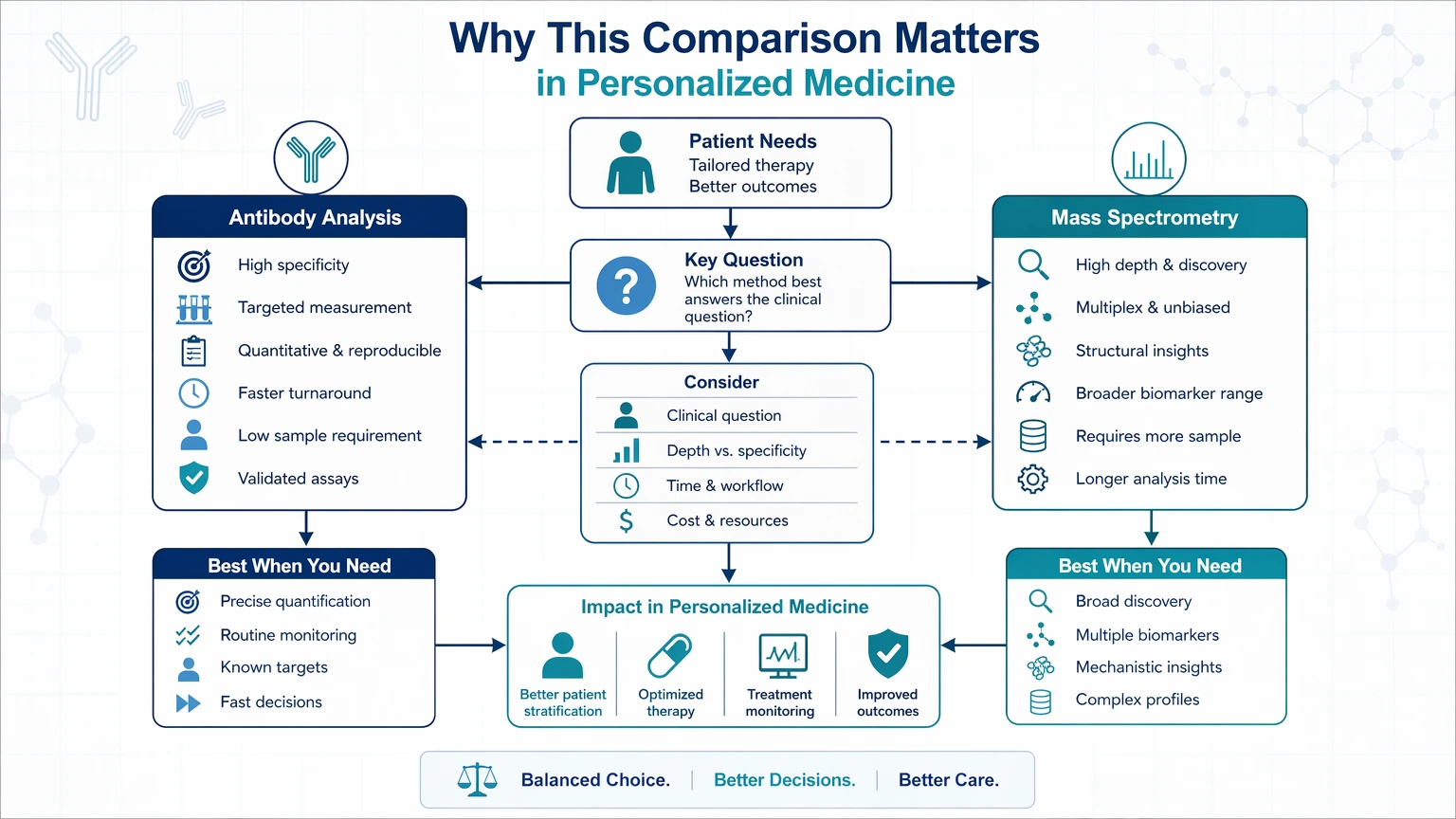
The practical split is straightforward:
- Antibody analysis answers predefined questions efficiently when suitable reagents are available.
- Mass spectrometry addresses discovery-oriented or structurally detailed questions that antibody binding alone may not resolve.
- A hybrid design reduces selection risk when a program needs both molecular depth and scalable follow-up testing.
This distinction matters in translational research, where sample volume is often limited, the sample matrix may be complex, and the difference between study groups may depend on isoforms, cleavage products, or modified peptides rather than total protein signal alone.
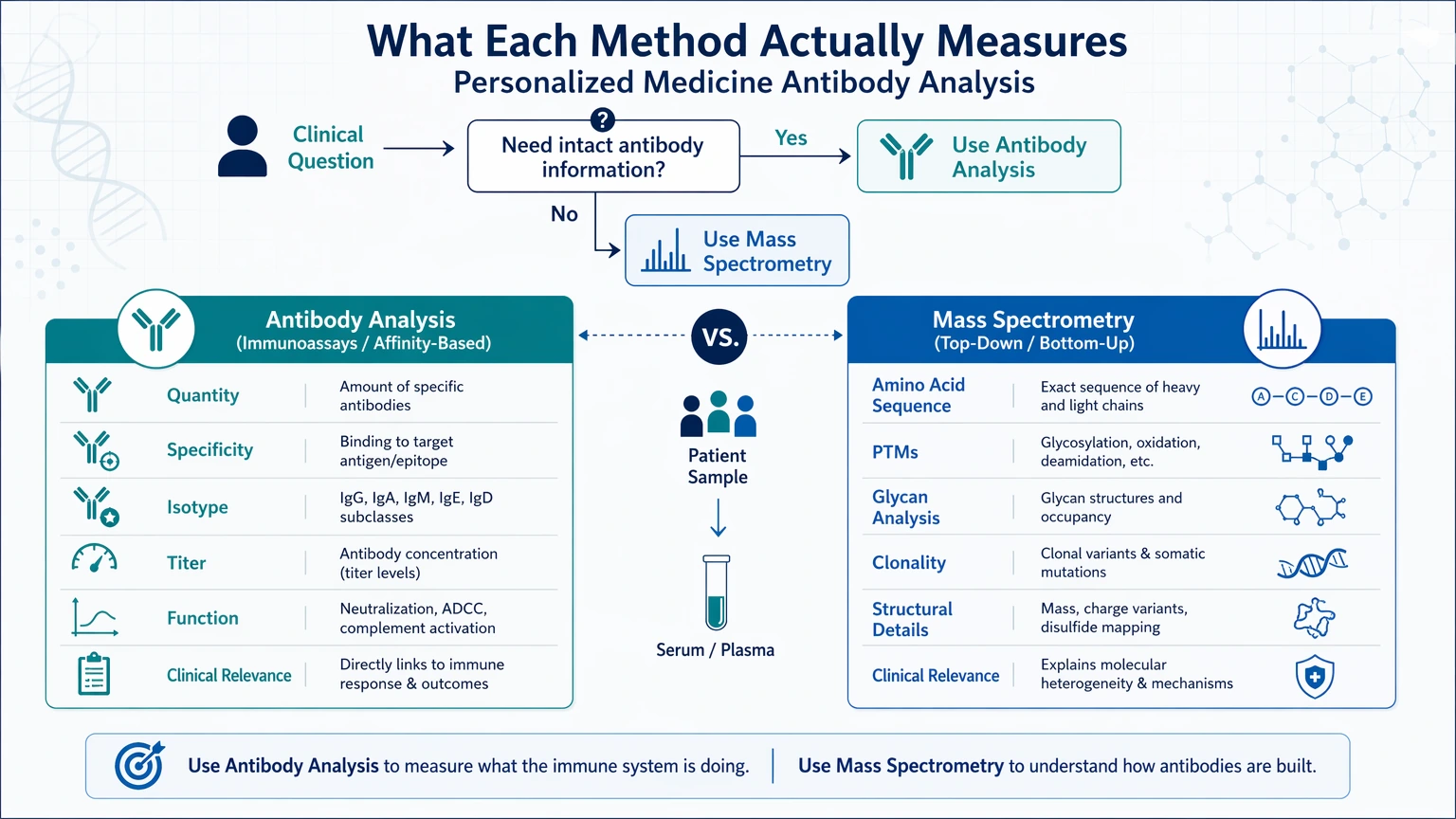
What Each Method Actually Measures
Antibody analysis
Antibody analysis usually detects a target through epitope-driven recognition. In practice, this often means an immunoassay format such as ELISA, bead-based multiplex analysis, western blot, immunocapture workflows, or other targeted antibody-dependent assays.
The readout depends on:
- whether the antibody binds the intended epitope in the selected sample matrix
- whether the epitope is exposed, masked, or altered
- whether related proteins or fragments share similar binding regions
- whether the assay measures total target abundance or only a narrower structural state
This makes antibody analysis a strong fit for known markers, especially when a study needs repeated measurements across many samples. It is less informative when the key question requires separating closely related molecular forms that share the same or overlapping epitopes.
Mass spectrometry
Mass spectrometry measures molecules by mass-to-charge behavior and fragment interpretation, usually with peptide- or proteoform-level evidence. Depending on workflow design, it can support discovery proteomics, targeted proteomics, modification mapping, or structural confirmation.
The readout depends on:
- peptide selection and detectability
- digestion strategy
- enrichment steps, when needed
- acquisition mode and instrument method
- spectral interpretation, normalization, and quality review
Because identification relies on peptide identification and fragment evidence rather than antibody binding, mass spectrometry can distinguish signals that immunoassays may collapse into one measurement. That includes isoforms, truncations, cleavage products, and some post-translational modifications.
Side-by-Side Method Selection Framework
The table below summarizes the main planning implications for the method choice.
| Decision axis | Antibody analysis | Mass spectrometry | Hybrid workflow |
|---|---|---|---|
| Target knowledge | Best suited to known targets | Better for unknown or partially defined biology | Useful when discovery will feed targeted follow-up |
| Specificity | Epitope-dependent; can be affected by cross-reactivity or masking | Molecularly assigned by peptide and fragment evidence | MS can verify antibody-based findings |
| Proteoform resolution | Often limited unless form-specific antibodies exist | Better for isoforms, cleavage products, and proteoforms | Discover by MS, scale by immunoassay when appropriate |
| PTM readout | Limited to available PTM-specific reagents | Better for PTM localization and modification mapping | MS defines the PTM, immunoassay supports follow-up if feasible |
| Multiplex analysis | Commonly single-analyte to medium-panel | Broad proteomic coverage or targeted panels are both possible | Use each platform where it adds the most value |
| Sensitivity | Often strong for predefined low-level targets when the assay matches the matrix | Can be effective but depends on enrichment, workflow, and matrix complexity | Apply MS selectively, then verify at scale |
| Sample matrix tolerance | Matrix effects still matter, but workflows may be simpler operationally | Matrix complexity can strongly affect detection and quantitation | Split matrices or stages by research question |
| Assay development burden | Requires qualified antibodies and fit-for-purpose optimization | Requires peptide strategy, standards or controls, and method setup | More coordination, fewer blind spots |
| Data burden | Lower interpretation burden for routine panels | Higher burden for spectral review, normalization, and bioinformatics | Moderate to high |
| Orthogonal confirmation | Often needed when biology is ambiguous | Commonly used as the orthogonal method | Built into the workflow by design |
Use these differences to align the analytical method with the biological question and validation plan.
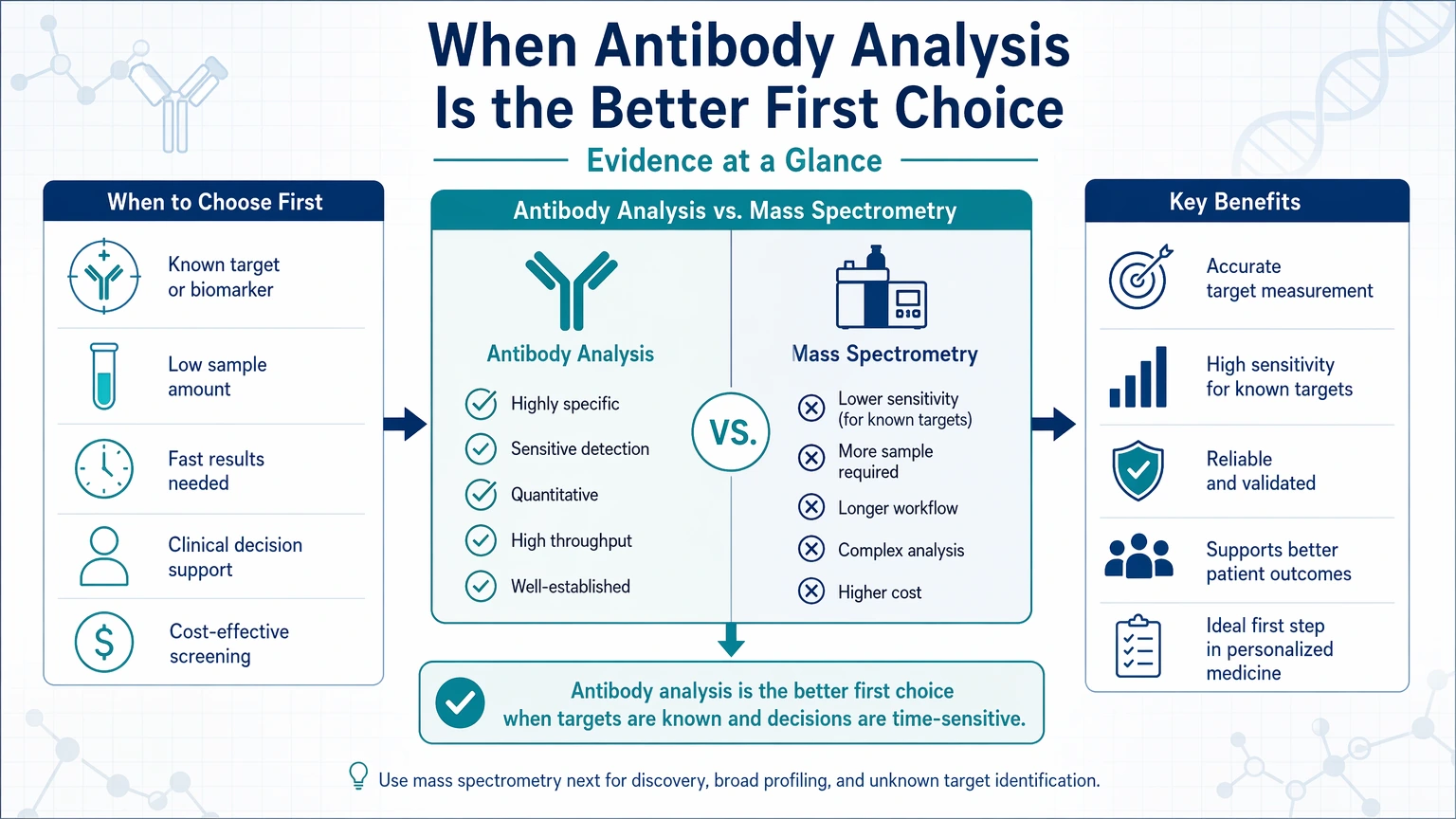
When Antibody Analysis Is the Better First Choice
Antibody analysis is often the better first step when the biological question is already narrow and the study needs repeatable measurement across many samples.
Common use cases include:
- biomarker validation after candidate selection is complete
- cytokine or immune-marker panel measurement in translational cohorts
- longitudinal monitoring of a defined protein set
- studies where sample throughput matters more than discovery depth
- projects with limited tissue in which the assay format already matches the available material
The advantage is not that antibody analysis is always more sensitive or more specific. The advantage is operational fit for a defined target list, especially when the reagents already perform acceptably in that matrix.
Antibody analysis is also practical for clinical-adjacent, research-use questions such as: “Do these predefined inflammatory proteins trend differently across groups?” That is a different question from: “Which molecular forms changed, and what does that change mean biologically?”
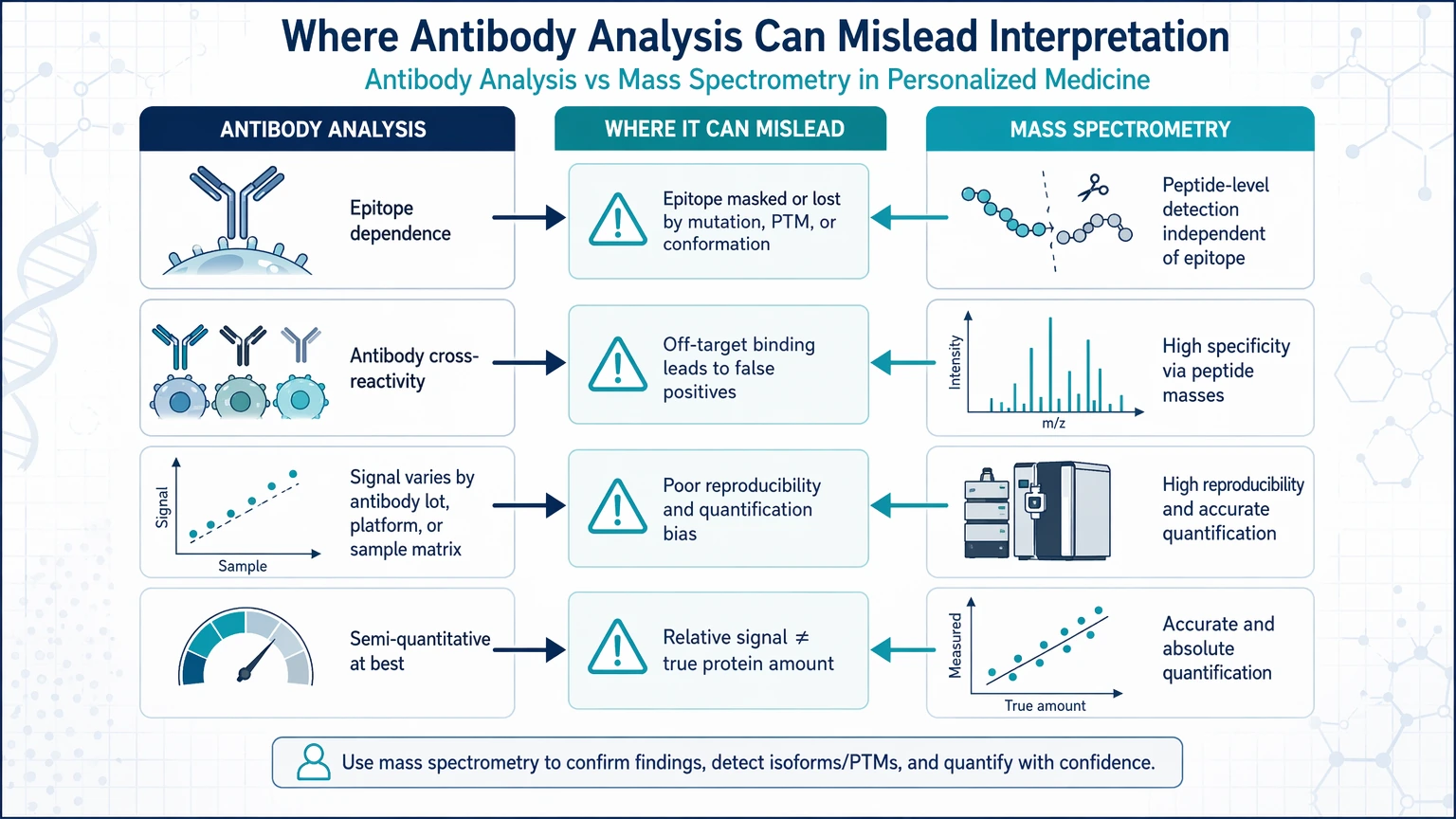
Where antibody analysis can mislead interpretation
The main limitation is that binding does not guarantee structural certainty. A positive signal may still leave questions such as:
- Is the assay detecting one form or several related forms?
- Does the antibody distinguish intact protein from cleavage products?
- Is a PTM changing antibody binding rather than target abundance?
- Is signal loss caused by lower concentration or reduced epitope accessibility?
These are common issues in personalized medicine research, especially when biomarker meaning depends on glycosylation, phosphorylation, oxidation, deamidation, or isoform switching.
When Mass Spectrometry Is the Better First Choice
Mass spectrometry is often the better first step when the team needs molecular resolution that an immunoassay cannot safely assume.
Typical triggers include:
- the biology is still incompletely defined
- suspected proteoforms could change interpretation
- post-translational modifications are central to mechanism
- antibody cross-reactivity is a concern
- candidate markers need structural confirmation before larger validation studies
- broad multiplex analysis is needed across many proteins or peptides
This is particularly relevant in plasma, serum, tissue lysate, PBMC, and cell supernatant studies, where multiple molecular forms can coexist and create conflicting results in antibody-based readouts.
For example, a translational team studying treatment response may care less about total protein abundance than about whether a phosphorylation site increases, a glycoform shifts, or an N-terminally processed form appears only in one subgroup. Those questions align better with mass spectrometry because the method can target the molecular feature itself rather than infer it from epitope recognition.
What teams should plan for before choosing MS
The gain in molecular detail comes with more analytical work. Mass spectrometry may require:
- more involved sample preparation
- peptide or site selection for targeted assays
- enrichment for low-abundance analytes or modified peptides
- stronger normalization and data review workflows
- closer attention to acquisition settings and matrix interference
That added effort is justified when the biological question truly requires molecular resolution.
Use Cases by Research Objective
Biomarker verification after discovery proteomics
If candidates have already been identified and the next step is to test a short list across more samples, antibody analysis may be the practical first-line option if the markers are well defined and qualified antibodies are available.
If candidate identity is still uncertain, or if the differences are driven mainly by isoform or modification state, targeted mass spectrometry is often the safer path before wider verification.
Cytokine and immune-marker panel readout
For repeated measurement of known immune markers, immunoassay-based multiplex analysis is often operationally efficient. The panel is predefined, and the study question usually centers on abundance trends across groups.
Mass spectrometry becomes more useful when the team needs broader panel expansion, interference assessment, or molecular confirmation beyond a standard panel readout.
PTM-focused analysis
When phosphorylation, glycosylation, oxidation, or deamidation may alter biological interpretation, mass spectrometry usually deserves priority. PTM-specific antibodies can be useful when the site is already known and the reagent behavior has been characterized for that use. For discovery-stage PTM questions, MS is usually the clearer starting point.
Endogenous or therapeutic antibody characterization
If a project must evaluate sequence-level features, coverage, C-terminal variation, glycosylation state, or other structural attributes of endogenous or therapeutic antibodies, mass spectrometry-based characterization is generally more informative than antibody-dependent readouts alone.
Tissue or plasma profiling with molecular heterogeneity
Complex matrices challenge both approaches, but in different ways. Immunoassays may encounter cross-reactivity, hook effects, or epitope accessibility issues. MS workflows may encounter ion suppression, digestion variability, and peptide detectability limits. When hidden heterogeneity is the main risk, mass spectrometry often deserves the first pass. When the main need is scaled confirmation of already validated targets, antibody analysis may be the more efficient next step.
Why Hybrid Workflows Often Make the Strongest Translational Design
A staged hybrid workflow is often the most defensible choice when a team needs both molecular confidence and scalable follow-up.
A practical sequence looks like this:
1. Discovery or clarification by mass spectrometry Identify candidate proteins, peptides, PTMs, or unexpected molecular forms.
2. Target narrowing and assay design Select the subset that matters for the biological or translational decision.
3. Focused verification by targeted proteomics or antibody analysis Use the follow-up method that matches the question: structural confirmation by MS, or higher-throughput cohort testing by immunoassay.
4. Orthogonal confirmation for key findings Confirm ambiguous or high-impact results with the alternate platform.
This approach is useful when a team must move a marker from exploratory research into a more standardized validation stage without losing track of structural uncertainty.
If your group is comparing antibody analysis with targeted proteomics for a defined matrix, target class, or PTM question, submit your requirements to MtoZ Biolabs to evaluate workflow fit before assay build-out.
Practical Selection Questions Before You Commit
Use these questions to choose the first platform.
Choose antibody analysis first if you can answer “yes” to most of these
- Is the target list already fixed?
- Is the main goal biomarker validation rather than discovery?
- Are suitable antibodies available for this matrix and analyte form?
- Would total or panel-level signal answer the research question?
- Is higher sample throughput more important than molecular fine structure?
Choose mass spectrometry first if you can answer “yes” to most of these
- Is the biology still uncertain?
- Could isoforms or PTMs change the conclusion?
- Do you need molecularly assigned evidence rather than binding-based signal?
- Is cross-reactivity or epitope masking a meaningful concern?
- Will peptide-level readout improve confidence in the decision?
Choose a hybrid path if these statements describe your program
- Discovery findings must move into scalable validation
- Immunoassay results need orthogonal confirmation
- Different sample sets require different levels of analytical depth
- A small number of high-risk markers carry structural ambiguity that would affect downstream decisions
Common Selection Mistakes
Treating total protein readout as equivalent to molecular identity
A total signal may be sufficient for some programs, but it may not distinguish the biologically relevant form.
Assuming MS is automatically the answer for every complex question
If the study only needs repeated measurement of a stable, predefined marker set, a well-matched immunoassay may be the cleaner operational choice.
Leaving confirmation strategy until late in the study
Method selection becomes easier when the team decides early whether key findings will need orthogonal confirmation, and which platform will provide it.
Underestimating matrix effects
Matrix complexity does not disappear because a method is familiar. Plasma, serum, tissue, and immune-cell samples each impose different constraints on antibody binding, digestion behavior, background interference, and quantitation.
Service Routes for Study Planning
For teams moving from method selection into execution, these service paths connect assay design, validation, and interpretation needs.
Conclusion
For personalized medicine antibody analysis vs mass spectrometry, the most useful rule is simple: use antibody analysis for predefined, focused measurement; use mass spectrometry for structural resolution, discovery, and confirmation of proteoforms or post-translational modifications; use a hybrid workflow when a program must connect exploratory protein biology with confident biomarker validation.
The real constraint is not which platform sounds more advanced. It is whether the method can answer the exact protein question without introducing avoidable ambiguity. If your project involves complex sample matrices, uncertain target forms, or a need to balance targeted follow-up with molecular depth, contact us to evaluate your project with MtoZ Biolabs and discuss whether antibody analysis, targeted proteomics, or a staged combined workflow is the better research fit.
FAQ
If we already have an immunoassay panel, when is it still worth adding mass spectrometry?
It is worth adding MS when the panel signal could hide meaningful molecular differences. Common examples include markers with multiple isoforms, proteins affected by cleavage, and pathways in which phosphorylation or glycosylation changes interpretation. In those cases, MS can clarify what the immunoassay signal actually represents.
What is the main tradeoff between antibody analysis and targeted proteomics for biomarker validation?
The main tradeoff is assay convenience versus molecular assignment. Antibody analysis is often easier to scale for a fixed panel, while targeted proteomics gives stronger evidence that the measured signal comes from the intended peptide or modified form. The better choice depends on whether the validation question is about total target abundance or a specific molecular state.
Can mass spectrometry improve specificity when antibody cross-reactivity is suspected?
Often yes, because MS identifies analytes through peptide and fragment evidence rather than binding alone. That does not remove all analytical challenges, but it can reduce uncertainty when homologous proteins, fragments, or off-target binding complicate an immunoassay result.
Are PTM-specific antibodies enough for personalized medicine studies?
They can be useful for narrow follow-up questions when the modified site is already known and the antibody has suitable performance in the intended matrix. They are less informative when site occupancy, neighboring modifications, or multiple modified forms could alter the interpretation.
How should teams choose between broad proteomics and a smaller targeted MS panel?
Use broader proteomics when the biology is still open and the goal is to discover candidate pathways, proteins, or modified forms. Use a targeted panel when the candidates are already defined and the next step is more focused verification or comparative quantitation across a set of samples.
What should be decided before scarce samples are allocated?
Teams should decide what level of molecular detail the study requires, whether orthogonal confirmation will be needed, and whether the most important readout is total signal, a specific proteoform, or a PTM-defined state. Those choices affect sample preparation, enrichment strategy, and how much material must be reserved for confirmation.
How to order?




