


• Services
  • Products

Parallel Reaction Monitoring for Targeted Quantification

    Introduction

    Quantitative proteomics studies often move from broad profiling to a narrower question: how reliably can a defined set of proteins be measured across many samples? A pharmacology group may need to track pathway proteins across treatment arms. A biomarker program may need to confirm candidate peptides in an expanded cohort. A biopharmaceutical team may need peptide-level evidence that supports release or comparability decisions. In each case, the study needs selective peptide measurement rather than proteome-wide discovery.

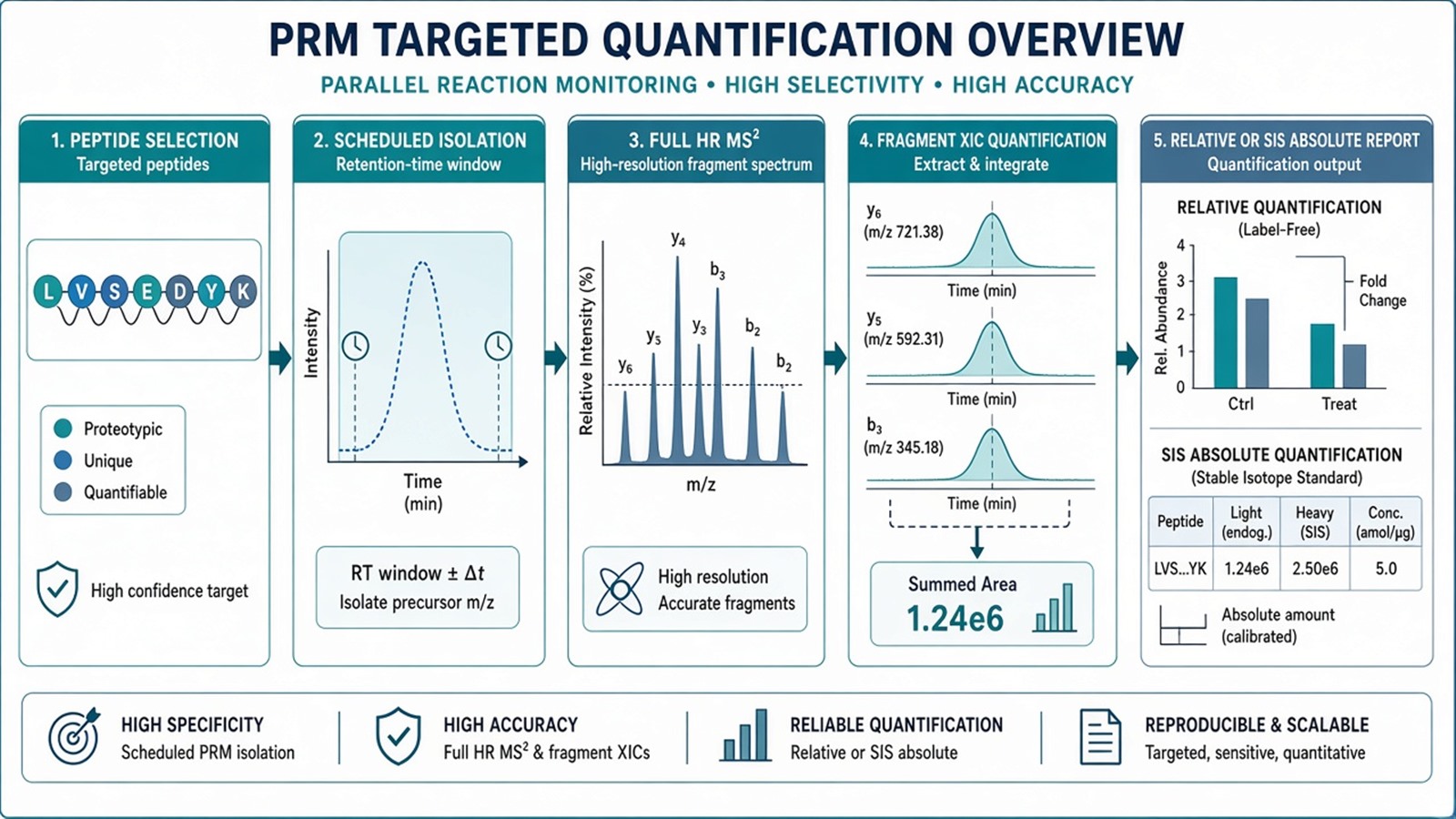
    Parallel reaction monitoring supports that goal on high-resolution mass spectrometers. The instrument isolates predefined peptide precursors and records fragment ion signals at high resolving power. Quantitation is derived from selected fragment ions rather than from a single low-resolution transition alone. That acquisition logic improves specificity in many complex matrices and supports confident peak assignment when predefined panels must perform reproducibly across validation cohorts.

    Understanding how this method differs from triple-quadrupole MRM, how assay phases are structured, and where high-resolution targeted MS fits a broader proteomics program helps teams choose the right validation path before samples are prepared.

    Related Services

    For projects where panel size, quantitation mode, or matrix complexity is still undefined, MtoZ Biolabs can review assay feasibility and recommend a phased development plan before sample submission.

    What Targeted Quantification Means in a High-Resolution Workflow

    Selective quantitation measures predefined analytes with controlled acquisition parameters. In protein-focused studies, the analyte is usually a proteotypic peptide generated by enzymatic digestion. The peptide signal is used to infer protein abundance under defined preparation and acquisition conditions.

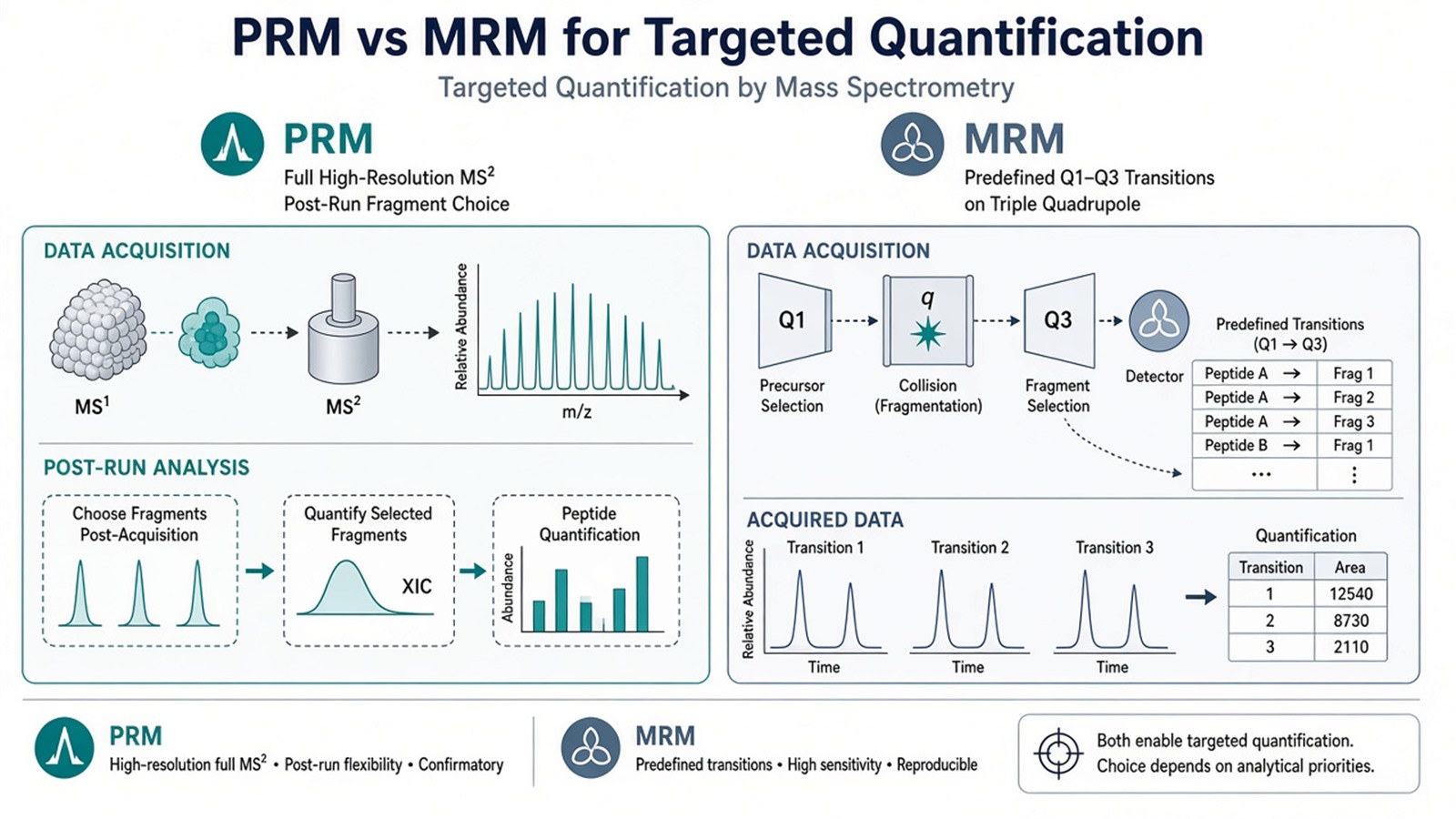
    This logic is shared with MRM, but parallel reaction monitoring uses high-resolution precursor isolation and fragment ion measurement rather than monitoring only a small number of predefined transitions on a triple-quadrupole platform. The practical difference is specificity. When co-eluting ions interfere with one fragment, additional high-resolution fragment ions from the expected peptide pattern can still support assignment.

    A strong assay project defines the quantitation goal early:

    • Relative quantification compares abundance across conditions or time points within one study design.
    • Absolute quantification reports concentration using calibrators and stable isotope-labeled internal standards.
    • Assay qualification documents selectivity, precision, and matrix performance for repeated use or transfer.

    The workflow is not a discovery survey. Unknown proteins cannot be quantified without prior peptide selection, LC scheduling, and isolation window definition.

    Core Principles of Parallel Reaction Monitoring

    1. High-Resolution Precursor Isolation

    During acquisition, the mass spectrometer isolates a target precursor within a defined m/z window. The isolated ion is fragmented, and fragment ions are measured at high resolving power. This differs from selected reaction monitoring on a triple quadrupole, where only one or a few product ions are monitored at unit resolution.

    Isolation window width is a key design parameter. A window that is too wide admits interfering precursors. A window that is too narrow risks missing the target if retention time drifts. Assay development therefore includes retention time stability review and window optimization on representative matrix material.

    2. Fragment Ion Quantitation

    Quantitation is performed on one or more fragment ions from the acquired MS2 spectrum. Using multiple fragments improves specificity because matrix interference is less likely to distort the full expected ion pattern for the target peptide.

    Post-acquisition re-integration is a technical advantage in some workflows. If assay refinement identifies a better fragment ion after initial acquisition, selected data can sometimes be reprocessed without repeating the full cohort run, depending on instrument settings and project SOP requirements.

    3. Scheduled Targeted Acquisition

    Large peptide panels require scheduled acquisition. The instrument monitors each precursor only within its expected retention time window. Cycle planning must balance panel size, dwell requirements, and chromatographic separation. Unrealistic multiplexing reduces quantitative precision even when the instrument platform supports high-resolution detection.

    4. Link to Protein-Level Inference

    As with other targeted proteomics methods, the workflow reports peptide ion signals while the biological question is often protein-level. Assay design therefore begins with protein target selection, continues with surrogate peptide choice, and ends with quantitative interpretation tied to the study decision.

    Standard Assay Development Phases

    A robust assay project follows a defined sequence. Each phase affects sensitivity, reproducibility, and report usability.

    Phase 1: Target and peptide selection

    Define proteins to quantify and choose proteotypic peptides with strong MS response, sequence uniqueness, and stable behavior in the study matrix.

    Phase 2: Precursor and window optimization

    Define precursor m/z values, isolation windows, and expected retention times on standard or matrix-matched material.

    Phase 3: LC method development

    Separate target peptides from matrix interferences and confirm retention stability across QC injections.

    Phase 4: Sample preparation and digestion

    Standardize enzyme conditions, cleanup, and normalization so peptide abundance reflects the biological comparison rather than prep variability.

    Phase 5: Targeted acquisition and integration

    Run scheduled high-resolution targeted MS on study samples, integrate fragment ions, and apply calibrators or internal standards according to the quantitation mode.

    Phase 6: QC review and reporting

    Document failed targets, interference flags, precision metrics, and assay limitations relevant to downstream use.

    Sample type strongly affects feasibility. Plasma, tissue lysate, cell extract, and biopharmaceutical matrix each present different digestion, recovery, and interference challenges during selective peptide measurement.

    High-resolution targeted MS acquisition schematic showing precursor isolation and fragment ion quantitation

    Figure 1. Each acquisition cycle isolates a predefined precursor and records high-resolution fragment ions used for selective peptide quantitation

    Sample and Assay Requirements

    Reliable quantitation depends on assay design quality as much as instrument capability.

    Sample Factor

    Recommended Condition

    Why It Matters

    Matrix type

    Defined and consistent across the cohort

    Matrix effects influence ionization, digestion recovery, and interference

    Protein input

    Sufficient for reproducible digestion and LC injection

    Low input reduces precision and assay robustness

    Digestion protocol

    Standardized enzyme, time, and cleanup

    Inconsistent digestion biases surrogate peptide abundance

    Internal standards

    Stable isotope-labeled peptides when possible

    Supports precision and absolute quantification when calibrators are used

    Panel size

    Matched to cycle capacity and scheduling strategy

    Oversized panels reduce dwell per target and weaken quantitation

    Prior evidence

    Discovery or MRM detectability data when available

    Helps distinguish interference-limited targets from truly low-abundance analytes

    Researchers should share target proteins, sample matrix, cohort size, and whether relative or absolute quantification is required before assay development begins.

    Core Advantages and Current Limitations

    1. Core Advantages

    High-resolution specificity for predefined targets

    Fragment ions measured at high resolving power can separate target signals from many nearby interferences.

    Fragment-level confirmation

    Multiple MS2 ions support confident peptide assignment when matrix complexity is high.

    Flexible integration after acquisition

    Selected fragment ions can be re-evaluated during data review in some project workflows.

    Strong fit for validation-stage panels

    Once optimized, the assay can support larger cohorts with controlled acquisition parameters.

    2. Current Limitations

    Requires prior target definition

    The workflow does not identify unknown proteins without prior peptide selection.

    Assay development investment

    Isolation windows, LC tuning, and matrix evaluation require upfront effort before large cohort acquisition.

    Instrument and cycle constraints

    Panel size must respect realistic scheduling limits on the acquisition platform.

    Peptide surrogate dependence

    Protein inference depends on surrogate peptide behavior and consistent digestion.

    The method is powerful for predefined panels, but evidence quality still depends on matrix control, QC sample monitoring, and validation depth matched to the study use.

    Applications in Quantitative Proteomics

    Researchers apply this method when predefined peptides must be measured with high-resolution confirmation across validation cohorts or QC programs.

    Application scenarios for biomarker biopharmaceutical and pathway quantitation studies

    Figure 2. Common applications include biomarker validation, biopharmaceutical peptide monitoring, pathway tracking, and discovery follow-up quantitation

    Researchers commonly apply parallel reaction monitoring in the following settings:

    • Biomarker validation. Quantify candidate peptides with reproducible abundance measurements in expanded plasma or tissue cohorts, often after discovery profiling has prioritized targets.
    • Discovery follow-up. Confirm regulated proteins identified by DIA or label-free studies with high-resolution fragment evidence in a larger sample set.
    • Biopharmaceutical peptide monitoring. Measure product-related surrogate peptides in formulation matrix when selective confirmation supports QC decisions.
    • Pathway protein tracking. Compare protein abundance across treatment arms or time points when a predefined panel must remain consistent across the study.
    • MRM interference recovery. Improve specificity when triple-quadrupole transitions show unstable ratios and interference rather than low abundance appears to be the limiting factor.
    • PTM site validation. Target modified peptides when enrichment, panel design, and site localization evidence support confident measurement.

    Discovery profiling, peptide mapping, functional assays, or pilot matrix comparisons often remain useful complementary evidence depending on the project decision.

    These scenarios show why this approach is often selected for validation-stage peptide quantification rather than first-pass proteome surveying.

    Expected Deliverables and Validation Depth

    A useful project report should include more than analyte peak tables. Depending on project scope, deliverables may include:

    • target protein and surrogate peptide list with precursor and isolation window documentation
    • fragment ion extraction and integration notes
    • quantitative results across samples or groups
    • calibration or normalization method summary
    • QC performance notes such as precision, linearity, or interference flags
    • recommendations for panel refinement or expanded targets when needed

    Validation depth should match the intended use. Exploratory relative quantification may accept a narrower documentation package. Biomarker or biopharmaceutical programs often require explicit selectivity, reproducibility, and matrix performance evidence aligned to the project SOP.

    How Targeted Monitoring Fits Broader Proteomics Programs

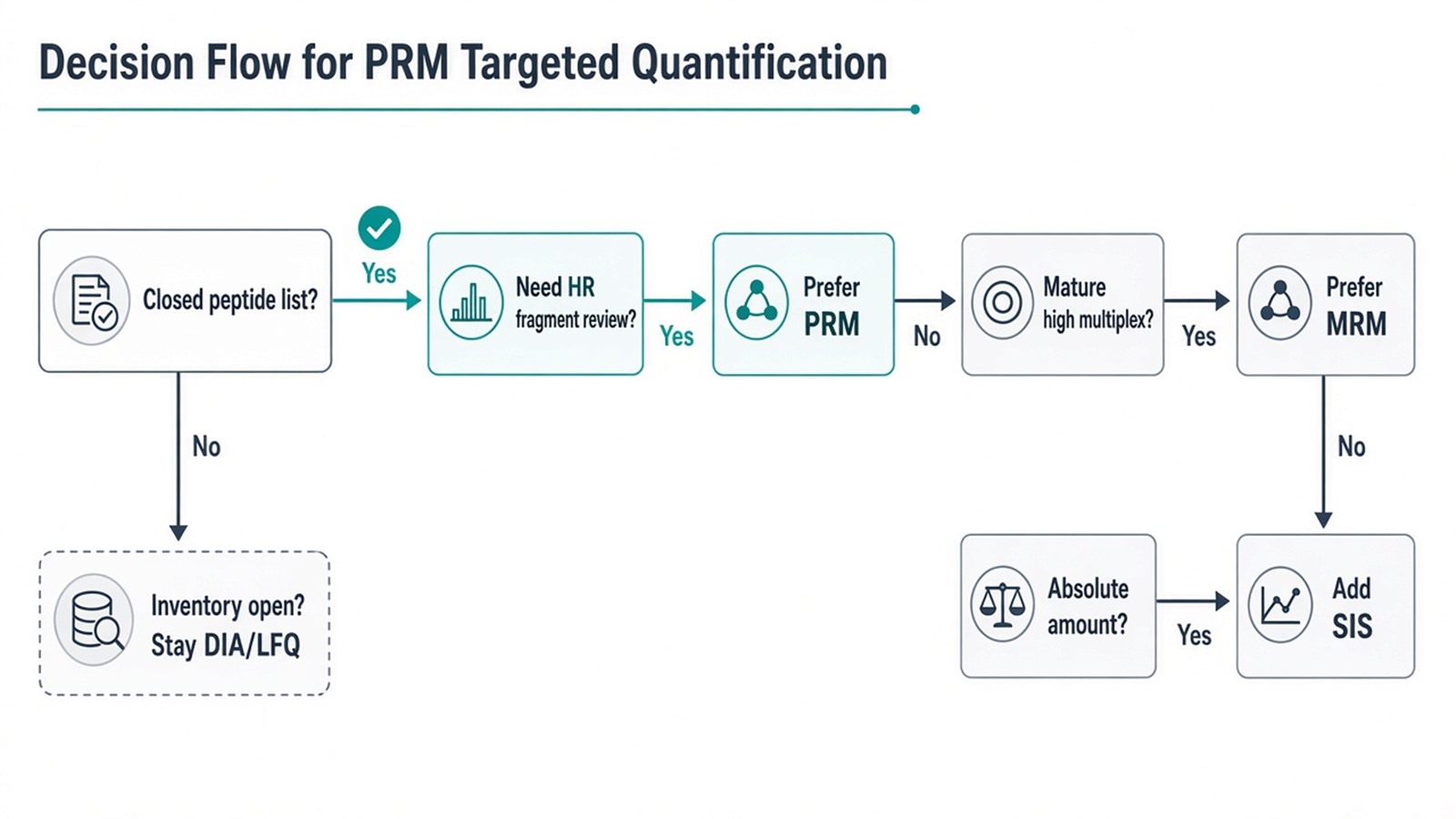
    Quantitative proteomics often combines multiple evidence types. Label-free or DIA profiling may identify regulated proteins. A predefined panel then quantifies prioritized targets in a larger cohort with high-resolution confirmation. MRM may remain appropriate for smaller panels in clean matrices where cycle efficiency and established triple-quadrupole methods are sufficient.

    The strongest programs define the quantitative question before platform selection. A study that only needs hypothesis generation may not justify full assay development. A study that must quantify fifteen proteins in two hundred plasma samples with fragment-level confirmation often does.

    When teams move from discovery into validation, bringing prior detectability evidence to feasibility review prevents repeating the same peptide choices under a new acquisition mode without addressing matrix or abundance limits.

    Frequently Asked Questions

    1. What is parallel reaction monitoring used for?

    Parallel reaction monitoring is used for selective quantitation of predefined peptide surrogates on high-resolution mass spectrometers, with fragment ion measurement supporting reproducible peptide quantification across sample cohorts.

    2. How does parallel reaction monitoring support quantitation differently from MRM?

    MRM typically monitors predefined transitions on a triple-quadrupole instrument. The high-resolution workflow isolates precursors and quantifies selected fragment ions from MS2 spectra, which can improve specificity when matrix interference affects low-resolution transitions.

    3. Can this workflow provide absolute quantification?

    Yes, when calibrators and stable isotope-labeled internal standards are included in the assay design. Relative quantification is also common for comparative studies within one experimental design.

    4. How many peptides can one panel include?

    Panel size depends on chromatography, cycle time, scheduling strategy, and matrix complexity. Feasibility review clarifies realistic multiplexing for a given instrument and sample type.

    5. When should validation-stage monitoring follow a discovery proteomics study?

    The method is often used after discovery or screening when a short list of candidate proteins must be quantified in a larger cohort with controlled acquisition parameters and fragment-level confirmation.

    Conclusion

    Parallel reaction monitoring provides a high-resolution route to predefined peptide quantitation when panels must perform with controlled specificity across validation cohorts and QC programs. By linking proteotypic peptides to optimized isolation windows, scheduled acquisition, and defined quantitation logic, the workflow supports biomarker validation, biopharmaceutical monitoring, pathway tracking, and discovery follow-up with fragment-level evidence. The method does not replace broad profiling, and it depends on phased assay development and matrix control. Researchers planning selective peptide quantitation can contact MtoZ Biolabs to review target panels, sample matrices, quantitation mode, and the appropriate validation path before assay development begins.

Submit Inquiry
Name *
Email Address *
Phone Number
Inquiry Project
Project Description *


How to order?


How to order

Submit Your Request Now ×
/assets/images/icon/icon-message.png

Submit Inquiry

/assets/images/icon/icon-return.png