






Monoclonal Antibody Sequencing for Clone Rescue: What to Do When Sequence Records Are Missing
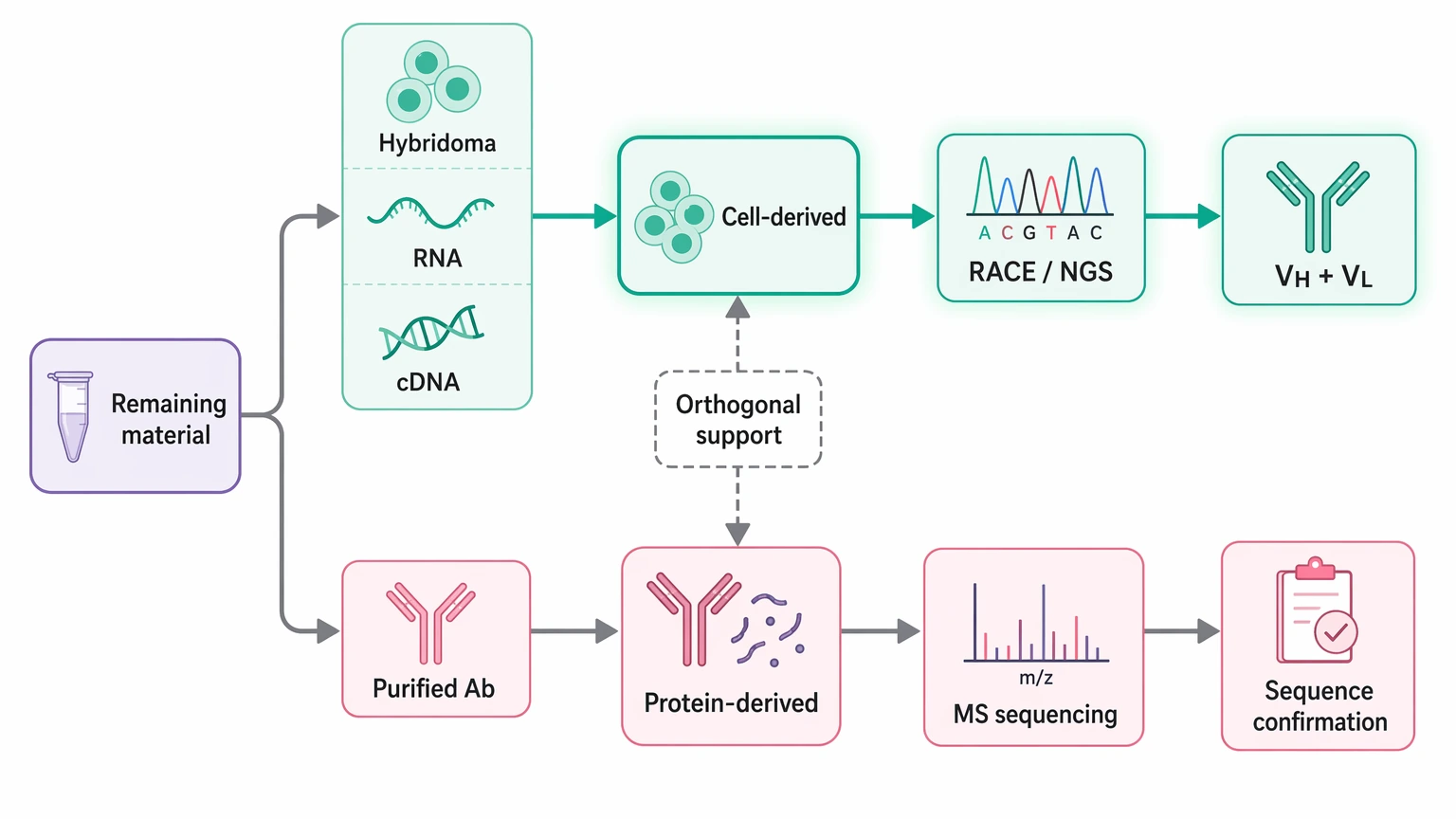
When sequence records go missing, clone rescue is still realistic in many cases. The right recovery path depends first on the material you still have, and second on what you need the sequence to support. If viable hybridoma cells, frozen cell pellets, or recoverable RNA are still available, RACE or next-generation sequencing (NGS) is usually the most direct way to recover VH and VL for recombinant re-expression. If purified antibody is the only remaining material, mass spectrometry-based antibody sequencing becomes the practical route, although peptide coverage, post-translational modifications, and chain pairing can make interpretation harder.
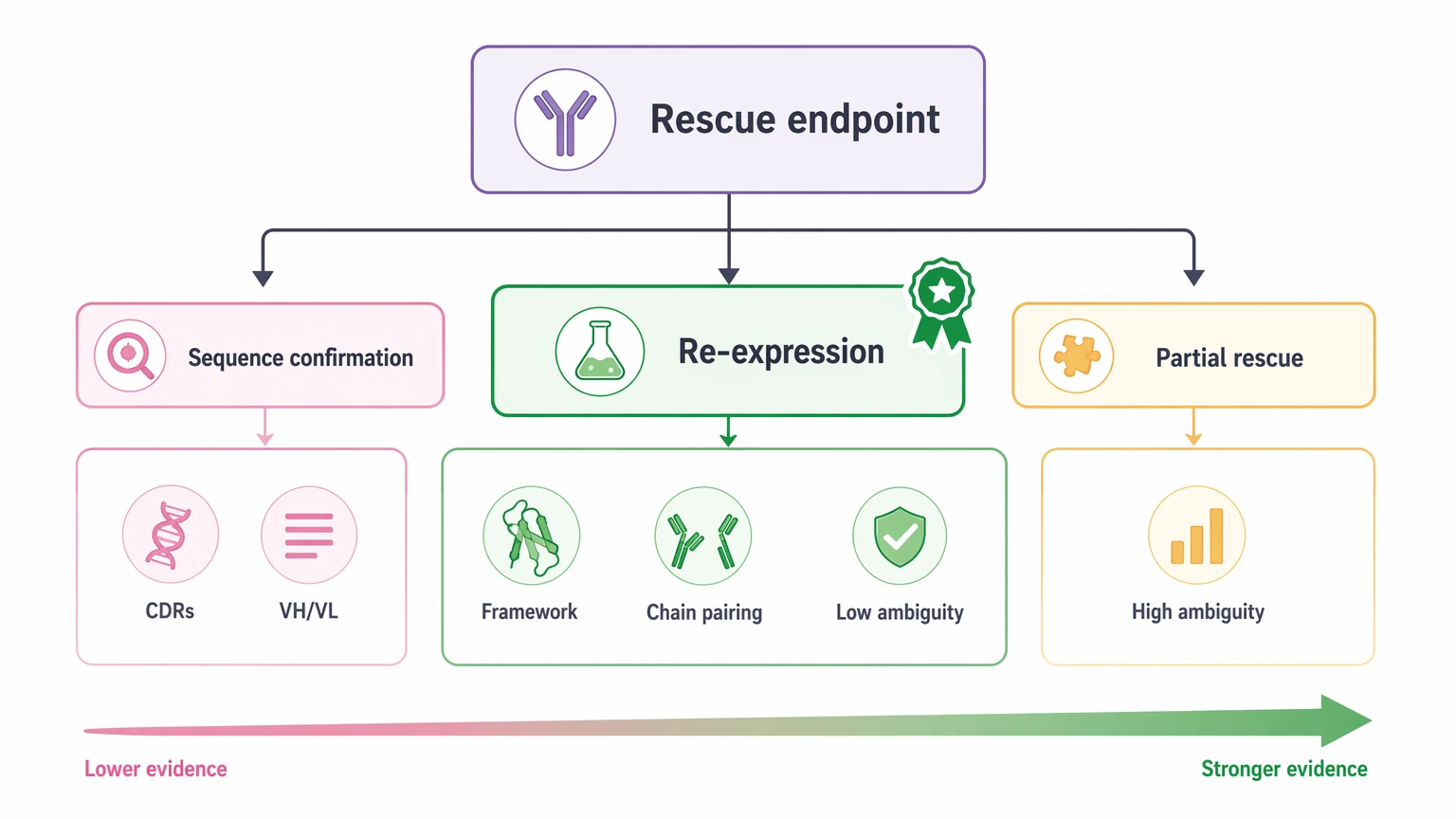
The next call matters just as much: define what “rescue” means for the project. If the immediate need is sequence confirmation for assay continuity, solid support for the variable region or the CDRs / complementarity-determining regions may be enough to move ahead. If the goal is recombinant re-expression, the bar is higher. You need interpretable heavy chain and light chain assignments, usable framework region context, and a validation plan that tests whether the reconstructed antibody can actually stand in for the legacy reagent.
Where missing records become a real operational problem
Sequence loss usually turns urgent when a team can no longer rely on the original cell bank, documentation, or supplier history. A hybridoma may still produce antibody, but the archived sequence records are incomplete. A purified antibody may still be in active use, but no one can confirm whether the listed VH and VL are correct. A translational assay team may also find that reproducibility questions will not be settled without sequence confirmation from the material currently in use.
The practical warning signs are familiar:
- the clone cannot move into recombinant re-expression
- historical records disagree on heavy chain, light chain, or isotype / subclass
- the hybridoma bank is unstable, inaccessible, or limited
- only archived supernatant or purified antibody remains
- assay transfer, engineering, or external manufacturing is blocked until the variable region is confirmed
Waiting usually makes the problem worse. Hybridoma viability can drop, RNA integrity can slip, and limited purified antibody stocks can disappear into repeated troubleshooting. Once those materials are exhausted, the rescue path can narrow fast.
The root causes that matter most in clone rescue
For this decision, four cause categories usually matter more than generic workflow language.
1. The rescue goal and the starting material do not align
Teams often request monoclonal antibody sequencing before agreeing on the real endpoint. Sequence confirmation and recombinant re-expression are related, but they are not the same job. A purified antibody may support useful de novo sequencing and variable region interpretation, yet still leave uncertainty around chain pairing. That can be acceptable for identity review, but it is a weaker basis for direct clone transfer.
2. The remaining material has integrity limits
A frozen pellet with a poor storage history may not yield clean transcript recovery. An old purified antibody may contain degradation products, co-purified proteins, or low-abundance material that complicates peptide mapping. In both situations, the sequencing method may still be workable, but the confidence level of the final deliverable can shift.
3. Chain pairing is less certain than it first appears
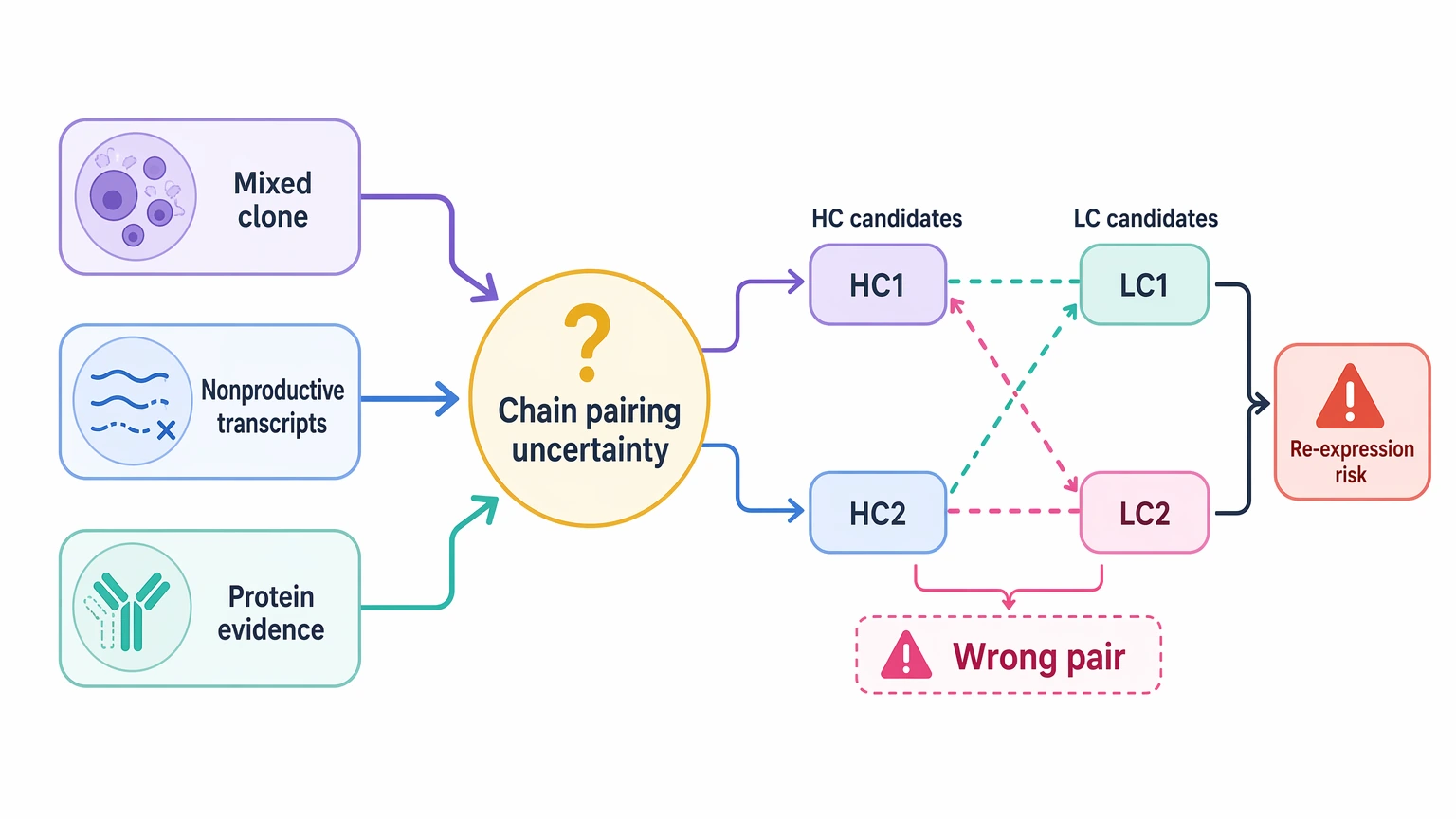
Recovering candidate heavy chain and light chain sequences is only one part of clone rescue. Mixed clone / hybridoma heterogeneity, nonproductive transcript recovery, and incomplete protein-level evidence can all create uncertainty around which chains truly belong together. That becomes the central issue when recombinant re-expression is the endpoint.
4. Legacy records may be partially right, but not ready for use
Old notebooks, partial contigs, isotype notes, or CDR-only annotations can still help. They should not be treated as final truth. Historical entries may contain transcription errors, unclear signal peptide handling, or incomplete framework region information. In rescue projects, legacy sequence records are supporting evidence, not a substitute for current biological confirmation.
Step-by-step planning guide for clone rescue
This article follows a project-planning structure because the main risk is choosing a feasible rescue path before scarce material is used up.
Step 1: Define the rescue endpoint before choosing the method
Start with the decision the sequence needs to support.
- Sequence confirmation: confirm identity, review reproducibility concerns, or compare current material with archived sequence records
- Recombinant re-expression: recover a usable heavy chain and light chain variable region package for re-expression design
- Partial rescue: recover the CDRs / complementarity-determining regions, isotype / subclass context, or enough variable region evidence to judge whether deeper work is warranted
This first step sets the level of ambiguity the project can tolerate. Partial variable region support may answer an identity question. On its own, it is rarely enough for a re-expression-ready design.
Step 2: Inventory all remaining starting material
Do not default to the sample that is easiest to ship. Use the one most likely to preserve the antibody’s original biology.
| Starting material | Most suitable use | Main strength | Main caution |
|---|---|---|---|
| Viable hybridoma cells | Recombinant re-expression | Direct access to productive transcripts | Mixed clone risk still needs review |
| Frozen cell pellet | Re-expression or sequence confirmation | May support RACE or NGS | RNA quality may be uneven |
| Extracted RNA or cDNA | Transcript recovery | Direct route to VH and VL | Quality depends on prior handling |
| Archived supernatant | Backup confirmation | Reflects secreted product | Low abundance and background proteins |
| Purified antibody | Sequence confirmation or last-resort rescue | Works after cell loss | Chain pairing and peptide coverage can remain incomplete |
Record storage history, concentration, number of vials, freeze-thaw exposure, and any previous analytical findings. Those details often explain whether the project should start with cell-derived material or move straight to protein-derived recovery.
Step 3: Choose the primary recovery route
If a usable hybridoma, RNA, or cDNA is still available, a cell-derived strategy usually gives the clearest route for clone rescue aimed at recombinant re-expression. RACE and next-generation sequencing (NGS) can recover antibody transcripts directly, which often gives better continuity across the full variable region.
Use a cell-derived route when:
- the hybridoma is viable or frozen cells remain
- RNA extraction is still realistic
- you need VH and VL with framework region continuity
- the endpoint is recombinant re-expression
Use mass spectrometry-based antibody sequencing when:
- only purified antibody remains
- the hybridoma is lost or unusable
- sequence confirmation is the immediate priority
- protein-level evidence is the only accessible record of the reagent
If both material types exist, orthogonal support is often worth building in. Transcript evidence can narrow chain candidates, while protein evidence can check whether the recovered sequences match the secreted antibody.
Step 4: Define the deliverable in technical terms
“Recovered sequence” is too broad for a rescue project. The output should be defined in chain-level terms:
- heavy chain variable region
- light chain variable region
- VH and VL assignment confidence
- CDRs / complementarity-determining regions
- framework region interpretation
- peptide coverage or transcript support summary
- chain pairing confidence
- isotype / subclass context
- notes on gaps, low-confidence residues, or alternative candidates
This is also the point where teams often realize that one sample type may answer one question but not another. A purified antibody can support useful de novo sequencing for sequence confirmation, yet still leave chain pairing unresolved for direct recombinant transfer. That result can still be useful if it is scoped correctly from the start.
Step 5: Screen the highest-risk issues before consuming the sample
A short feasibility review should focus on the risks most likely to change the plan.
| Risk category | Common sign | Why it matters | Practical response |
|---|---|---|---|
| RNA degradation | Old pellet, poor storage history | Weak transcript recovery | Preserve backup material and review extraction strategy |
| Mixed clone / hybridoma heterogeneity | Conflicting chain candidates | Productive and nonproductive transcripts may coexist | Tighten interpretation and plan confirmation |
| Low antibody purity | Extra bands or carrier background | Reduced peptide coverage | Consider cleanup or additional orthogonal checks |
| Chain pairing uncertainty | Multiple plausible VH or VL candidates | Re-expression design becomes less certain | Build validation into the project plan |
| PTM interference | Blocked N-termini or unexpected modifications | De novo sequencing becomes harder to interpret | Use overlapping peptide evidence where possible |
At this stage, a consultation can prevent unnecessary sample loss. If your team needs to compare a hybridoma-based path with a purified antibody rescue route, MtoZ Biolabs can evaluate the starting material, expected deliverable, and validation needs before you commit the remaining sample. That is often the best time to submit your requirements, not after a partial dataset has already narrowed the options.
Step 6: Plan orthogonal validation before calling the clone rescued
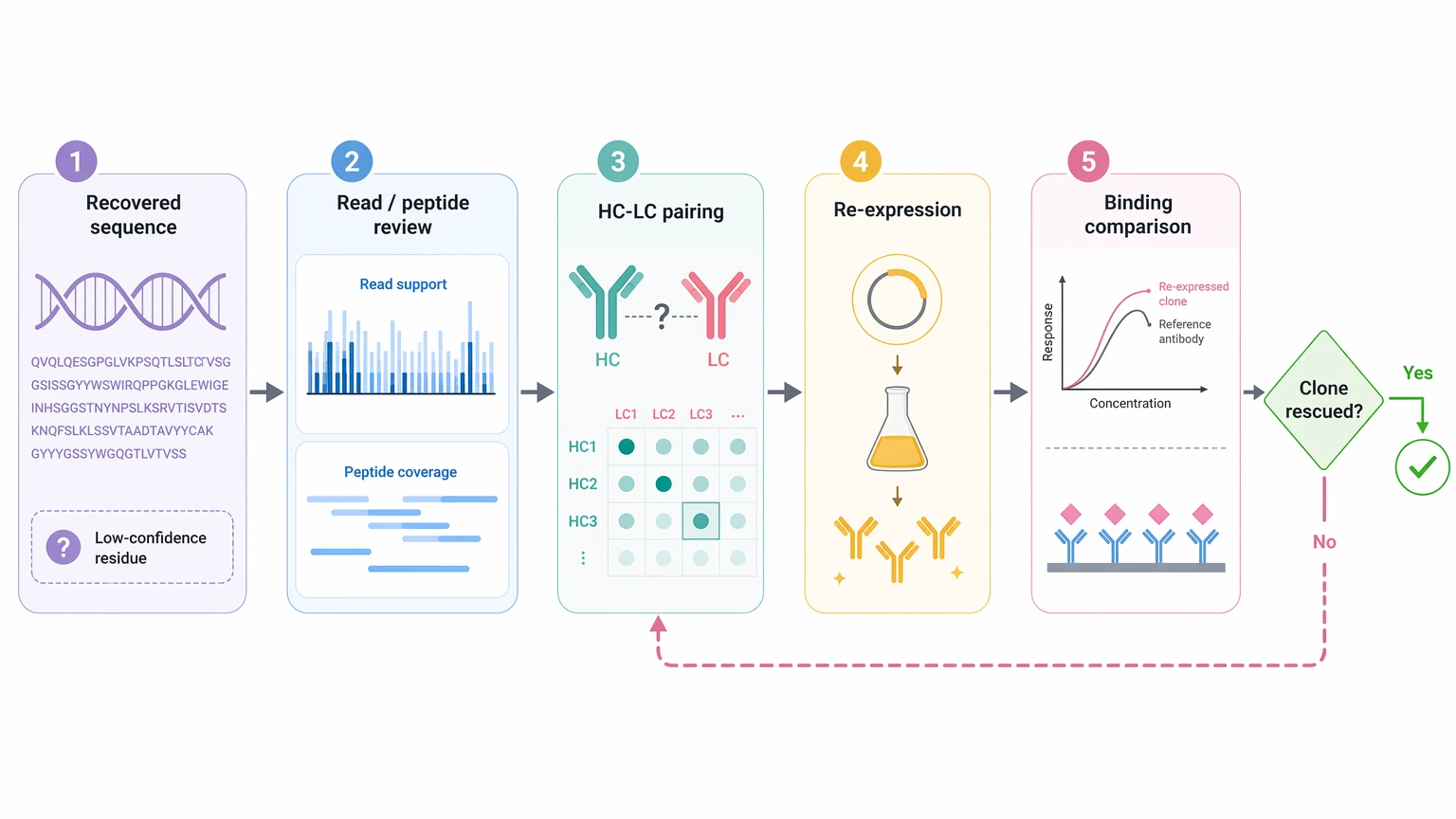
Recovered sequence and rescued clone are different milestones. A plausible sequence package still needs to be tested before the antibody is treated as a functional replacement.
A practical orthogonal validation plan may include:
- agreement between cell-derived and protein-derived evidence when both are available
- review of read support, contig consistency, and peptide coverage
- recombinant re-expression of the proposed heavy chain and light chain pair
- binding comparison against the legacy reagent
- analytical review of substitutions, low-confidence residues, or sequence gaps
- confirmation that the chosen chain pairing behaves as expected in the intended assay context
This matters because sequence recovery alone does not show functional interchangeability.
How to judge whether the rescue output is good enough
A useful rescue result should answer three questions clearly: what was recovered, how confident the chain assignments are, and whether the output supports sequence confirmation or recombinant re-expression.
For cell-derived recovery, good signs include consistent VH and VL candidates, productive transcript identification, and agreement across contigs or replicate amplifications. For protein-derived recovery, the most useful indicators are strong peptide coverage across the variable region, overlapping peptide support in key CDRs, and a clear explanation of how heavy chain and light chain assignments were made.
What counts as “good enough” depends on the endpoint. A sequence confirmation project may be complete once the current material matches or disproves the archived sequence records. A recombinant re-expression project usually needs stronger evidence, because chain pairing and framework region interpretation have to support real design decisions.
Common mistakes that slow rescue projects down
Several avoidable choices can make clone rescue harder than necessary.
First, teams sometimes use limited material before deciding whether the project is about sequence confirmation or recombinant re-expression. That blurs the acceptance criteria from the beginning.
Second, they may trust partial legacy documentation too much. A single old sequence file, especially one without clear chain labels or framework region context, should be checked against current material rather than copied directly into a re-expression plan.
Third, they may assume that CDR recovery equals clone rescue. In practice, CDRs are critical but not always enough for a recombinant-ready construct.
Fourth, they may wait too long to preserve backup material. If only one frozen pellet or one aliquot of purified antibody remains, the workflow should be planned carefully before repeat testing starts.
Conclusion
Monoclonal antibody sequencing for clone rescue works best when the project is built around the real constraint: the starting material that still exists, the variable region deliverable needed next, and the level of chain pairing confidence required for that decision. Cell-derived recovery is usually the stronger route when hybridoma material or usable RNA remains and recombinant re-expression is the goal. Protein-derived recovery becomes the key option when purified antibody is the only surviving source or when sequence confirmation is the immediate need. For legacy hybridoma transfer, assay continuity review, or purified-antibody-only rescue, a structured feasibility assessment followed by orthogonal validation lowers the chance of treating a tentative sequence as a finished replacement. If your team needs to assess sample suitability, define the expected VH and VL output, or plan sequence confirmation before re-expression, contact MtoZ Biolabs to evaluate your project and discuss the rescue workflow that fits the material you still have.
FAQ
Can supernatant be used for clone rescue if no purified antibody is available?
Sometimes. Archived supernatant can provide protein-level evidence that a secreted antibody is present, but abundance and background proteins may limit how much sequence information can be recovered. It is usually a backup starting material rather than the preferred one.
Why can a hybridoma produce extra antibody-related transcripts that are not useful?
Hybridoma cells can contain nonproductive transcript variants or evidence of mixed clone / hybridoma heterogeneity. That means sequencing may detect more than one chain candidate, and not every transcript will represent the functional secreted antibody.
Does isotype / subclass information identify the antibody sequence?
No. Isotype / subclass context helps interpret the source reagent and may support chain annotation, but it does not replace variable region recovery. Clone rescue still depends on resolving the heavy chain and light chain variable regions.
When should I ask for full VH and VL instead of CDRs only?
Ask for full VH and VL when the project may move into recombinant re-expression, engineering, or formal reagent transfer. CDR-focused output is more useful when the immediate question is identity checking rather than rebuild readiness.
What project details should be prepared before starting a consultation?
Prepare the sample type, storage history, vial count, concentration if known, known isotype / subclass, any previous sequence records, and the exact downstream decision the rescue must support. That makes it easier to evaluate your project and avoid using the wrong sample first.
If two sequencing routes disagree slightly, does that mean the rescue failed?
Not necessarily. Small differences can come from ambiguous residues, PTM-related interpretation, or transcript candidates that need further review. The next step is usually targeted orthogonal validation, not an immediate assumption that the project cannot proceed.
How to order?




