






LC-MS/MS in Proteomics: Methods and Applications
Introduction
LC-MS/MS has become the central analytical platform for modern proteomics because it combines chromatographic separation with tandem mass spectrometry to identify and quantify peptides at scale. A discovery team may need unbiased protein profiling across treatment groups. A PTM research group may need phosphosite localization with confident fragment evidence. A biologics laboratory may need peptide mapping coverage for a therapeutic protein. A biomarker program may need targeted PRM measurement after an initial discovery screen. Each goal uses LC-MS/MS, but the method details differ.
LC-MS/MS in proteomics refers to workflows in which peptides or proteins are separated by liquid chromatography, measured in a mass spectrometer, and fragmented in a second MS stage to generate sequence or quantitation evidence. The method family includes discovery data-dependent acquisition, reproducible data-independent acquisition, and targeted PRM or MRM monitoring. Application fit depends on whether the project priority is deep identification, robust quantitation, modification mapping, or repeated assay-style measurement.
This article summarizes the main LC-MS/MS methods used in proteomics and the applications they support in research and protein product analysis.
What LC-MS/MS Means in Proteomics
In proteomics, LC-MS/MS usually describes a bottom-up workflow in which proteins are digested into peptides, peptides are separated online by reversed-phase liquid chromatography, and the mass spectrometer performs survey MS scans followed by MS/MS fragmentation of selected or window-defined precursors.
The LC step reduces ionization competition and improves measurement consistency. The MS step records precursor m/z and intensity. The MS/MS step generates product ions that support peptide sequence assignment, modification localization, or targeted quantitation. Protein-level conclusions are then built from peptide-spectrum matches and quantitative peptide measurements.
LC-MS/MS is not a single fixed experiment. Instrument settings, acquisition mode, digestion strategy, and enrichment steps change the type of proteomics evidence produced in the same sample type.
Main LC-MS/MS Method Categories in Proteomics
Proteomics laboratories usually organize LC-MS/MS methods by acquisition strategy and quantitation approach.
Discovery identification by data-dependent acquisition
Data-dependent acquisition (DDA) selects the most intense precursor ions during the LC run for MS/MS fragmentation. DDA is widely used for protein identification in complex mixtures because it prioritizes spectral diversity and deep peptide sampling in each run.
Reproducible quantitation by data-independent acquisition
Data-independent acquisition (DIA) fragments peptides across predefined mass windows in a systematic manner. SWATH and related DIA modes are often paired with spectral libraries to support reproducible quantitation across larger sample cohorts.
Targeted measurement by PRM or MRM
Targeted LC-MS/MS monitors selected peptide transitions with high specificity and reproducibility. PRM on high-resolution instruments and MRM on triple quadrupole platforms are common choices for assay-style protein panel measurement after discovery.
Modification-focused LC-MS/MS
Enrichment workflows for phosphorylation, ubiquitination, glycosylation, or other post-translational modifications precede LC-MS/MS analysis. Search parameters and fragmentation settings are adjusted to improve site localization confidence.
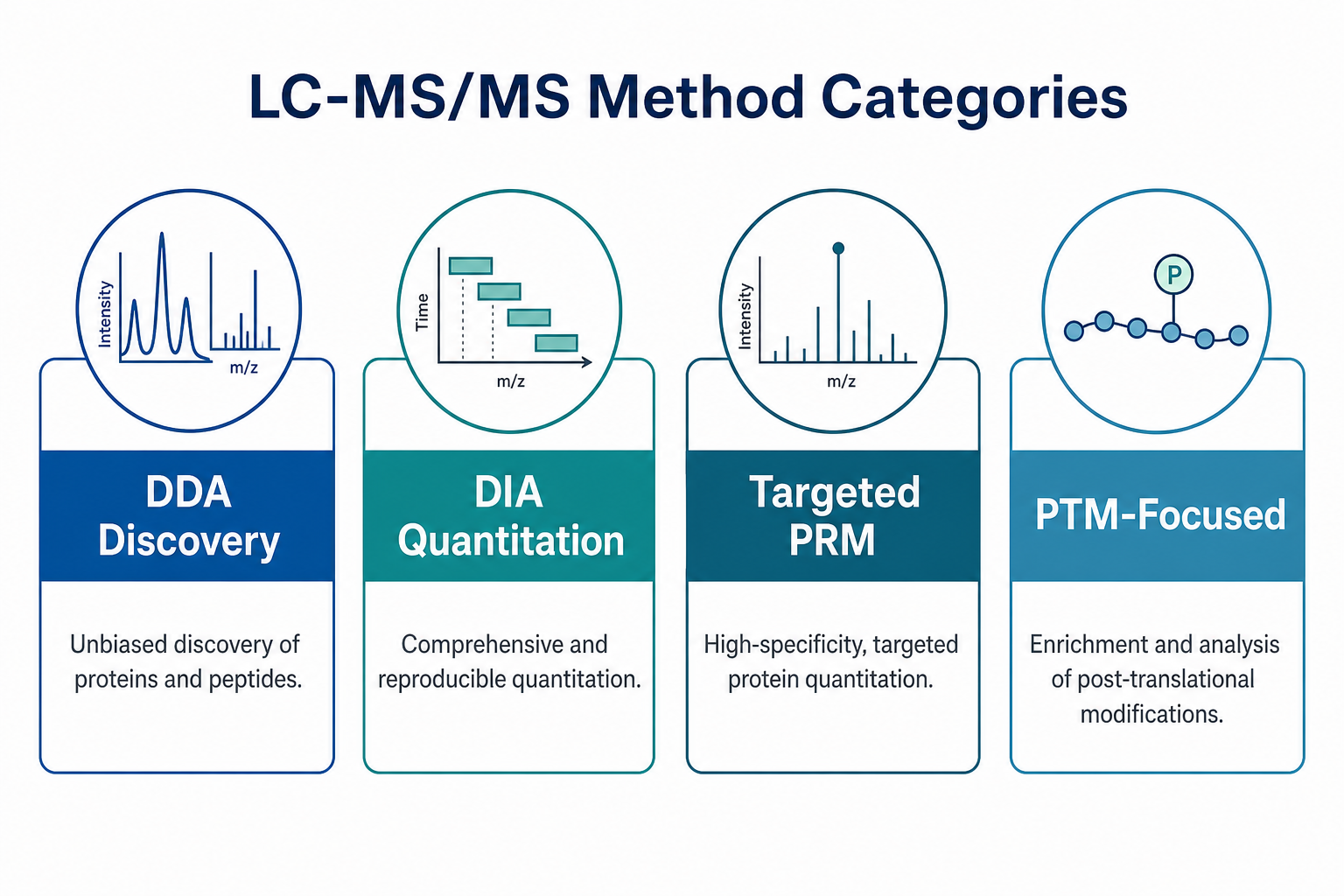
Figure 1. LC-MS/MS proteomics methods include DDA discovery, DIA quantitation, targeted PRM or MRM, and modification-focused workflows.
Sample Preparation Methods That Shape LC-MS/MS Performance
LC-MS/MS results depend on sample preparation as much as instrument settings.
Protein extraction and lysis conditions must preserve the proteins of interest while remaining compatible with digestion. Reduction and alkylation are commonly applied before tryptic digestion when disulfide bonds would otherwise limit peptide recovery. Alternative proteases may be selected to improve coverage of transmembrane regions or specific sequence contexts.
Peptide cleanup removes salts, detergents, and other interferents that suppress electrospray ionization. Fractionation or abundant protein depletion may be required for low-abundance targets in plasma or complex lysates. Enrichment columns or affinity workflows concentrate modified peptides before LC-MS/MS when PTM analysis is the primary goal.
Preparation choices should be fixed during project design because they are difficult to change without new sample material.
Quantitation Methods Coupled to LC-MS/MS
Identification and quantitation are often performed in the same LC-MS/MS program. Quantitation strategy should match the experimental design.
|
Quantitation Method |
LC-MS/MS Basis |
Typical Use |
|---|---|---|
|
Label-free |
Peptide precursor or extracted ion intensity |
Discovery comparison across conditions |
|
Spectral counting |
Number of MS/MS spectra per protein |
Screening-level abundance ranking |
|
TMT or iTRAQ |
Isobaric reporter ions in MS/MS |
Multiplexed sample comparison |
|
SILAC |
Metabolic heavy-light peptide ratios |
Cell culture perturbation studies |
|
PRM or MRM |
Monitored peptide transitions |
Targeted panel quantitation |
Label-free and DIA-based approaches are common in discovery cohorts. Isobaric labeling supports multiplexed biological comparisons. Targeted methods are preferred when a defined protein set must be measured repeatedly.
Related Services
LC-MS/MS proteomics projects often combine identification, quantitation, and reporting services according to sample type and study goal. Relevant options include:
Label-Free Quantitative Proteomics Service, MS Based
SWATH Based Protein Quantitative Service
MRM/PRM Quantitative Proteomics Service
Proteomics Bioinformatic Analysis Service
Researchers planning LC-MS/MS proteomics can consult MtoZ Biolabs to review sample type, acquisition strategy, and the reporting depth required for the study.
Matching LC-MS/MS Methods to Proteomics Applications
Different proteomics questions favor different LC-MS/MS method emphasis. The table below summarizes common pairings.
|
Application |
Preferred LC-MS/MS Method Emphasis |
Typical Deliverable |
|---|---|---|
|
Unbiased protein discovery |
DDA with label-free quantitation |
Protein list and differential abundance table |
|
Large cohort comparison |
DIA or SWATH with library matching |
Reproducible quantitative protein matrix |
|
Biologics peptide mapping |
DDA with reference database search |
Coverage map and PSM-supported peptide table |
|
Phosphoproteomics |
Phosphopeptide enrichment plus DDA or DIA |
Localized phosphosite assignments |
|
Biomarker follow-up |
Targeted PRM panel |
Quantitative peptide panel results |
|
PTM pathway analysis |
Enrichment plus modification-aware search |
Modified peptide and site summary |
|
Quality attribute monitoring |
Targeted PRM or MRM on selected peptides |
Assay-style repeat measurement report |
Method selection should be defined before sample preparation because acquisition mode and enrichment strategy are closely linked to the application goal.
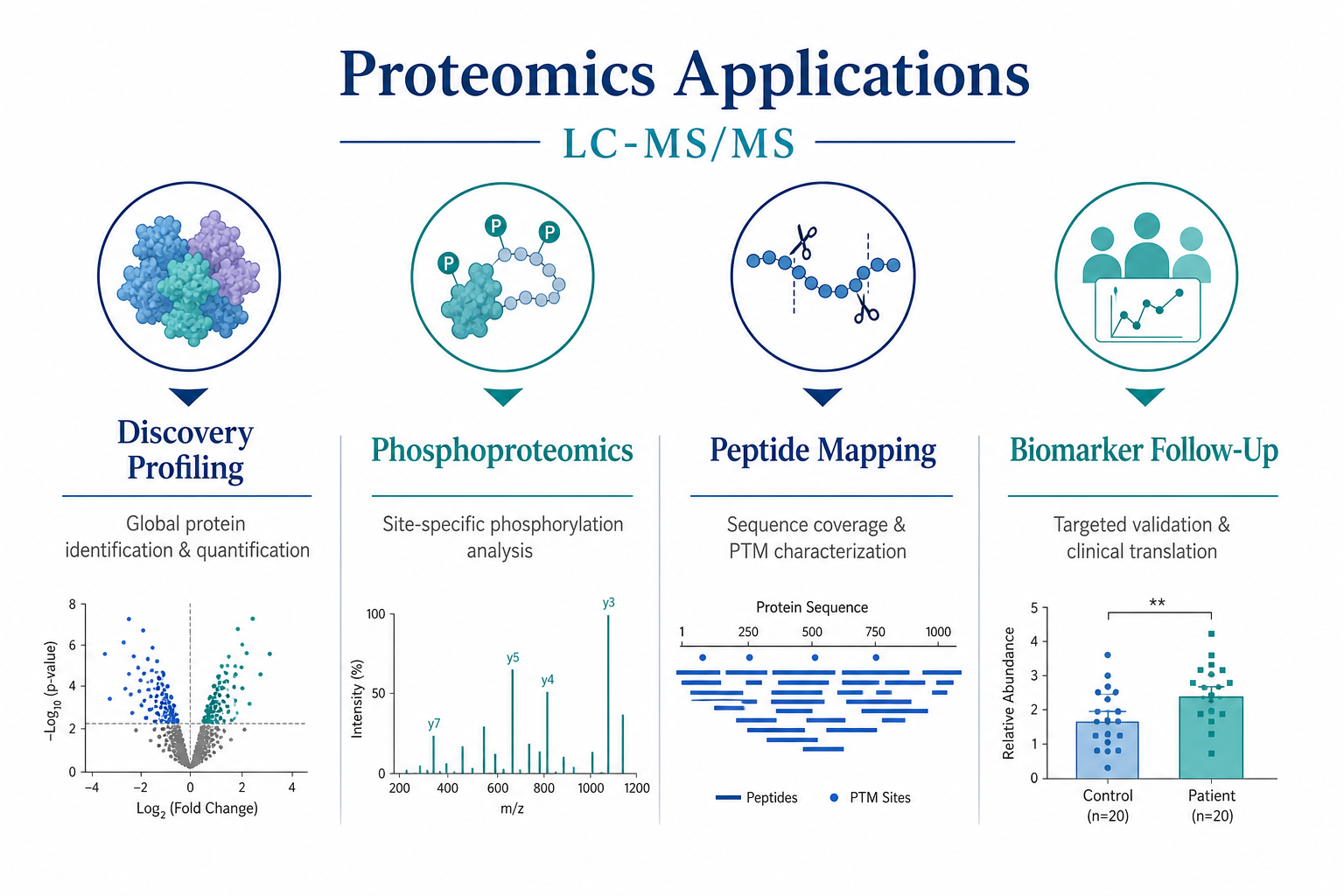
Figure 2. LC-MS/MS proteomics applications include discovery profiling, phosphoproteomics, biologics peptide mapping, and targeted biomarker follow-up.
Core Technical Advantages and Current Limitations
Core Technical Advantages
Sequence-level evidence from MS/MS fragmentation.
Product ions support peptide assignment and many modification localization tasks.
Flexible method scale from discovery to targeted assays.
The same platform can support DDA screening and later PRM confirmation.
Multiplexed protein measurement.
One LC-MS/MS run can analyze hundreds to thousands of peptides depending on sample complexity and gradient length.
Compatibility with enrichment workflows.
PTM-focused applications can be integrated into the same peptide-centric platform.
Current Limitations
Acquisition trade-offs.
DDA favors identification breadth, while DIA and targeted modes prioritize reproducibility and panel focus.
Sample complexity affects depth.
Low-abundance proteins may require fractionation, depletion, or longer LC gradients.
Missing quantitative values.
Not every identified protein is quantified in every run, especially in complex DDA experiments.
Interpretation depends on search and library quality.
Database completeness and spectral library representativeness influence results.
Standard LC-MS/MS Workflow Overview
Most LC-MS/MS proteomics projects follow a common workflow logic regardless of application.
Sample preparation produces digested peptides suited to LC injection. Reversed-phase LC separates peptides before ionization. The mass spectrometer acquires MS and MS/MS data using the selected mode. Software assigns PSMs, infers proteins, and calculates quantitative values when in scope. Reporting delivers identification tables, quantitative comparisons, and method notes that define how the LC-MS/MS data support the project conclusion.
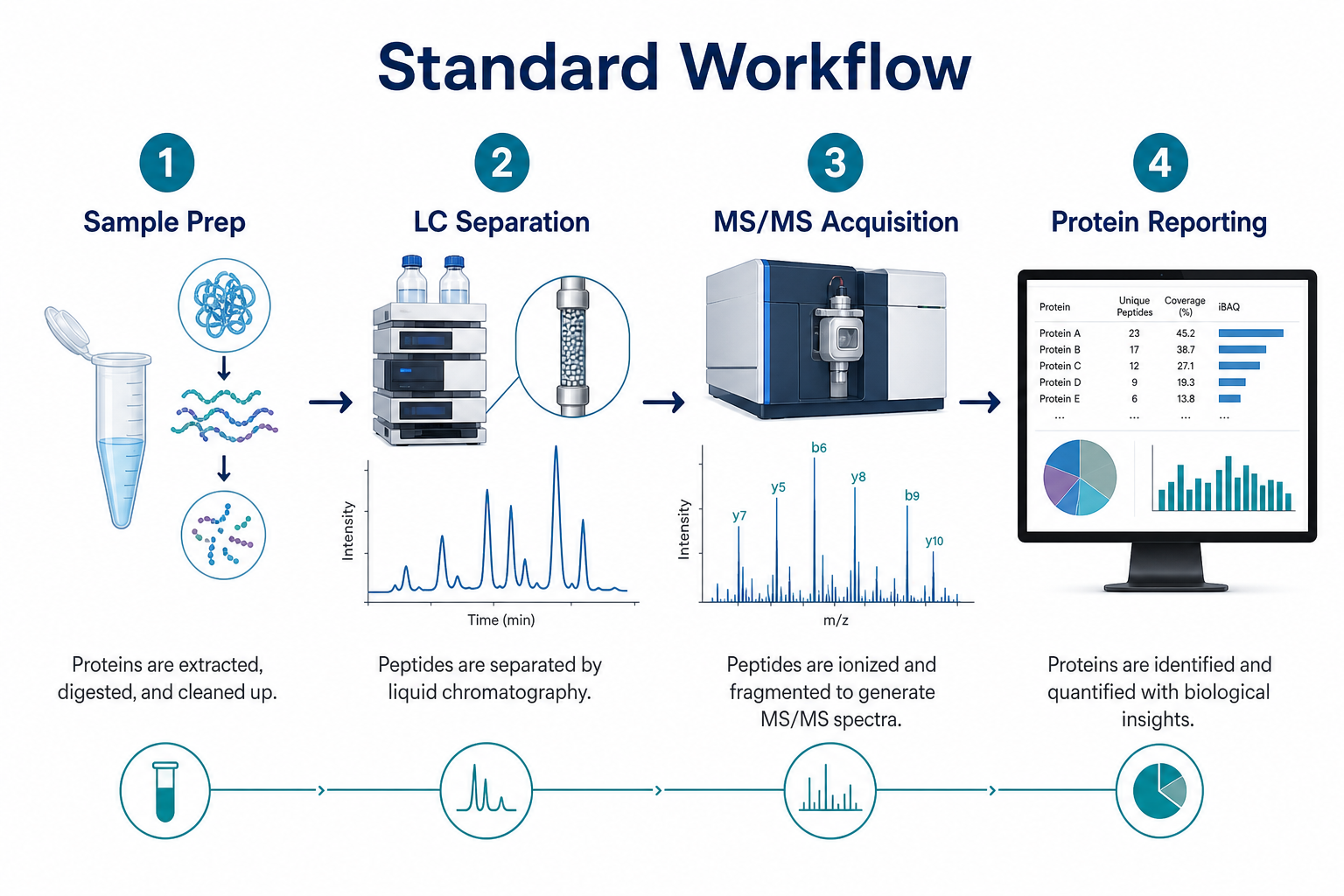
Figure 3. A standard LC-MS/MS proteomics workflow links sample preparation, LC separation, MS/MS acquisition, and protein-level reporting.
Frequently Asked Questions
1. What is LC-MS/MS in proteomics?
LC-MS/MS in proteomics combines liquid chromatography peptide separation with tandem mass spectrometry to identify and quantify peptides that support protein-level conclusions.
2. What is the difference between DDA and DIA in LC-MS/MS proteomics?
DDA selects intense precursors dynamically for MS/MS during the run. DIA fragments peptides systematically across defined windows for more reproducible quantitation.
3. When is targeted PRM used instead of discovery LC-MS/MS?
PRM is often used when a defined protein or peptide panel must be measured repeatedly with higher reproducibility after discovery or when assay-style monitoring is required.
4. Can LC-MS/MS identify post-translational modifications?
Yes. Modification-aware database searches and enrichment workflows can localize many PTMs when MS/MS fragment evidence is sufficient.
5. What sample types are compatible with LC-MS/MS proteomics?
Cell lysates, tissues, plasma, serum, and purified proteins are common, but preparation strategy must match the sample matrix and application.
Conclusion
LC-MS/MS is the analytical foundation of most modern proteomics programs because it links peptide separation, fragmentation, identification, and quantitation in one platform. DDA discovery, DIA quantitation, targeted PRM, and modification-focused enrichment represent the main method branches used across proteomics applications. Discovery profiling, phosphoproteomics, biologics peptide mapping, and biomarker follow-up differ in acquisition and reporting emphasis, but all depend on LC-MS/MS evidence quality.
Successful proteomics outcomes require matching LC-MS/MS method selection to the application before sample preparation begins. Teams that define acquisition strategy, quantitation mode, and reporting goal early can generate more interpretable protein data with fewer repeat experiments. Researchers planning LC-MS/MS proteomics can contact MtoZ Biolabs to review sample type, method route, and the reporting format required for the project.
How to order?




