






Label Transfer in Protein Interaction Studies: Principle, Workflow, and Method Selection
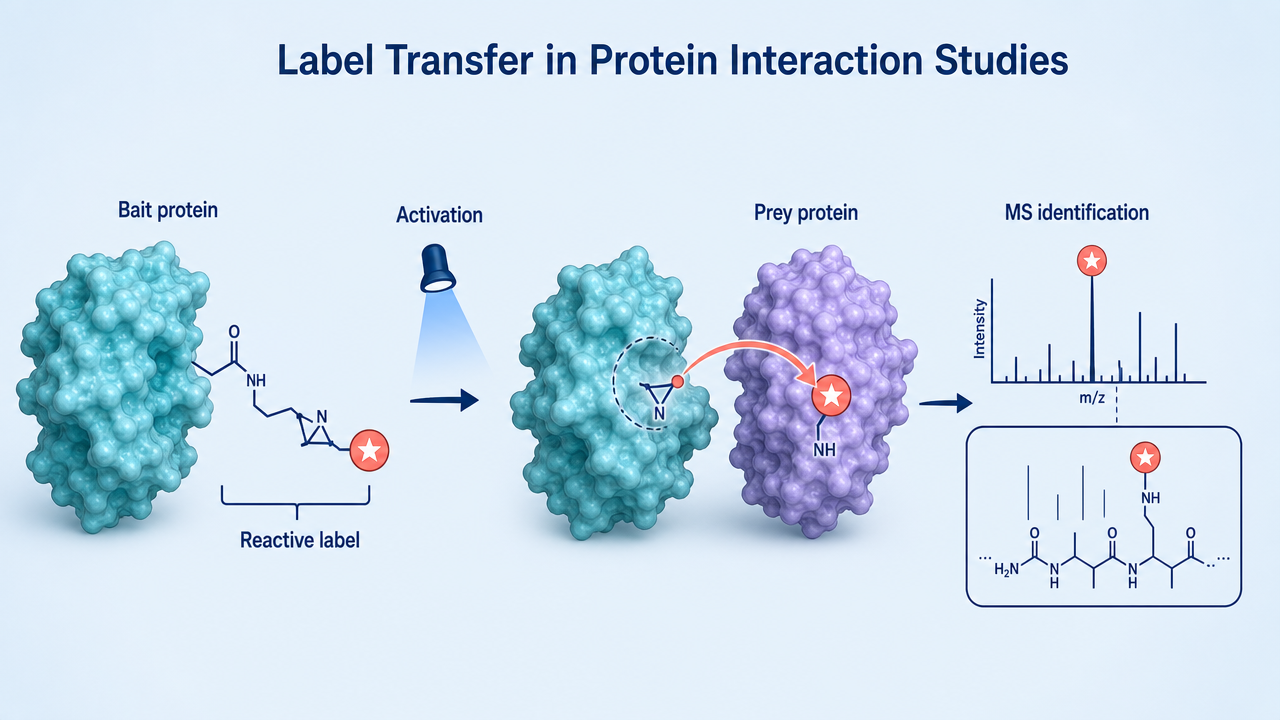
Label transfer is a protein interaction strategy that uses a reactive label attached to a bait protein or ligand to mark nearby binding partners. After the bait-prey complex forms, light or chemical activation creates a covalent link or transfers a detectable tag to the interacting protein. The labeled prey proteins can then be enriched, separated, and identified by mass spectrometry, Western blotting, fluorescence detection, or affinity capture.
Key Takeaways
-
Label transfer is designed to capture protein interactions that may be weak, transient, or difficult to preserve during purification.
-
The method depends on bait labeling, complex formation, activation, label transfer or crosslinking, enrichment, and protein identification.
-
It is most useful when proximity or direct-contact evidence is needed around a defined bait protein.
-
Controls are essential because nonspecific labeling, reagent accessibility, and activation conditions can create false positives.
What Does Label Transfer Measure?
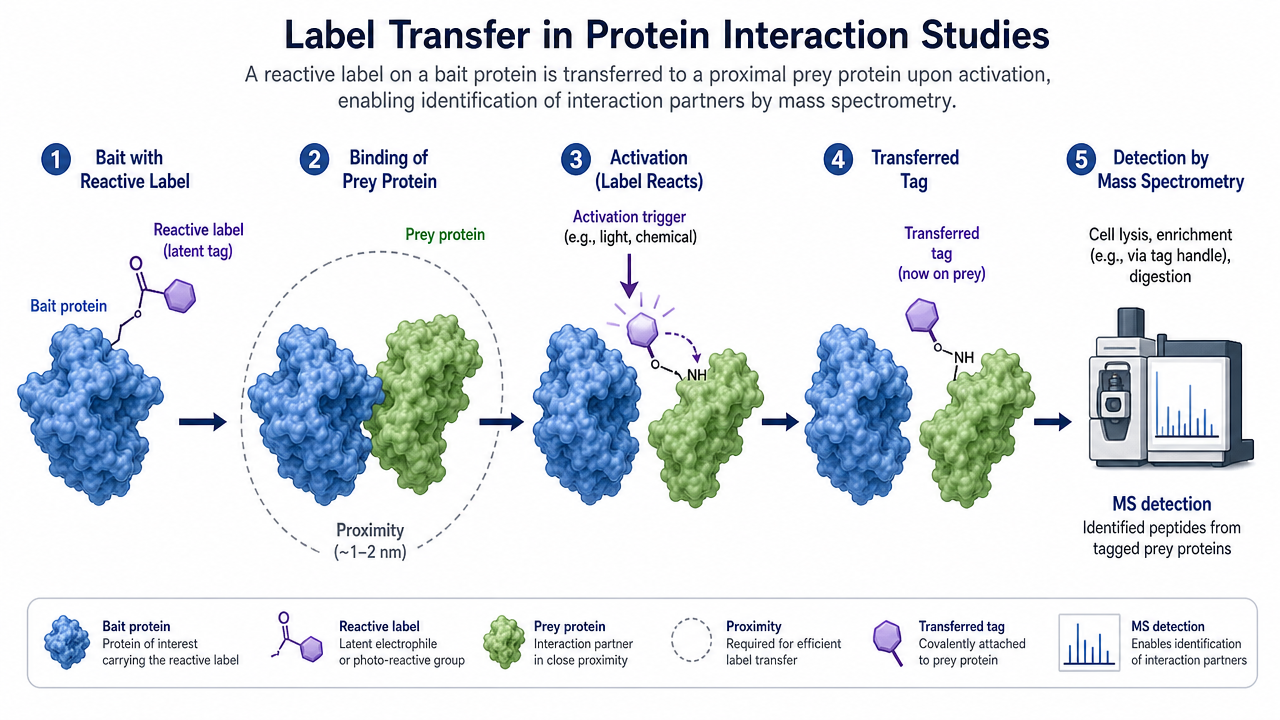
Label transfer does not simply report that two proteins co-purify. It marks proteins that are close enough to the activated bait-linked reagent to receive the label or form a covalent connection. That makes it useful for interaction mapping when the interaction may not survive washing or when the researcher wants stronger proximity evidence around a defined bait.
Related Services
Label Transfer Protein Interaction Analysis Service
Crosslinking Protein Interaction Analysis Service
Chemical Crosslinking-Mass Spectrometry (CXMS) Analysis Service
Photocrosslinking Mass Spectrometry Service
Core Workflow
The workflow begins with a bait protein, ligand, antibody, peptide, or other targeting molecule modified with a reactive label. The labeled bait is incubated with the sample so that interaction partners can bind under controlled conditions. Activation then triggers covalent reaction or label transfer to nearby prey proteins. After cleavage, enrichment, or separation, the labeled proteins are analyzed.
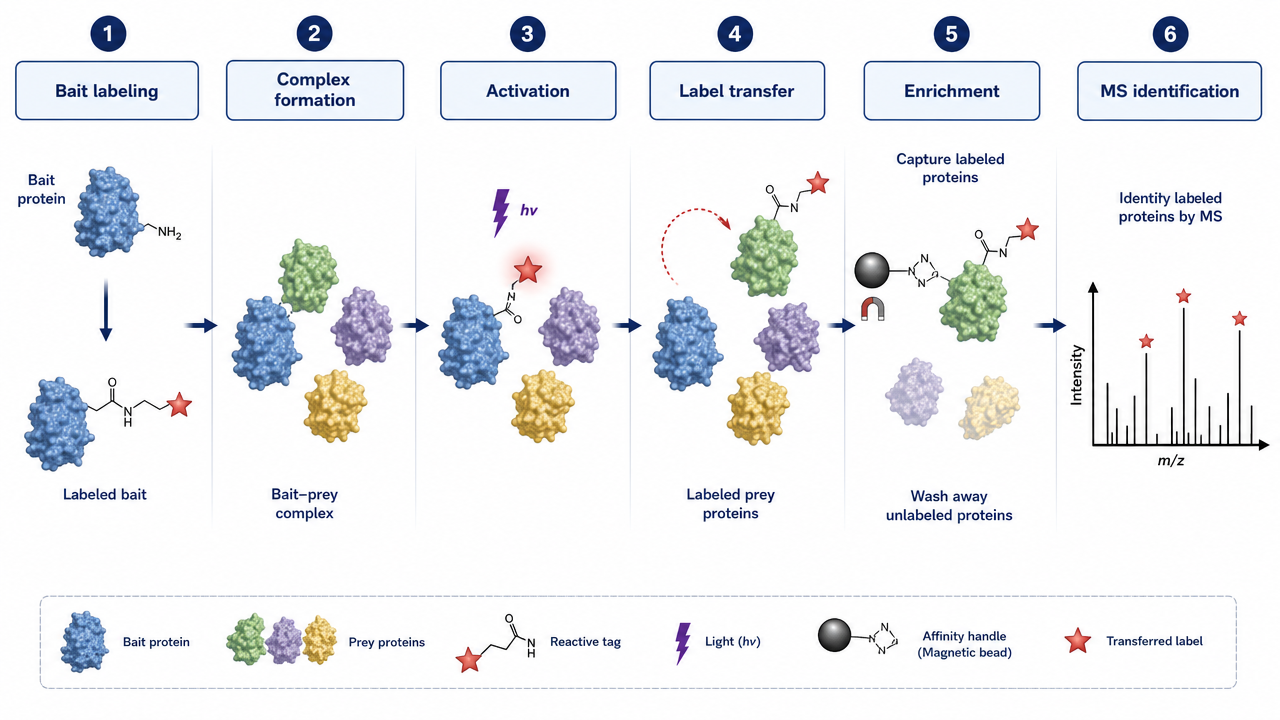
The most important design choices are reagent chemistry, spacer length, activation condition, bait activity after labeling, sample matrix, and detection method. A reagent that disrupts bait binding can produce a clean-looking experiment with little biological meaning.
Applications in Protein Interaction Studies
Label transfer is useful for weak or transient interactions, receptor-ligand studies, signaling complexes, membrane-associated interactions, protein complex mapping, and bait-centered interaction discovery. It can also help prioritize prey proteins for follow-up validation by Co-IP, pull-down, targeted MS, or functional assays.
Because the method is proximity-based, it can reveal candidates that standard immunoprecipitation misses. The tradeoff is that proximity does not always prove direct functional interaction.
Limitations and Controls
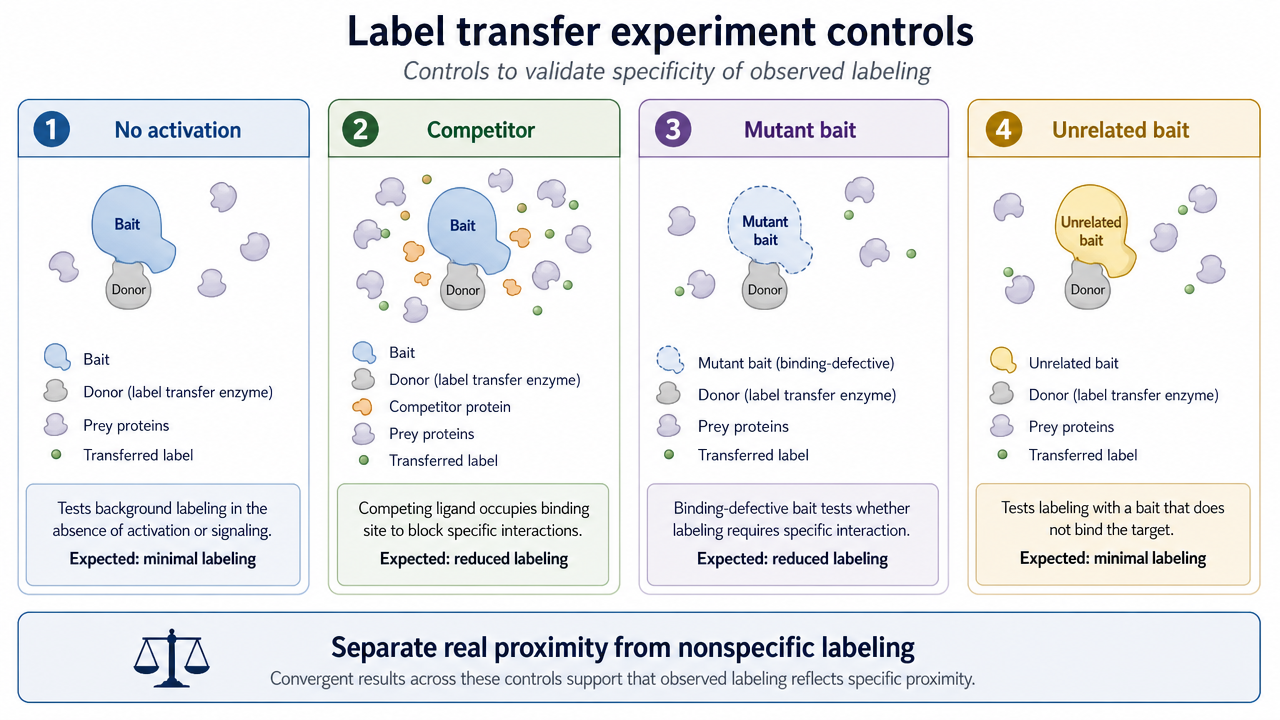
Label transfer can produce false positives if the reactive label reaches nearby but irrelevant proteins. It can also miss real partners if the label is poorly positioned, the interaction surface is shielded, or activation damages the complex. Controls should include bait-only, no-activation, competitor, mutant bait, and unrelated bait conditions where feasible.
How Label Transfer Compares with Other Methods?
| Method | Best for | Strength | Main caution |
|---|---|---|---|
| Label transfer | Bait-centered proximity labeling | Captures weak or transient contacts | Nonspecific labeling must be controlled |
| Co-IP-MS | Protein complexes that survive purification | Practical for native complexes | Weak interactions may be lost |
| Pull-down-MS | Bait-ligand or bait-protein discovery | Flexible bait format | Immobilization can alter binding |
| Crosslinking-MS | Spatial proximity and complex architecture | Provides distance constraints | Crosslink coverage can be incomplete |
FAQ
1. What is label transfer in protein interaction studies?
Label transfer is a method that uses a bait-linked reactive label to mark nearby interacting proteins after complex formation and activation.
2. What kinds of interactions can label transfer capture?
It can help capture weak, transient, or proximity-dependent interactions that may be lost during standard purification.
3. Is label transfer the same as Co-IP?
No. Co-IP enriches protein complexes that remain associated during immunoprecipitation. Label transfer marks nearby proteins through reactive chemistry or covalent transfer.
4. How are label transfer products identified?
Labeled proteins can be detected by mass spectrometry, Western blotting, fluorescence detection, autoradiography, or affinity capture depending on the label.
Conclusion
Label transfer is valuable when a protein interaction is transient, weak, or difficult to preserve by purification alone. It provides bait-centered proximity evidence that complements Co-IP-MS, pull-down-MS, crosslinking-MS, and interaction network analysis. The best results come from careful reagent design, activation control, and orthogonal validation.
How to order?




