






Photocrosslinking Mass Spectrometry Service
MtoZ Biolabs provides a Photocrosslinking Mass Spectrometry Service to capture and identify proximity or binding partners through light triggered covalent crosslinking followed by high resolution LC-MS/MS analysis. This service supports photoaffinity target identification, transient interaction mapping, binding site localization, and mechanism of action studies across small molecules, peptides, proteins, and complex biological samples.
What Is Photocrosslinking Mass Spectrometry?
Many biologically relevant contacts are transient or weak, and they can be lost during cell lysis, washing, or conventional affinity enrichment. Photocrosslinking addresses this challenge by converting proximity at a specific moment into a stable covalent linkage, enabling confident downstream identification under stringent conditions.
A practical advantage of photocrosslinking is temporal control. Because crosslinking is initiated by a brief light pulse, the reaction can occur rapidly and at a chosen time point, which helps preserve the physiological interaction state. The chemical crosslinking MS typically uses bifunctional reagents such as DSS or BS3 that react broadly with accessible residues in solution over seconds to minutes. While this approach can provide useful distance constraints, the slower and less controllable reaction kinetics may miss the fastest interaction dynamics and is often less practical in live-cell settings. In comparison, photocrosslinking offers a rapid, on demand trigger that better supports dynamic interaction capture and cellular applications.
Principle of Photocrosslinking Mass Spectrometry
Photocrosslinking mass spectrometry combines photoactivated covalent capture with a proteomics readout. A photoactivatable moiety is introduced into the system, allowed to equilibrate under near physiological conditions, and then activated by light to form covalent bonds with molecules in immediate spatial proximity. The covalently captured targets are subsequently enriched and analyzed by LC-MS/MS to identify interacting proteins.
Common photo-reactive groups:
🔸Diazirines
🔸Benzophenones
🔸Aryl azides
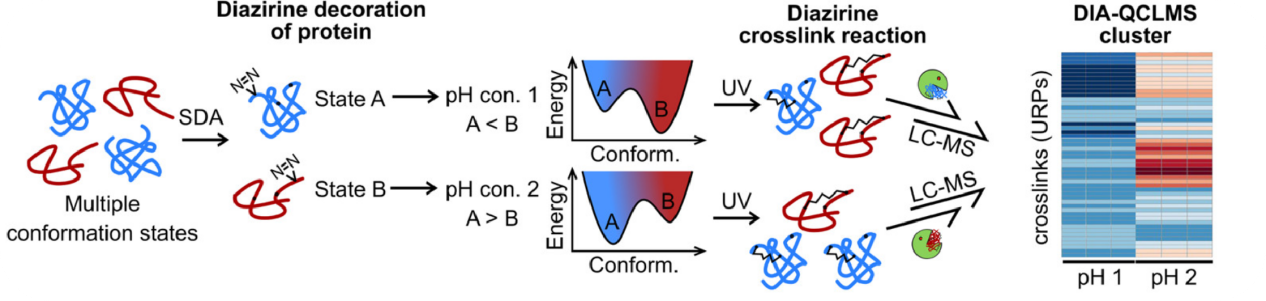
Müller, F. et al. Anal Chem. 2019.
Figure 1. Photocrosslinking Mass Spectrometry Quantitation Workflow
Photocrosslinking Mass Spectrometry Service at MtoZ Biolabs
MtoZ Biolabs delivers an end to end workflow from experimental strategy through LC-MS/MS identification and interpretation. Our service is designed to fit both discovery and hypothesis-driven studies while minimizing background and improving confidence in target assignment.
Why Choose MtoZ Biolabs
✔️Experienced Scientific Team
Specialists in proteomics, crosslinking strategies, and LC-MS/MS interpretation support study design and execution.
✔️Advanced Analytical Platforms
High performance LC-MS/MS workflows enable sensitive identification and reliable quantitative comparisons.
✔️Customizable Study Designs
Flexible configurations including competition, dose response, time course, and multi-group comparisons tailored to your biological question.
✔️Fast Turnaround
Streamlined project management and efficient workflows keep timelines practical without compromising quality.
✔️Dedicated Customer Support
Responsive communication, clear reporting, and actionable recommendations for follow-up validation.
Applications of Photocrosslinking Mass Spectrometry Service
1. Biopharma and Translational Research
Supports target identification, target engagement, and mechanism of action studies by covalently capturing probe or ligand proximal proteins, including transient interactions in complex or cellular contexts.
2. Clinical and Disease Biology
Enables mapping of dynamic protein interaction networks and state-dependent complexes relevant to cancer, immunology, neuroscience, and infectious disease models, helping prioritize disease-associated interactors and pathways.
3. Agriculture and Forestry Science
Facilitates discovery of stress- and development-associated protein interactions in plants and plant-associated systems, supporting functional studies of signaling, metabolism, and trait-related pathways under changing conditions.
4. Microbiology and Environmental Research
Captures rapid and context-dependent interactions in microbes or mixed systems, aiding studies of host–microbe interactions, metabolic adaptation, and environmental response mechanisms.
FAQ
Q1: What types of samples are suitable?
We accept various sample types, including but not limited to:
Cells, cell lysates, purified proteins or complexes, membrane fractions, and other enriched subcellular preparations
Q2: How should I prepare my samples?
1. Collection and handling: Collect samples as fresh as possible, and snap-freeze promptly using liquid nitrogen, and keep all handling steps cold on ice or at 4°C.
2. Storage: Store samples at -80°C and avoid repeated freeze-thaw cycles.
3. Shipping: Ship samples on dry ice or with cold packs as appropriate for the sample type to maintain low temperature during transit.
4. Packaging and labeling: Use leak-proof, secure packaging and clearly label each tube with sample ID, group, and replicate information.
For more information, please refer to Sample Submission Guidelines for Proteomics and Sample Submission Guidelines for Metabolomics.
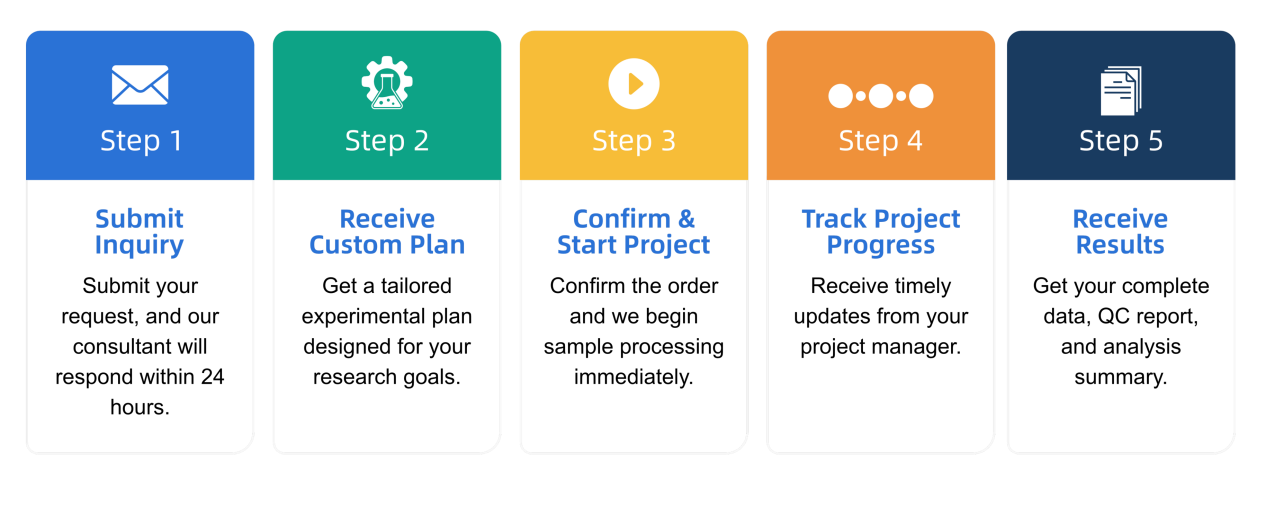
Q3: What is the service general workflow?
Q4: What data formats are provided?
1. Raw data: vendor MS raw files and optional mzML
2. Processed tables: XLSX or CSV (protein IDs, peptide evidence, crosslinked species or adduct assignments when applicable, localization or site-mapping summaries, and comparative statistics when included)
3. Spectral evidence and figures: PDF plus PNG or TIFF (QC summaries, annotated spectra for key crosslinks, mapping visuals, and comparison plots when applicable)
4. Report and methods: concise PDF describing experimental design, controls, key parameters, instrument settings, and software versions for reproducibility
Additional formats can be provided upon request to meet specific analysis or publication requirements.
Start Your Project with MtoZ Biolabs
Contact us to discuss your experimental design or request a quote. Our technical specialists are available to provide a free business assessment.
Supporting Antibody Products for Protein Interaction Studies
MtoZ Biolabs offers antibody products for IP, Co-IP, IP-MS, and related protein interaction workflows, complementing protein interaction analysis services and supporting target enrichment and downstream mass spectrometry analysis.
IP-MS Validated Antibodies
Explore antibodies evaluated for target enrichment and downstream mass spectrometry applications, with product information available to support antibody selection.
View IP-MS Validated AntibodiesOther Supporting Products
How to order?




