






What Is Label-Free Analysis? LFQ Principles, Workflow, Advantages, and Limitations
Label-free quantification (LFQ) is operated as an unlabeled relative proteomics workflow: extract and digest each sample without isotopic or chemical tags, acquire each digest as its own liquid chromatography-tandem mass spectrometry (LC-MS/MS) run, identify peptides, extract intensity features, align and normalize across runs, then summarize to a protein-level relative matrix. Data-dependent acquisition (DDA) commonly feeds MaxLFQ-style MS1 peak-area quantification; data-independent acquisition (DIA) feeds fragment-chromatogram quantification under a library or library-free route. Run order, digestion consistency, and batch structure are part of the method, not optional extras. Ordinary LFQ intensities support same-protein relative comparison inside one coherent plan. They do not report calibrated absolute concentration (Cox et al. 2014).
Researchers who already have unlabeled samples or a defined cohort design can also review the MtoZ Biolabs Label-Free Quantitative Proteomics Service for project-specific feasibility and analysis planning.
LFQ Operational Workflow Step by Step
A workable LFQ project follows a fixed order. Skipping earlier controls cannot be repaired by a later heatmap alone.
1. Match sample preparation without labeling
Extract proteins, reduce and alkylate, digest (usually with trypsin), and clean up peptides under one protocol. Keep loading matched across the cohort. Residual detergent, uneven digestion, and protocol drift become artificial group differences after independent injections.
2. Acquire independent LC-MS/MS runs under one plan
Inject each digest separately. Randomize or block run order by group. Record column ID, instrument block, and QC injections. DDA and DIA are acquisition choices inside the unlabeled workflow, not synonyms for LFQ itself.
3. Identify peptides and extract quantitative features
Search fragment spectra against a protein database. For DDA-LFQ, integrate MS1 precursor chromatograms of identified peptides. For DIA, extract fragment-ion chromatograms with false discovery rate (FDR) control. Spectral counting can support rough ranking but is usually weaker for subtle fold changes than peak-area LFQ.
4. Align, normalize, and handle missing values
Align features across runs by m/z and retention time. Apply a declared normalization rule, then review distributions and principal component structure before differential testing. For normalization choices and checks, see How to Normalize Data in Label-Free Quantitative Proteomics?.
5. Summarize proteins and interpret with QC attached
Aggregate peptide evidence to protein values, test group contrasts under stated multiple-testing control, and keep peptide support, missingness, and batch notes with the candidate list. Pathway enrichment reflects overrepresentation relative to a quantified background. It does not prove pathway activity.
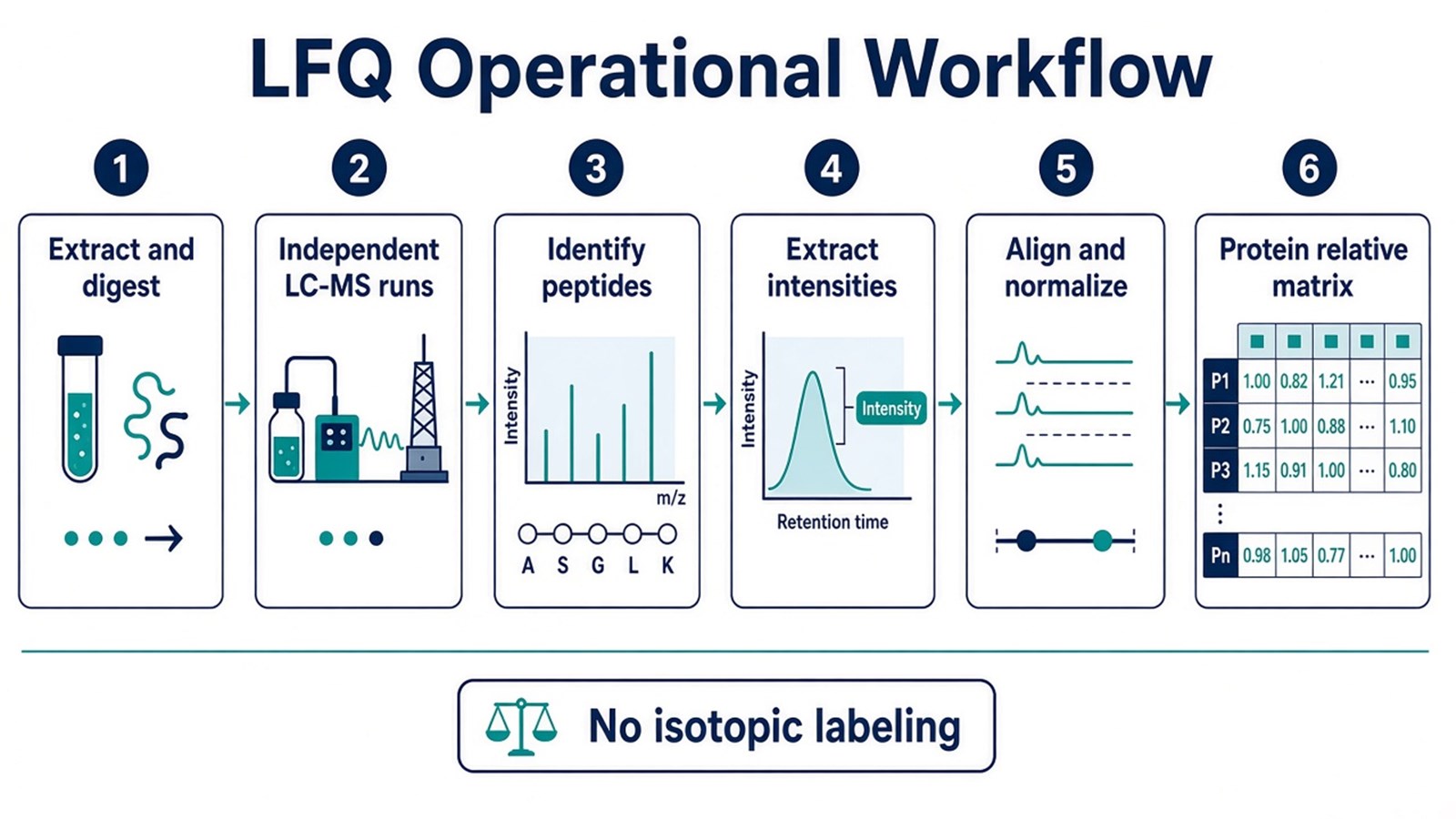
Figure 1. LFQ is executed as independent unlabeled runs; relative protein values appear only after alignment, normalization, and protein summarization.
If digestion or run order is confounded, later software options cannot invent a clean biological contrast.
Principle Behind the Workflow
LFQ assumes that, under comparable LC-MS conditions, the recorded signal of a given peptide tracks the relative amount of that same peptide across samples. Software reconstructs that comparison after acquisition because samples were never mixed into one labeled pool.
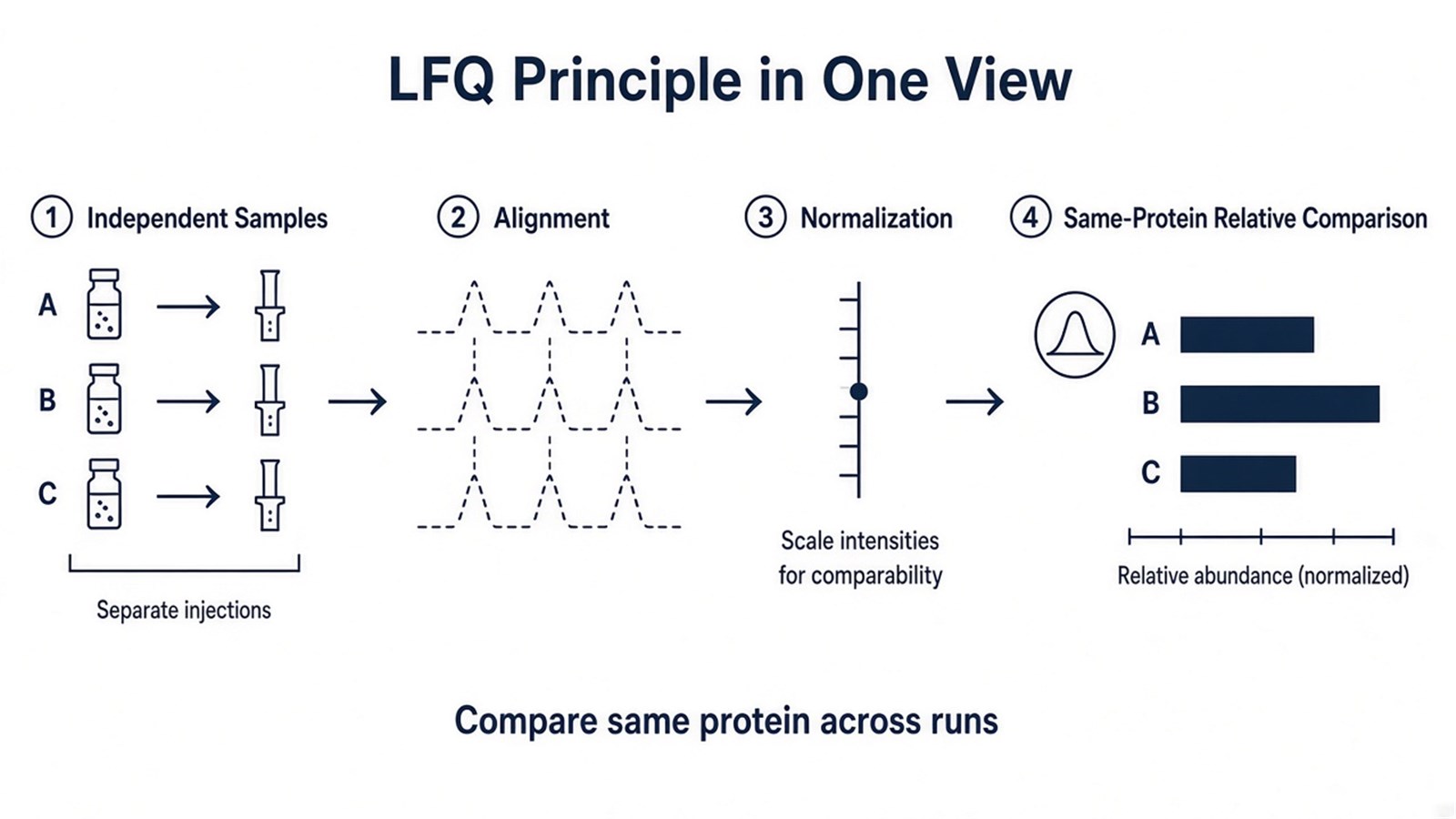
Figure 2. LFQ compares the same protein across independently acquired runs after alignment and normalization; it does not rank different proteins by molar amount.
An LFQ intensity supports relative change of one protein inside one study plan, not a copy-number certificate.
For definition-level detail beyond this operations guide, researchers can refer to What Is Label-Free Quantification in Proteomics?. For design-level trade-offs, see Advantages and Disadvantages of Label-Free Quantitative Proteomics.
Advantages and Limitations in Operational Terms
|
Operational point |
Advantage when controls hold |
Matching limitation |
|---|---|---|
|
Labeling chemistry |
No TMT/iTRAQ/SILAC reaction step |
No same-run multiplex damper on injection drift |
|
Cohort size |
Flexible independent enrollment |
Every added run carries chromatography risk |
|
Sample types |
Works when labeling is impractical |
Digestion and cleanup quality still decide success |
|
Quantitative claim |
Relative discovery across matched runs |
Not absolute concentration without standards |
|
Completeness |
DIA can reduce stochastic DDA gaps |
Window interference or DDA missingness can remain |
Judgment Criteria: When This LFQ Workflow Fits
|
Study need |
LFQ workflow often fits |
Reassess before queuing runs |
|---|---|---|
|
Claim |
Relative same-protein discovery |
Absolute units or diagnostic cutoff |
|
Sample plan |
Independent matched injections under one regime |
Must freeze contrast in one TMT plex |
|
Acquisition |
DDA-LFQ or unlabeled DIA planned with tooling |
Closed peptide panel ready for MRM/PRM |
|
QC capacity |
Run order, QC pools, and normalization can be enforced |
Uncontrolled batching across columns/instruments |
|
Chemistry |
Labeling would fail or consume scarce material |
Clean amine labeling and closed plex are available and preferred |
Prefer LFQ when samples must stay independent and unlabeled. Prefer TMT when a closed plex and same-run comparison fit better. Prefer MRM or PRM with stable isotope-labeled standards (SIS) when absolute units for a shortlist are required. Prefer DIA inside LFQ when scheduled-window completeness is the priority; prefer DDA-LFQ when MaxLFQ and identification-centric files are the planned path.
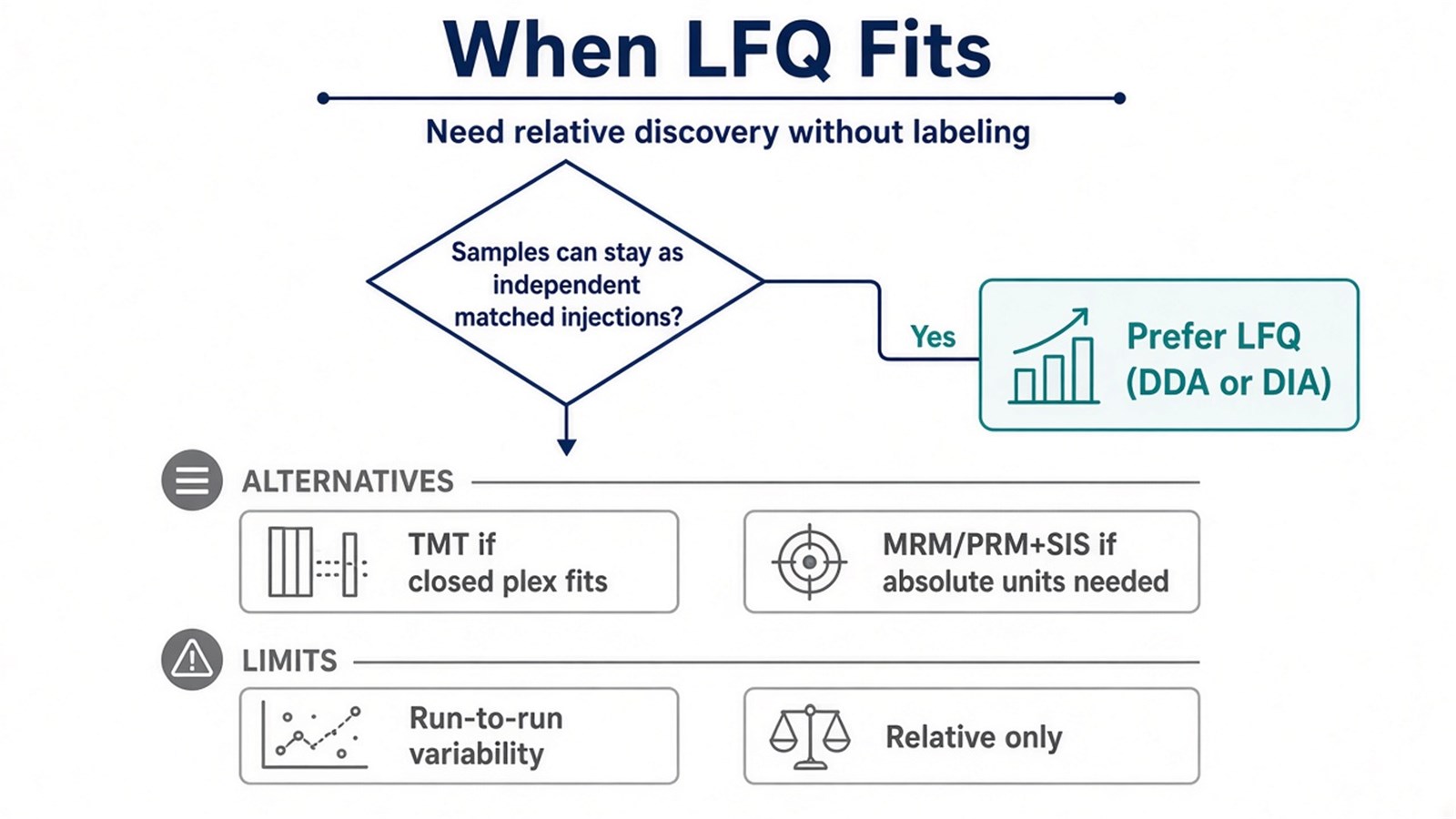
Figure 3. Run the LFQ workflow when relative unlabeled discovery can be maintained across independent injections; change method when the claim requires a closed plex or absolute units.
Applications and Boundaries
Typical applications are treatment or genotype screens, tissue-state comparisons, clinical or preclinical discovery cohorts, and matrices where labeling chemistry is unreliable. Diagnostic cutoffs sit outside ordinary discovery LFQ reporting unless a separately validated assay framework is in place.
Once extraction chemistry, acquisition mode, normalization plan, and relative readout are defined, the project can be evaluated as an LFQ study. Researchers can review the MtoZ Biolabs Label-Free Quantitative Proteomics Service for sample evaluation, feasibility assessment, and workflow planning. For unlabeled DIA options, see Label-Free DIA Quantitative Proteomics.
Frequently Asked Questions
1. Is label-free analysis the same as DIA?
No. LFQ means labels were not used. DIA means precursors are fragmented in scheduled windows. Unlabeled samples can be acquired as DDA or DIA.
2. What is the default quantitative metric in this workflow?
Peak-area or intensity-based features are the default for relative discovery statistics. Spectral counting is a coarser alternative.
3. Can LFQ report absolute protein concentration?
Not from ordinary LFQ intensities. Absolute amount needs matched standards and a calibration model.
4. Why is run order part of the LFQ workflow?
Because each sample is a separate injection. Confounded order can look like biology after quantification.
5. When is TMT the better next experiment than LFQ?
When the contrast can be frozen in one kit, labeling is feasible, and same-run relative comparison is the main need.
Reference
- J. Cox, M.Y. Hein, C.A. Luber, I. Paron, N. Nagaraj, M. Mann (2014). Accurate proteome-wide label-free quantification by delayed normalization and maximal peptide ratio extraction, termed MaxLFQ. Mol. Cell. Proteomics, 13, 2513-2526. https://doi.org/10.1074/mcp.M113.031591
- L.C. Gillet, P. Navarro, S. Tate, H. Rost, N. Selevsek, L. Reiter, R. Bonner, R. Aebersold (2012). Targeted data extraction of the MS/MS spectra generated by data-independent acquisition: a new concept for consistent and accurate proteome analysis. Mol. Cell. Proteomics, 11, O111.016717. https://doi.org/10.1074/mcp.O111.016717
How to order?




