






IP-MS Antibodies vs Western Blot Antibodies: Why Application Validation Matters
Many interaction projects begin with an antibody that already works on a western blot. The same reagent is then moved into immunoprecipitation, co-immunoprecipitation, or IP-MS, where recovery, background, and LC-MS/MS readout fail even though the band on membrane looked clean. The mismatch is rarely random. Western blot validation and IP-MS validation test different performance under different physical conditions.
Application validation matters because IP, Co-IP, IP-MS, AP-MS, and pull-down-MS do not place the same demands on the reagent. Classical IP or Co-IP with western readout may need an IP-capable antibody. IP-MS and Co-IP-MS need enrichment performance that remains interpretable after digestion and mass spectrometry. AP-MS and pull-down-MS reduce or remove dependence on a target-specific antibody altogether. Choosing the workflow before checking validation context is a common reason projects stall at the enrichment step.
If you are deciding between a western blot antibody and an antibody validated for IP-MS, share the target protein, sample type, interaction question, and planned readout with MtoZ Biolabs while the experimental design is still open.
What Western Blot Validation Actually Tests
Western blot validation asks whether an antibody can detect a protein after SDS-PAGE, transfer, and membrane-based probing. The assay favors denatured or partially denatured epitopes, controlled loading comparison, and visual band interpretation.
A strong western blot result supports:
- Recognition of the intended protein in a lysate or fraction
- Approximate size consistency with expectation
- Specificity signals from knockout, knockdown, or blocking controls when available
Western blot validation does not fully test:
- Binding to the native or native-like protein in solution
- Performance on beads during immunoprecipitation
- Survival through IP wash conditions
- Background co-enrichment that will enter LC-MS/MS
- Reproducible bait recovery across replicate IPs
For product selection, western blot data are useful background. They are not proof that the same antibody is validated for IP-MS.
What IP-MS Application Validation Tests
An antibody validated by IP-MS, or described as an IP-MS validated antibody, should show performance in the enrichment workflow that feeds mass spectrometry. Application validation here means the reagent was tested for immunoprecipitation under conditions relevant to MS readout, not only for band detection on a membrane.
IP-MS validation typically supports review of:
- Bait recovery in the immunoprecipitate
- Specificity relative to close homologs or abundant off-targets when evidence is shown
- Background level that remains interpretable for partner identification
- Compatibility with bead chemistry, host, and isotype used in the IP plan
An antibody validated for IP-MS is matched to workflows where unknown or expanded partner lists will be searched by LC-MS/MS. That is a higher bar than western blot reactivity alone.
Side-by-Side Comparison of Validation Context
|
Validation or application context |
Primary readout |
What success means |
Typical workflow fit |
|---|---|---|---|
|
Western blot |
Membrane band |
Protein detected after denaturation |
Expression check, targeted confirmation |
|
Classical IP |
Western blot of eluate |
Bait recovered by IP |
Bait qualification, condition testing |
|
Classical Co-IP |
Western blot of bait and partners |
Known partners co-enriched |
Hypothesis testing with predefined partners |
|
IP-MS / Co-IP-MS |
LC-MS/MS protein IDs |
Bait plus co-enriched proteins identified |
Discovery-oriented interaction studies |
|
AP-MS |
LC-MS/MS after tag purification |
Tagged bait interactome |
Tagged systems when antibody is weak |
|
Pull-down-MS |
LC-MS/MS after recombinant bait capture |
Binding partners in controlled assay |
Direct or reconstituted binding tests |
The table compares validation logic, not interchangeable catalog labels. A reagent validated in one column may still be unsuitable for another without additional evidence.
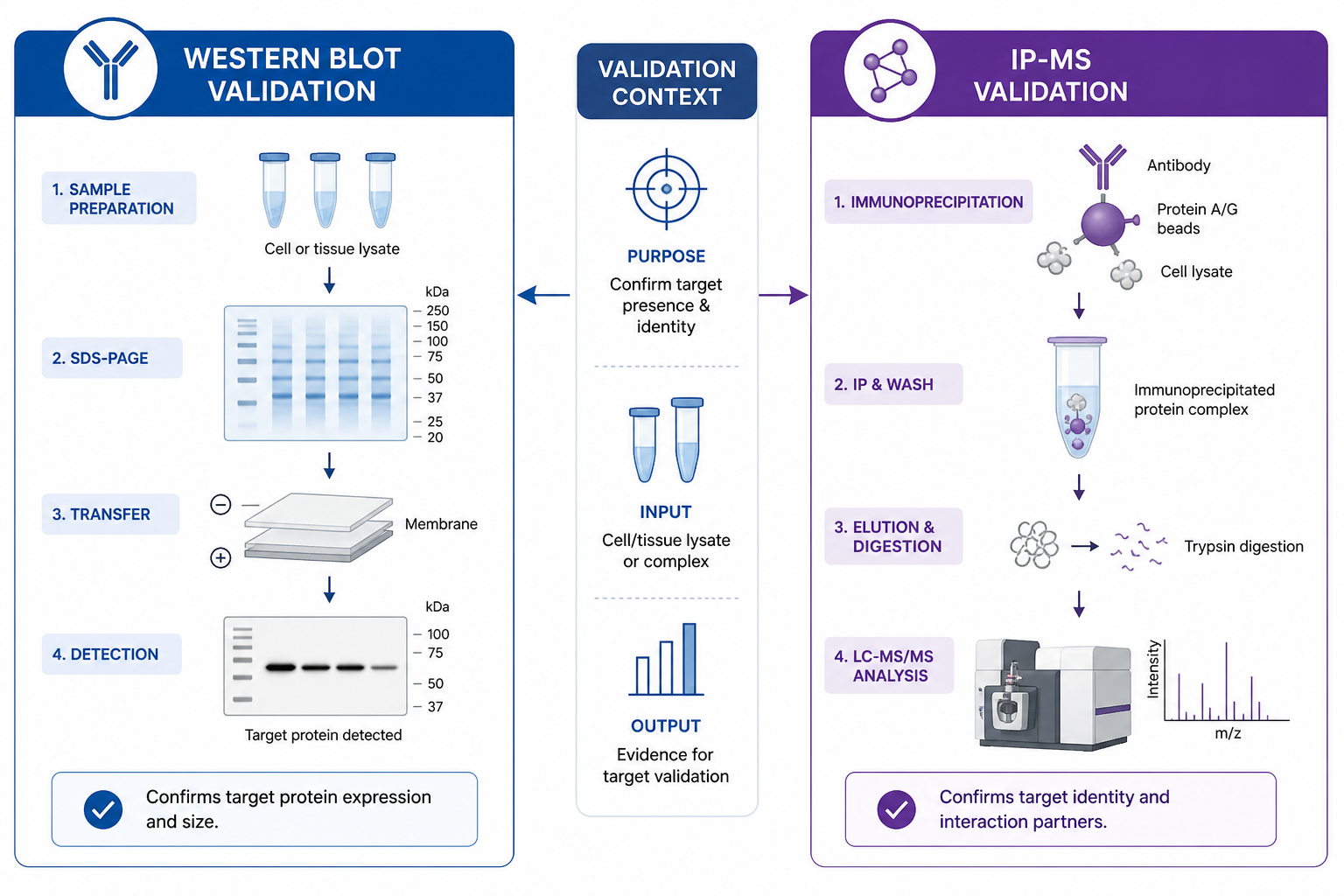
Figure 1. Western blot and IP-MS validation test different antibody performance under different assay conditions.
Why a Western Blot Antibody Often Fails in IP-MS
Several technical gaps explain the common WB-to-IP-MS failure pattern.
Epitope context changes after denaturation. Western blot exposes linear epitopes during gel electrophoresis. Immunoprecipitation requires binding in lysate, often while the protein retains secondary structure or exists in complexes.
Bead capture and wash stringency differ from membrane probing. An antibody may detect a protein on a blot yet bind too weakly, too briefly, or with too much off-target carryover during IP washes for MS.
Background becomes searchable in MS. A faint nonspecific band on a western blot may be ignorable. The same background in IP-MS can produce long candidate lists dominated by sticky proteins.
Species, isoform, and modification state may differ. Western blot success in one cell line does not confirm IP recovery in another matrix or for a modified bait isoform.
Supply and format may not fit replicate IP-MS. Even a specific antibody can underperform if host-isotype pairing, bead compatibility, or lot consistency is wrong for the planned scale.
Related Products
Related Services
IP-MS Protein Interactomics Analysis Service
Co Immunoprecipitation (Co-IP) Service
Affinity Purification-Mass Spectrometry Service
Pull Down based Protein Analysis Service with Mass Spectrometry
Protein-Protein Interaction Analysis Service
Frequently Asked Questions
1. Is an antibody that works for western blot automatically suitable for IP-MS?
No. Western blot tests detection after denaturation. IP-MS requires immunoprecipitation performance with MS-compatible enrichment quality.
2. What is the difference between IP-capable and IP-MS validated?
IP-capable usually means the antibody can support immunoprecipitation under stated conditions. IP-MS validated means enrichment performance was tested in a workflow relevant to mass spectrometry readout.
3. Do I need an IP-MS validated antibody for classical Co-IP with western detection?
Not necessarily. Classical Co-IP with targeted western readout may need an IP-capable antibody rather than IP-MS validation unless MS expansion is planned.
4. When should I choose AP-MS or pull-down-MS instead of IP-MS?
Consider AP-MS when tagging is acceptable and antibody performance is uncertain. Consider pull-down-MS when the question is direct or reconstituted binding with a recombinant bait.
5. How should I shortlist reagents before an IP-MS project?
Define the interaction question and readout first, then match application validation to that readout. Review IP-MS validated products when LC-MS/MS discovery is required, and review service options when workflow design still needs alignment.
Conclusion
Western blot antibodies and IP-MS antibodies are evaluated under different application conditions. Western blot validation supports detection on membrane. IP-MS validation supports bait enrichment with interpretable MS background in an immunoprecipitation workflow. Application validation matters because it aligns reagent choice with the actual readout—whether that is classical IP, Co-IP, IP-MS, or an alternative such as AP-MS or pull-down-MS.
Contact Mtoz Biolabs to review target context, validation evidence, and workflow fit before committing to an antibody-centered enrichment design or an alternative interaction service path.
How to order?




