






Identify Unknown Autoantibodies vs Mass Spectrometry: Method Selection and Research Use Cases
Quick Answer: Which Workflow Should You Choose?
If your immediate question is whether reactive serum contains an unknown autoantibody signal, start with an autoantibody-centered screening workflow. If your question is which molecular target is being recognized, mass spectrometry becomes more useful after enrichment or capture. If you have unexplained autoreactivity but no defined target, the most practical route is often a hybrid workflow: confirm reactivity, enrich the bound antigen or protein complex by immunocapture or immunoprecipitation, then use LC-MS/MS for antigen identification and follow with orthogonal validation.
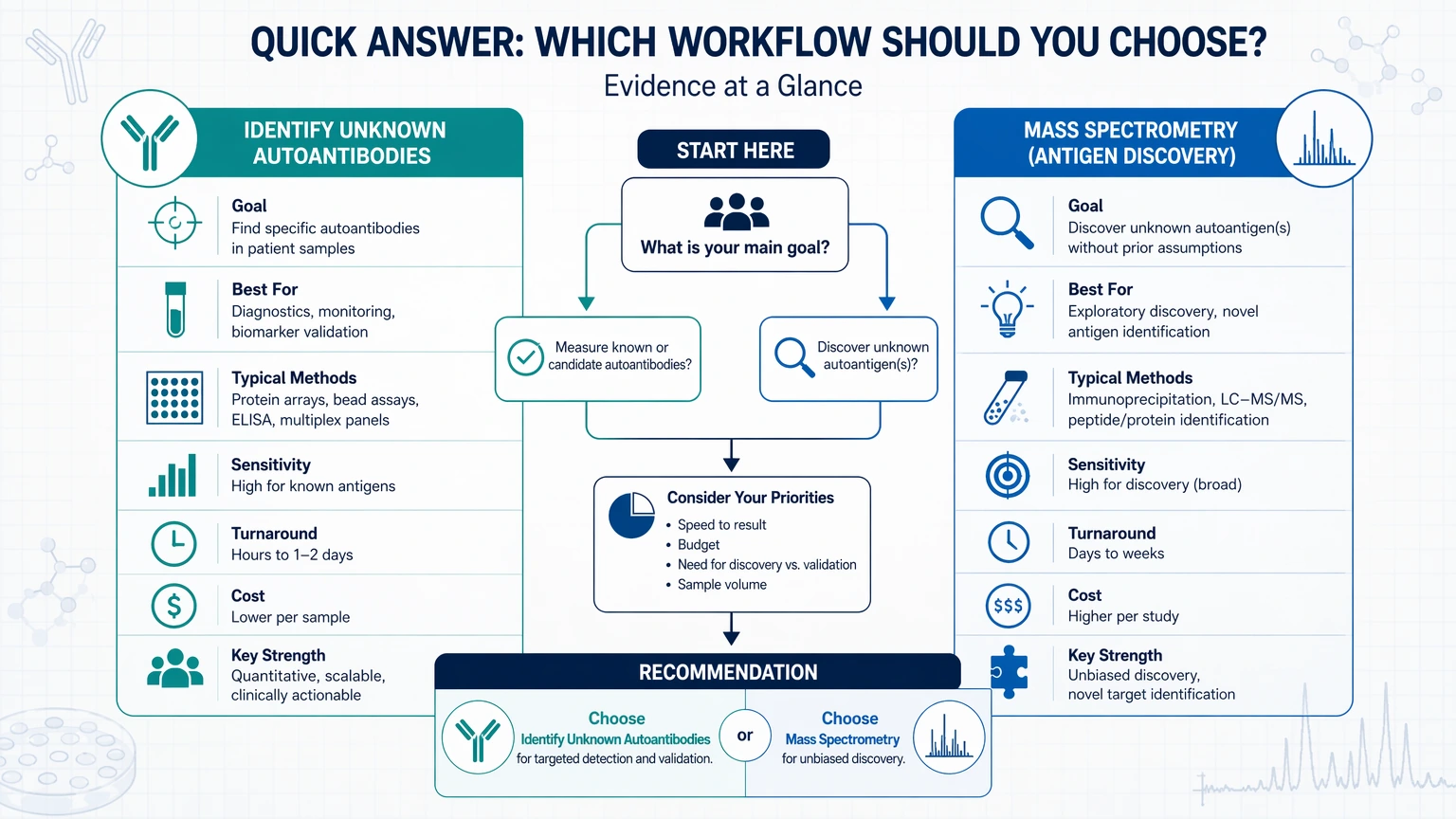
That distinction matters because 鈥渋dentify unknown autoantibodies鈥?is a research objective, not a single assay. In many studies, the real decision is not autoantibody workflow or mass spectrometry, but which step should come first and what evidence is needed before advancing to the next stage.
What 鈥淚dentify Unknown Autoantibodies鈥?Means in a Research Workflow
Researchers often use 鈥渋dentify unknown autoantibodies鈥?to describe several different tasks:
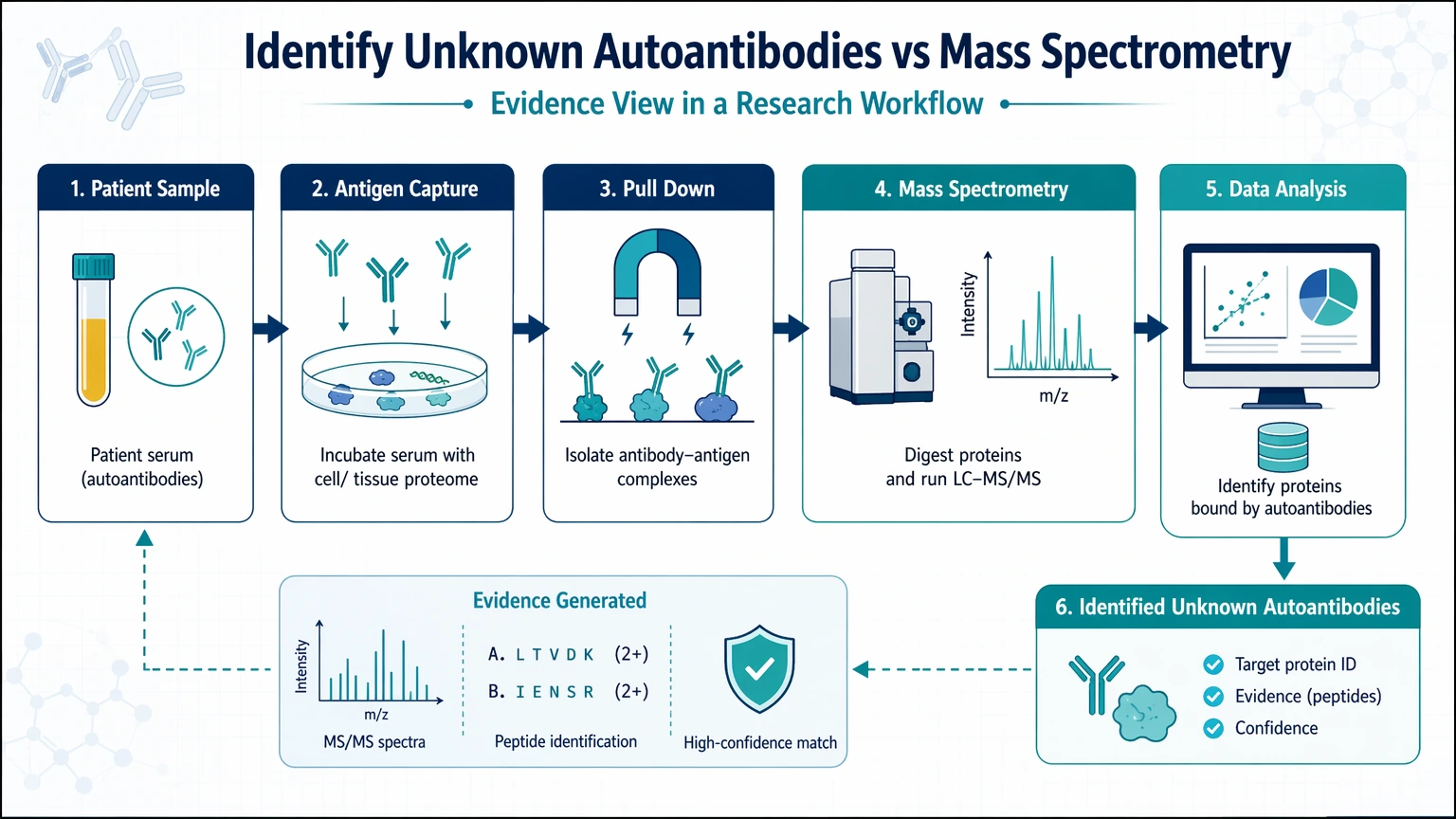
- detecting whether autoreactive binding is present
- defining the autoantigen recognized by that binding
- comparing reactivity patterns across samples or cohorts
- confirming whether a suspected candidate antigen is credible
These questions are related, but they do not produce the same type of evidence.
An immunology-led workflow usually starts from the autoantibody side of the interaction. The primary readout is binding, reactivity, or enrichment behavior. This approach is useful when you have reactive serum, plasma, or CSF and need evidence that a reproducible signal exists before investing in deeper target deconvolution.
A proteomics-led workflow usually starts from the protein side. The output is a list of proteins, peptides, and confidence-filtered identifications. That is useful when the project centers on peptide identification, protein inference, and narrowing a shortlist of likely antigens from a captured fraction, lysate, or isolated complex.
The operational difference is straightforward:
- Autoantibody-centered methods ask: is there specific autoreactivity?
- Mass spectrometry-centered methods ask: what proteins are present in the enriched material?
Projects often go off track when those two questions are treated as interchangeable.
How Mass Spectrometry Fits Into Unknown Autoantibody Studies
Mass spectrometry does not usually detect an unknown autoantibody directly from complex serum and then immediately return the relevant biological target. In most exploratory studies, MS enters the workflow after a capture step such as:
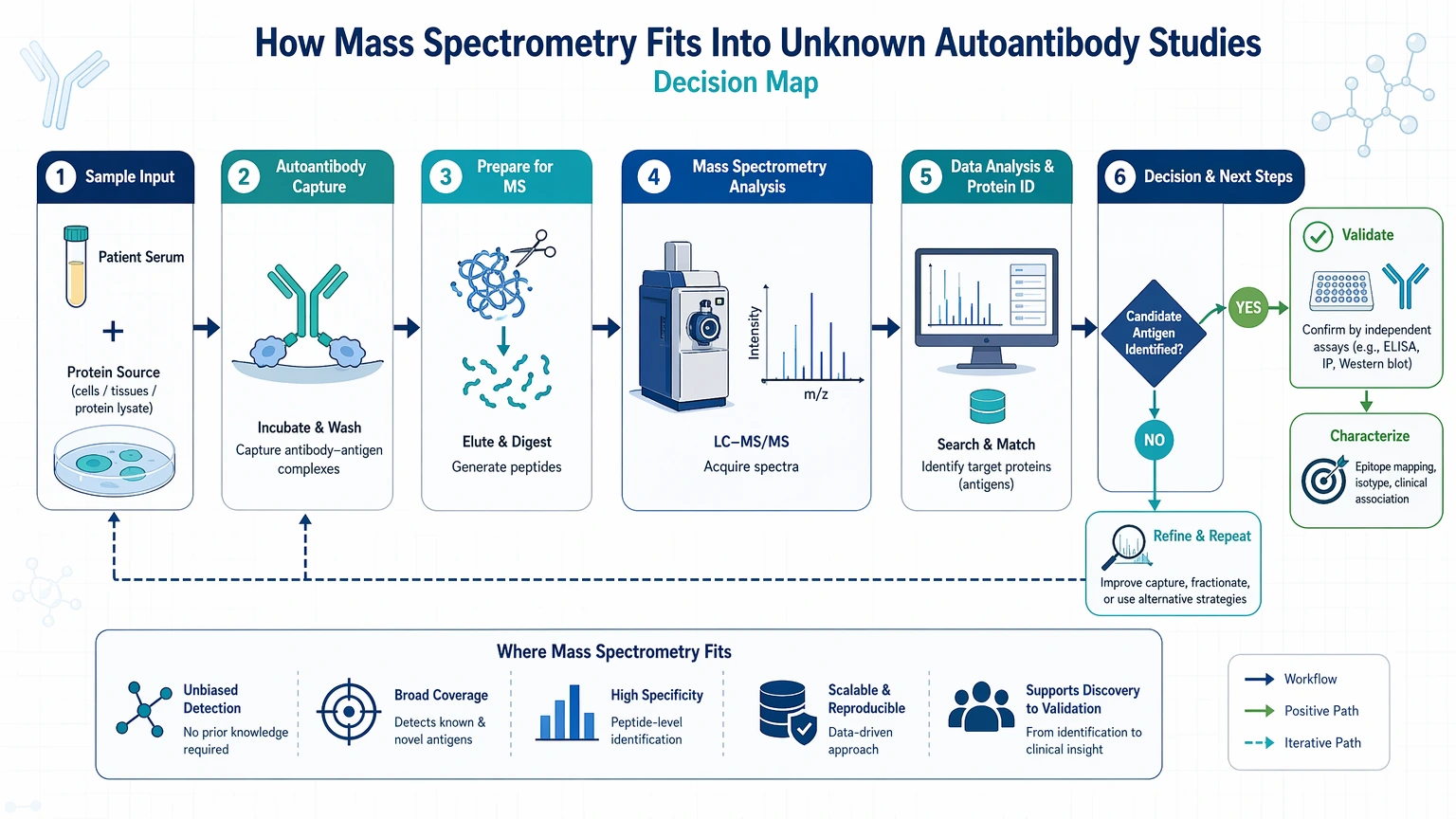
- immunoprecipitation
- immunocapture
- affinity enrichment
- subcellular or membrane fractionation
- pull-down of bound protein complexes
That enrichment step often determines whether the dataset is interpretable or dominated by background proteins.
In unknown autoantibody research, LC-MS/MS is typically used to identify proteins or peptides associated with antibody-bound material. Researchers then assess whether an identified protein is a plausible candidate antigen, whether a low-abundance protein may have been masked by abundant background, and whether a post-translational modification could explain selective recognition.
Mass spectrometry is most informative when the study needs:
- molecular identification rather than only reactivity confirmation
- comparison of captured proteins across controls and cases
- peptide-level evidence
- follow-up targeted analysis after discovery
- PTM-aware analysis when recognition may depend on modification state
MS alone, however, does not prove that an identified protein is the true autoantigen. It supports target deconvolution. Confirmation still depends on appropriate specificity controls and follow-up experiments.
Unknown Autoantibody Workflows vs Mass Spectrometry: Key Differences
The table below summarizes the main planning implications for the method choice.
| Comparison point | Autoantibody-centered discovery | Mass spectrometry-centered identification |
|---|---|---|
| Primary question | Is there specific autoreactivity? | What proteins are present in enriched material? |
| Typical input | Reactive serum, plasma, CSF | Enriched complexes, tissue or cell lysate, captured fractions |
| Main output | Reactivity profile, binding pattern, positive or negative signal | Protein ID list, peptide-spectrum evidence, candidate antigen shortlist |
| Best use | Early signal confirmation, cohort screening, hypothesis narrowing | Antigen identification, complex composition, comparative proteomic profiling |
| Dependence on enrichment | Sometimes moderate | Usually high for unknown-target work |
| Major limitation | May not reveal the molecular target | May detect bystanders, contaminants, or abundant background proteins |
| Control priorities | Healthy and disease controls, assay specificity control | Bead-only, isotype, no-antibody, and matched biological controls |
| Follow-up need | Often needs antigen-level confirmation | Usually needs orthogonal validation to confirm a true target |
Use these differences to align the analytical method with the biological question and validation plan.
The practical takeaway is simple: one workflow answers 鈥渄oes a signal exist?鈥?while the other answers 鈥渨hat may be present in the captured target pool?鈥?Those support different experimental decisions and different outsourcing plans.
When to Start With Immunology-Based Screening
Start with an immunology-based route when your uncertainty is mainly about signal existence or sample selection, not protein identity.
This is usually the better first step when:
- you have serum with unexplained binding from a screening assay
- the target is completely unknown and sample volume is limited
- you need to rank samples before committing to enrichment and LC-MS/MS
- you want to compare reactivity across a cohort
- you suspect weak or heterogeneous autoreactivity
In this setting, the main value is triage. Screening can show which samples are worth taking into immunoprecipitation or immunocapture, whether matched controls show similar background, and whether the project has enough contrast for a discovery-stage proteomics experiment.
It is also useful when the biological matrix is difficult. Serum contains highly abundant proteins and polyclonal antibodies that can overwhelm downstream analysis if the initial signal is poorly defined. A staged screening step helps avoid spending MS effort on samples that do not show reproducible enrichment behavior.
What screening cannot do on its own is provide confident antigen identification. If the core deliverable is a named protein target, screening is not the endpoint.
When to Start With Mass Spectrometry-Based Identification
Start with MS earlier when the project already has a workable enrichment strategy and the main gap is molecular identity.
That is often appropriate when:
- the sample has already been pre-enriched or immunoprecipitated successfully
- you have a strong biological rationale for a target class or cellular compartment
- one or a few samples matter more than broad cohort screening
- you need peptide-level evidence for a candidate antigen
- you suspect that multiple interacting proteins or modified forms may be relevant
For example, if reactive serum consistently pulls down a specific cellular fraction, a proteomics-first route may be the fastest way to reduce a large unknown to a shortlist. The same logic applies when a tissue lysate or cell lysate can serve as bait material and the project goal is protein inference from bound complexes.
This route still requires caution. Discovery MS often returns abundant structural, cytoskeletal, chaperone, or otherwise sticky proteins that were captured nonspecifically. Without strong controls, the resulting protein list may look informative while offering little support for the true autoantigen.
Use MS first only when your project can support:
- a realistic enrichment plan
- appropriate specificity control samples
- enough input material for informative LC-MS/MS
- a path to orthogonal confirmation
When a Hybrid Workflow Is the Better Choice
A hybrid strategy is often the most useful option for unknown autoantibody studies because it separates the project into evidence-building stages.
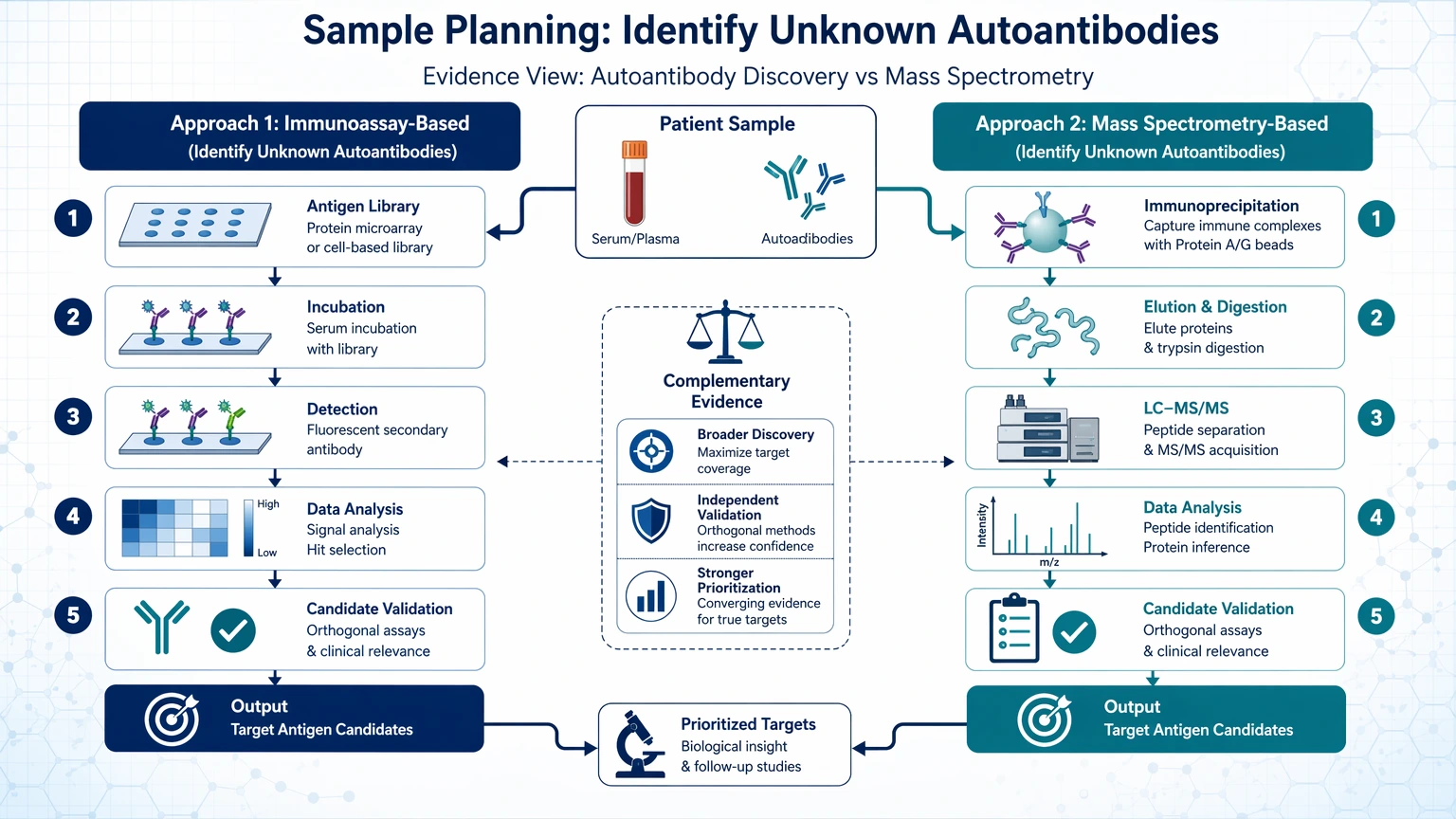
A common sequence looks like this:
1. Confirm reproducible autoreactivity in selected samples. 2. Define the most suitable matrix or source material for capture. 3. Perform immunocapture, affinity enrichment, or immunoprecipitation with matched controls. 4. Analyze enriched material by LC-MS/MS. 5. Rank candidate proteins using peptide evidence, background subtraction, and biological plausibility. 6. Confirm leading hits with orthogonal validation.
This staged design answers three questions in order:
- Is the serum actually reactive?
- Can that reactivity enrich a distinct target pool?
- Which identified proteins remain plausible after control filtering?
It also makes project planning more concrete for outsourced studies. Instead of asking a provider to 鈥渋dentify an unknown autoantibody鈥?in one step, you can define milestones: signal confirmation, capture feasibility, discovery MS, and validation of shortlisted antigens.
If you are comparing providers and want to evaluate your project before committing to a full discovery campaign, MtoZ Biolabs can help map sample type, controls, and downstream analysis choices to a non-clinical target identification workflow.
Sample, Control, and Data Requirements Before Selecting a Service
For this type of study, service fit often depends more on sample and control design than on platform labels.
Sample Planning
Relevant inputs may include:
- serum or plasma from reactive cases
- healthy or disease comparator serum
- CSF for neurologic or compartment-specific questions
- tissue lysate or cell lysate as an antigen source
- immunoprecipitated complexes or enriched fractions
Before selecting a workflow, clarify whether your project is built around:
- unknown target discovery
- one suspected antigen class
- comparison across multiple samples
- follow-up confirmation of a predefined hit
Control Design
Controls should match the failure mode you want to rule out. Depending on the workflow, that may include:
- healthy control serum
- disease control serum
- bead-only control
- isotype control
- no-antibody control
A proper specificity control is especially important when working with sticky matrices, membrane fractions, or low-signal pull-downs.
Data Expectations
Ask what the deliverable will actually contain. In exploratory research use only settings, a useful report may include:
- protein groups and unique peptides
- confidence filters used for identification
- comparative abundance or enrichment context
- notes on ambiguous protein inference
- annotation relevant to localization, pathway, or antigen plausibility
- options for targeted follow-up
What you should not expect is a protein name automatically translated into a confirmed disease-relevant autoantigen. Discovery outputs are candidate-driven and need validation.
Common Technical Pressure Points
Frequent bottlenecks include:
- low recovery during enrichment
- interference from abundant serum proteins
- poor reproducibility across pull-down replicates
- hidden targets that are low-abundance proteins
- antigens recognized only in a specific conformational or modified state
- missed biology caused by a relevant post-translational modification
These issues should be addressed before method selection, not after data delivery.
How to Choose a Provider for Autoantibody Target Identification Research
When comparing service options, focus less on generic platform language and more on workflow logic.
Useful questions include:
- Can the provider separate reactivity screening from antigen identification?
- Do they support immunocapture or pull-down design rather than only running LC-MS/MS?
- How do they handle background controls and contaminant filtering?
- Can they report peptide-level evidence clearly enough to support candidate ranking?
- Is there a realistic path to orthogonal follow-up, such as targeted proteomics or immunoassay-based confirmation?
- Do they scope the work as exploratory research use only, without diagnostic claims?
A strong provider fit usually means the team can explain what each stage can conclude, what it cannot conclude, and what sample design would make the next stage easier to interpret.
If your team is comparing options for autoantigen discovery mass spectrometry or a staged autoantibody target identification workflow, ask MtoZ Biolabs to review sample compatibility, enrichment strategy, and reporting depth before you choose a provider.
Service Routes for Study Planning
For teams moving from method selection into execution, these service paths connect assay design, validation, and interpretation needs.
Conclusion
For identify unknown autoantibodies vs mass spectrometry, the right choice depends on where uncertainty sits in the research chain. Use an autoantibody-centered workflow when you first need to establish specific autoreactivity. Use a mass spectrometry-centered workflow when enriched material is available and the next question is molecular target assignment. Use a hybrid workflow when you need to move from reactive serum to a defensible candidate antigen list with follow-up confirmation.
The main limitation of screening-only workflows is that they may stop short of antigen identity. The main limitation of MS-only workflows is that identified proteins may reflect background or associated binders rather than the true target. A staged design reduces both risks by linking signal confirmation, enrichment, LC-MS/MS, and orthogonal validation in a single research plan.
For non-clinical autoantibody target identification studies, contact MtoZ Biolabs to scope sample inputs, controls, enrichment, and follow-up analysis before you lock the workflow.
FAQ
Are 鈥渦nknown autoantibody identification鈥?and 鈥渁utoantigen identification鈥?the same thing?
No. Unknown autoantibody identification can refer to detecting or characterizing autoreactive binding, while autoantigen identification asks which protein target that binding recognizes. The first question is often addressed by screening or capture behavior; the second usually requires enrichment plus protein-level analysis such as LC-MS/MS.
What makes a discovery-MS hit more convincing as a candidate antigen?
A stronger candidate antigen usually shows several features at once: reproducible enrichment relative to controls, peptide evidence that survives filtering, consistency with the source material, and a plausible biological link to the observed reactivity. Follow-up testing still matters because discovery data alone do not establish target specificity.
Why can reactive serum produce a long protein list but no clear autoantigen?
This usually happens when capture conditions enrich abundant background proteins, nonspecific binders, or proteins from associated complexes rather than the true target. Weak antibody affinity, low antigen abundance, disrupted conformational epitopes, and matrix interference can all reduce contrast between real signal and background.
When is targeted proteomics a better follow-up than another discovery run?
Targeted proteomics is more useful after discovery has already narrowed the field to a manageable shortlist. At that stage, the goal is no longer broad target deconvolution; it is focused confirmation across samples, replicates, or experimental conditions.
Do matched disease controls add value if healthy controls are already included?
Often yes. Healthy controls help define baseline nonspecific binding, but disease controls can reveal whether the observed pattern is unique to your study set or common across inflammatory backgrounds. That distinction can change how you prioritize candidate antigens for validation.
What should a team send before asking MtoZ Biolabs to scope an unknown autoantibody study?
Prepare a short project brief with sample type, cohort structure, available controls, expected antigen source, and the exact decision you need the data to support. That gives MtoZ Biolabs enough context to recommend whether screening, enrichment plus LC-MS/MS, or a hybrid workflow is the better starting point.
How to order?




