






Hybridoma Sequencing vs Antibody Protein Sequencing: Which Method Is More Suitable?
Introduction
Antibody sequence recovery projects often reach a fork in the road. A team may have a functional monoclonal antibody, but the available material may be hybridoma cells, RNA, purified IgG, or only a partial historical record. Hybridoma sequencing recovers VH and VL from hybridoma- derived nucleic acids. Antibody protein sequencing recovers sequence information from purified antibody protein, usually through LC-MS/MS and peptide assembly. Both routes can support clone rescue, recombinant planning, and documentation, but they are not interchangeable.
The wrong choice can waste limited sample and still leave the project without a sequence suitable for vector design or QC review. Hybridoma sequencing is efficient when viable cells or quality RNA remain, but it cannot proceed after cell loss. Antibody protein sequencing works from purified IgG, but it requires more MS interpretation and depends on sample purity and coverage. The more suitable method is therefore the one that matches the material available, the evidence standard required, and the downstream use of the recovered sequence.
Related Services
| Service Area | Recommended Service |
| Hybridoma sequencing | Hybridoma Antibody Sequencing Service |
| PCR-based antibody sequencing | PCR Based Antibody Sequencing Service |
| Antibody protein sequencing | De Novo Antibody Sequencing Service |
| MS-based antibody sequencing | Mass Spectrometry Based Antibody Sequencing Service |
| Full antibody sequencing | Antibody Sequencing Service |
| Protein-level confirmation | Peptide Mapping Service |
Researchers comparing hybridoma sequencing and antibody protein sequencing can consult MtoZ Biolabs to review sample availability, VH/VL coverage needs, and reporting goals before choosing a workflow.
When Researchers Face This Decision
This comparison usually appears when a monoclonal antibody exists, but the sequence record is missing or uncertain. Common scenarios include hybridoma bank failure, declining productivity, loss of expression plasmids, legacy purified IgG with no genetic backup, or a need to verify that a recombinant product matches an intended design.
In each case, the practical question is whether the project should begin from genetic material in the producing hybridoma or from the antibody protein itself. Answering that question before sample submission prevents method mismatch and reduces rework.
Typical decision scenarios include:
1. Viable hybridoma cells or RNA remain: Cell-based recovery is usually the first option to evaluate.
2. Only purified antibody remains: Protein-level sequencing becomes the primary viable route.
3. Hybridoma rescue with incomplete records: Material type and metadata quality determine which route is feasible.
4. Documentation or comparability is required: The required evidence level may favor one route, a hybrid workflow, or orthogonal confirmation.
Four Comparison Dimensions That Matter Most
A useful comparison should focus on decision variables rather than generic platform preference.
1. Starting Material
Hybridoma sequencing depends on hybridoma cells, RNA, or cDNA. Antibody protein sequencing depends on purified IgG or another antibody preparation with acceptable purity and amount.
2. Evidence Type
Hybridoma sequencing provides transcript-level VH/VL recovery from amplifiable immunoglobulin templates. Antibody protein sequencing provides protein-level sequence evidence assembled from peptides.
3. Workflow Efficiency
Hybridoma sequencing is often faster when cell health and RNA quality are good. Antibody protein sequencing may require more digestion, LC-MS/MS depth, and expert assembly time.
4. Rescue Value after Material Loss
Hybridoma sequencing has high rescue value while cells remain accessible. Antibody protein sequencing becomes essential when genetic material is gone but purified antibody still exists.
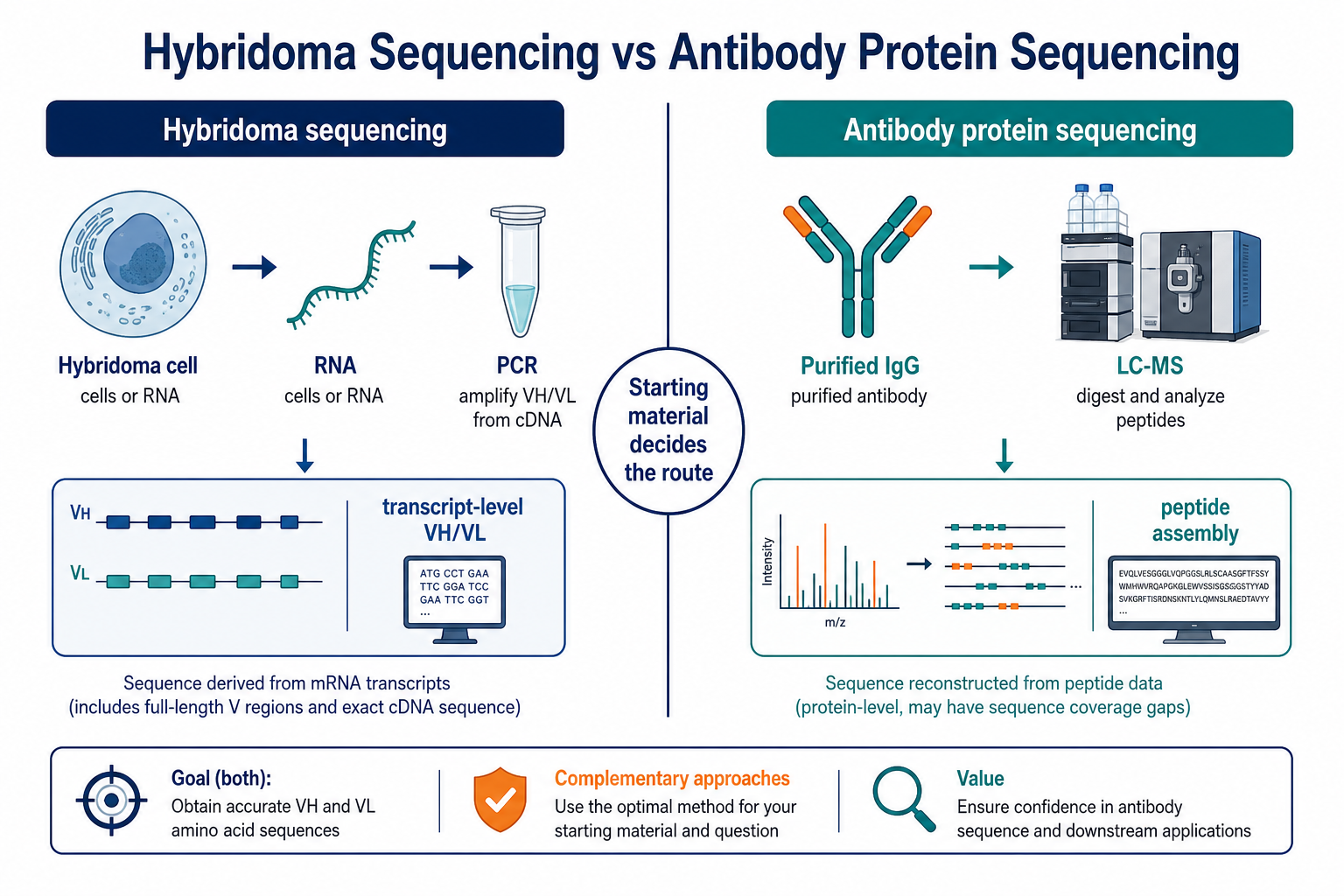
Figure 1. Hybridoma sequencing begins from cells or RNA, while antibody protein sequencing begins from purified antibody and LC-MS/MS peptide evidence.
How Hybridoma Sequencing Works
Hybridoma sequencing uses viable hybridoma cells or high-quality RNA as input. Immunoglobulin transcripts are converted to cDNA, variable regions are amplified by PCR, and VH and VL sequences are assembled with CDR annotation.
The route is straightforward when cells are healthy, monoclonality is acceptable, and species or isotype metadata are accurate. It is often the most efficient first step for clone backup, hybridoma rescue, and recombinant vector design while genetic material remains accessible.
The main weakness is dependence on cell viability, RNA integrity, primer design, and monoclonality. Once hybridoma cells and usable RNA are gone, this route cannot proceed without an alternative sample type.
How Antibody Protein Sequencing Works
Antibody protein sequencing, often implemented as de novo antibody sequencing, uses purified IgG as input. The antibody is digested into peptides, LC-MS/MS spectra are acquired, and VH and VL regions are reconstructed through overlapping peptide evidence and expert assembly.
This route is valuable when hybridoma stocks are lost, productivity has declined beyond practical cell-based recovery, or only legacy purified material remains. It provides direct evidence from the antibody molecule itself rather than from the producing cells.
The main weakness is dependence on antibody purity, sample amount, peptide coverage, and interpretation complexity. It is usually not the best first choice when healthy hybridoma RNA is still easily available unless timing or material constraints favor immediate protein-level analysis.
Side-by-Side Comparison
The principles above explain why sample type should come before method preference. The table below adds practical differences in output type, rescue value, and reporting depth.
| Dimension | Hybridoma Sequencing | Antibody Protein Sequencing |
| Starting material | Hybridoma cells, RNA, or cDNA | Purified IgG or antibody preparation |
| Reference required | No | No |
| Evidence type | Transcript-level VH/VL | Protein-level peptide assembly |
| Best when cells remain | Strong fit | Usually unnecessary as first step |
| Best after cell loss | Not feasible without nucleic acid source | Strong fit |
| Typical turnaround | Often faster with healthy cells | Often longer due to MS workflow |
| Typical deliverable | Annotated VH/VL from PCR | Assembled VH/VL from peptides |
| Main strength | Efficient genetic recovery | Works without genetic source |
| Main limitation | Fails after cell or RNA loss | Depends on purity, amount, and coverage |
| Rescue value | High while material remains | High when only protein remains |
| Orthogonal confirmation | Protein-level check optional | Genetic record comparison optional |
This comparison shows why neither method is universally more suitable. The better route follows the sample available and the evidence level required.
Which Approach Fits Different Study Goals
Choose hybridoma sequencing when viable hybridoma cells or high-quality RNA are available, the goal is efficient VH/VL recovery, and the project focuses on clone backup, hybridoma rescue, or recombinant planning from transcript-level evidence.
Choose antibody protein sequencing when hybridoma cells are no longer available, purified monoclonal antibody remains in usable form, protein-level primary structure evidence is required, or legacy IgG must be recovered without genetic source material.
Consider a hybrid workflow when both cell material and purified antibody are available and the project requires orthogonal support for high-value expression, documentation, or comparability decisions.
Use peptide mapping separately when a trusted reference sequence already exists and the goal is confirmation rather than initial VH/VL discovery.
Researchers should also define whether variable-region recovery alone is sufficient or whether broader chain coverage, CDR annotation detail, and validation depth must be included in the final report.
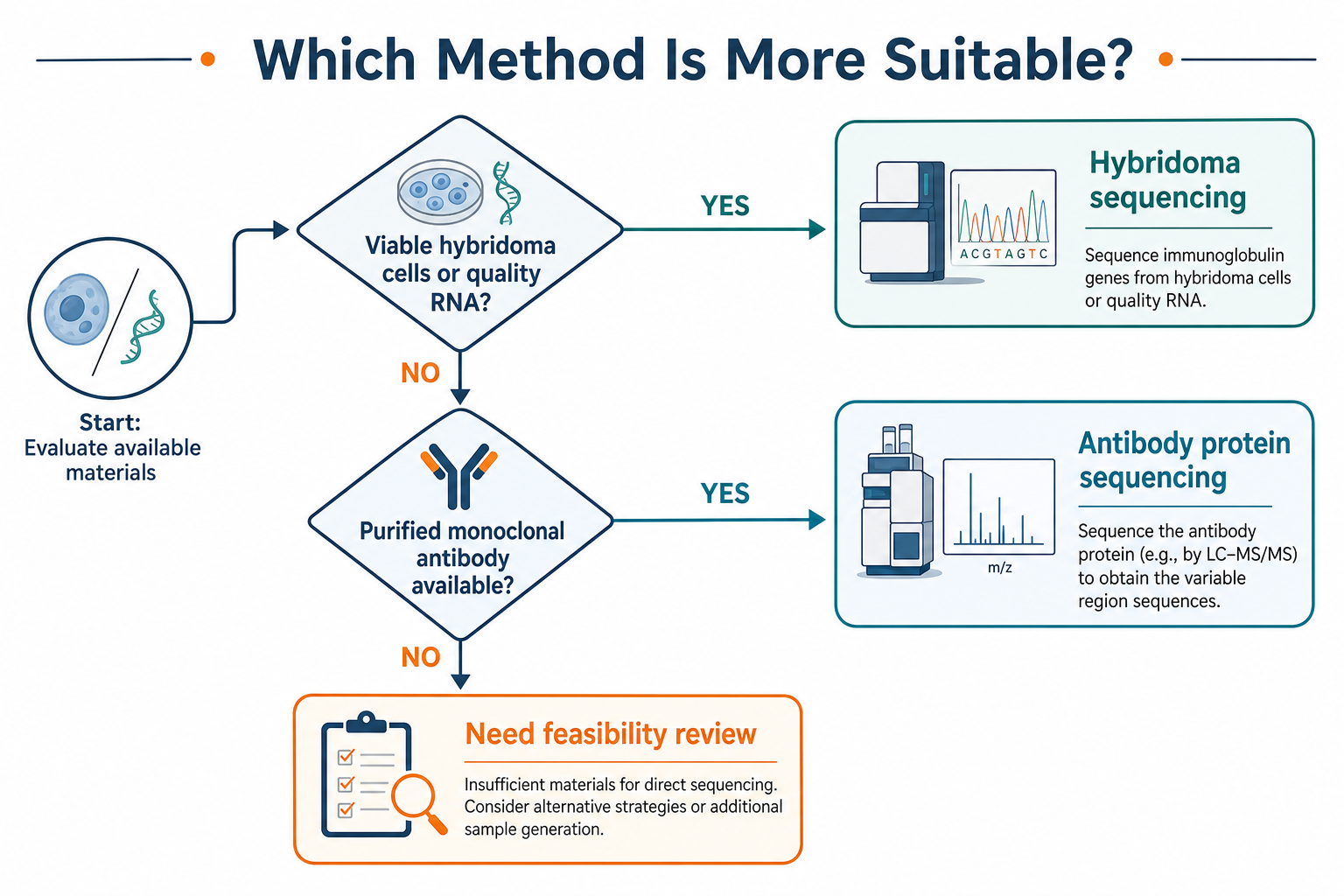
Figure 2. Viable hybridoma material favors hybridoma sequencing; purified antibody availability favors antibody protein sequencing.
Decision Recommendations by Project Type
The decision tree above provides a quick route selection logic. The table below adds project- specific guidance for teams that already know their primary goal.
| Project Type | More Suitable First Approach | Why |
| Healthy hybridoma bank still available | Hybridoma sequencing | Faster genetic recovery while cells are accessible |
| RNA available but cells are limited | Hybridoma sequencing or PCR-based recovery | Genetic route remains efficient when template quality is good |
| Hybridoma lost but purified IgG remains | Antibody protein sequencing | Only viable route without nucleic acid source |
| Legacy antibody with no records | Antibody protein sequencing | Protein-level recovery does not require genetic archive |
| Recombinant expression planning from live hybridoma | Hybridoma sequencing | Transcript-level VH/VL supports vector design efficiently |
| High-value rescue with both sample types | Hybrid workflow | Genetic recovery plus protein- level confirmation |
| QC against known reference sequence | Peptide mapping, not initial discovery | Confirmation differs from unknown sequence recovery |
These recommendations are starting points. Metadata quality, monoclonality, antibody purity, and reporting urgency can shift the final plan.
Hybrid Workflows and Fallback Planning
A strict either-or decision is not always necessary. Strong antibody programs often plan a fallback before material is lost.
A practical sequence continuity plan may look like this:
1. Recover VH/VL by hybridoma sequencing while cells or RNA are still healthy.
2. Store purified IgG from the same clone when possible.
3. If genetic recovery fails later, move to antibody protein sequencing from stored IgG.
4. Use peptide mapping only when a reference sequence is already established.
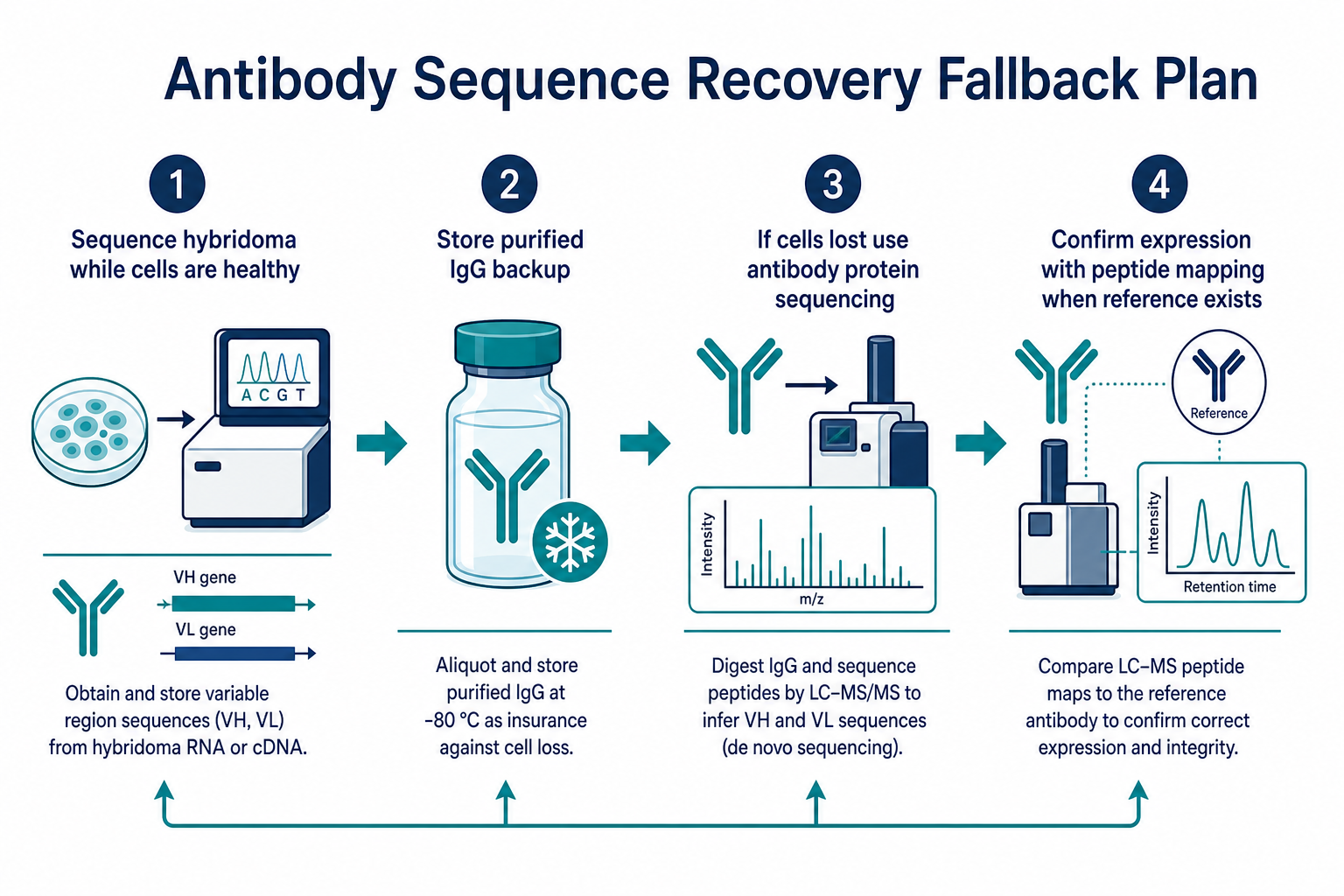
Figure 3. A practical fallback plan archives genetic sequence early and reserves antibody protein sequencing if hybridoma material is lost later.
Some projects also combine routes in one study. Hybridoma sequencing can provide transcript- level VH/VL evidence, while antibody protein sequencing can confirm expressed products or resolve ambiguity in difficult variable regions. The best design depends on material availability and the evidence standard required for the next decision.
Limitations to Keep in Mind
Hybridoma sequencing depends on genetic material quality. Poor viability, degraded RNA, mixed clones, or incorrect species and isotype assumptions can reduce success even when antibody secretion continues at low levels.
Antibody protein sequencing depends on antibody purity, sample amount, digestion coverage, and expert MS interpretation. It is not automatically more suitable simply because it works without cells. A slower protein-level route may still be the only viable option after cell loss.
Researchers should also avoid comparing methods only by turnaround time. A faster genetic route is not better if cells are no longer available. A more complex protein-level route may still be the only rescue path when purified antibody remains.
Neither method automatically proves binding activity, developability, or full-chain coverage unless those deliverables are scoped in advance.
Practical Selection Checklist
Before choosing between hybridoma sequencing and antibody protein sequencing, answer these questions:
1. Are viable hybridoma cells or high-quality RNA still available?
2. Is purified monoclonal antibody available if genetic routes fail?
3. Does the project require unknown VH/VL recovery or reference-backed confirmation?
4. Is the goal clone rescue, expression design, documentation, or QC comparability?
5. Is VH/VL coverage enough, or is broader reporting required?
6. Does the project need orthogonal confirmation from a second route?
If genetic material is available and healthy, hybridoma sequencing is usually the more suitable first step. If only purified antibody remains, antibody protein sequencing should be planned from the start.
Frequently Asked Questions
1. Is hybridoma sequencing always more suitable when cells exist?
Usually yes, when cell health and RNA quality are acceptable. Antibody protein sequencing becomes more suitable when hybridoma material is too degraded, unavailable, or unsuitable for reliable PCR recovery.
2. Is antibody protein sequencing better for rescue projects?
It is the better rescue route when hybridoma cells and usable RNA are gone but purified IgG remains. Hybridoma sequencing remains preferable while viable genetic material is still accessible.
3. Can both methods be used in one project?
Yes. Some teams recover VH/VL by hybridoma sequencing and confirm expressed products or resolve ambiguity by antibody protein sequencing.
4. Does hybridoma sequencing provide the same evidence as protein sequencing?
Not exactly. Hybridoma sequencing provides transcript-level evidence from the producing cells. Antibody protein sequencing provides evidence from the antibody molecule itself. Both can support VH/VL recovery, but the evidence source differs.
5. How can teams avoid wasting limited sample?
Define available material first, match the method to that material, and request a feasibility review before submission.
Conclusion
Hybridoma sequencing and antibody protein sequencing answer the same broad need from different starting materials. Hybridoma sequencing is usually more suitable when viable hybridoma cells or quality RNA remain available. Antibody protein sequencing is more suitable when hybridoma stocks are gone but purified monoclonal antibody remains. The strongest decision process matches method to material, defines VH/VL coverage needs early, and plans a fallback before genetic resources are lost. Researchers comparing these routes for rescue, redevelopment, or documentation can contact MtoZ Biolabs to select the workflow best aligned with sample availability and project goals.
How to order?




