






How to Evaluate an Antibody Sequencing Service for Legacy Antibodies and Undocumented Clones
Send a legacy antibody or undocumented clone to an antibody sequencing service only when the provider can answer three questions before any scarce material is used: which recovery route fits the sample, how heavy chain and light chain assignment will be handled, and what final deliverable will be usable for verification or recombinant re-expression. If a vendor cannot clearly distinguish a hybridoma workflow from a purified antibody workflow, that is already a warning sign.
For most teams, the decision comes down to three practical points: what material is still available, what level of sequence recovery is actually needed, and how much evidence the provider can provide for VH and VL recovery. A useful result is not just a raw sequence. It is a documented sequence recovery package with chain identity, confidence annotation, CDR and framework region context, and a stated plan for orthogonal validation.
Why Legacy Antibody Projects Need a Different Evaluation Standard
A routine sequencing request often starts with a well-tracked monoclonal reagent. A legacy project usually does not. Labels may show a clone nickname, a target shorthand, or an old project code, while the original clone identity, isotype, and expression history are missing, incomplete, or uncertain. That changes the buying decision.
The main risk is not just technical failure. It is spending irreplaceable material on a workflow that cannot give you an answer you can actually use. A frozen hybridoma may no longer yield recoverable nucleic acid. An archived purified antibody may still bind its target, but its storage buffer or limited remaining volume can complicate LC-MS/MS work. An inherited archived reagent may even represent more than one underlying clone.
That is why a legacy antibody project should be evaluated for fit, not just platform access. The real question is whether the provider can recover a usable variable region result and report it in a form that supports clone continuity, confirmation work, and possible recombinant re-expression.
The Four Evaluation Questions That Matter Most
For this decision, four technical categories usually matter more than broad platform descriptions.
1. What starting material do you actually have?
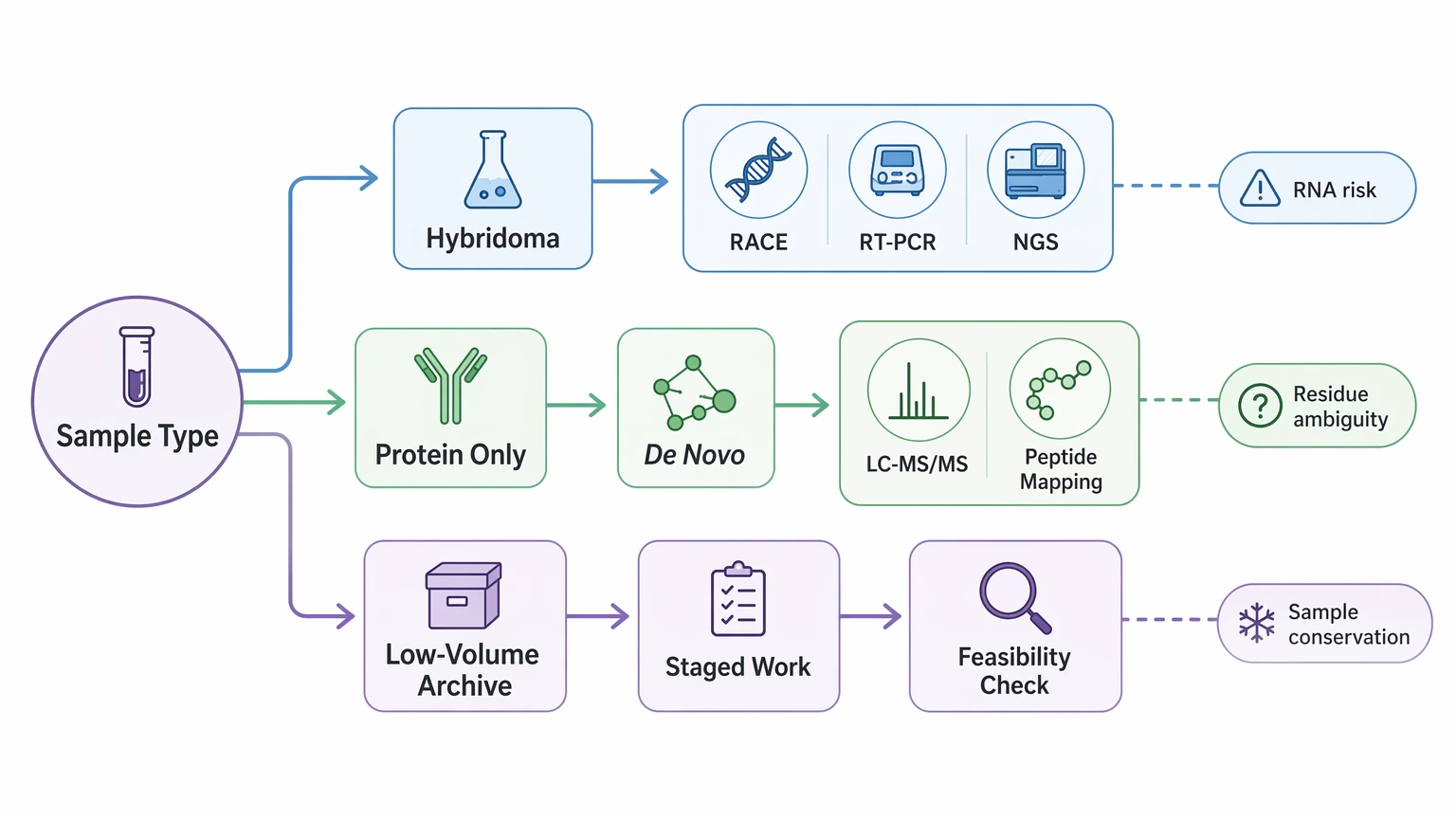
The sample type sets the first limit on method choice. Viable or partly recoverable hybridoma material may support RACE, RT-PCR, or NGS. A protein-only sample points toward de novo sequencing with LC-MS/MS and peptide mapping. A low-volume archived vial may call for staged work so feasibility is checked before deeper sample use.
2. How high is the chain pairing risk?
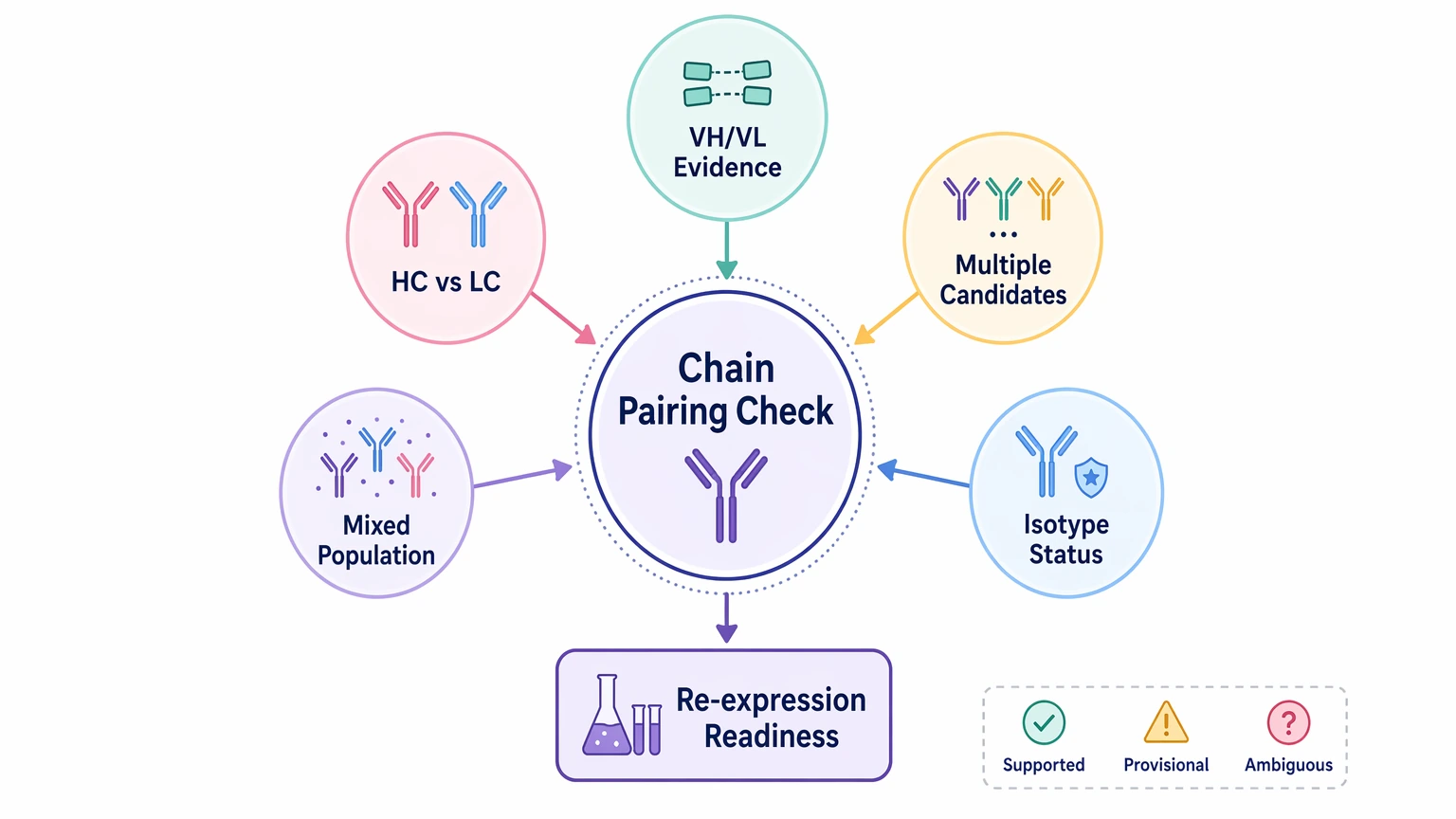
An undocumented clone is not automatically a single clean source. Mixed cell populations, mislabeled tubes, or unstable cultures can produce multiple chain candidates. If the project needs re-expression, the service should explain how it will support chain pairing, not just how it will generate candidate sequences.
3. Will the deliverable be useful outside the report itself?
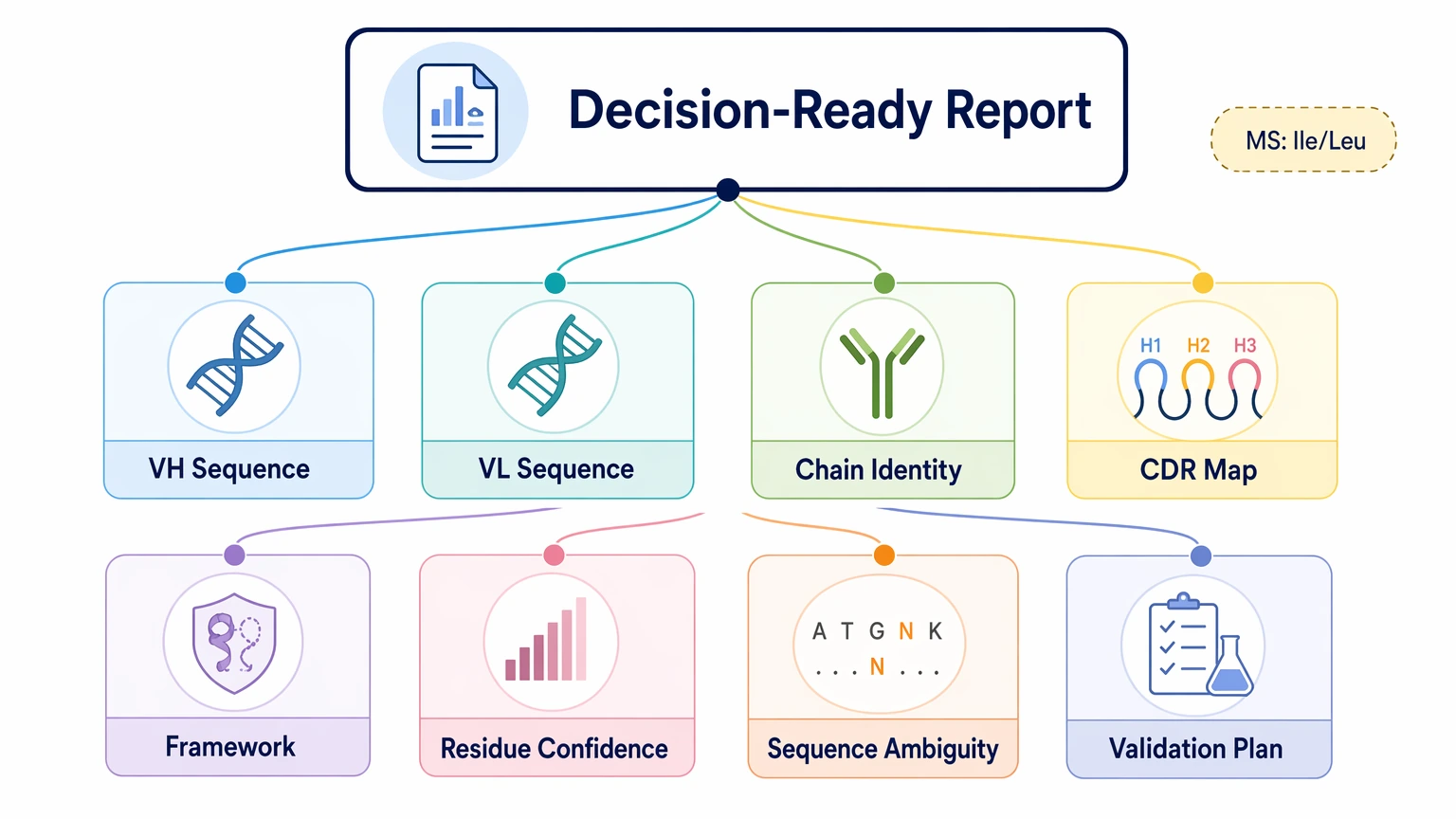
A sequence report can look polished and still fall short in practice. If it does not include CDR boundaries, framework region annotation, residue-level confidence, or explicit heavy chain/light chain assignment, the team may still struggle to design confirmation studies or expression constructs.
4. How will the provider control sample risk?
For scarce material, workflow planning is part of technical quality. A credible provider should be able to describe pre-assessment logic, staged sample use, and decision points for stopping when confidence is too low.
A Project-Planning Framework for Vendor Evaluation
This topic fits a project-planning structure better than a generic sequencing overview. Use the steps below before you commit the last remaining vial.
Step 1: Define the minimum useful outcome
Start with the endpoint, not the platform. Clarify whether you need:
- variable region recovery only
- paired heavy chain and light chain
- support for legacy clone identity review
- sequence files suitable for recombinant re-expression
- a sequence proposal plus planned orthogonal validation
This step keeps vendor discussions grounded. A team that only needs continuity screening may accept a narrower output than one preparing construct design.
Step 2: Match sample type to workflow logic
Ask the provider to describe method fit in direct terms.
| Starting material | Likely route | Main technical concern | Best screening question |
|---|---|---|---|
| Viable hybridoma cells | RACE, RT-PCR, NGS | mixed clone risk | How do you recover and assign paired coding information from cells? |
| Aged pellet or uncertain cell stock | RT-PCR or NGS if recoverable | RNA degradation | What pre-assessment is done before deeper work starts? |
| Purified antibody | LC-MS/MS, peptide mapping, de novo sequencing | residue ambiguity | How are uncertain residues and chain assignments reported? |
| Low-volume archived reagent | staged low-input workflow | sample consumption | What stop/go checkpoints protect the remaining material? |
A provider that gives essentially the same answer for every sample type is not looking at your project carefully enough.
Step 3: Ask for evidence behind chain assignment
For undocumented materials, chain pairing is often the most important technical checkpoint. Ask how the service will handle:
- explicit heavy chain versus light chain assignment
- evidence supporting proposed VH and VL
- more than one chain candidate
- mixed populations or ambiguous chain recovery
- whether isotype is inferred, experimentally supported, or left unresolved
The strongest answer is not absolute certainty. It is a clear explanation of what the evidence supports and where the interpretation is still provisional.
Step 4: Review the reporting structure before the project starts
Do not wait for the final report to find out that the output is too thin. Ask for a sample report or a written deliverable outline.
A decision-ready report should usually include:
- proposed VH and VL sequences
- clear chain identity statements
- CDR and framework region annotation
- confidence annotation for residue calls
- explicit notes on sequence ambiguity
- discussion of isoleucine/leucine ambiguity where relevant in MS-based work
- file formats that can support construct design or further review
- recommended next steps for orthogonal validation
If the goal includes recombinant recovery, the provider should also explain how the output will support design review instead of leaving you with an isolated sequence string.
Step 5: Check whether orthogonal confirmation is built into the plan
No single workflow proves every aspect of identity for every legacy sample. Cell-based recovery may still run into clone instability. Protein-based de novo sequencing may still leave some ambiguous residues. That is normal. What matters is whether the provider says so plainly and recommends a practical follow-up plan.
At this stage, you can submit your requirements for sample type, project goal, and expected report content so the service can judge whether the available material is better suited to nucleic-acid recovery, protein sequencing, or a staged combination strategy. When teams need that pre-project review, MtoZ Biolabs can evaluate your project in the context of archived cells, purified antibody, or inherited research reagents before the main sequencing work begins.
What a Strong Deliverable Looks Like
A good legacy sequencing deliverable should reduce uncertainty, not bury it. That means the report should separate what is well supported from what still needs confirmation.
For hybridoma-derived material, the report should explain how paired chain information was recovered and whether competing sequences were observed. For purified antibody, the report should show how peptide evidence supports the proposed sequence and where sequence ambiguity remains. In both cases, the useful deliverable is interpretive as well as descriptive.
Buyers should also pay attention to tone. A report that presents every residue as equally certain, or treats proposed chain pairing as automatically solved, may be less trustworthy than one that states its limits directly.
When to Proceed, Pause, or Re-Scope
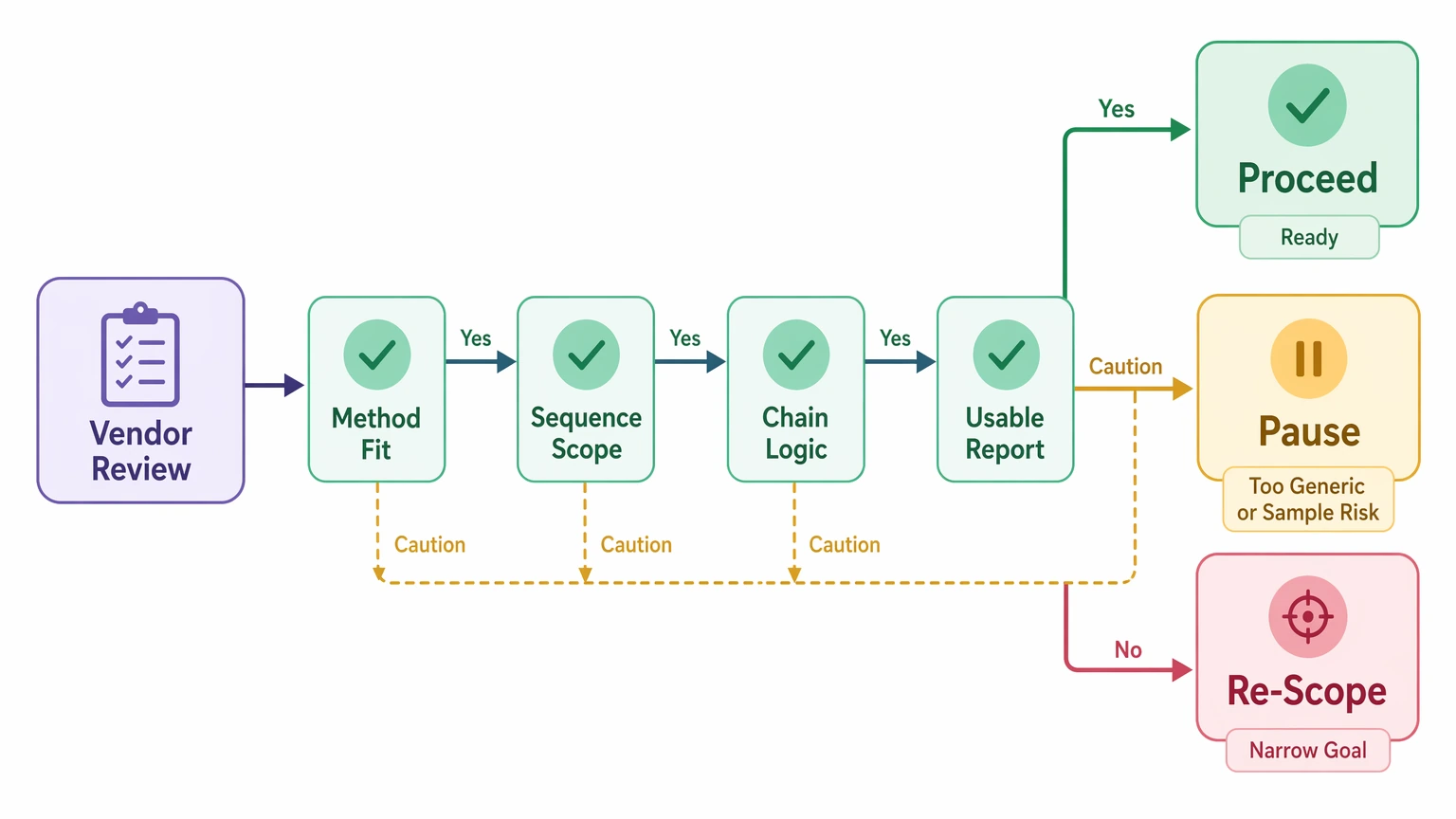
Proceed when the provider can match your sample to a suitable method, define the sequence scope, explain chain assignment logic, and describe a report that supports downstream confirmation.
Pause when the workflow description stays generic, the sample is too limited for the proposed first pass, or the deliverable would not support your real next step.
Re-scope when the original goal is too ambitious for the material on hand. For example, a project aimed at full recombinant rescue may need to begin with variable region confirmation, or a protein-only sample may need extra validation planning before construct design.
Common Mistakes Buyers Make
Three errors come up often in legacy outsourcing decisions:
- Choosing by platform name alone. A sophisticated platform does not help if the workflow does not fit the sample state.
- Underestimating chain ambiguity. A project can still fail downstream after sequence generation if heavy chain and light chain assignment remain unclear.
- Treating the final report as self-validating. Sequence recovery should guide the next experiment, not replace it.
Conclusion
The best way to evaluate an antibody sequencing service for a legacy antibody or undocumented clone is to look at method fit, chain assignment logic, reporting quality, and sample-risk control as one connected plan. That approach is especially relevant for inherited antibody assets, aging hybridoma stocks, and freezer-stored purified antibody samples where documentation gaps make routine outsourcing less dependable. If your team is deciding whether to proceed, pause, or narrow the project goal, contact us to review the sample state, required deliverable, and validation path; MtoZ Biolabs can help evaluate your project before scarce archive material is committed.
FAQ
Can an antibody sequencing service work with partially documented materials rather than completely unknown samples?
Yes, and partial records can still help. Old isotype notes, target labels, or previous clone nicknames may support chain interpretation and follow-up validation even when the original sequence file is missing.
What should we prepare before the vendor call?
Bring a short inventory: sample type, approximate remaining volume or cell amount, storage history, buffer composition if known, any isotype record, and the exact downstream goal. That makes the pre-assessment more informative and helps reduce avoidable sample use.
Is full-length coding sequence always necessary for legacy rescue?
No. Some projects only need the variable region to review clone continuity or begin confirmation work. Others need a sequence package that can move directly into design for recombinant re-expression. The vendor should confirm which level of recovery is realistic for your sample.
How should a provider communicate uncertainty in MS-based antibody recovery?
Look for residue-level notes, not vague caveats. A useful report marks uncertain positions directly, explains whether the issue comes from peptide evidence limits or chain interpretation, and recommends what follow-up work could resolve it.
When should we ask for a staged project instead of a single full-scope run?
Ask for staged work when the material is rare, old, or poorly documented. A limited pre-assessment can show whether recovery looks feasible before the provider uses more of the archive in a larger sequencing effort.
How to order?




