






How to Evaluate a De Novo Peptide Sequencing Service for Unknown Peptide Identification Projects
If database search has failed or produced conflicting matches, a de novo peptide sequencing service is the right next step only when the provider can show that your sample is interpretable by LC-MS/MS and that the final report will support a real sequence decision rather than a plausible residue string alone.
For most unknown peptide identification projects, the first priority is not vendor branding or instrument model. It is sample readiness, fragmentation interpretability, ambiguity reporting, and whether the deliverable is strong enough for sequence confirmation, synthesis planning, impurity assignment, or internal review.
Quick decision block
- Use de novo peptide sequencing when the peptide may be novel, truncated, modified, degraded, or absent from the reference database.
- Pause before outsourcing if sample amount, peptide purity, or solvent compatibility are unclear.
- Prioritize providers that disclose residue ambiguity, annotate fragment ions, and explain how sequence confirmation will be handled after the initial readout.
- Rule out weak vendors if they promise “the sequence” without discussing intact mass, fragmentation spectrum quality, PTM risk, or raw data access.
Why Unknown Peptide Projects Need a Different Vendor Screen
Most teams already understand what de novo peptide sequencing is. The harder issue is whether an outside lab can turn a limited or imperfect sample into sequence evidence you can actually use for unknown peptide identification.
That usually comes up in situations like these:
- an isolated fraction shows an intact mass that does not fit the expected target
- a database search produces low-confidence or contradictory candidates
- a degradation or impurity peak must be assigned during development
- a natural-source peptide has uncertain termini or low abundance
- a synthetic follow-up sample may contain oxidation, truncation, cyclization, or another structural change
In each case, the report has to support a downstream decision. A short report with one candidate sequence and no annotated spectra may not be enough for sequence confirmation, synthesis planning, impurity assignment, or internal review.
When a De Novo Peptide Sequencing Service Is the Right Choice
De novo peptide sequencing infers amino acid order from tandem mass spectrometry without requiring a complete database match. It becomes most useful when the peptide is poorly represented in the searchable reference space or when modification patterns break the assumptions behind database-based identification.
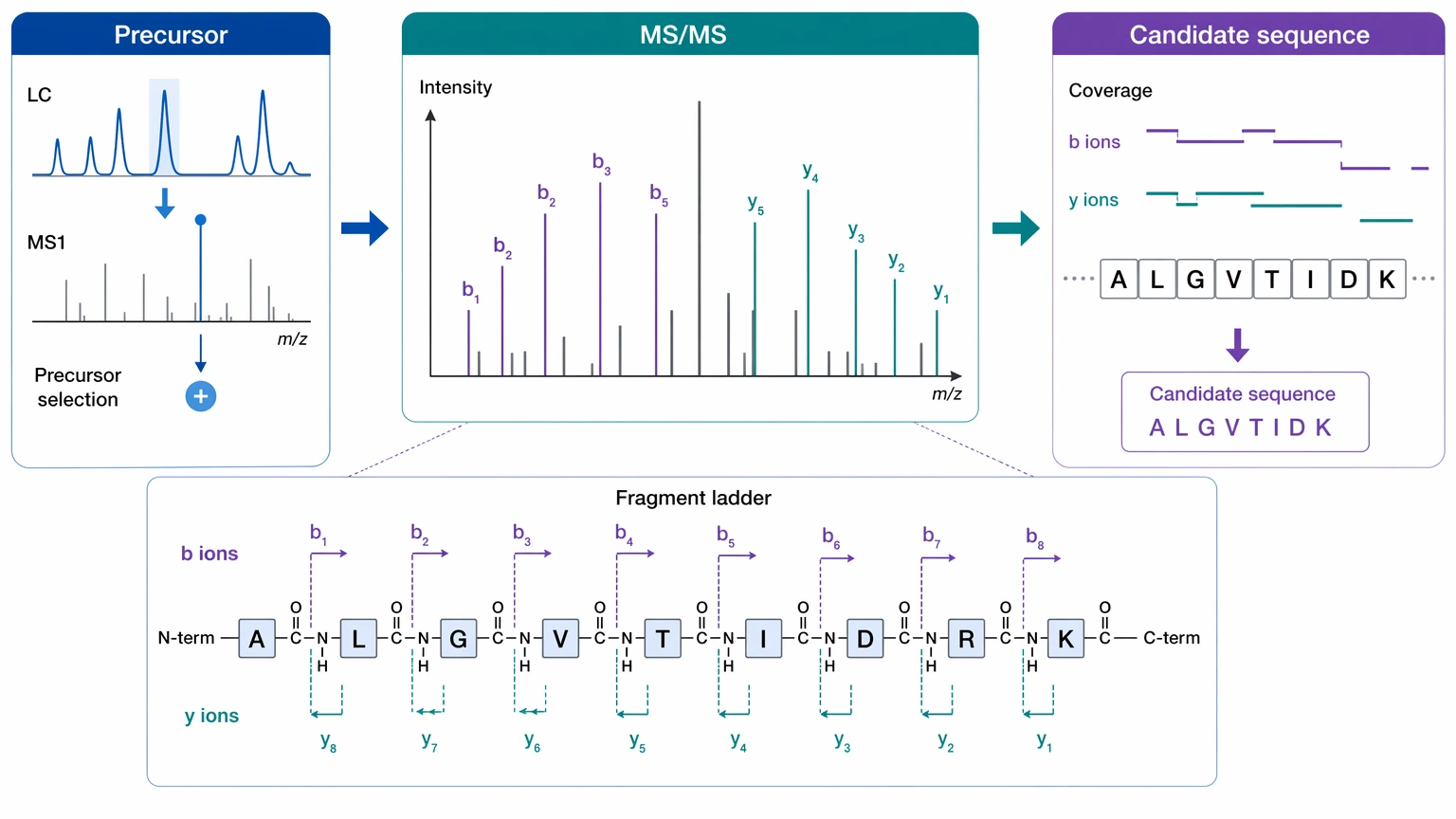
That does not mean de novo interpretation will solve every unknown. Incomplete fragment ladders, isobaric residues, labile post-translational modification behavior, and mixed precursor ion populations can all reduce sequence confidence. In some projects, the result is a ranked candidate sequence set with local confidence assignment rather than one fully unambiguous sequence.
So the real outsourcing question is fit. Not “Can this lab run LC-MS/MS?” but “Can this workflow generate sequence evidence that is usable for my sample type and decision stage?”
A Method-Selection Framework for Comparing Providers
Step 1: Define the sequence decision before you compare vendors
Start with the decision the report needs to support. That sets the bar for reporting depth.
Common decision types include:
- identifying an unknown peptide from a purified fraction
- confirming whether a suspected sequence is correct
- assigning a degradation-related peptide species
- narrowing candidate sequence models before synthesis
- determining whether a PTM or terminal change explains a mass shift
If the goal is early hypothesis generation, a candidate sequence list may be enough. If the sequence will drive synthesis or impurity disposition, the provider should offer intact mass reconciliation, annotated spectra, confidence assignment by region, and a practical route to orthogonal validation.
The comparison below shows how reporting expectations change with project purpose.
| Project goal | Minimum useful output | Decision-grade output |
|---|---|---|
| Unknown peptide identification | Candidate sequence list | Ranked candidate sequence with annotated spectra and confidence notes |
| Sequence confirmation | Match or no-match statement | Fragment ion evidence by region plus unresolved-position disclosure |
| Impurity assignment | Proposed mass-shift explanation | Sequence hypothesis, PTM logic, and alternative interpretations |
| Pre-synthesis review | Plausible sequence | Follow-up confirmation plan and raw data availability |
A provider that cannot show this decision-to-deliverable logic is unlikely to support a demanding unknown peptide project well.
Step 2: Check sample readiness before discussing instrument claims
A strong provider will ask detailed questions before accepting the sample. That review should cover sample input sufficiency, peptide purity, sample complexity, and buffer compatibility.
Ask about:
- total peptide amount and concentration
- solvent composition and nonvolatile components
- salt, detergent, polymer, or lipid burden
- whether the sample contains one major peptide or multiple components
- prior intact mass data or LC-MS/MS observations
- expected adsorption loss or scarcity constraints
These details matter because sample handling problems often limit interpretation more than the instrument does. If the dominant precursor ion is weak, unstable, or buried in co-eluting material, the fragmentation spectrum may not support useful sequence coverage.
Step 3: Evaluate MS/MS interpretability, not just platform branding
Instrument names by themselves do not tell you whether the service fits an unknown peptide identification project. The better question is how the provider judges interpretability from the precursor ion and fragment ion evidence.
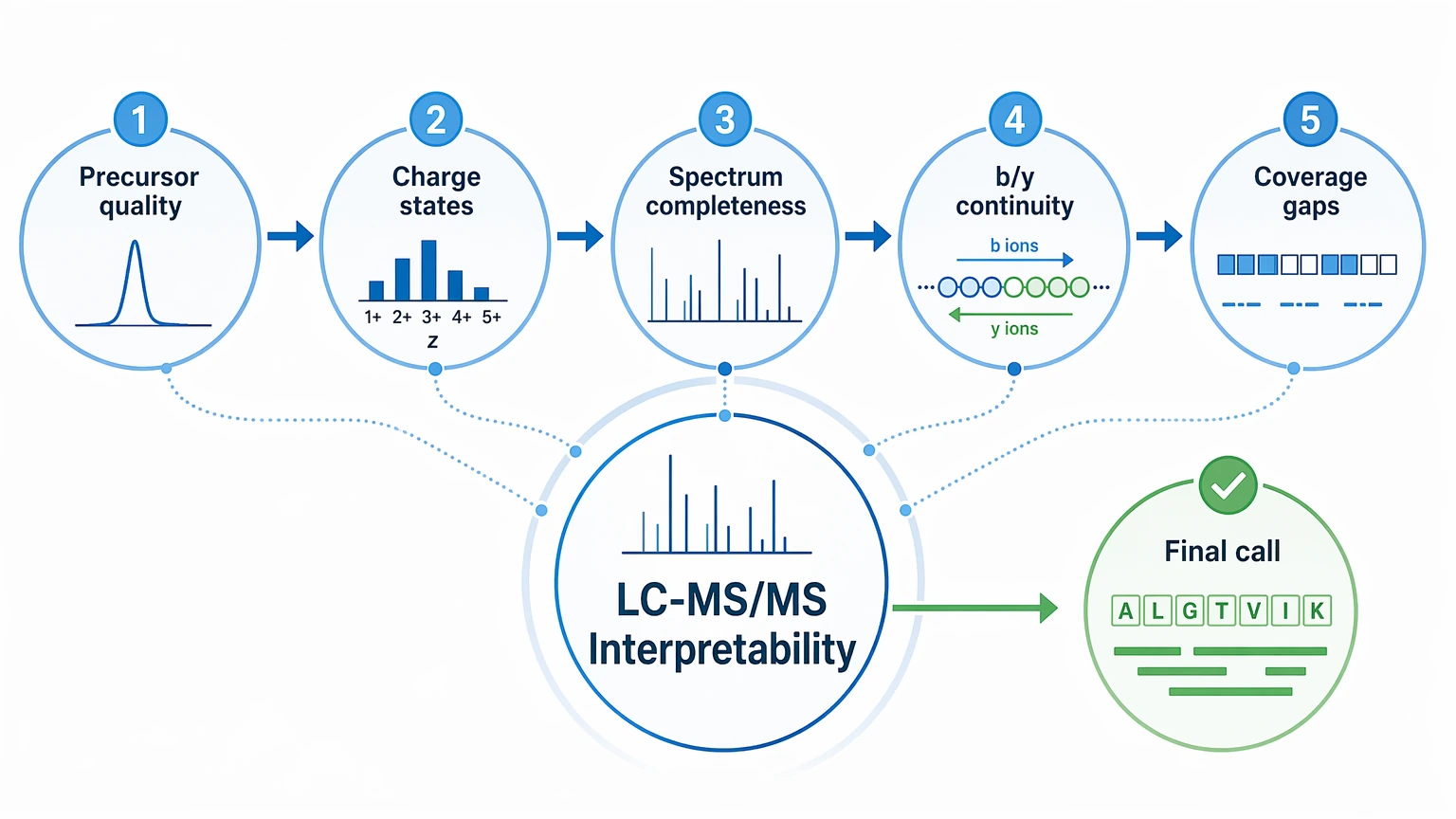
A capable vendor should be able to explain how they assess precursor ion isolation quality, charge-state distribution, fragmentation spectrum richness, continuity of b ions and y ions, sequence tag generation, coverage gaps, and candidate ranking when more than one interpretation remains plausible.
This is also where database search limitation should be addressed directly. If database matching failed, the provider should explain how de novo peptide sequencing will build sequence evidence from the observed tandem mass spectrometry pattern instead of merely rerunning another database-dependent workflow.
An explicit limitation statement matters here. LC-MS/MS-based de novo interpretation cannot always assign every residue with the same confidence, especially when PTMs suppress informative fragmentation or when the spectrum lacks continuous b ion or y ion coverage.
Step 4: Ask how PTMs and ambiguity are reported
Unknown peptide identification often involves oxidation, deamidation, amidation, acetylation, pyroglutamate formation, cyclization, truncation, or other mass-altering events. Those possibilities should be discussed before sample submission, not after a weak report arrives.
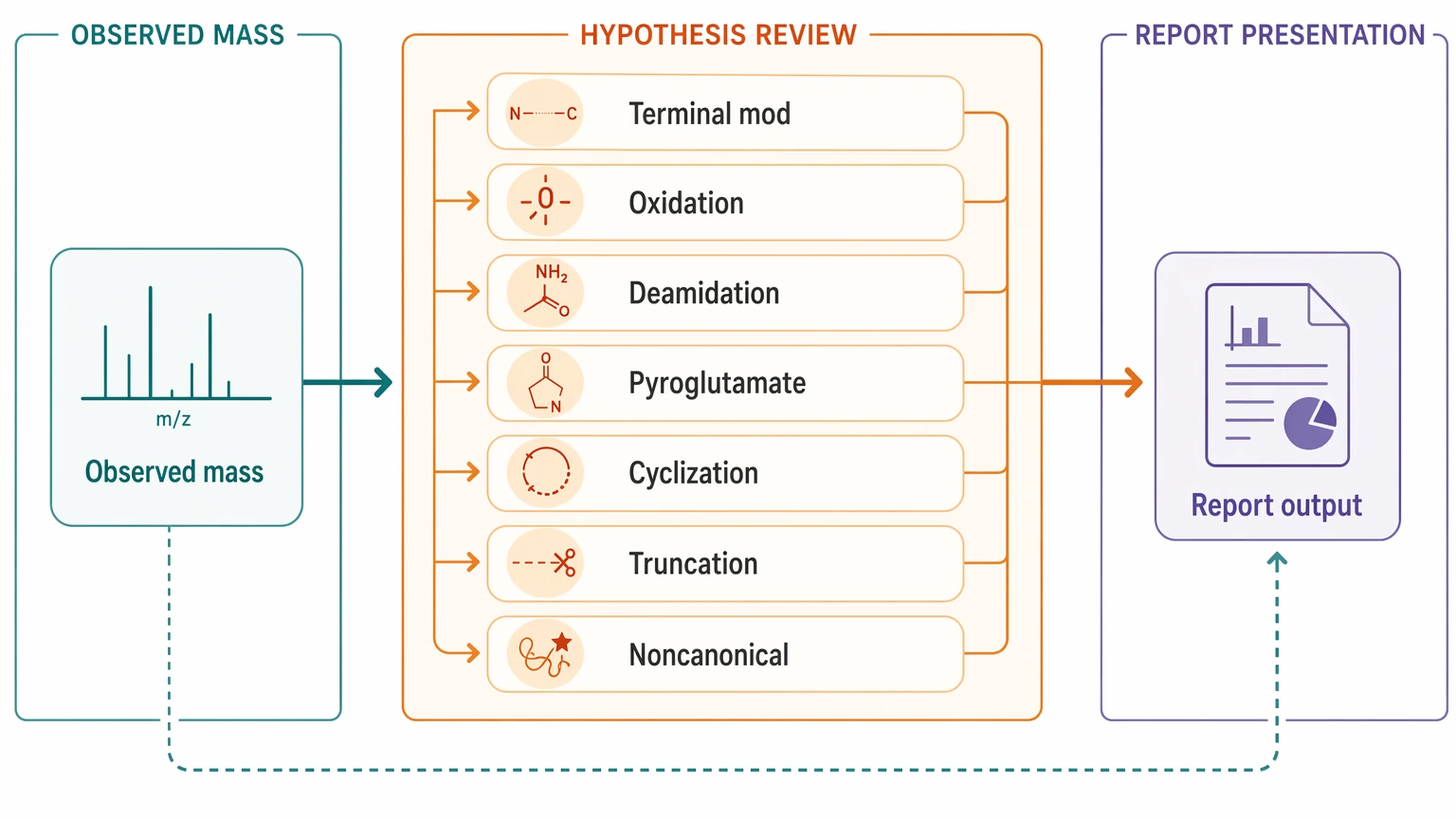
The vendor should describe which PTM hypotheses will be considered, how terminal modifications are evaluated, how labile PTMs are handled in spectral annotation, whether noncanonical residues can be proposed or only flagged as unresolved, and how alternative sequence interpretations are disclosed.
The best reports do not hide uncertainty. If a residue call is weak, that should appear as residue ambiguity or as an alternate candidate sequence, not as a polished but overstated final answer.
If you are comparing service fit for a PTM-rich or low-input project, submit your requirements to MtoZ Biolabs with the sample amount, peptide purity estimate, suspected PTM risk, and any prior intact mass data so the team can evaluate your project against an appropriate de novo peptide sequencing workflow and report depth.
Step 5: Inspect the report template before you place the order
For this kind of outsourcing decision, the report format is part of the method. Ask for a redacted example deliverable.
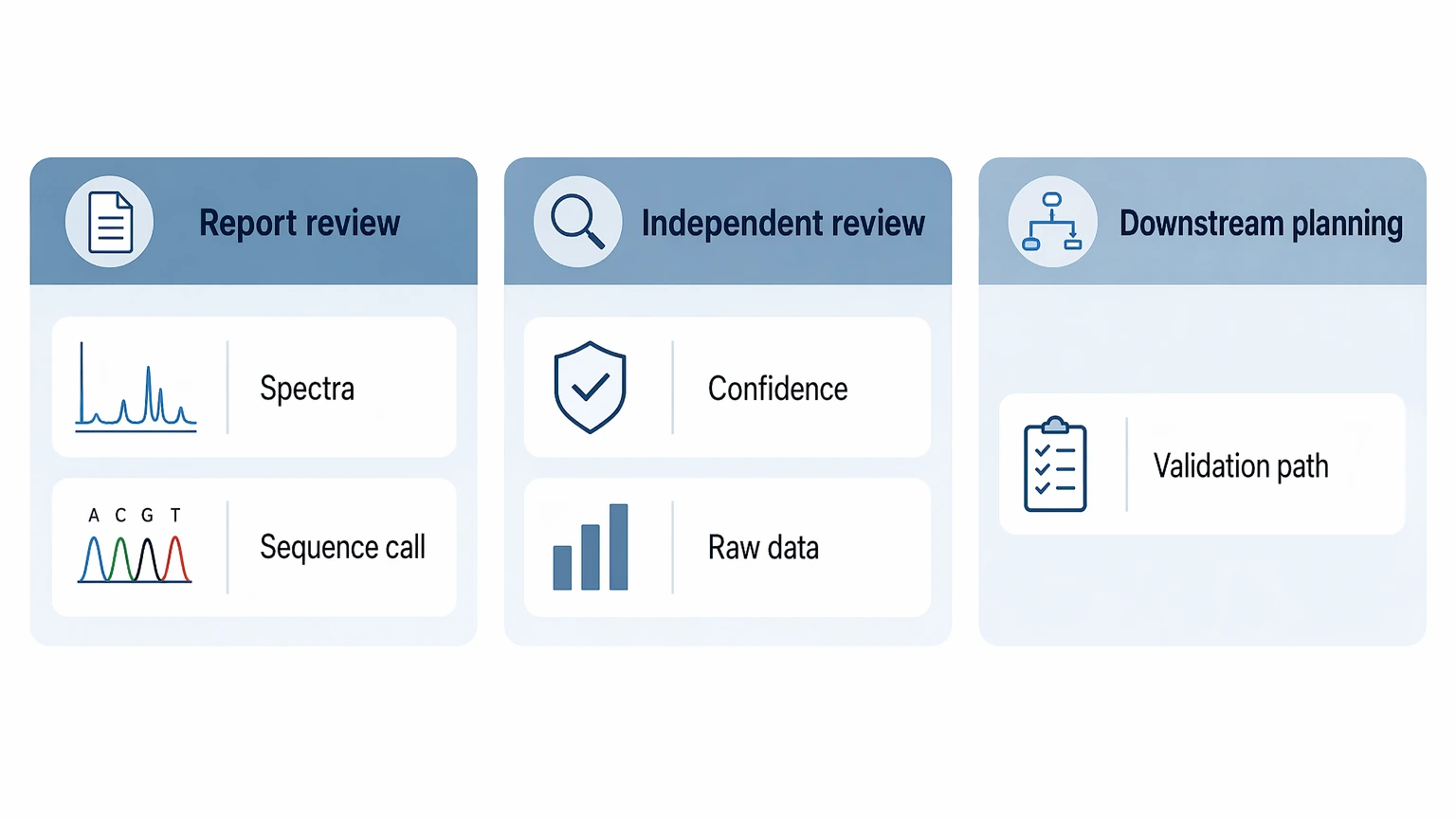
A decision-useful report should usually include sample receipt and preparation notes, LC-MS/MS method summary, intact mass observations, candidate sequence output, annotated spectra for key precursor ion assignments, fragment ion mapping, sequence coverage comments, confidence assignment by region, residue ambiguity disclosure, PTM hypotheses, contaminant flags, and raw data access terms.
Without those elements, it is difficult to tell whether the proposed sequence is scientifically supported or simply the top-ranked guess from a partly informative dataset.
Step 6: Prefer a sequencing path that includes confirmation planning
A de novo peptide sequencing service becomes more useful when the vendor also plans for orthogonal validation. Not every project needs extra experiments, but the provider should explain what comes next if one residue call or PTM assignment will change a business or development decision.
Useful follow-up options may include intact mass confirmation against the preferred candidate sequence, targeted LC-MS/MS of uncertain sequence regions, synthesis-and-match comparison, or focused validation of a critical modification site. That planning matters most when the output will feed synthesis, impurity control, lead progression, or IP review.
Questions to Ask Before Submission
Use this checklist to separate a technically serious service from a generic sequencing offer:
- What sample amount and concentration range are most compatible with your LC-MS/MS workflow?
- How do you handle mixed purity or co-eluting peptide species?
- What evidence will you provide for each candidate sequence?
- How do you report unresolved residues and isobaric residues?
- How do you test PTM or terminal modification hypotheses?
- Will the report include annotated spectra and raw data?
- What orthogonal validation options do you recommend if the sequence will drive synthesis or impurity assignment?
- Will you review prior intact mass or chromatographic data before sample submission?
Service Routes to Consider
If your project is moving from vendor screening to sample submission or follow-up confirmation, these service routes are usually the most practical next options.
Conclusion
A strong de novo peptide sequencing service should do more than return a candidate sequence. For unknown peptide identification, the provider needs to screen sample readiness carefully, explain how LC-MS/MS evidence supports the interpretation, disclose residue-level confidence limits, and outline when orthogonal validation is still needed. That approach fits projects involving novel peptides, degradation products, truncated species, and database-unmatched samples where sequence confidence matters more than a fast but thin answer.
If your team is preparing an outsourcing package for sequence confirmation or unknown peptide identification, contact us at MtoZ Biolabs to evaluate your project, discuss the expected report depth, and decide what sample details should be provided before submission.
FAQ
Can de novo peptide sequencing still help if I already have a short sequence tag?
Yes. A sequence tag can improve precursor selection and candidate ranking, especially when database search limitation is the main reason the project stalled.
Should I clean up the sample before sending it if material is scarce?
Usually yes, but only after discussing recovery risk. Desalting or solvent exchange can improve ionization, yet each handling step may also reduce total peptide recovery.
What if my unknown peak is probably a degradation product rather than a full peptide?
That is still a strong outsourcing scenario, but ask whether the service supports partial sequence confirmation, truncation analysis, and modification-aware interpretation instead of assuming full-length recovery.
Is raw data useful for procurement review, or only for scientists?
It is useful for both. Scientists can re-check spectral annotation, and project managers can verify that the deliverable matches the agreed scope.
How should I describe the project if I do not know the peptide identity yet?
Focus on what you do know: source material, purification context, intact mass, chromatographic behavior, suspected PTMs, sample amount, and the decision the sequence must support.
Related Services
How to order?




