






How Antibody Repertoire Sequencing Supports Discovery Programs—and Where It Differs From Defined Antibody Sequencing
Antibody repertoire sequencing is most useful when the next discovery decision involves a mixed B-cell population rather than one already defined antibody. It can show whether an immune response is broad or narrowly focused, which clonotype families are expanding, and how V(D)J recombination and somatic hypermutation shape the B-cell receptor (BCR) repertoire. But if the actual goal is the exact variable region sequence and native heavy chain / light chain pairing for one lead, repertoire-level data usually cannot answer that on its own.
That distinction matters because the two approaches operate at different biological resolutions. Antibody repertoire sequencing describes diversity across many cells, while defined antibody sequencing is a form of antibody sequence recovery for one selected antibody entity, such as a hybridoma product, a single B cell, or a purified antibody processed through an appropriate recovery workflow. In many discovery programs, both matter. They just answer different questions at different stages.
Key Takeaways
- Antibody repertoire sequencing profiles population-level features such as repertoire diversity, clonotype distribution, V/J usage, lineage structure, and somatic hypermutation patterns.
- Defined antibody sequencing aims to recover one exact antibody sequence with enough chain definition and sequence completeness for cloning or recombinant re-expression.
- In bulk repertoire sequencing, native heavy chain / light chain pairing is often not preserved, which limits direct reconstruction of a single functional antibody.
- Clonotype abundance can support lead identification / candidate prioritization, but it does not prove binding specificity or confirm a re-expression-ready sequence.
- Sample type often decides the method choice early: PBMCs and mixed B-cell populations usually fit repertoire profiling, whereas hybridoma, single-cell, or purified-antibody projects more often require defined sequence recovery.
What Antibody Repertoire Sequencing Measures
Antibody repertoire sequencing examines many antibody-related sequences from an immune-cell population at the same time. In discovery work, the most informative signals usually come from the rearranged variable region, especially sequence features created by V(D)J recombination and then diversified through somatic hypermutation.
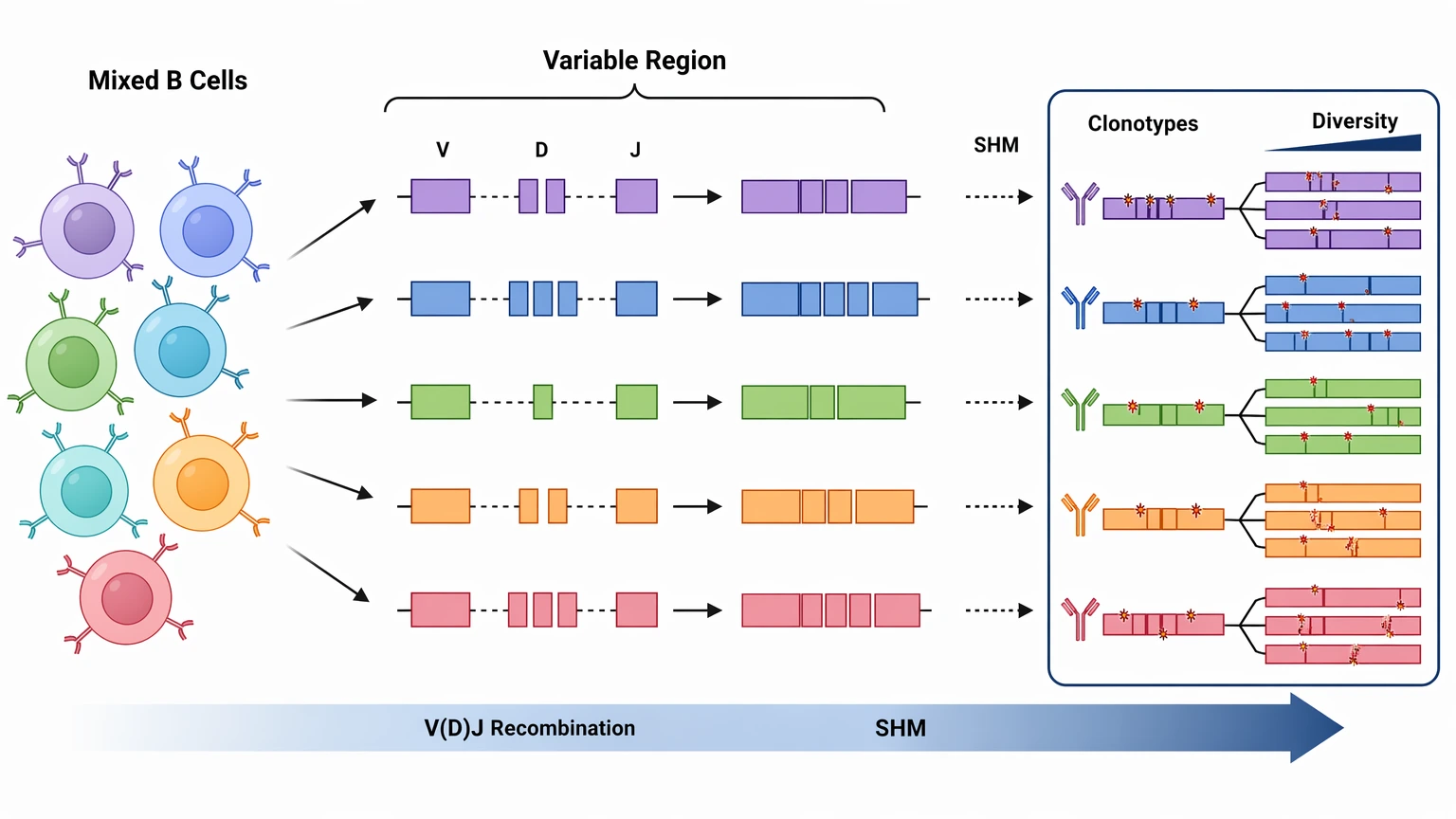
So the output is not one monoclonal identity. Instead, it gives a structured picture of how the response is distributed across many B cells. Depending on study design, the dataset may show:
- which clonotype families expanded after immunization or donor exposure
- how repertoire diversity shifts across tissues or time points
- whether specific V and J genes are enriched
- how mutation patterns differ between candidate lineages
- whether a response appears diffuse or concentrated around a smaller number of families
For discovery teams, that population-level view is often exactly what they need. It helps answer questions such as: Is there a detectable antigen-driven response? Which animal, donor, or compartment looks most promising? Should follow-up work focus on one lineage family or keep a broader screening strategy in place?
What Defined Antibody Sequencing Tries to Recover
Defined antibody sequencing starts from a narrower question: What is the sequence of this antibody? The target is one antibody entity, not a mixed repertoire. The expected deliverable is chain-resolved sequence information with enough confidence to support synthesis, cloning, confirmation, or recombinant re-expression.
That changes both the workflow and the way results are interpreted. Once a team has selected a candidate, the project usually needs:
- explicit heavy and light chain assignment
- sufficient variable-region coverage, not just partial CDR evidence
- confidence that the recovered sequence belongs to the intended antibody
- a result that can move into expression and functional validation
This is why repertoire sequencing and defined antibody sequencing should not be treated as interchangeable versions of the same service. One describes population structure. The other is meant to recover the identity of a defined molecule.
Why Antibody Repertoire Sequencing Still Matters in Discovery
Even with that limitation, antibody repertoire sequencing can be highly informative in early and mid-stage discovery.
It narrows the search space
When a team starts with PBMCs, lymphoid tissue, or sorted B-cell subsets, the first challenge is often scale. There may be thousands to millions of relevant rearrangements. Repertoire-level analysis turns that complexity into patterns a team can actually work with, making it easier to focus on enriched families instead of treating every candidate the same way.
It reveals family-level behavior
In some programs, the strongest signal is not one dominant sequence but a cluster of related clonotypes with similar mutation paths or shared CDR features. That can shape screening strategy, especially when the goal is to prioritize a lineage family for deeper recovery rather than declare a single winner too early.
It informs next-step study design
Repertoire data often shapes what comes next. A focused response may justify single-cell sequencing for pair-resolved recovery. A broad but weak response may point to additional immunization, different sampling, or more selective cell sorting. At that planning stage, readers who need to align sample type with the expected deliverable can submit your requirements to MtoZ Biolabs to evaluate your project before scarce material is committed to the wrong workflow.
The Main Boundary: Pairing and Resolution
The most common misunderstanding is that a highly abundant repertoire sequence can be treated as a direct antibody lead. That shortcut is risky for three reasons.
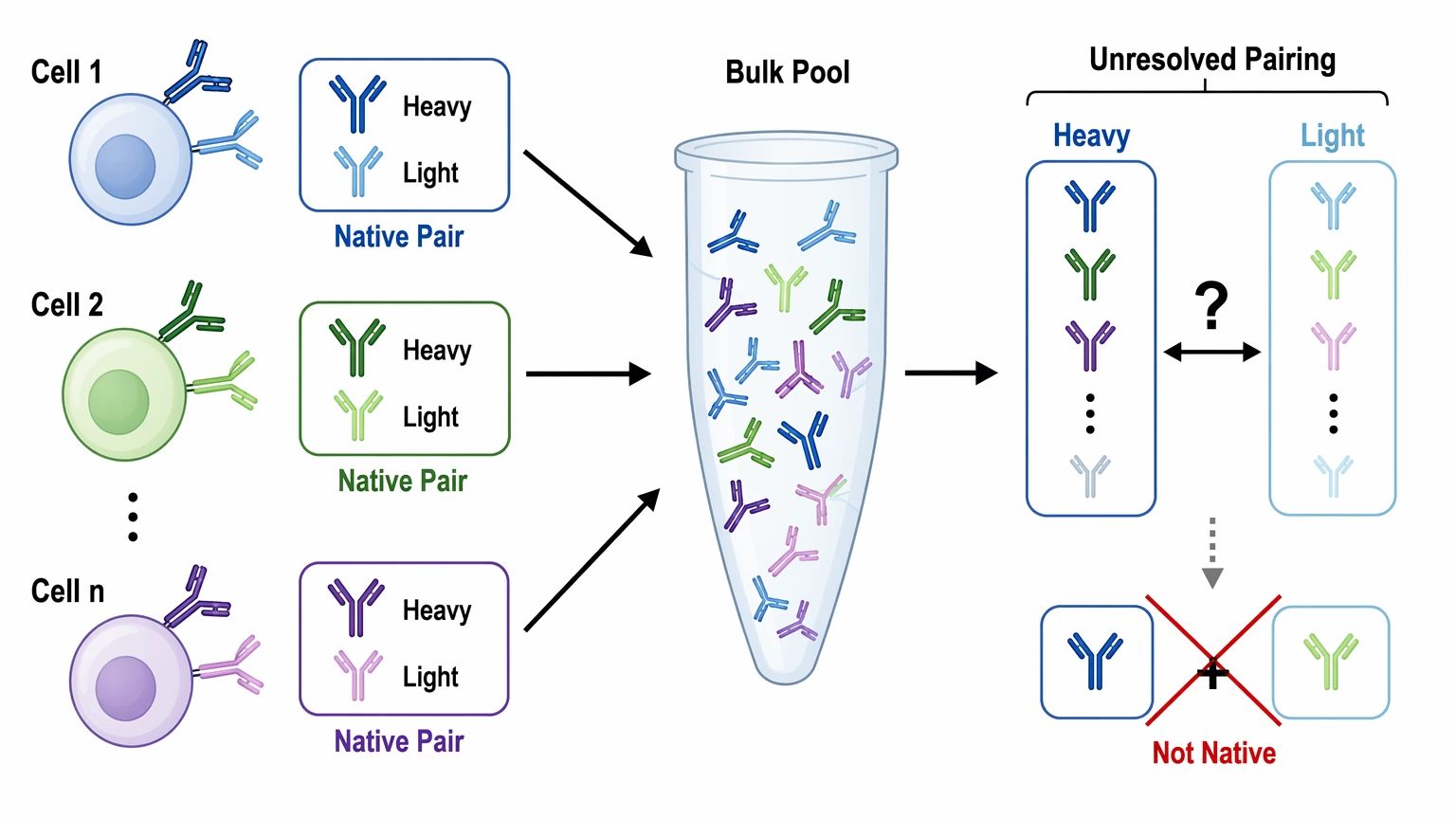
Bulk repertoire sequencing often loses native pairing
In bulk repertoire sequencing, heavy and light chains are usually read from a pooled population. Even when both chain types are well represented, the dataset often does not preserve the original cell-by-cell pairing. As a result, one frequent heavy chain and one frequent light chain cannot simply be combined and assumed to represent the native antibody.
Frequency does not equal function
A clonotype may be highly expanded because it reflects a strong immune response, but expansion alone does not establish that it is the binder identified in a downstream assay. Binding specificity, affinity, and expression behavior still need orthogonal confirmation.
Sequence scope may not be enough for recovery
Some repertoire workflows are optimized for clonotype tracking rather than full reconstruction. They may capture informative CDR-centered or variable-region signals without delivering the chain completeness needed for re-expression planning.
A Practical Comparison
The planning difference becomes easier to see when the two approaches are placed side by side.
| Decision Dimension | Antibody Repertoire Sequencing | Defined Antibody Sequencing |
|---|---|---|
| Biological unit of analysis | Mixed B-cell population | One defined antibody entity |
| Common starting material | PBMCs, B-cell subsets, lymphoid tissue | Hybridoma, single B cell, purified antibody |
| Main readout | Clonotype distribution, repertoire diversity, V/J usage, mutation patterns | Chain-resolved variable-region sequence |
| Heavy chain / light chain pairing | Often unresolved in bulk repertoire sequencing | Core requirement |
| Best discovery use | Response mapping and candidate prioritization | Exact sequence recovery and confirmation |
| Sequence completeness need | Often sufficient for repertoire interpretation | Usually higher for re-expression readiness |
| Downstream step | Follow-up recovery or validation | Expression, binding tests, characterization |
How to Choose Based on the Next Decision
Instead of starting with platform branding, start with the next question your team actually needs to answer.
Choose antibody repertoire sequencing when you need population-level insight
This route fits projects asking whether an immune response is focused, which samples show stronger clonal expansion, which families should move forward, or how mutation patterns differ across groups. It is especially useful when the starting material is still a mixed-cell population and the program is in lead identification / candidate prioritization mode.
Choose defined antibody sequencing when you need one recoverable antibody identity
This route fits projects centered on a selected clone, a hybridoma, or a purified antibody. If the required output must support cloning, synthesis, or recombinant re-expression, exact chain definition matters more than repertoire abundance patterns.
Use both when the program moves from mapping to recovery
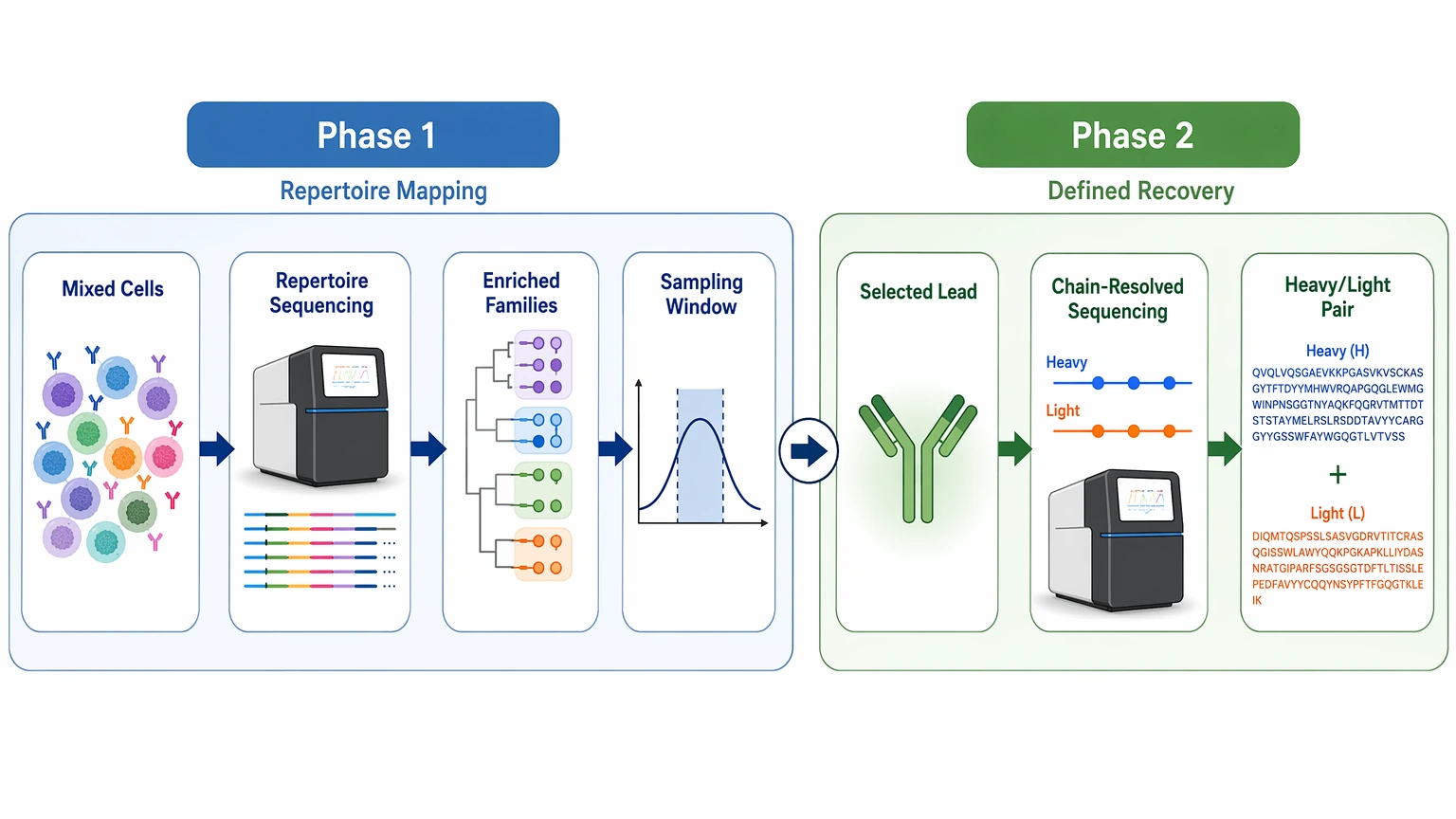
Many discovery efforts naturally run in two phases: first, sequencing antibody repertoires to identify enriched families or favorable sampling windows; second, defined antibody sequencing to recover the actual heavy/light sequence of a chosen lead. That staged design is often easier to defend than expecting one dataset to do both jobs.
Sample Type Usually Decides Faster Than Technology Branding
For planning purposes, the starting sample often gives the clearest answer.
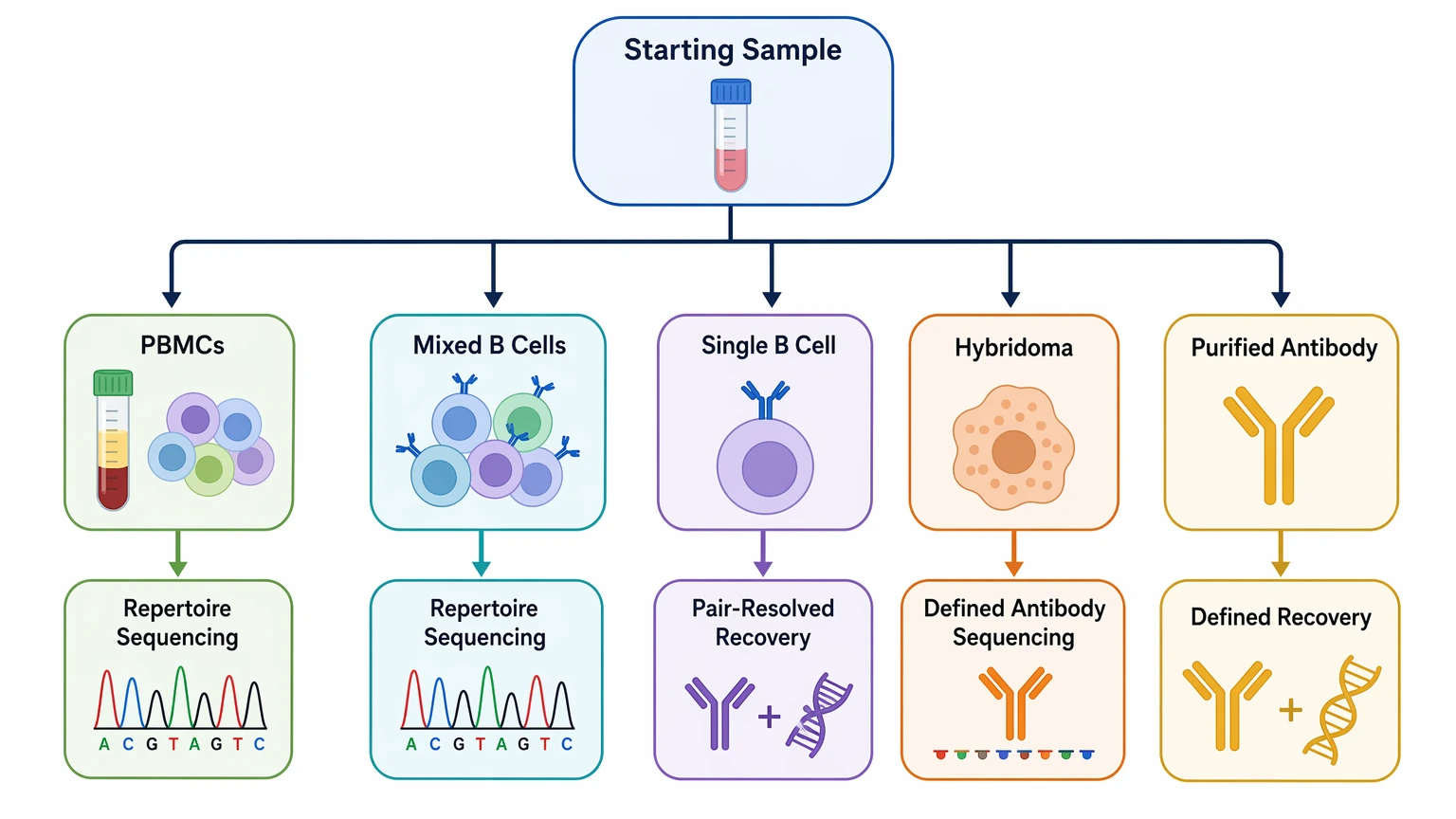
- PBMCs or mixed B-cell populations usually point toward antibody repertoire sequencing.
- Single B cells are more appropriate when native heavy/light chain pairing is central.
- Hybridoma samples generally align with defined antibody sequencing because the source is already monoclonal.
- Purified antibody shifts the logic further, often toward protein-level recovery strategies rather than repertoire analysis.
This is also where project language matters. Saying “antibody sequencing” without defining the biological unit can blur two very different deliverables.
What Repertoire Data Can Support—and What It Cannot
Used well, repertoire data can guide discovery effectively. It can rank enriched families, compare samples, identify convergent sequence trends, and support candidate prioritization. It can also show when follow-up recovery work is justified.
What it usually cannot do by itself is provide definitive native pairing from bulk data, prove that the top clonotype is the functional lead, or supply a complete sequence package ready for re-expression. When a team already has NGS repertoire reads and now wants to express one chosen antibody, the better next step is usually a defined recovery workflow rather than pushing the same repertoire dataset beyond what it can support.
Conclusion
Antibody repertoire sequencing is most informative when a discovery program needs a population-level view of repertoire diversity, clonotype structure, somatic hypermutation, and clonal expansion across mixed immune samples. Defined antibody sequencing becomes the better fit when the decision shifts from mapping responses to recovering one chain-resolved antibody sequence with enough sequence completeness for downstream validation and recombinant re-expression. For immunization studies, donor-response profiling, hybridoma follow-up, or purified-antibody recovery planning, MtoZ Biolabs can evaluate your project context and sample starting point, so if you are deciding between repertoire profiling and exact sequence recovery, contact us to discuss the study before you allocate critical material.
FAQ
Can repertoire sequencing still help if we already have functional screening hits?
Yes, but mostly as supporting context. It can show whether your hits sit within a broader enriched lineage or come from a sparse background, which may help with prioritization. It does not replace clone-specific recovery for the screened binder.
Why is heavy chain / light chain pairing such a big issue for recombinant expression?
Because expression requires one real antibody combination, not two independently plausible chains. If pairing is uncertain, the sequence may still be biologically interesting but may not correspond to the original functional antibody.
Does single-cell sequencing solve the same problem as bulk repertoire sequencing?
Not exactly. Single-cell sequencing can still generate repertoire-scale information, but it is often chosen when preserving native pairing for individual cells is part of the goal. In practice, that makes it much closer to defined recovery logic than standard bulk repertoire sequencing.
If we start with a hybridoma, is repertoire sequencing ever the better first choice?
Usually no. A hybridoma already represents a monoclonal source, so the main need is generally defined antibody sequencing or another clone-resolved recovery method rather than population-level repertoire profiling.
What kind of validation usually follows defined antibody sequencing?
Teams often move next into recombinant expression, binding confirmation, and other characterization steps. Sequence recovery identifies a candidate molecular form; it does not, by itself, establish performance in every downstream assay.
Can purified antibody and immune-cell sequencing be combined in one program?
Yes. Some programs use repertoire analysis early to understand response structure, then shift to purified-antibody or clone-specific recovery once one candidate becomes the central asset. That combination makes sense when discovery mapping and exact sequence reconstruction are both required.
How to order?




