






Glycan Profiling Methods vs Phosphoproteomics: Key Differences in Targets, Workflows, and Data
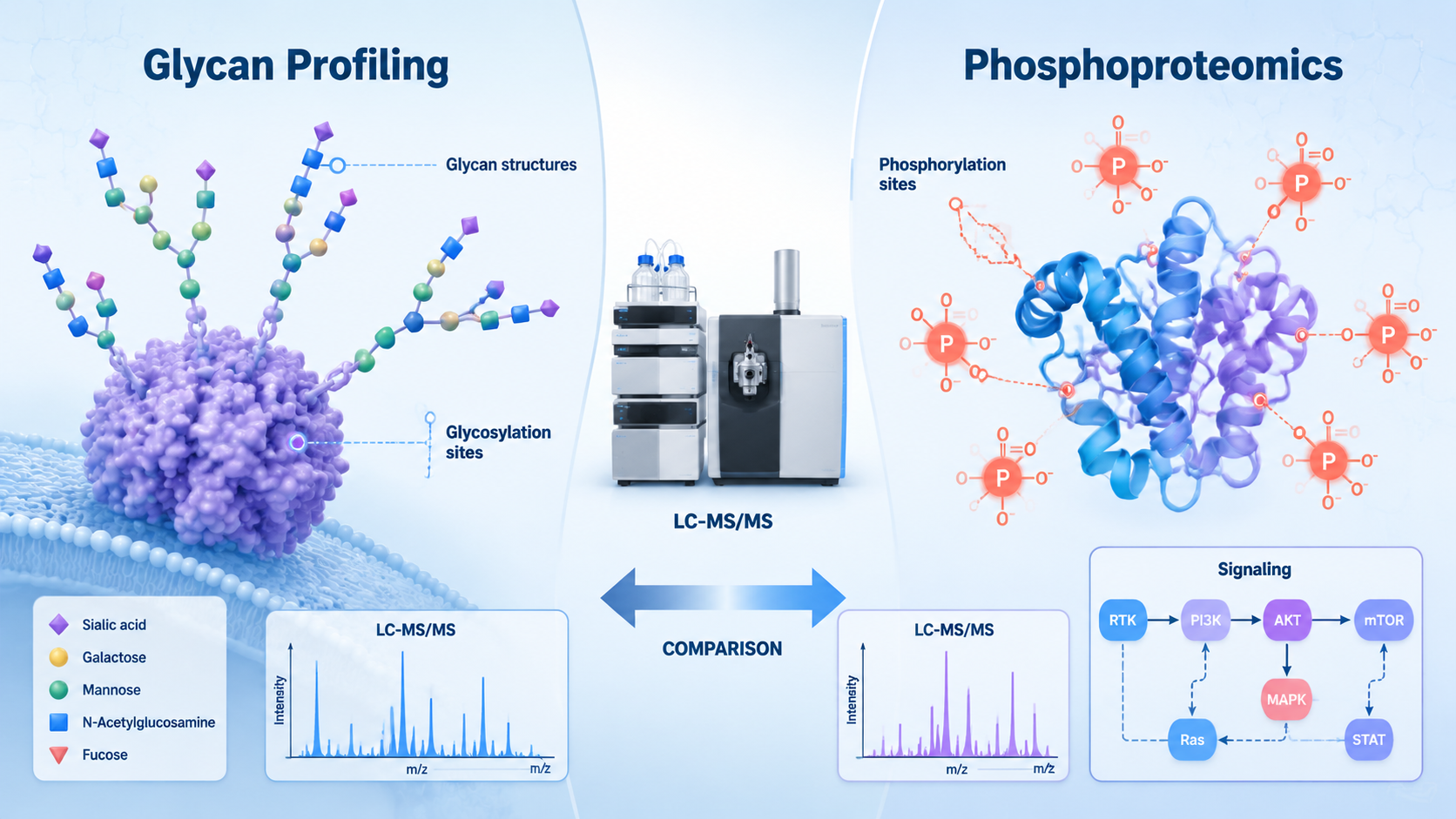
Glycan profiling and phosphoproteomics both study protein-related molecular modifications, but they answer different biological questions. Glycan profiling focuses on carbohydrate structures, glycosylation patterns, glycosylation sites, and glycoform heterogeneity. Phosphoproteomics focuses on phosphorylation sites and signaling activity. The main difference is not only the modification type; it is the chemistry, sample preparation, enrichment strategy, MS interpretation, and biological meaning of the data.
Key Takeaways
- Glycan profiling studies sugar structures and glycosylation heterogeneity; phosphoproteomics studies phosphorylation sites and signaling regulation.
- Glycan workflows often require glycan release, derivatization, glycopeptide analysis, or glycoprotein-level characterization.
- Phosphoproteomics usually relies on phosphopeptide enrichment and LC-MS/MS site localization.
- Glycan data are central for biopharmaceutical quality, immunogenicity, stability, and glycoprotein biology.
- Phosphoproteomics is strongest for kinase signaling, pathway activation, treatment response, and dynamic cell-state analysis.
What Glycan Profiling Measures?
Glycan profiling measures carbohydrate structures attached to proteins, lipids, or other biomolecules. In protein-focused projects, the key questions are often: which glycans are present, how abundant are they, where are they attached, and how do glycoforms differ across samples, batches, diseases, or treatments?
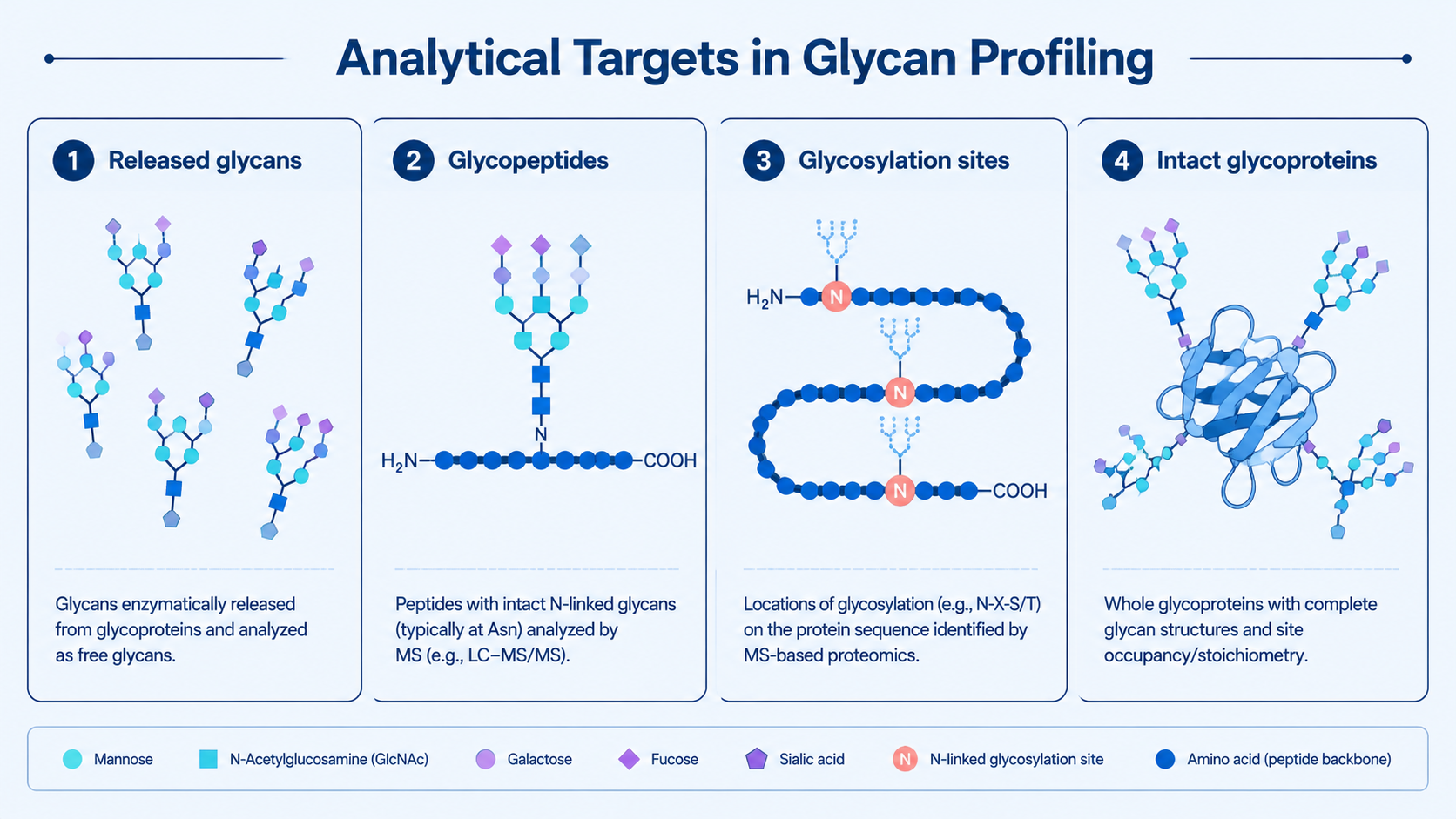
Different glycan profiling methods answer different levels of the problem. Released glycan analysis gives structural and abundance information for glycans after they are cleaved from proteins. Glycopeptide analysis preserves site information. Intact glycoprotein analysis can show proteoform or glycoform patterns, but it is harder to interpret in complex samples.
Related Services
Biopharmaceutical Glycan Analysis Service
Comprehensive Glycosylation Analysis Service
Glycosylation Site Analysis Service | LC-MS/MS
What Phosphoproteomics Measures?
Phosphoproteomics measures phosphorylation events on serine, threonine, tyrosine, and sometimes less common phosphorylated residues. The central question is usually not "is this protein present?" but "which phosphorylation sites change, and what does that say about signaling?"
Phosphorylation can change rapidly after stimulation, drug treatment, stress, differentiation, or disease progression. A protein's total abundance may remain stable while one regulatory phosphorylation site changes strongly. That is why phosphoproteomics should often be interpreted alongside total proteomics when possible.
Workflow Differences
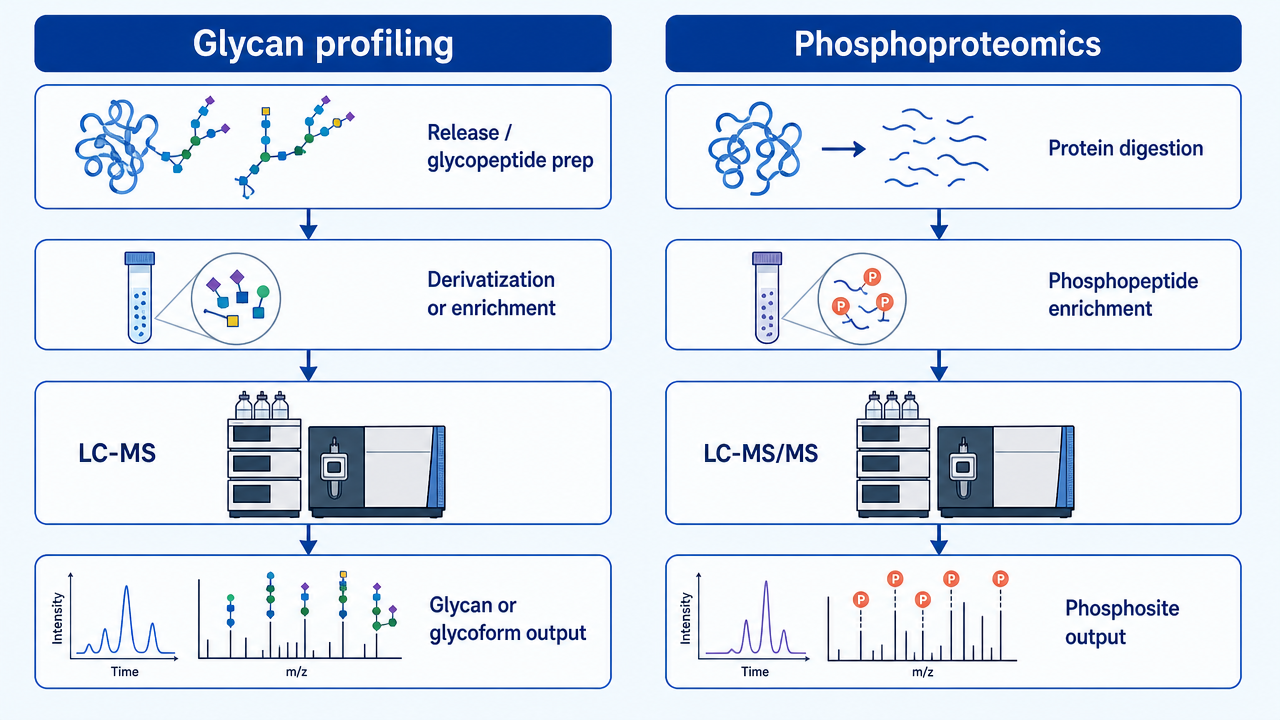
Glycan profiling and phosphoproteomics diverge early in sample preparation. Glycan workflows may involve enzymatic release of N-glycans, chemical release of O-glycans, labeling or derivatization, cleanup, HILIC or reversed-phase separation, and MS or fluorescence detection. If site information is required, glycopeptide preparation and fragmentation strategy become critical.
For phosphoproteomics, proteins are usually digested into peptides first, then phosphopeptides are enriched using IMAC, TiO2, or related chemistries. LC-MS/MS then identifies phosphopeptides and localizes phosphorylation sites.
Data Output Differences
Glycan profiling may report glycan composition, structural features, linkage information, relative abundance, glycosylation site occupancy, glycopeptide forms, or batch-to-batch glycan distribution. The output often has direct relevance for biopharmaceutical quality because glycosylation can influence efficacy, stability, serum half-life, and immunogenicity.
Phosphoproteomics reports phosphopeptides, modified residues, localization probability, phosphorylation intensity, kinase motif patterns, pathway enrichment, and condition-specific signaling changes. The output is most useful for mechanistic biology, kinase pathway analysis, drug response, and target discovery.
Main Applications
Glycan profiling is widely used in monoclonal antibody characterization, Fc glycosylation monitoring, biosimilar comparability, glycoprotein biology, cell-surface glycan studies, disease biomarker discovery, and host-cell or production-process optimization.
Phosphoproteomics is used for kinase signaling, cancer pathway activation, drug mechanism studies, cell differentiation, stress response, immune signaling, and time-course experiments where regulatory events shift quickly.
Main Limitations
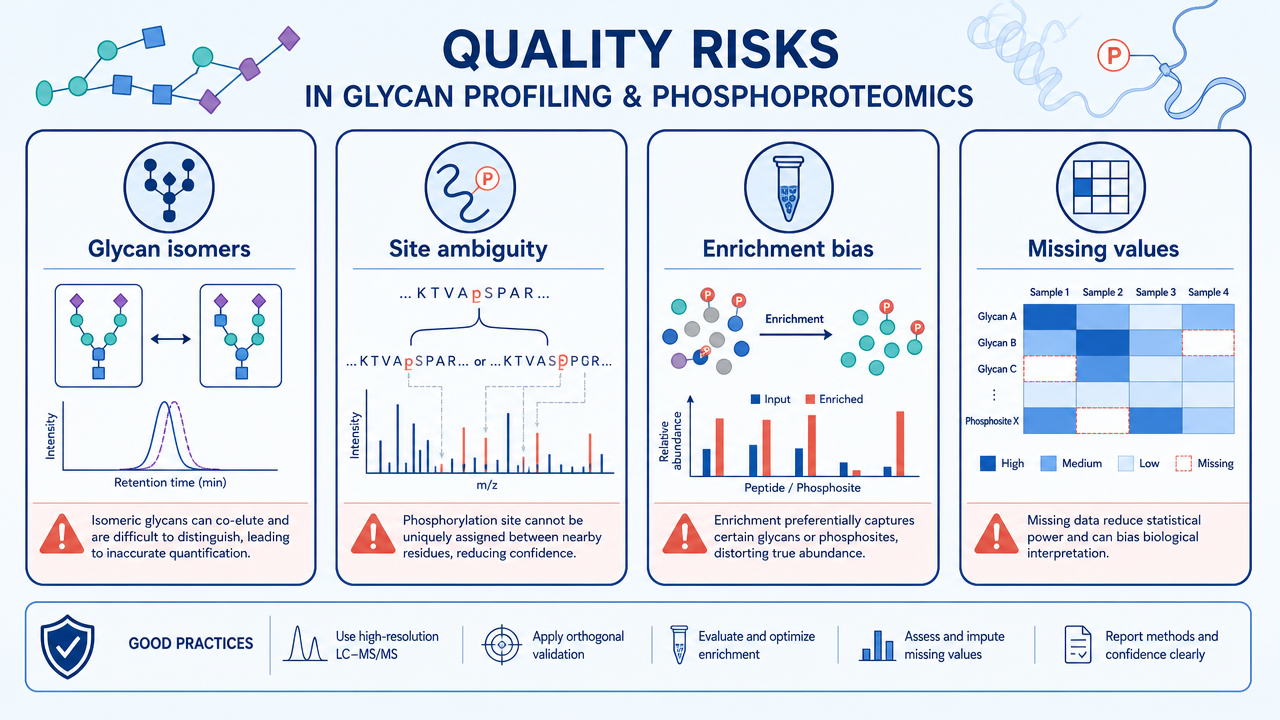
Glycan analysis is difficult because glycans are branched, isomeric, and often heterogeneous. The same mass may correspond to multiple structural possibilities. Linkage and site information may require specific fragmentation, exoglycosidase digestion, orthogonal separation, or glycopeptide-level analysis.
Phosphoproteomics is difficult because phosphopeptides are often low-abundance and phosphorylation is dynamic. Site localization can be ambiguous when multiple possible residues exist in one peptide. Enrichment bias and missing values also affect quantitative interpretation.
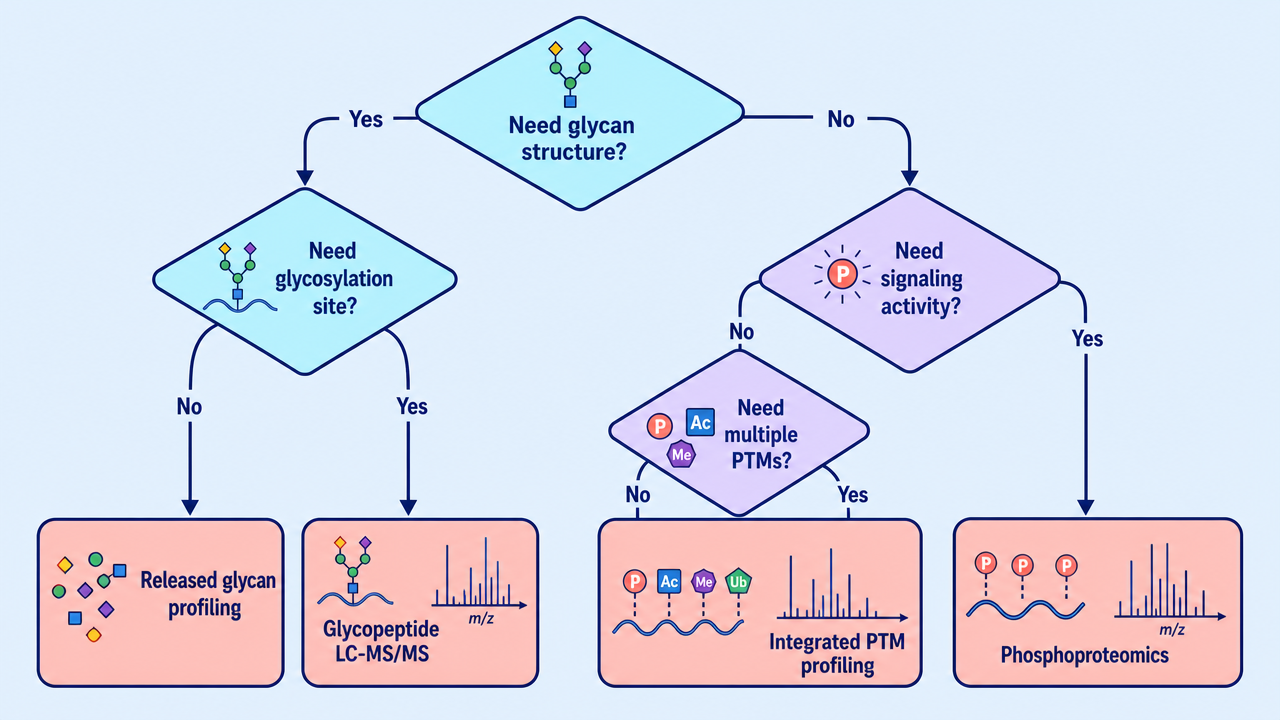
How to Choose Between Glycan Profiling and Phosphoproteomics?
| Question | Better method | Why | Main caution |
|---|---|---|---|
| Which glycans are present on a biologic? | Glycan profiling | Direct glycan composition and distribution | Site information may need glycopeptide analysis |
| Which glycosylation sites are occupied? | Glycopeptide LC-MS/MS | Preserves peptide-site context | Fragmentation and site confidence matter |
| Which kinase pathways are activated? | Phosphoproteomics | Site-level signaling readout | Needs phosphopeptide enrichment |
| Does a drug alter signaling over time? | Quantitative phosphoproteomics | Captures dynamic phosphorylation | Time-point design is critical |
| Is product glycosylation comparable across batches? | Biopharmaceutical glycan analysis | QC-relevant glycoform comparison | Method consistency is essential |
| Are several PTMs involved? | Integrated PTM profiling | Broader modification context | Each PTM has different chemistry |
FAQ
1. What is the main difference between glycan profiling and phosphoproteomics?
Glycan profiling measures carbohydrate structures and glycosylation patterns, while phosphoproteomics measures phosphorylation sites and signaling-related protein regulation.
2. Can glycan profiling identify glycosylation sites?
Released glycan profiling alone does not preserve site information. Glycopeptide LC-MS/MS is usually needed when the project requires site-specific glycosylation evidence.
3. Why is phosphoproteomics used for signaling studies?
Phosphorylation changes rapidly in response to kinase activity, receptor activation, drug treatment, stress, and cell-state transitions. Site-level phosphorylation data can therefore reveal pathway activity that total protein abundance may miss.
4. Which method is more useful for biopharmaceutical quality control?
Glycan profiling is often more directly relevant for biopharmaceutical QC because glycosylation can affect product stability, potency, immunogenicity, and batch comparability.
5. Can glycan profiling and phosphoproteomics be combined?
Yes. They can be combined in multi-PTM or multi-omics studies when the research question involves both glycosylation-related regulation and phosphorylation-driven signaling.
Conclusion
Glycan profiling and phosphoproteomics are complementary, not interchangeable. Glycan profiling explains carbohydrate structure and glycosylation heterogeneity, while phosphoproteomics explains phosphorylation-dependent signaling. The right choice depends on the target modification, sample type, biological question, and evidence level required for interpretation or quality control.
How to order?




