






Global Histone PTM Profiling: How to Identify Multiple Histone Modifications?
Histones carry a wide range of post-translational modifications (PTMs), including methylation, acetylation, phosphorylation, and lysine lactylation. These modifications can occur at different residues and may coexist within the same histone protein. When the research target involves multiple modification types or has not yet been narrowed to a specific PTM, global histone PTM profiling provides a way to investigate a broader range of modification patterns using mass spectrometry.
Unlike an analysis focused on a single modification class, global profiling examines multiple predefined PTM types within the scope supported by the sample preparation and analytical method. The resulting data can reveal modified peptides, localized sites, and potential modification candidates that require further confirmation.
For projects involving multiple histone modification types, MtoZ Biolabs provides a Histone PTM Identification Service, using mass spectrometry to investigate histone modification profiles.
What Is Global Histone PTM Profiling?
Global histone PTM profiling uses liquid chromatography–tandem mass spectrometry (LC-MS/MS) to identify multiple modification types and their corresponding modified peptides and sites in histone samples. The main distinction between global and focused PTM analysis is the scope of the investigation. Focused analysis examines a selected modification class, such as histone methylation or acetylation, while global profiling can include multiple modification classes in the same analytical study when the sample preparation and analytical conditions support them.
Global profiling is particularly useful when:
- The target histone modification type has not been fully established.
- Multiple PTM classes are relevant to the same research question.
- The study requires an initial overview of modification types and sites before selecting targets for further investigation.
Once specific modification classes or sites have been identified, focused PTM analysis can provide more detailed characterization. Quantitative analysis can also be incorporated into the study design when comparisons between experimental conditions are required. Mass spectrometry-based histone profiling has demonstrated the extensive diversity of histone modifications. For example, Tan et al. (2011) identified numerous histone modification marks and characterized lysine crotonylation as a distinct histone modification, illustrating the value of investigating modification types beyond a limited set of established marks.
Histone PTM Classes and Search Scope
Global histone PTM profiling is designed to investigate multiple modification classes rather than focus on a single predefined PTM. The modification scope depends on the research objectives, sample preparation, and analytical methods. Commonly investigated histone modifications include:
|
Modification Class |
Representative Modifications |
|---|---|
|
Lysine Methylation |
Monomethylation, Dimethylation, Trimethylation |
|
Arginine Methylation |
Monomethylation, Symmetric Dimethylation, Asymmetric Dimethylation |
|
Lysine Acetylation |
Histone Lysine Acetylation |
|
Lysine Lactylation |
Histone Lysine Lactylation (Kla) |
|
Phosphorylation |
Serine, Threonine, Tyrosine Phosphorylation |
|
Other Lysine Acylations |
Succinylation, Crotonylation, Butyrylation, β-Hydroxybutyrylation |
|
Ubiquitination-Related Modifications |
K-ε-GG Remnant Identification |
Not all modification classes can be investigated using the same sample preparation and analytical workflow. Some modifications require specific enrichment strategies or additional analytical evidence for confident identification. Therefore, the actual search scope should be determined according to the target modifications and project requirements. The biological roles and regulatory mechanisms of these histone modifications are discussed in Exploring Histone Post-Translational Modifications.
Broad Histone PTM Identification by LC-MS/MS
Sample Preparation for Global Histone PTM Profiling
Sample preparation aims to enrich histones while preserving the modifications targeted for analysis. Cultured cells and tissues can serve as sample sources, depending on histone recovery and sample quality. Acid extraction and salt extraction are established approaches for histone isolation (Shechter et al. 2007). After histone enrichment, proteins are enzymatically digested into peptides for LC-MS/MS analysis. Because histone tails contain closely spaced lysine and arginine residues, conventional trypsin digestion may generate short peptides, limiting the coverage of adjacent modification sites.
Chemical derivatization, such as propionylation, can be used in some workflows to modify lysine residues and improve histone tail peptide coverage (Garcia et al. 2007). However, this treatment may interfere with the identification of endogenous lysine propionylation. Therefore, the preparation strategy should be selected according to the target modification classes. Appropriate handling is also important for preserving labile modifications, such as phosphorylation. For projects requiring histone extraction and enrichment, see the Histone Isolation and Enrichment Service.
Peptide Separation and Mass Spectrometric Acquisition
Following digestion, peptides are separated by reversed-phase liquid chromatography and analyzed using high-resolution tandem mass spectrometry. Orbitrap platforms, such as the Fusion Lumos and Exploris 480, provide accurate precursor mass measurements and MS/MS fragmentation information for peptide identification and PTM characterization. Accurate mass measurement is particularly important when distinguishing modifications with similar mass shifts. For example, lysine acetylation (+42.0106 Da) and trimethylation (+42.0470 Da) differ by approximately 0.0364 Da. Sufficient mass resolution and accuracy are required to distinguish these modifications. MS/MS fragmentation provides additional evidence for peptide sequence identification and modification-site localization. When multiple candidate residues occur within the same peptide, site-determining fragment ions are needed to distinguish their modification positions.
Database Searching for Multiple PTM Types
Database searching compares experimental MS/MS spectra with theoretical peptide sequences to identify histone-derived peptides and their modifications. Reliable identification depends on an appropriate sequence database and search parameters that reflect the target PTMs and sample preparation workflow.
The search database should include species-specific histone sequences and relevant histone variants. Fixed modifications should account for predictable chemical changes introduced during sample preparation, while variable modifications should include the PTM classes targeted by the study. Including too many variable modifications expands the search space and increases the number of candidate peptide matches. Search parameters should therefore be selected according to the research objectives and sample preparation conditions.
The choice between closed and open search strategies also depends on whether the study focuses on known PTMs or aims to investigate unexpected modifications:
- Closed search: Uses predefined variable modifications to identify known PTM classes and their corresponding modified peptides. It is suitable when the target modifications have already been established.
- Open search: Allows the detection of peptide mass shifts beyond the predefined modification list, providing candidates for investigating unexpected modifications.
Open-search results do not automatically establish new PTM identities. Unmatched mass shifts require further evaluation to exclude isotope peaks, adducts, co-isolation interference, and sample preparation artifacts. Additional MS/MS evidence or orthogonal validation may be needed to determine the chemical identity of a candidate modification.
When interpreting database search results, identification-level false discovery rate (FDR) and site-localization confidence should be evaluated separately. FDR assesses the reliability of peptide or protein identifications, whereas site-localization scores evaluate the evidence supporting a modification at a specific amino acid residue. A confidently identified modified peptide does not necessarily indicate that its modification site has also been confidently localized.
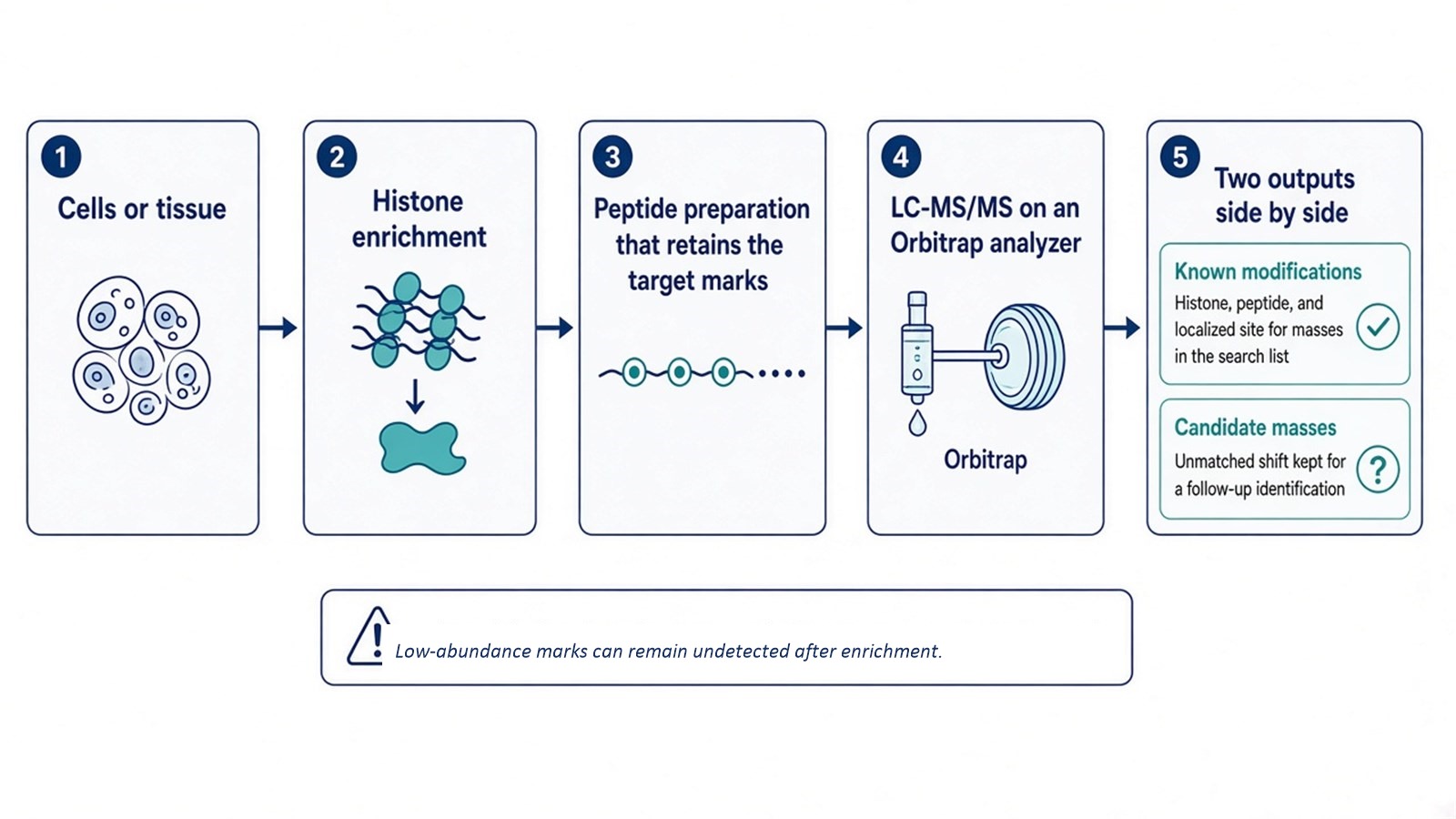
Figure 1. Global histone PTM profiling from enrichment through a search list, with known sites and candidate masses kept as separate outputs.
What Can Global Histone PTM Profiling Reveal?
Global histone PTM profiling provides several types of information about histone modifications:
- Histone proteins and variants: Identifies detectable histone proteins and their variants based on sequence coverage and database selection.
- Modification types: Reveals the PTM classes detected within the predefined search scope.
- Modification sites: Identifies modified amino acid residues when sufficient MS/MS evidence supports site localization.
- Co-occurring modifications: Reveals multiple modifications present on the same peptide when supported by the fragmentation evidence.
- Potential modification candidates: Highlights unexpected peptide mass shifts that may warrant further investigation.
One important distinction is that identifying multiple modifications on the same peptide does not establish the complete modification pattern of an intact histone protein. Bottom-up LC-MS/MS analyzes enzymatically generated peptides and cannot necessarily connect modifications located on separate peptide segments to the same histone molecule.
For studies requiring information about multiple modifications across longer histone fragments, middle-down mass spectrometry can provide additional characterization. This approach preserves larger portions of histone sequences and allows multiple modification sites within the same fragment to be investigated (Huang et al. 2015). See the Middle-Down MS-Based PTM Analysis Service for related analytical approaches.
The actual number and types of modifications identified depend on histone recovery, modification stability, peptide abundance, MS/MS sampling, and database search settings. Therefore, failure to detect a particular modification does not establish its absence from the original sample.
Once the relevant peptides have been identified and the question moves to treatment, genotype, or time, the next experiment is a quantitative comparison with matched groups, designed through the Histone PTMs Quantitative Analysis Service.
Frequently Asked Questions
Can uncommon histone modifications be found without naming them in advance?
A closed search recovers only the masses specified in advance, whereas an exploratory search can flag a repeatedly observed unmatched shift as a candidate. Naming that candidate as a specific uncommon modification still requires fragment localization and, where isomers share the mass, chemistry beyond the mass shift. Very low-abundance marks can remain undetected even when the search is broad.
Do plant and mammalian histones use different site logic?
The residue logic is the same for both: the mass must be localized to a lysine, arginine, serine, threonine, or tyrosine on the histone sequence present in the database for that species. Plant tissues are suitable when histones can be extracted, and the site list reflects the plant sequences and the abundance in that tissue.
Why can two marks on one peptide not be read as the full histone pattern?
Bottom-up sequencing reports the peptide that was selected. Marks outside that peptide, or on other copies of the histone, are invisible in that spectrum. A full-molecule combination requires a longer peptide or an intact-protein measurement (Huang et al. 2015).
Conclusion
Global histone PTM profiling enables the identification of multiple modification types and their locations across enriched histone samples. The modifications included in the database search determine which PTM classes can be identified, while unexpected mass shifts require additional evidence before their chemical identities can be confirmed. The detection of low-abundance modifications also depends on sample characteristics and analytical coverage. Together, the results provide an overview of histone modification sites and types, helping researchers identify candidates for further targeted or quantitative studies.
MtoZ Biolabs provides Histone Post-Translational Modification Analysis Service to support the identification of multiple histone PTM types and their modification sites. Sample types, target modification classes, and project objectives can be discussed with our team to determine a suitable analytical approach. Contact us for a free consultation. All services are intended for research use only.
References
- B.A. Garcia, S. Mollah, B.M. Ueberheide, S.A. Busby, T.L. Muratore, J. Shabanowitz, D.F. Hunt (2007). Chemical derivatization of histones for facilitated analysis by mass spectrometry. Nat. Protoc., 2, 933-938. https://doi.org/10.1038/nprot.2007.106
- D. Shechter, H.L. Dormann, C.D. Allis, S.B. Hake (2007). Extraction, purification and analysis of histones. Nat. Protoc., 2, 1445-1457. https://doi.org/10.1038/nprot.2007.202
- M. Tan, H. Luo, S. Lee, F. Jin, J.S. Yang, E. Montellier, et al. (2011). Identification of 67 histone marks and histone lysine crotonylation as a new type of histone modification. Cell, 146, 1016-1028. https://doi.org/10.1016/j.cell.2011.08.008
- H. Huang, S. Lin, B.A. Garcia, Y. Zhao (2015). Quantitative proteomic analysis of histone modifications. Chem. Rev., 115, 2376-2418. https://doi.org/10.1021/cr500491u
How to order?