






Exosome Proteomics Sample Requirements: What to Prepare Before LC-MS/MS Analysis
Introduction
Exosome proteomics projects often stall at submission, not at LC-MS/MS acquisition. A team may already know the biological question, yet still be unsure whether to send biofluid or isolated vesicles, how much material is enough, which buffer is compatible, or what QC information should accompany the shipment. Incomplete sample documentation leads to delayed intake, weaker identification depth, or results that mainly reflect preparation quality rather than biology.
Exosome proteomics sample requirements exist to prevent that failure mode. Before LC-MS/MS analysis, researchers need a clear checklist covering sample type, isolation status, amount, storage, shipping, and QC evidence. This article outlines what to prepare for an exosome or extracellular vesicle proteomics submission and how those details affect analytical readiness. For project-specific sample review, researchers can refer to the Exosome Protein Analysis Service page to submit sample source, EV isolation status, QC information, and analysis goals.
What Must Be Defined Before Submission
Four decisions should be locked before samples leave the laboratory.
1. Sample type: biofluid, conditioned medium, or already isolated exosomes or EVs.
2. Isolation status: whether vesicle enrichment has been completed, and by which method.
3. Analytical goal: protein profiling, comparative analysis, or process documentation.
4. QC package: which characterization data will travel with the samples.
If any of these items is undefined, intake review should come before shipping. Clarifying requirements early is faster than repeating isolation after an underpowered MS run.
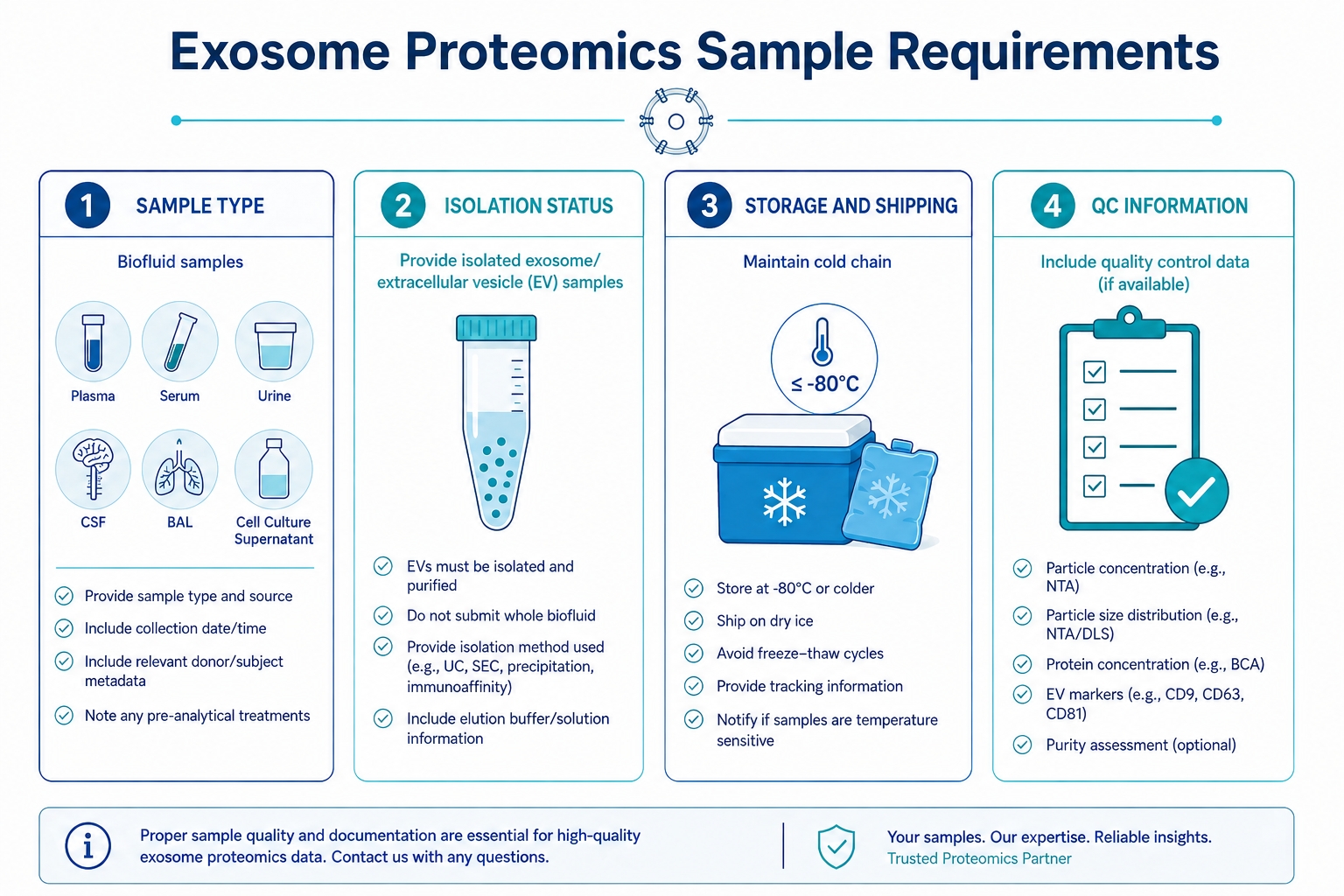
Figure 1. Pre-submission planning for exosome proteomics covers sample type, isolation status, cold-chain handling, and QC documentation.
Sample Types Commonly Used for Exosome Proteomics
Exosome and EV proteomics projects can be evaluated from several starting materials, depending on sample matrix, EV preparation status, available amount, and the selected LC-MS/MS workflow. These starting materials generally fall into three categories: biofluid samples, cell culture-derived samples, and already isolated exosome or EV preparations.
1. Biofluid Samples
(1) Plasma and serum are common clinical and translational matrices. They often carry abundant soluble proteins, so isolation quality strongly affects background in LC-MS/MS. Visibly hemolyzed samples are not recommended for submission.
(2) Urine may support vesicle studies when collection, concentration, and storage are controlled.
(3) Cerebrospinal fluid (CSF) can be used for EV or exosome proteomics when volume and isolation planning are confirmed for the selected assay package.
2. Cell Culture-Derived Samples
Cell culture conditioned medium is widely used in mechanistic projects. Medium composition, serum supplements, and harvest timing should be documented because residual medium proteins can dominate vesicle preparations.
3. Already Isolated Exosome or EV Preparations
Already isolated exosome or EV pellets or suspensions can be submitted when purity and integrity requirements are met and characterization notes are available.
Researchers who are unsure whether to submit biofluid, conditioned medium, or already isolated EV preparations can use the Exosome Protein Analysis Service page for sample-format review before shipment.
Isolation Status: Biofluid vs Ready-to-Analyze Vesicles
1. If You Are Sending Biofluid or Conditioned Medium
State the collection protocol, anticoagulant or preservative if relevant, centrifugation history, and whether vesicle isolation should be included before proteomics. Also note freeze-thaw history. Repeated freeze-thaw cycles can change particle recovery and protein background.
2. If You Are Sending Isolated Exosomes or EVs
Provide isolation method details such as ultracentrifugation, density gradient, size exclusion chromatography (SEC), precipitation, filtration, affinity capture, microfluidic enrichment, or combined workflows. Include resuspension buffer composition, estimated particle or protein amount, and storage temperature. Buffer components that interfere with digestion or LC-MS/MS should be disclosed early.
Sending isolated vesicles is often more efficient when purity, integrity, and QC notes are already available. Sending upstream material is appropriate when isolation, enrichment, or purification support is needed as part of the service path.
Amount, Concentration, and Suggested Starting Volumes
Suggested starting material depends on isolation yield, preparation purity, analysis route, QC scope, and replicate structure. The values below should be treated as intake references for planning rather than universal acceptance thresholds.
| Sample Type |
Quantitative Proteomics |
EV Characterization Package |
|---|---|---|
|
Plasma or serum |
1 mL |
3 mL |
|
Urine |
50 mL |
50 to 100 mL |
|
CSF |
2 mL |
5 mL |
|
Cell culture supernatant |
50 mL |
50 to 100 mL |
CSF volume and multi-module packages should still be confirmed case by case. Comparative designs need enough material for all groups and replicates, not only for one discovery run. Protein amount estimates and particle concentration estimates remain useful when available.
Storage and Shipping Requirements
Cold-chain integrity is part of sample quality.
Store samples at −80°C when analysis is not immediate, and ship on dry ice. Avoid hemolysis, microbial contamination, and repeated freeze-thaw whenever possible. If a sample has already undergone multiple freeze-thaw cycles, record that history rather than omitting it.
Label each vial with a unique sample ID that matches the submission sheet. Include group assignment, collection date, isolation date if applicable, and buffer notes. Avoid handwritten ambiguity that cannot be reconciled at intake.
QC Information to Include with the Submission
QC data do not replace proteomics, but they improve interpretation and intake decisions.
Useful QC information includes:
-
particle size and concentration estimates from NTA
-
morphology evidence when TEM or cryo-EM was performed
-
Western blot marker evidence for expected vesicle proteins such as CD9, CD63, or CD81 when available
-
total protein estimate of the vesicle preparation
-
isolation method summary and major buffer components
-
notes on hemolysis, microbial contamination risk, or medium supplements
Routine EV QC for intake planning is centered on NTA, TEM or cryo-EM, and WB marker checks. ELISA or flow-cytometry based EV QC is not treated as a standard package module here.
Not every project will have a complete QC panel. In that case, state what is available and what is missing. Partial QC is still more informative than no documentation.
Pre-Submission Readiness Path
Use a simple readiness path before packaging samples.
-
Confirm whether the shipment is biofluid or isolated vesicles.
-
Confirm the analytical goal: profiling or comparative analysis.
-
Estimate available amount across all planned replicates.
-
Attach isolation and buffer details.
-
Attach available QC files or summarize QC status.
-
Align sample IDs with the group design sheet.
-
Choose shipping temperature and courier conditions that preserve the stated storage plan.
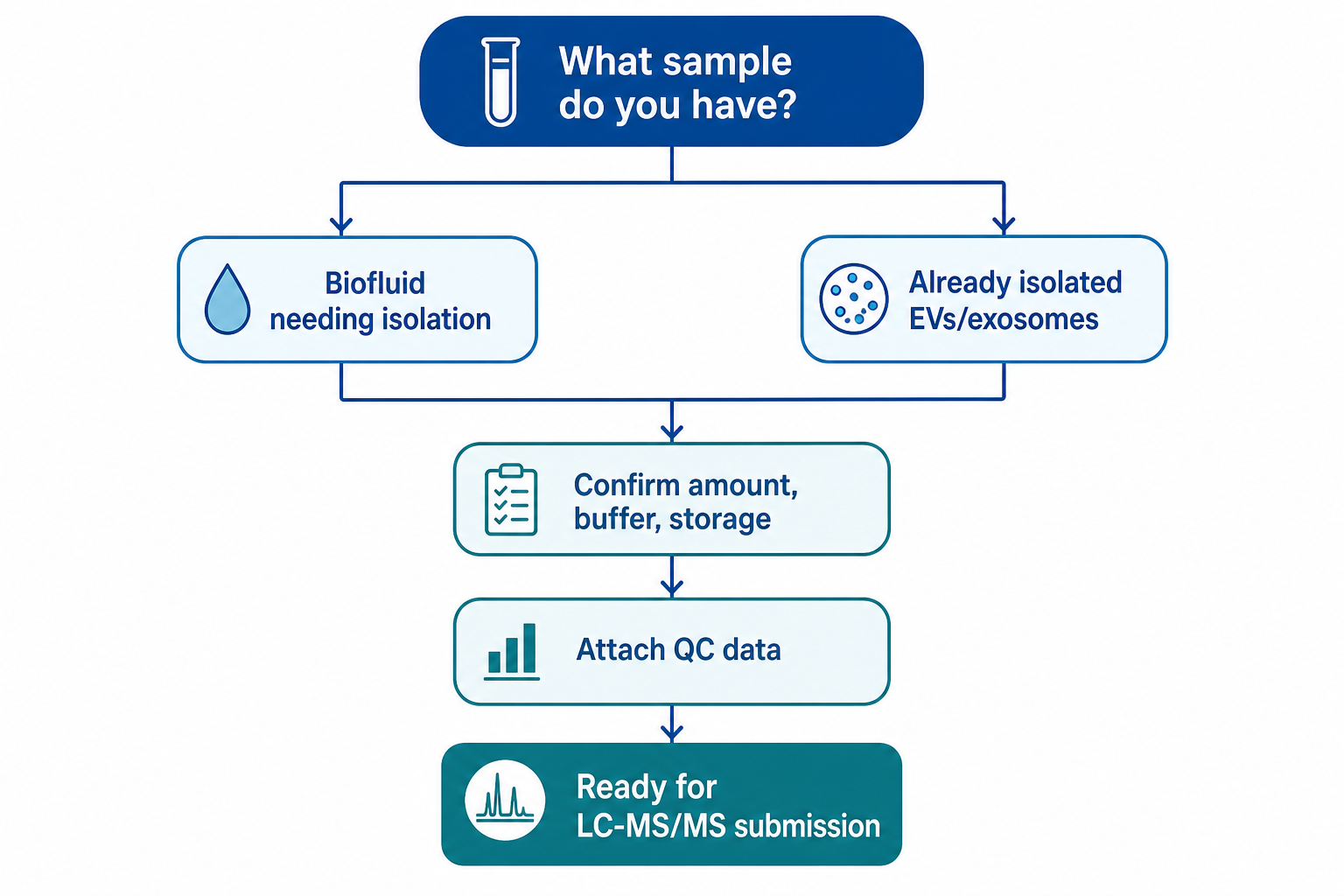
Figure 2. A readiness path links sample format, amount and buffer confirmation, QC documentation, and LC-MS/MS submission.
Common Submission Gaps That Delay Exosome Proteomics
Projects are frequently delayed when:
-
sample IDs on vials do not match the submission form
-
isolation method is undescribed
-
buffer contains incompatible detergents or additives that were not disclosed
-
comparative groups are listed without replicate intent
-
QC is missing and purity concerns are discovered only after acquisition
-
shipment arrives thawed or unlabeled
Most of these issues are preventable with a short pre-submission checklist.
Submission Checklist for LC-MS/MS Planning
Before requesting exosome proteomics analysis, prepare:
-
sample type and number of vials
-
isolation status and method summary
-
estimated vesicle protein amount or particle yield
-
resuspension buffer composition
-
storage history and shipping condition
-
group design and replicate plan
-
available QC data files or QC status notes
-
analytical goal: profiling, comparative analysis, or process review
MtoZ Biolabs supports exosome and extracellular vesicle proteomics projects through sample-format review, QC information assessment, LC-MS/MS workflow planning, and study design evaluation. Researchers can submit sample source, EV isolation status, available input, buffer composition, QC summary, group design, and analysis goals through the Exosome Protein Analysis Service page for project-specific review.
To confirm exosome proteomics sample requirements for your study, contact MtoZ Biolabs with sample type, isolation status, estimated amount, buffer details, QC summary, and whether the priority is profiling or comparative analysis.
Frequently Asked Questions
1. Can I submit plasma directly for exosome proteomics?
Plasma can be used as a starting matrix, but vesicle isolation quality will determine proteomics interpretability. Confirm whether isolation is already completed or should be included before LC-MS/MS.
2. What QC is most useful if I can provide only one characterization assay?
Particle size and concentration data are often a practical minimum. Marker evidence and morphology data further strengthen interpretation when available.
3. Do EV and exosome submissions follow the same sample requirements logic?
Yes in practice. Both require clear isolation documentation, amount estimates, storage history, and QC context. Use the terminology that matches your preparation, and describe the method precisely.
4. What if my vesicle yield is low?
State the estimated yield before shipping. Low-yield samples may still support limited profiling, but they are less suitable for multi-group comparative designs without adjusted expectations or additional material.
5. Should buffers be removed before submission?
Disclose buffer composition first. Some components interfere with digestion or chromatography. Compatibility should be reviewed during intake rather than assumed.
Conclusion
Exosome proteomics sample requirements are a pre-analytical checklist, not a formality. Sample type, isolation status, amount, storage, shipping, and QC information jointly determine whether LC-MS/MS can answer the intended biological or process question.
Teams that complete this checklist before shipment reduce intake delays and improve the chance that proteomics outputs reflect vesicle cargo rather than undocumented preparation artifacts. For submission planning, MtoZ Biolabs can review readiness details and align the exosome or EV proteomics path to the material you currently have.
Related Services
Exosome Protein Analysis Service
Exosome Quantitative Proteomics Service
Exosomal Protein Isolation and Profiling Service
How to order?




