






DIA Proteomics: Data-Independent Acquisition for Quantitative Analysis
Data-independent acquisition (DIA) proteomics is a mass spectrometry-based quantitative approach that systematically collects fragment-ion information across predefined precursor windows. Unlike acquisition strategies that select individual precursors based on signal intensity, DIA records broader fragment-ion data that can be computationally extracted for protein identification and quantification (Gillet et al. 2012).
DIA is widely used for relative quantitative proteomics studies that require consistent protein measurement across multiple samples. By combining DIA acquisition with optimized data analysis strategies, researchers can compare protein abundance changes across biological groups, cohorts, or experimental conditions. Researchers who already have defined groups and a relative comparison objective can also review the MtoZ Biolabs DIA Quantitative Proteomics Service for project-specific feasibility and analysis planning.
What DIA Quantitative Proteomics Is Designed to Answer
DIA is designed for relative protein abundance comparison across predefined experimental groups. By systematically acquiring fragment-ion information, DIA enables researchers to compare the same proteins across multiple samples and identify proteins associated with biological changes.
DIA is commonly applied when the research goal is discovery-scale protein profiling, such as:
- Comparing treatment and control groups;
- Identifying proteins associated with phenotypic differences;
- Profiling protein changes across cohorts or conditions.
DIA provides relative quantitative information rather than calibrated absolute protein concentration. When absolute amounts of predefined proteins are required, targeted quantitative approaches with appropriate standards and calibration should be considered.
How DIA Quantitative Proteomics Works
In a DIA workflow, peptides are first separated by liquid chromatography and introduced into the mass spectrometer. The instrument divides the selected mass range into multiple predefined precursor windows and sequentially fragments ions within each window. This process generates comprehensive fragment-ion data from multiple peptides in each sample.
After acquisition, computational analysis extracts peptide-specific signals from the complex DIA dataset. By matching fragment-ion patterns with peptide sequences and evaluating quantitative signals such as fragment-ion intensity and chromatographic behavior, peptide measurements are summarized into protein-level abundance values.
Because DIA collects fragment-ion information in a systematic manner, it enables consistent relative quantification of the same proteins across multiple samples. The quality of DIA quantitative results depends on factors including chromatographic performance, interference, protein database quality, and data-processing strategies.
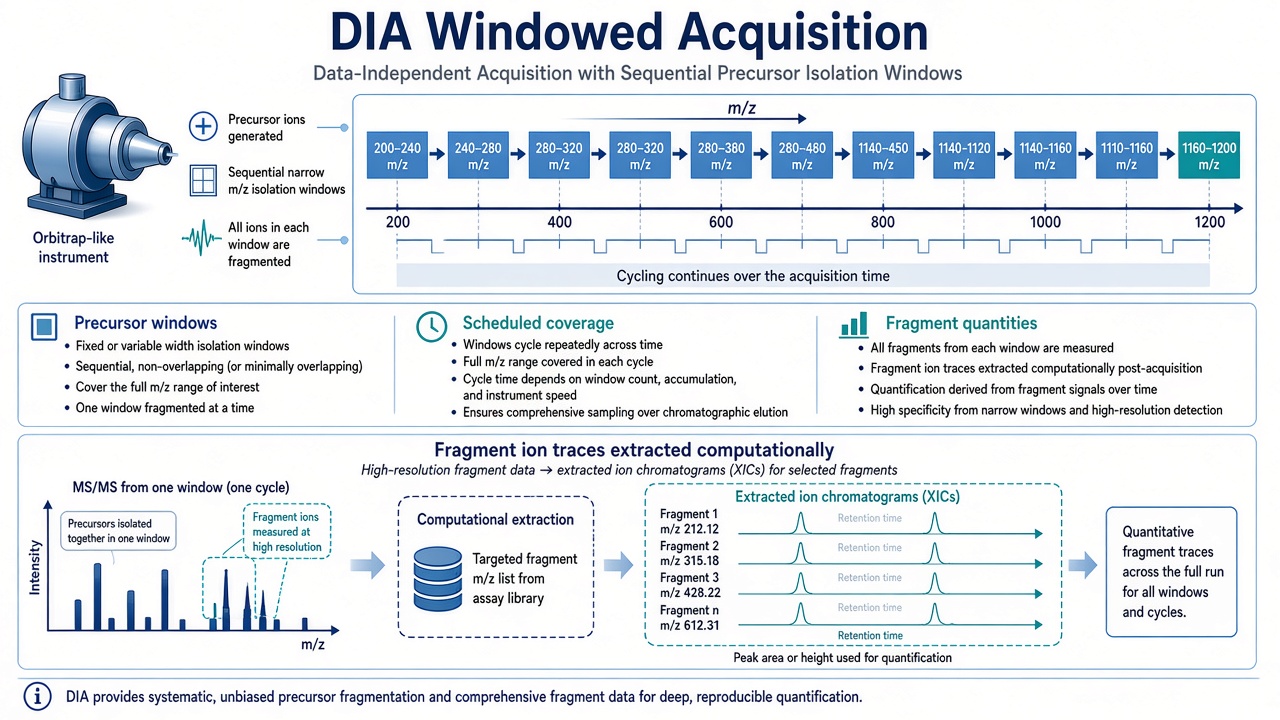
Figure 1. DIA schedules precursor windows and extracts quantitative information from multiplexed fragment-ion data.
DIA vs. DDA: Different Acquisition Strategies
DIA and DDA are two different mass spectrometry acquisition strategies that define how precursor ions are selected and fragmented during LC-MS/MS analysis.
In DDA (Data-Dependent Acquisition), the instrument selects precursor ions based on predefined rules, commonly prioritizing stronger signals for fragmentation. This approach can provide detailed MS/MS information for selected peptides but may result in differences in peptide sampling between runs. In DIA (Data-Independent Acquisition), the instrument systematically fragments predefined precursor windows and records multiplexed fragment-ion information across the selected mass range. This approach provides a more consistent acquisition pattern across samples and supports comparative quantitative analysis.
The choice between DIA and DDA depends on the research objective and study design:
| Study requirement | More suitable approach |
|---|---|
| Consistent quantitative comparison across multiple samples | DIA |
| Flexible analysis of larger sample cohorts | DIA |
| Improving quantitative data completeness and comparability | DIA |
| Broad protein identification and discovery | DDA |
| Focused MS/MS identification of selected precursor ions | DDA |
| Studies suitable for run-by-run acquisition comparison | DDA |
DIA and DDA describe acquisition strategies, not labeling approaches. Both can be combined with different quantitative workflows depending on the experimental design, while labeling status (such as TMT or label-free quantification) should be considered as a separate decision factor.
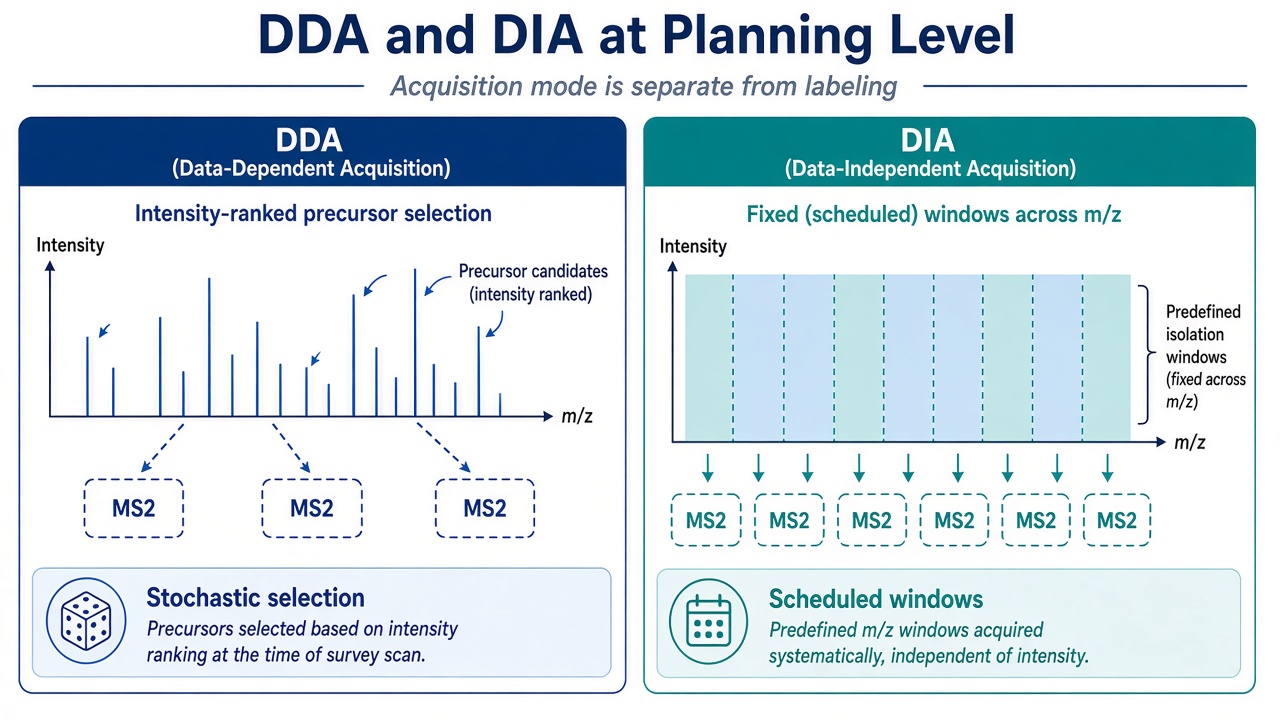
Figure 2. DDA and DIA differ in how precursors are scheduled; labeling status is planned as a separate axis.
Study Design and Data Characteristics
DIA studies are typically designed around independent sample injections with consistent sample preparation, LC-MS/MS acquisition, and data processing workflows. Key considerations include biological replicates, experimental groups, batch organization, and sample quality to support reliable quantitative comparison.
Typical planning amounts are more than 20 μg total protein, with 50 μg commonly used. Concentration is typically planned above 0.5 μg/μL. These values are planning references rather than strict acceptance criteria, as sample matrix, degradation, contaminants, and preparation conditions also influence feasibility.
DIA deliverables commonly include protein quantification tables, quality assessment results, differential protein analysis, and functional annotation outputs when applicable. Results should be interpreted by considering quantitative changes, statistical evidence, replicate consistency, and peptide-level support.
When DIA Fits a Relative Discovery Plan
DIA fits when relative discovery is the endpoint, samples can be injected independently under a controlled plan, and denser scheduled fragment coverage is the design priority. Reassess when the claim needs calibrated absolute amount, when chromatography cannot be kept coherent, or when a coordinated labeled multiplex is the better match for a small fixed cohort.
DDA-based MS1 peak-area LFQ remains a different label-free quantification route and should be evaluated separately when peak-area logic is the open question. Researchers can refer to Label-Free Quantitative Proteomics: LFQ-Based Protein Quantification for that distinction. Strategy trade-offs across methods are covered in How to Choose a Quantitative Proteomics Strategy. The broader theme map sits in Quantitative Proteomics: Methods, Strategies, Workflow, and Applications.
Frequently Asked Questions
1. Is DIA the same as label-free proteomics?
No. Label-free means isotope or isobaric labels are not used. DIA is an acquisition mode. In MtoZ relative-discovery offerings, DIA is typically paired with unlabeled digests, which is a service configuration of those two axes.
2. How does DIA differ from DDA-LFQ on this site?
DDA-LFQ, as used here, quantifies from MS1 peak areas across independent DDA runs. DIA quantifies from scheduled windowed fragment-ion data. They answer related relative-discovery goals through different measurement layers.
3. Can DIA provide absolute protein concentration?
Not by itself. Absolute amount needs a targeted design with suitable peptides, standards, and calibration.
4. What protein amount is typically used when planning DIA?
Typical planning amounts are more than 20 ug total protein and more than 0.5 ug/uL, with 50 ug commonly used. Feasibility still depends on matrix, buffer, degradation, and database availability.
5. When should DIA candidates move to PRM?
When a shortlist is named and the next claim needs focused or calibrated measurement of selected peptides, or when the study begins as a fixed panel.
Conclusion
DIA supports relative quantitative proteomics by scheduling precursor windows and extracting fragment-ion quantities across a coherent injection plan. Keep acquisition mode separate from labeling status when you design the study. Once the contrast, sample plan, and acquisition choice are defined, researchers can review the MtoZ Biolabs DIA Quantitative Proteomics Service for project-specific sample evaluation, feasibility assessment, and workflow planning.
Reference
- L.C. Gillet, P. Navarro, S. Tate, H. Rost, N. Selevsek, L. Reiter, R. Bonner, R. Aebersold (2012). Targeted Data Extraction of the MS/MS Spectra Generated by Data-independent Acquisition: A New Concept for Consistent and Accurate Proteome Analysis. Mol. Cell. Proteomics, 11, O111.016717. https://doi.org/10.1074/mcp.O111.016717
How to order?




