






De Novo Plasmid Sequencing: When Partial Read Confirmation Is Not Enough for Construct Verification
Partial read confirmation stops being a solid basis for release when a plasmid is about to move into an expensive downstream step and the current evidence covers only local sequence windows, not the full construct. If unresolved junctions, repeat-rich elements, unexpected function, or ambiguous primer walking still leave the structure in doubt, the question is no longer routine QC. It is construct verification.
Quick decision block
Escalate to de novo plasmid sequencing when:
- critical regions are outside primer-covered windows
- any backbone-insert junction remains inferred rather than directly resolved
- the construct contains large inserts, a repeat region, or modular architecture
- restriction digest, PCR, and Sanger confirmation agree only partially
- the plasmid will be used for transfection, viral packaging, stable cell line work, animal studies, or external transfer
A few clean reads do not establish a correct full-length plasmid sequence. They show that certain primer-targeted segments match expectation. They do not prove the full plasmid architecture, the continuity of the circular molecule, or the absence of hidden changes elsewhere in the vector backbone.
What partial confirmation actually proves
Targeted checks answer narrow questions well. A junction-end Sanger trace can confirm a local insert boundary. A digest can support a coarse map. Colony PCR can confirm an expected fragment size. Those are useful screens, especially for small, simple constructs.
The limitation is coverage. Each check leaves substantial regions untested. A plasmid can pass local confirmation and still carry an unexpected insertion, deletion, duplication, inversion, or broader rearrangement. The gap is not about whether the read quality looks clean. The gap is whether the evidence matches the decision in front of you. If the project needs proof that the entire circular construct is correct, local agreement is not the same as untargeted full-construct verification.
Why apparently correct plasmids can still be wrong
For this decision, a few root-cause categories matter more than a long troubleshooting checklist.
Local agreement can hide global structural errors
Reference-guided confirmation asks whether a known segment matches the expected design. It does not show that every module is present once, in the intended order, and in the correct insert orientation across the full plasmid.
Junctions are where design intent often fails
Assembly boundaries are common failure points. If a backbone-insert junction is not recovered continuously, part of the construct map is still being assumed. That matters most when promoter, coding region, linker, terminator, or homology arm placement affects downstream use.
Repeat-rich constructs can mislead targeted reads
A repeat region, tandem element, or recombination-prone cassette can produce reads that look acceptable on their own while hiding a different overall arrangement. This comes up often in modular synthetic biology builds and vector constructs with repeated regulatory features.
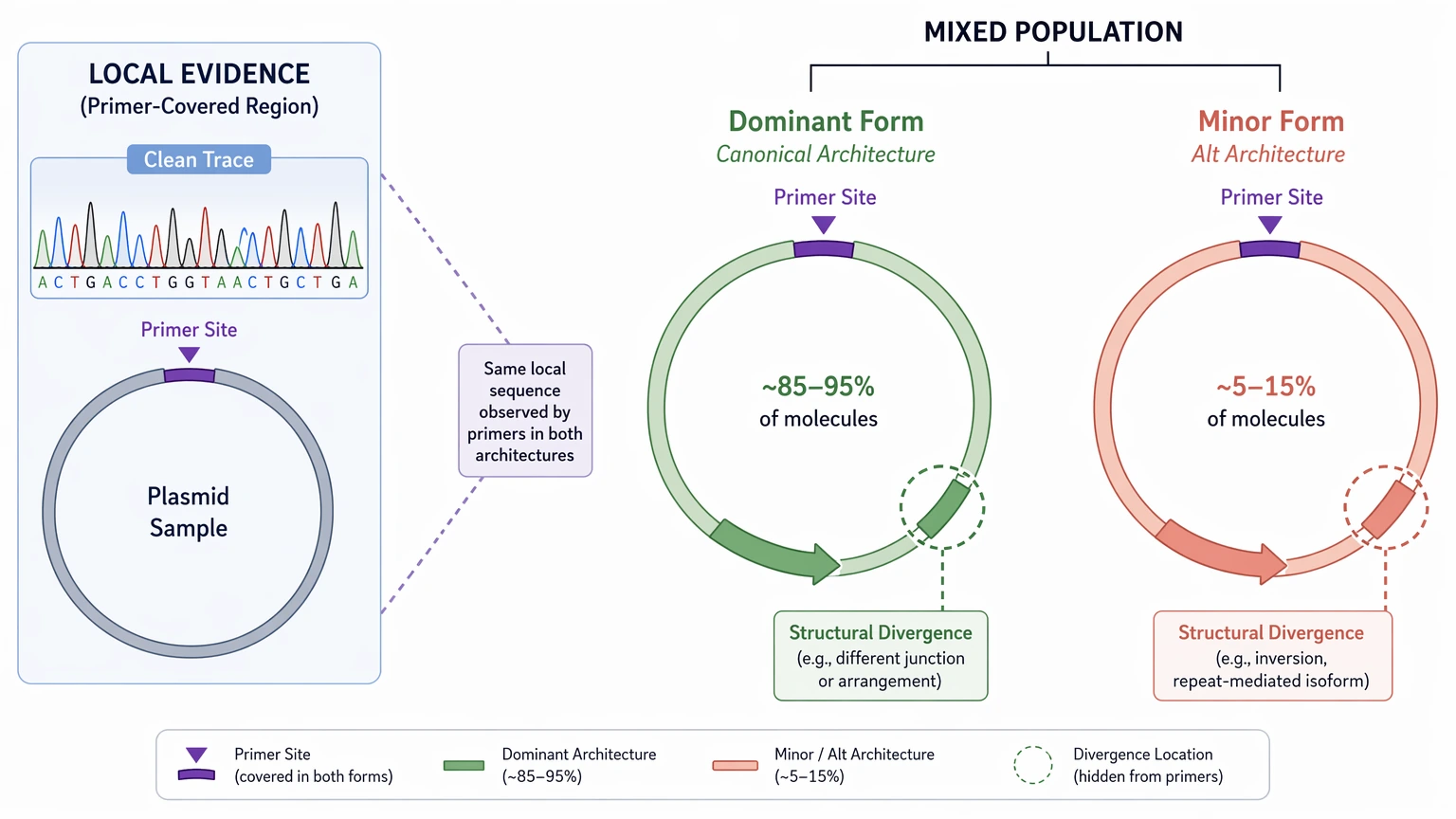
Mixed forms can survive routine QC
A mixed plasmid population does not always produce an obviously chaotic chromatogram. One dominant form may look clean at the primer-covered site while a minority or alternative form differs elsewhere. For release decisions, that is a real risk, not just a trace-quality nuisance.
Functional failure can expose hidden construct problems
When expression, editing, or packaging performance fails even though local reads look right, the plasmid itself becomes a credible source of error. At that stage, another small confirmation step often adds time without resolving the main uncertainty.
When to escalate instead of repeating primer walking
The practical question is straightforward: would the untested regions change your go or no-go decision?
Another round of primer walking is still reasonable when the unknown region is narrow, the expected map is stable, there are no complex repeats, and all critical junctions except one small gap already have direct support.
Escalation to de novo plasmid sequencing makes more sense when the unknown is structural, not just local. Common triggers include:
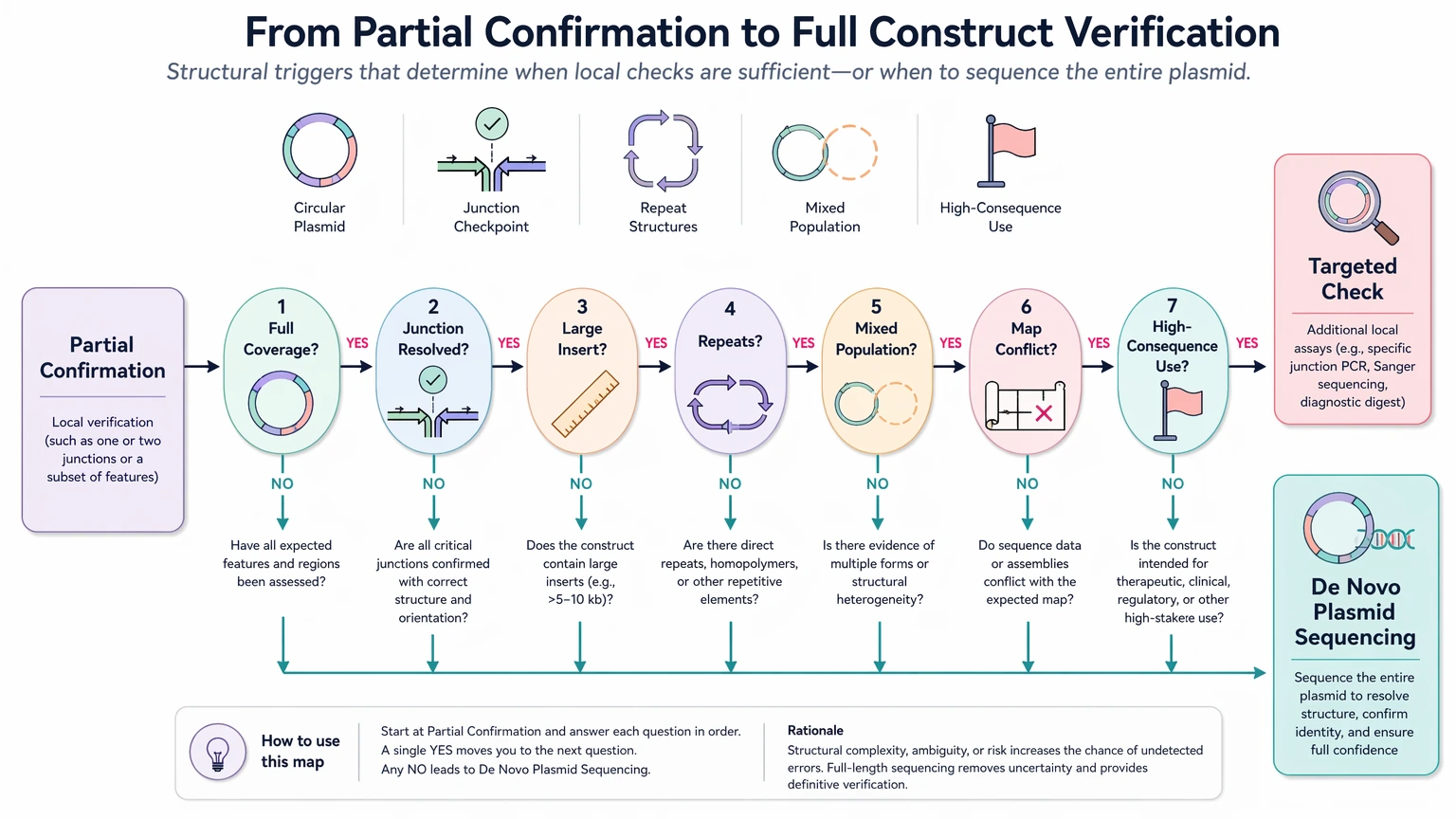
- incomplete coverage across the full circular construct
- one or more unresolved backbone-insert junction regions
- large payloads with sparse primer coverage
- suspected mixed plasmid population
- disagreement between expected map architecture and observed evidence
- unexplained changes after propagation
- release into high-consequence workflows or partner handoff
The table below helps frame that threshold.
| Scenario | Recommended workflow | Key limitation | Validation need |
|---|---|---|---|
| Small plasmid with clean junction coverage and no repeats | One more targeted check may be enough | Untested backbone segments can still remain | Confirm that critical regions are directly covered |
| Large insert with limited primer windows | Escalate to de novo plasmid sequencing | Local reads do not reconstruct full order | Recover a supported circular assembly |
| Repeat-rich or recombination-prone design | Escalate to untargeted full-construct verification | Local reads may miss collapse or duplication | Review continuity and structural calls |
| Suspected mixture after propagation | Escalate before release | Dominant traces can obscure alternative forms | Distinguish one main architecture from a mixture |
| Functional failure with partial sequence agreement | Reassess the construct before more biology | Local correctness does not rule out structural error | Compare recovered sequence to intended design |
Use the table as a release screen, not as a universal rule. Simple constructs in lower-risk settings may not need full de novo work. High-stakes handoff decisions often do.
Service Routes to Consider
For this project scenario, readers usually compare these service routes before requesting a quote or submitting samples.
A practical project-planning path for de novo plasmid sequencing
1. Define the release decision first
Start with the downstream use. A plasmid headed into exploratory internal work does not need the same evidence package as one entering viral production, stable cell line generation, animal dosing, or tech transfer.
2. Map existing evidence to actual coverage
List every assay already run and mark exactly what each one tested. This step often shows that the team has confirmation of identity at a few landmarks, but not proof of the complete structure.
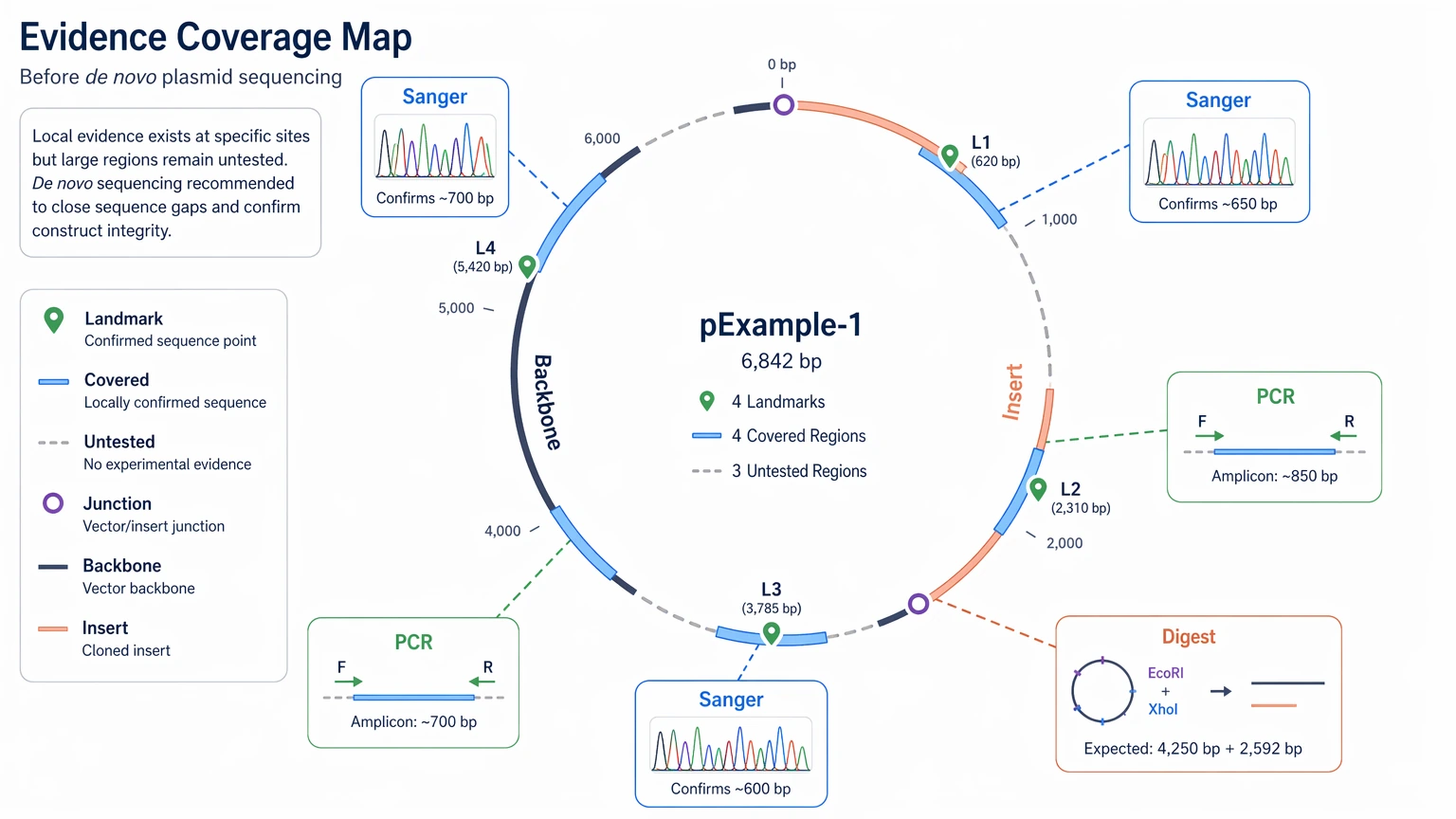
3. Decide whether the unanswered regions still matter
If an untested segment could alter function, module copy number, orientation, or backbone integrity, the current package is not yet full construct verification.
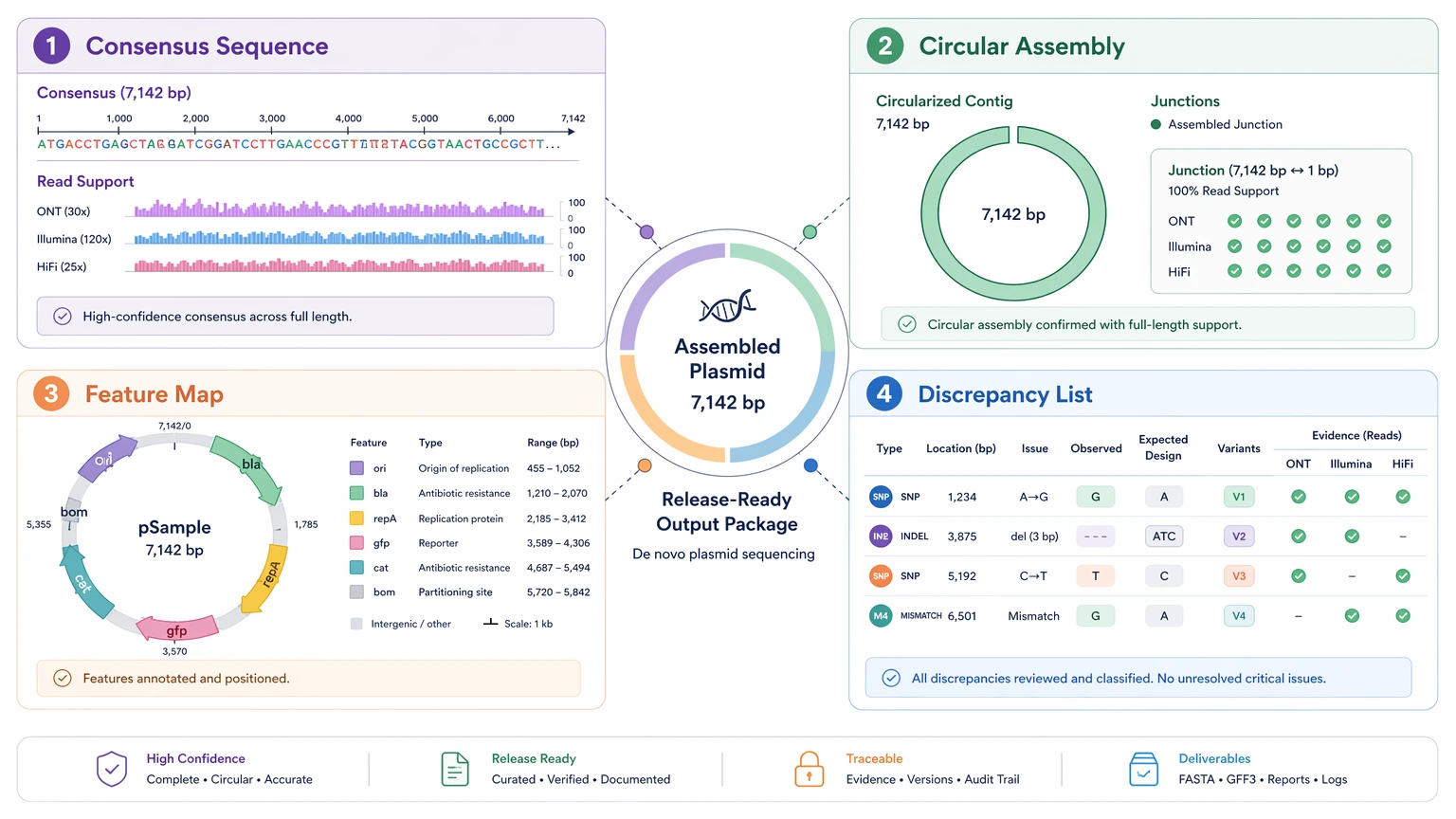
4. Define the de novo output before submission
For release decisions, raw reads alone are not the most useful output. What matters more is a recovered consensus sequence, an evidence-backed circular assembly, a feature map comparison against the intended design, and a clear sequence discrepancy list with local read support.
5. Prepare project context early
Useful inputs include the expected map, plasmid size, host strain history, prior Sanger traces, digest results, and the exact downstream release question. If your team needs that evidence reviewed against an actual release decision, submit your requirements to MtoZ Biolabs to evaluate your project around construct complexity, current data gaps, and the most decision-relevant deliverables.
Expected results and how to validate them
A successful escalation does not just add more sequence. It changes the quality of the release decision.
Immediate deliverables
You should expect:
- a recovered full-length plasmid sequence or a clearly stated confidence boundary
- continuity assessment across each critical backbone-insert junction
- a feature map alignment against the expected construct
- a defined list of sequence discrepancy findings
- region-level read support notes for ambiguous or weakly supported segments
- an assessment of whether one dominant construct or a mixed plasmid population is more consistent with the data
Follow-up confirmation
Some results still need a second layer of review before release. For example:
- a critical discrepancy near a promoter, coding sequence, or homology region may justify targeted follow-up sequencing
- a possible low-level mixture may require clone isolation or repeat testing
- an architecture that is sequence-correct but still functionally weak may need orthogonal biological confirmation
Put differently, de novo reconstruction can strengthen the sequence decision, but it does not replace every downstream functional check.
Key cautions and practical limits
Sample condition still affects interpretability. Degraded plasmid DNA, low input, or contaminating nucleic acids can lower confidence in the recovered structure or increase the chance that repeat work will be needed.
Controls and repeat expectations matter too. If the construct will seed a production workflow, sequence the actual release candidate and keep traceable links to prior chromatograms, maps, and clone history. A clean result from a related clone is not always enough.
Batch effects and contamination risk should remain under review, especially after propagation, re-transformation, or plasmid prep from uncertain source material. A mixed plasmid population can reflect biological instability, handling issues, or both.
Interpretation also has limits. A reported consensus sequence is strongest where direct read support is dense and continuous. Regions with repeats, structural ambiguity, or sparse support may still need cautious interpretation rather than a blanket release decision.
Sometimes another method is the better next step. If the unresolved issue is only a short gap in an otherwise stable construct, more primer walking may be faster. If the problem is clone instability, contamination control, or repeated mismatch to design intent, rebuilding the construct or seeking outside review may be more efficient than extending partial confirmation again.
Conclusion
Partial confirmation stops being enough when the remaining uncertainty is structural and the plasmid is about to enter a costly or hard-to-repeat stage. The main triggers are unresolved junctions, complex or repeat-rich architecture, suspected mixtures, and cases where local sequence agreement is being treated as proof of whole-plasmid integrity. In those settings, de novo plasmid sequencing supports a stronger release decision by moving the evidence standard from isolated matches to full-construct recovery, discrepancy review, and architecture-level validation. That approach is especially relevant for synthetic biology builds, vector development programs, donor constructs, and external handoff projects where local confirmation leaves too much open. If that matches your situation, contact MtoZ Biolabs to discuss the construct map, prior reads, and release context so the team can help evaluate your project before the plasmid moves further downstream.
FAQ
Can a plasmid pass Sanger confirmation and still fail construct verification?
Yes. Sanger confirmation can verify the regions the primers actually read, while construct verification asks whether the entire plasmid matches the intended architecture. The two are related, but they are not equivalent.
Which discrepancies usually matter most before vector packaging or cell engineering?
Changes in insert orientation, missing or duplicated modules, altered junctions, and backbone-level mutations near functional elements usually matter more than a single uncertain base in a noncritical region.
Does a clean restriction digest remove the need for de novo plasmid sequencing?
Not by itself. A digest can support an expected map pattern, but it may miss smaller structural changes, junction errors, or alternative forms that preserve overall fragment sizes.
What should a handoff-ready plasmid report include?
At minimum, teams usually need the recovered sequence, a comparison to the intended map, a list of discrepancies, junction-level evidence, and clear notes on any low-confidence regions that could affect release.
When is rebuilding the plasmid smarter than sequencing it again?
Rebuilding becomes the better next step when repeated propagation changes the construct, mixtures keep returning, or the expected design itself is uncertain enough that another confirmation round will not resolve the underlying problem.
How to order?




