






Confirming Mature Protein Starts: N-Terminal Sequencing for Processing Site Verification and Lot Release
Introduction
Recombinant proteins rarely begin exactly where the gene sequence starts. Signal peptides are removed during secretion. Propeptides may be cleaved before the mature form becomes active. Expression systems can leave unintended N-terminal extensions or fail to remove leader sequences as expected. For QC and release teams, the critical question is often not the full primary structure but a narrower one: where does the mature protein actually start?
N-terminal sequencing answers that question by reading amino acid order directly from the accessible N-terminus of a purified protein or peptide. The method supports lot release, clone verification, biosimilar comparability, and documentation when terminal evidence is required. Unlike whole-protein sequencing, the workflow focuses on the first residues at the protein N- terminus rather than reconstructing the entire chain.
Teams evaluating whether a sample can support reliable N-terminal confirmation should define the QC question, expected read length, and documentation standard before choosing a specific analytical route. MtoZ Biolabs can Review N-terminal sequencing feasibility across Edman and MS workflows before samples are prepared or submitted.
Related Services
| Customer Need | Recommended Service Direction |
| Need N-terminal sequence analysis | N-Terminal Sequencing Service |
| Need Edman degradation protein sequencing | Protein Sequencing Service by Edman Degradation |
| Need Edman-based N-terminal workflow | Edman Degradation for N-Terminal Sequence Analysis Service |
| Need blocked N-terminus handling | N-Terminal Sequencing (N-Terminal Unblocked) Service |
| Need MS-based N-terminal confirmation | MS-Based Protein N-Terminal Sequence Analysis Service |
| Need biopharmaceutical N-terminal QC | Biopharmaceutical N-Terminal Sequencing Service |
What N-Terminal Sequencing Confirms
At its core, N-terminal sequencing confirms the amino acid sequence beginning at the free N- terminus of a purified protein or peptide. This differs from database-assisted Peptide Mapping Service, which asks whether observed peptides match a reference entry across the full sequence. It also differs from De Novo Protein Sequencing Service, which assembles primary structure when no reference exists.
N-terminal sequence analysis is especially relevant when researchers need to:
-
confirm that a recombinant product begins with the expected mature sequence after signal peptide removal
-
verify processing of leader sequences, propeptides, or fusion tag cleavage sites
-
document N-terminal identity for batch release, tech transfer, or regulatory files
-
compare N-terminal starts between biosimilar and reference products
-
verify synthetic peptide N-terminal identity before release or downstream use
When the project requires only terminal evidence over a defined read length, N-terminal sequencing is often more direct and cost-efficient than full-length protein sequencing.
Two Main Analytical Routes
Most N-terminal sequencing projects follow one of two routes, or a combination of both.
1. Edman Degradation
Sequential chemical cycles remove and identify N-terminal residues one at a time from purified material. Each cycle produces a phenylthiohydantoin (PTH) amino acid identified typically by HPLC. Edman-based workflows are widely accepted for direct N-terminal readout when the terminus is free and unblocked.
2. MS-based N-terminal Analysis
Enzymatic digestion, enrichment, or targeted LC-MS/MS identifies N-terminal peptides and interprets mass spectrometric evidence against a reference sequence or de novo. MS routes can be preferable when the N-terminus is modified, blocked, or when broader peptide-level confirmation is needed alongside terminal evidence.
The best route depends on N-terminal accessibility, sample purity, expected read length, and whether cycle-based or mass spectrometric evidence satisfies the QC standard.
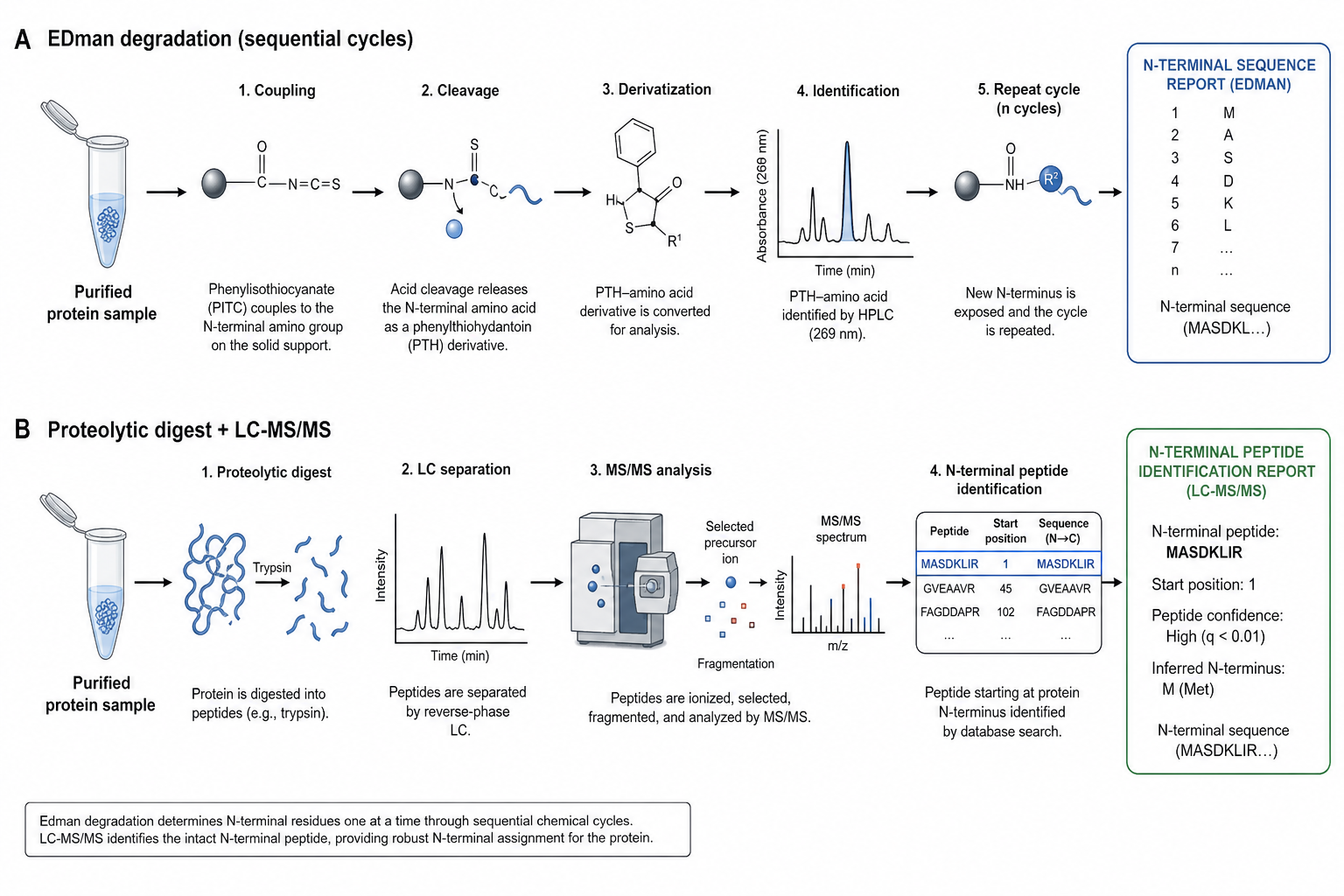
Figure 1. N-terminal sequencing projects typically follow Edman degradation, MS-based analysis,or a combined route depending on sample chemistry and QC requirements.
How Processing Site Verification Works in Practice
Processing site verification is one of the most common drivers for N-terminal sequencing in recombinant protein QC.
A typical workflow begins with expression of a construct that includes a signal peptide or fusion tag. After purification, the team expects the mature product to begin at a defined residue. Intact mass alone may confirm approximate molecular weight but often cannot prove which residue is truly N-terminal, especially when multiple processing variants are possible.
N-terminal sequencing reads outward from the observed N-terminus and compares the result against the expected mature start. A match over three to ten residues is often sufficient for internal QC. Biopharmaceutical projects may require longer reads or orthogonal confirmation depending on SOP.
Common processing scenarios include:
1. Secreted recombinant proteins. Confirm signal peptide cleavage and mature start after export.
2. Fusion protein cleavage. Verify tag removal and expected N-terminal sequence after enzymatic or chemical cleavage.
3. Propeptide activation. Confirm that the biologically active form begins at the intended residue.
4. Synthetic peptides. Verify N-terminal sequence before release when identity at the terminus is the decision point.
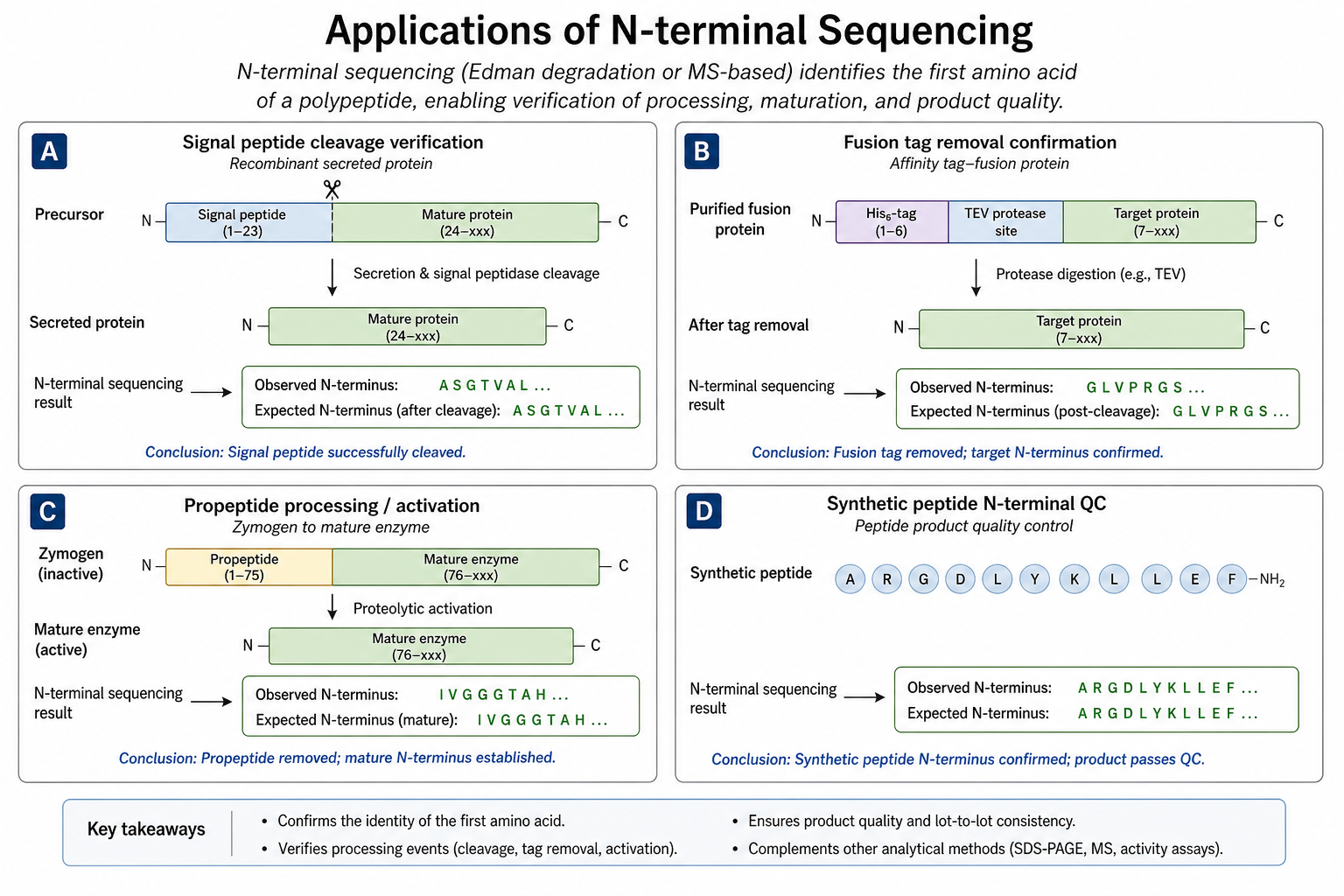
Figure 2. Signal peptide removal, tag cleavage, and mature start confirmation are common N-terminal sequencing applications in recombinant QC.
One Edman Cycle in Brief
When Edman degradation is selected, each cycle includes three core steps relevant to N-terminal readout quality.
1. Coupling
Phenyl isothiocyanate (PITC) reacts with the free N-terminal alpha-amino group.
2. Cleavage
The N-terminal amino acid is released under controlled acid conditions, exposing the next residue.
3. Identification
The cleaved residue is converted to a stable PTH-amino acid and identified, most commonly by reversed-phase HPLC comparison with standards.
Repeating these cycles builds a sequential N-terminal read. Automated protein sequencers perform coupling, cleavage, conversion, and PTH delivery in programmed cycles with logged residue assignments.
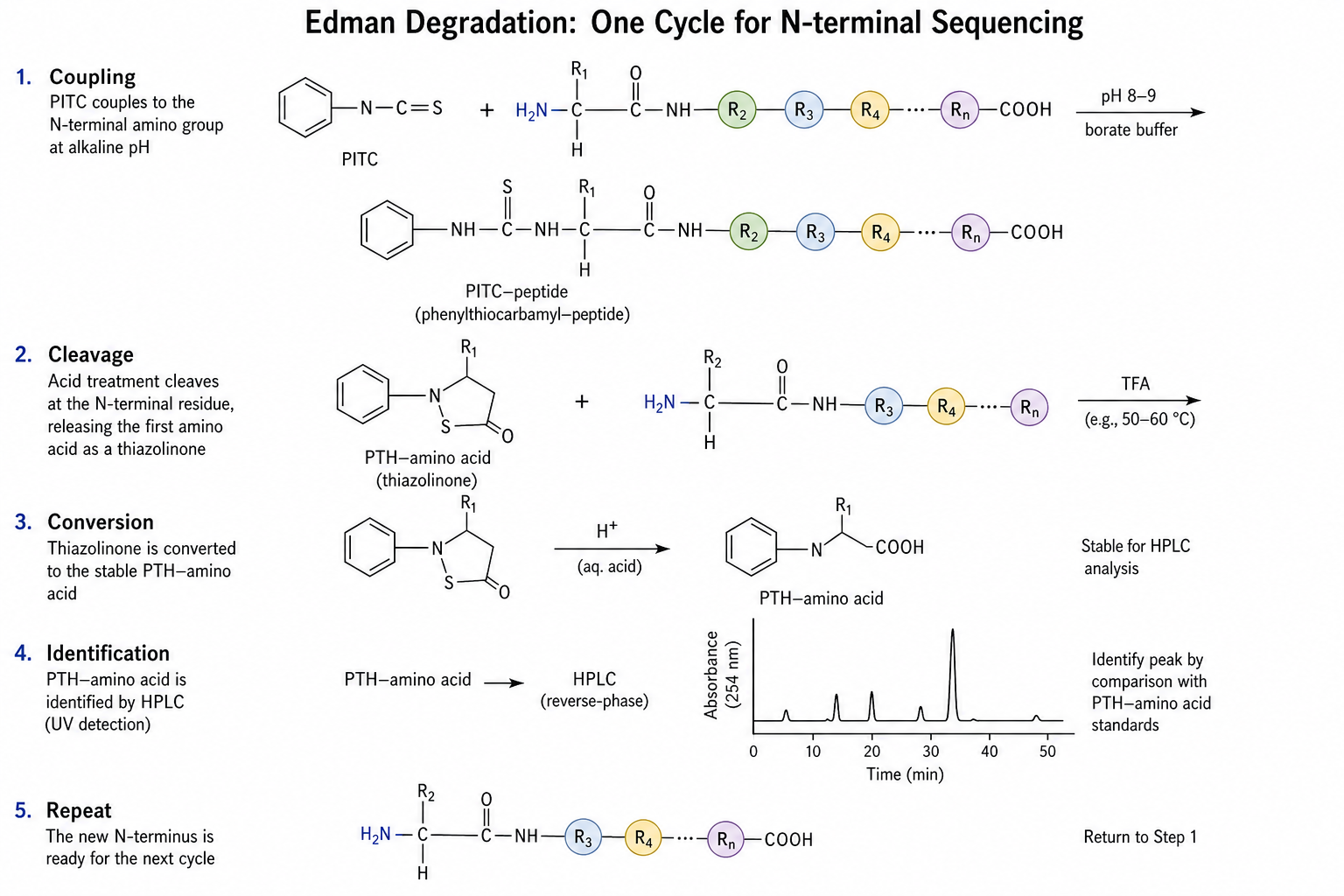
Figure 3. Edman-based N-terminal sequencing builds sequence evidence one residue per cycle from the free N-terminus outward.
Read quality depends on sample purity, N-terminal blocking status, cycle efficiency, and instrument sensitivity. Highly pure material with an accessible N-terminus generally produces the cleanest early-cycle data.
Sample Requirements for Reliable N-Terminal Reads
N-terminal sequencing performance depends heavily on sample quality at submission.
1. Purity
Co-purifying proteins or overlapping HPLC peaks can dominate sequencer or MS response and obscure the target N-terminus.
2. N-terminal Accessibility
Acetylation, pyroglutamate formation, or other blocking modifications may prevent standard Edman coupling unless pretreatment is applied.
3. Sample Format
Liquid purified protein, HPLC fractions, and PVDF gel bands can all be suitable when purity and load are adequate.
4. Target Sequence Information
Providing the expected N-terminal sequence helps providers assess feasibility and compare results during verification projects.
For blocked or modified termini, N-Terminal Sequencing (N-Terminal Unblocked) Service or MS- Based Protein N-Terminal Sequence Analysis Service may be required before a confident read is obtained.
Expected Deliverables
A strong N-terminal sequencing report should include more than a residue list. Useful deliverables often include:
-
assigned N-terminal sequence over the requested read length
-
method notes indicating Edman, MS, or combined analysis
-
signal quality or confidence comments for early residues
-
comparison against provided target sequence when verification is the goal
-
recommendations for orthogonal confirmation if ambiguity remains
Researchers should define expected read length during scoping. A lot release project may require only the first five to ten residues, while a characterization project may request a longer read if sample quality supports it.
Advantages and Limitations
1. Advantages
(1) Focused QC evidence. N-terminal sequencing answers a defined terminal question without full primary structure assembly.
(2) Established acceptance. Direct N-terminal data are widely used in protein and biopharmaceutical QC workflows.
(3) Flexible route selection. Edman and MS routes can be matched to sample chemistry and documentation needs.
(4) Efficient for mature start confirmation. Short reads often satisfy processing site verification requirements.
2. Limitations
(1) Requires accessible N-terminus for Edman. Blocking modifications can stop cycle-one coupling unless treated.
(2) Limited read length by Edman. Signal often fades after a practical number of cycles.
(3) Not a substitute for full sequence confirmation. Internal or C-terminal regions require other methods.
(4) Leu/Ile ambiguity in Edman. Standard PTH-HPLC systems often cannot distinguish leucine and isoleucine.
Frequently Asked Questions
1. How is N-terminal sequencing different from full protein sequencing?
N-terminal sequencing confirms sequence from the N-terminus over a defined read length. Full protein sequencing assembles primary structure across the entire chain.
2. Can N-terminal sequencing confirm signal peptide removal?
Yes. When the mature start is known or predicted, a short N-terminal read can verify that processing occurred as expected.
3. What sample types are suitable?
Purified proteins, peptides, PVDF blots, and some HPLC fractions can be suitable when purity and N-terminal accessibility are acceptable.
4. What if the N-terminus is blocked?
Blocking modifications may require pretreatment or an MS-based route before standard Edman analysis can proceed.
5. Does N-terminal sequencing prove full protein identity?
No. It confirms N-terminal sequence over the read length obtained. Broader identity may require peptide mapping or additional methods.
Conclusion
N-terminal sequencing provides direct evidence for mature protein starts, processing site verification, and terminal identity when purified material is available and the QC question is focused on the N-terminus. By matching Edman or MS routes to sample chemistry and documentation requirements, teams can obtain terminal data that supports lot release, clone verification, and biopharmaceutical QC without full primary structure assembly.
For N-terminal confirmation, processing site verification, or release testing support, MtoZ Biolabs provides N-Terminal Sequencing Service with feasibility review, route selection, and report-ready deliverables. Contact the technical team to evaluate sample purity, blocking status, and expected read length before submission.
How to order?




