






Biological Fluid Antibody Analysis vs Mass Spectrometry: Method Selection and Research Use Cases
Quick Answer: Which Method Should a Research Team Choose?
Start with an antibody-based workflow when the research question is about detecting or comparing a known antibody-related signal in a biological fluid such as serum, plasma, CSF, or saliva. Typical examples include measuring total antibody, an antigen-specific antibody, or an isotype / subclass pattern across study groups. Choose mass spectrometry when the question requires molecular identity, peptide-level identification, distinction between intact and fragmented species, assessment of a post-translational modification, or clarification of ambiguous binding data. Use both in sequence when the study needs high-throughput screening first and molecular confirmation second.
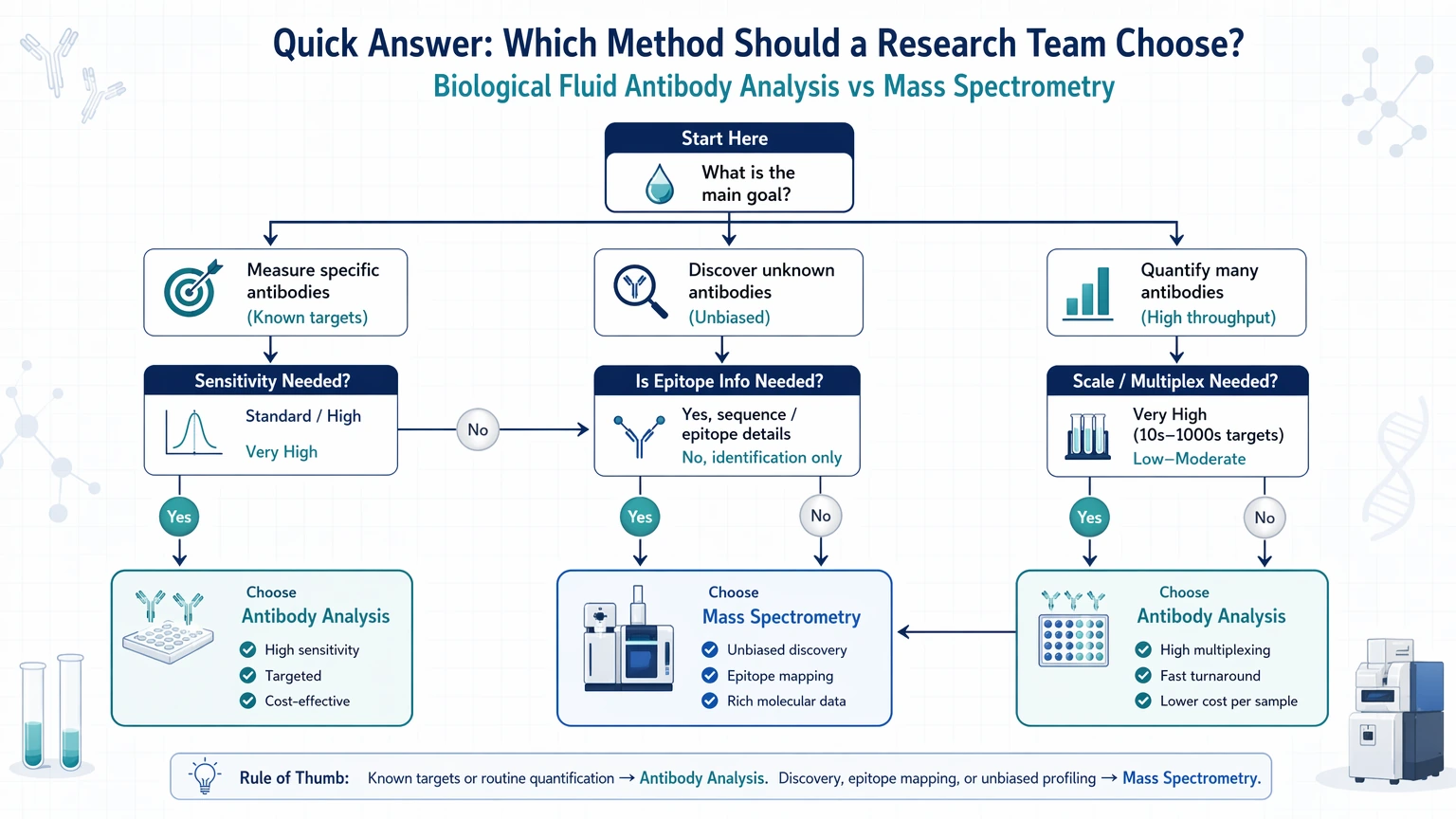
That is the practical answer to biological fluid antibody analysis vs mass spectrometry: method selection should follow the claim your analytical readout must support. If you need a binding- or abundance-oriented answer, an immunoassay-style workflow is often the most direct starting point. If you need structural or composition-level evidence, move to targeted MS, untargeted / discovery MS, or intact mass / fragment analysis. If one platform answers only part of the question, plan orthogonal validation from the start.
Biological Fluid Antibody Analysis vs Mass Spectrometry: What Is the Real Difference?
These methods do not measure the same thing, even when they use the same sample.
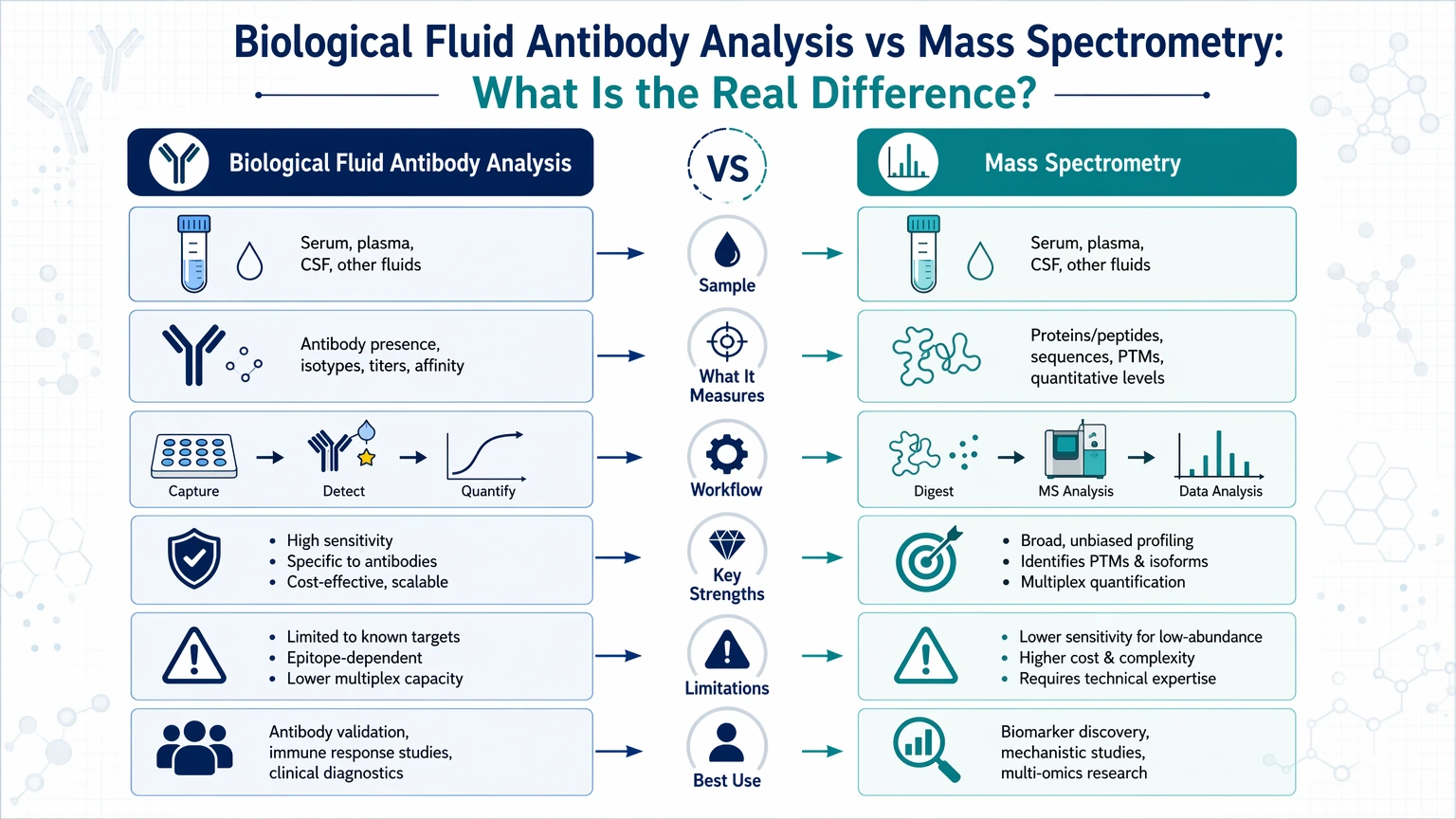
In biological fluid studies, antibody analysis is usually a binding-based measurement. In practice, that often means an immunoassay format designed to detect a known target, compare relative signal between groups, or estimate the presence of a specific antibody class. The readout reflects how assay reagents capture a target-related signal. That signal may represent total abundance, target engagement, subclass distribution, or an affinity / binding signal, but it does not by itself prove the exact molecular composition of what generated the signal.
Mass spectrometry, by contrast, measures ions derived from molecules or molecular fragments. Its readout is not based on binding. It is based on mass, fragmentation pattern, chromatographic behavior, and method design. In antibody-related work, MS can support surrogate peptide quantitation, sequence confirmation, fragment mapping, proteoform separation, or detection of coexisting proteins that may confound immunodetection.
This distinction matters because many studies run into interpretation problems rather than assay failure. A strong immunoassay signal can still leave open questions about cross-reactivity, immune complex interference, degradation, or whether the signal came from intact antibody rather than fragments. A well-designed MS workflow can address those questions, but it may not be the most efficient way to screen a large cohort for a known antibody response.
What Biological Questions Can Antibody-Based Analysis Answer Best?
Antibody-based workflows are often the operational starting point when the biological question is already well defined.
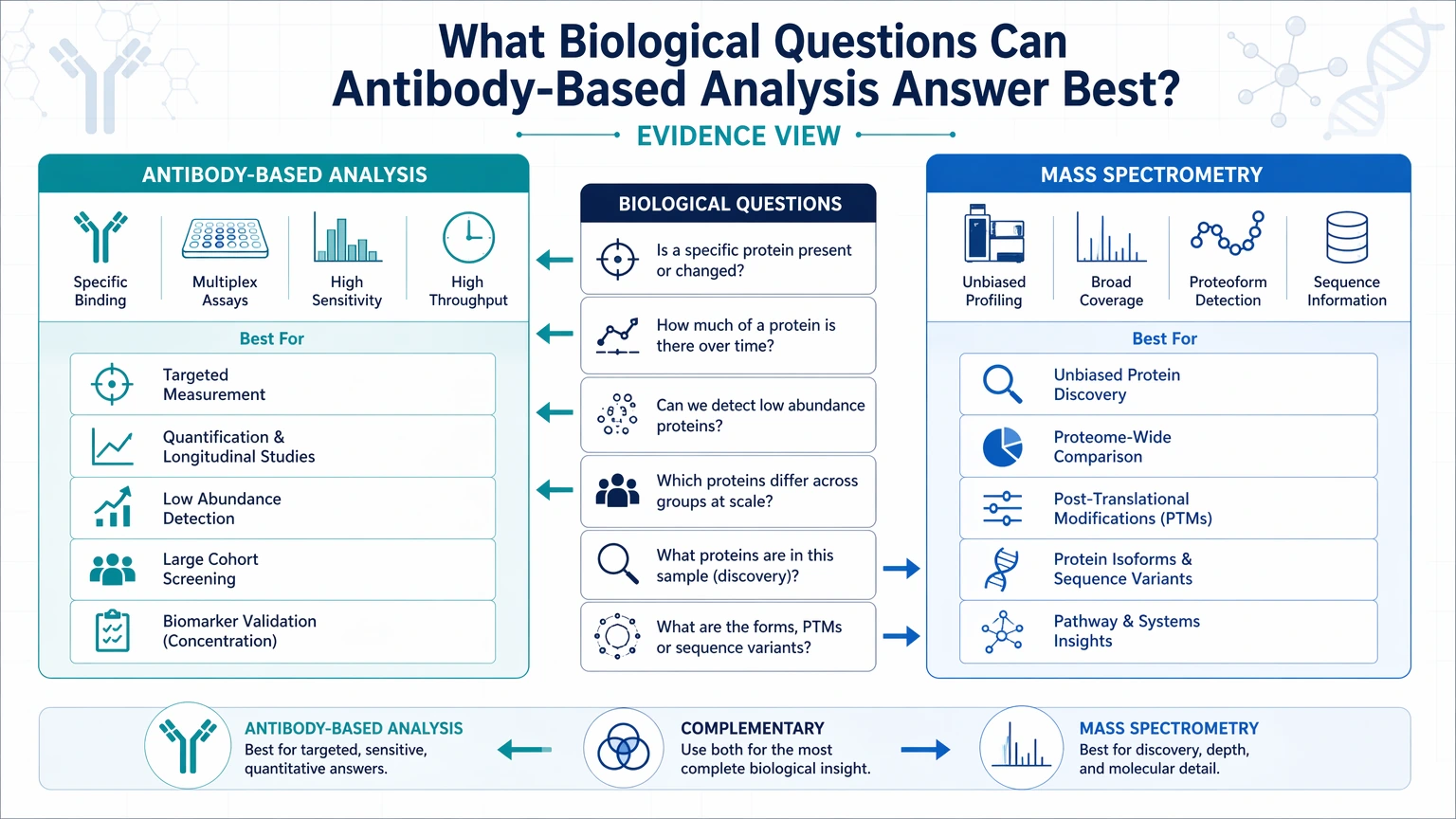
They are commonly selected when teams need to:
- compare antigen-specific antibody responses across study groups
- estimate total antibody levels in serum or plasma
- track isotype / subclass shifts
- evaluate relative response patterns over time
- screen many samples for the presence of a known signal
- support translational studies where the next decision is cohort stratification rather than structural characterization
In these settings, the main value of the assay is a practical readout at useful throughput for a predefined target.
Where antibody analysis is strongest
Known analyte, known question. If the target is defined and the project asks who has more or less of a given signal, immunoassay-style detection is often the most direct option.
Cohort comparison. In preclinical and translational research, antibody analysis can support broad comparisons across treatment arms, time points, or exposure groups.
Lower sample burden in some formats. Many antibody assays can work with limited biological fluid volume, which matters for CSF, pediatric samples, serial collection designs, or scarce biobank material.
Simpler reporting for some endpoints. If the goal is relative comparison, research-use thresholding, or trend analysis rather than molecular characterization, the reporting framework may be easier to implement.
Limits to keep in view
The main limitation is that the readout is indirect. It depends on reagent behavior and assay design.
Common ambiguity sources include:
- cross-reactivity with related antigens or proteins
- non-specific binding
- altered epitope exposure caused by complex formation or sample handling
- limited ability to distinguish intact antibodies from fragments
- difficulty separating multiple related forms within a single signal window
For that reason, antibody analysis is highly useful for targeted detection, but it does not replace molecular confirmation when signal attribution is uncertain.
What Questions Require Mass Spectrometry Instead?
Mass spectrometry becomes more informative when the study needs a molecular answer rather than a binding answer.
Typical reasons to select MS include:
- the need to distinguish intact antibody from fragments
- concern that one measured signal may reflect multiple related species
- interest in post-translational modification or glycoform state
- a need for peptide-level identification
- studies of therapeutic antibody transformation in matrix
- investigation of interference from high-abundance proteins or co-eluting components
- selective confirmation after uncertain immunoassay findings
Where MS adds information that immunoassay cannot
Molecular specificity. A targeted peptide panel or carefully designed transition list can assign signal to a defined molecular feature rather than to binding alone.
Resolution of heterogeneity. MS can separate or characterize fragments, subclasses, modified forms, and other proteoform differences that may collapse into a single immunoassay signal.
Support for unknown or mixed states. In exploratory work, untargeted / discovery MS can help identify unexpected components, while targeted MS can quantify predefined molecular surrogates after candidates are established.
Orthogonal evidence. When a team needs stronger evidence that an antibody-related signal corresponds to a particular molecule or molecular state, MS often serves as the orthogonal method.
What MS does not automatically solve
MS is not a direct substitute for every antibody assay. It has its own constraints:
- sample prep may require denaturation, digestion, cleanup, or enrichment
- low-abundance targets may remain difficult without selective capture or concentration
- matrix effect and ion suppression can reduce effective sensitivity
- data analysis and method interpretation are more specialized
- throughput may be lower for deep characterization workflows than for simpler immunodetection formats
MS is therefore most defensible when the added analytical burden supports a concrete study decision.
Method Comparison Across Sensitivity, Specificity, Throughput, and Molecular Resolution
The most useful comparison is not which platform is better, but what each readout allows you to claim.
The table below summarizes the main planning implications for the method choice.
| Decision dimension | Antibody-based analysis | Mass spectrometry |
|---|---|---|
| Core analytical readout | Binding signal to a defined target or epitope | Mass/fragment evidence from peptides, proteins, or fragments |
| Best target type | Known analyte, known binding question | Molecularly defined species, heterogeneous targets, modified forms |
| Sensitivity context | Often favorable for known low-level targets when reagents perform well | Can be limited by ion suppression, recovery, and analyte complexity |
| Specificity boundary | Driven by reagent selectivity; vulnerable to cross-reactivity | Driven by transition or fragment design and sample complexity; still method-dependent |
| Multiplexing | Panel-based multiplexing is possible but reagent-dependent | Strong for targeted panels or broader discovery designs |
| Molecular resolution | Limited for fragments, PTMs, and closely related species | Stronger for proteoforms, fragments, surrogate peptides, and modifications |
| Workflow burden | Often easier to deploy for known targets | Higher prep, instrumentation, and interpretation burden |
| Throughput | Often better for large-cohort screening | Good for targeted runs; deeper characterization may reduce scale |
| Typical use | Screening, relative comparison, cohort stratification | Confirmation, characterization, interference resolution, targeted quantitation |
Use these differences to align the analytical method with the biological question and validation plan.
Two terms deserve particular attention:
- Sensitivity is not just the lowest detectable amount. In biological fluid analysis, it is shaped by matrix background, target abundance, and preparation losses.
- Specificity is not absolute. Antibody assays can lose specificity through binding interference, while MS can lose specificity through poor peptide choice, incomplete separation, or weak fragmentation evidence.
If your team is shortlisting methods, write down the exact claim you need the dataset to support. That one sentence often narrows the choice quickly. If you want outside input before committing scarce samples, you can submit your requirements at the method-selection stage rather than after a full cohort run.
How Sample Type and Matrix Complexity Affect Platform Choice
The same target can behave very differently across biological fluids, and that changes method selection.
Serum and plasma
These are common matrices for antibody detection, but they contain high-abundance proteins, circulating complexes, and potential interferents. Antibody-based assays often fit serum or plasma studies well when the question is comparative and the target is known. MS becomes more useful when the team needs to distinguish a therapeutic antibody from endogenous background, resolve fragments, or investigate why one assay signal does not match the expected biology.
CSF
CSF usually offers less material and lower analyte abundance. That can favor low-volume immunodetection for defined questions, especially in early screening. But when blood contamination, degradation, or low-level confounding species are concerns, targeted MS may be justified despite the heavier workflow.
Saliva and other low-protein matrices
Saliva can support noninvasive sampling, but signal stability and matrix composition may complicate both platforms. Antibody assays may face variable background and dilution effects. MS may face recovery challenges and may require tighter normalization or enrichment.
Urine or interstitial fluid
These matrices can support certain antibody-related or protein surrogate questions, but analyte stability and concentration become central design issues. In these cases, the decision may shift from platform preference to whether the target is directly measurable at all or whether a surrogate strategy is more realistic.
Across all matrices, method selection should reflect:
- target abundance and heterogeneity
- available sample volume
- expected interference sources
- need for relative versus molecularly attributed quantitation
- whether the endpoint is screening, confirmation, or characterization
Research Use Cases: When to Choose Antibody Analysis, Mass Spectrometry, or Both
Choose antibody analysis when the endpoint is comparative detection
Examples include:
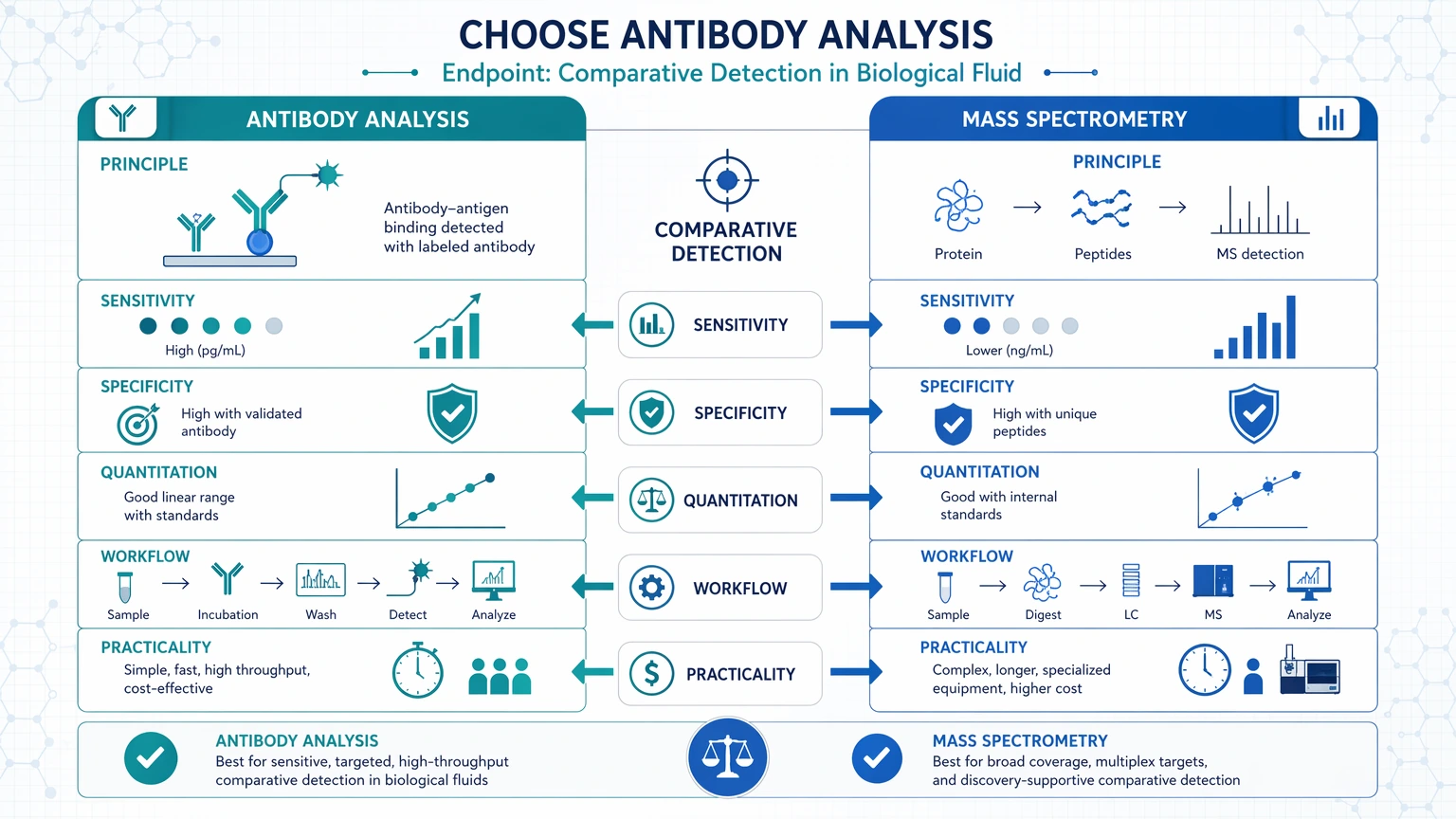
- measuring antigen-specific antibody responses across cohorts
- comparing total antibody or subclass distributions in serum or plasma
- tracking response dynamics in translational research studies
- screening large sample sets before narrowing a subset for deeper work
In these cases, the assay does not need to explain every molecular state. It needs to answer a focused biological comparison with sufficient specificity for the decision at hand.
Choose mass spectrometry when the endpoint is molecular attribution
Examples include:
- determining whether the observed signal represents intact antibody or breakdown products
- characterizing a therapeutic antibody in a biological matrix
- investigating modification state, glycosylation-related shifts, or cleavage patterns
- resolving suspected immunoassay interference
- establishing surrogate peptide measurements for targeted quantitation
This route is especially useful when project risk comes from assigning the source of a signal incorrectly.
Choose a staged combination when one platform alone leaves uncertainty
A two-step design is often the most defensible option in translational work:
1. Screen many samples with an antibody-based workflow. 2. Send selected positives, outliers, discordant cases, or representative groups for MS follow-up. 3. Use MS for orthogonal validation, fragment assessment, or structural clarification.
This design matches the common split between throughput needs and interpretive confidence. It can also reduce unnecessary MS workload by reserving molecular characterization for samples that matter most to the study decision.
A practical example is a plasma-plus-CSF study in which one subgroup needs cohort-level antibody response comparisons and another needs evidence that the detected signal is not distorted by fragments or coexisting proteins. In that setting, a staged workflow often fits the study logic better than forcing one platform to answer every question.
A Practical Selection Framework for Translational and Antibody Research Teams
Before selecting a method, answer these five questions in order:
1. What exactly is the analyte?
Is it a known antibody, a subclass pattern, an immune complex, a therapeutic molecule, a fragment mixture, or a peptide surrogate? If the analyte is not clearly defined, discovery-oriented MS or an exploratory pilot may be needed before targeted quantitation.
2. What claim must the data support?
Do you need relative comparison, presence/absence screening, targeted quantitation, or molecular characterization? A binding assay and a peptide-level assay support different claims.
3. What is the biological fluid, and how much of it is available?
Matrix composition, volume limits, storage history, and expected interference all affect whether direct immunodetection, enrichment, or digested targeted MS is realistic.
4. What is the main interpretation risk?
If the main risk is missing a low-level signal, an immunoassay may be the better starting point. If the main risk is incorrect signal attribution, MS often becomes more important.
5. Is the project endpoint a screen, a confirmation step, or a translational bridge?
Screening studies often start with antibody analysis. Characterization studies often move toward MS. Translational bridging studies often need both.
Teams that want to reduce rework often benefit from discussing this framework before locking in the first assay. MtoZ Biolabs can evaluate your project against sample matrix, target definition, and reporting needs to help determine whether an immunodetection workflow, an MS workflow, or an orthogonal plan better fits the research question.
Conclusion: Match the Method to the Claim, Not the Hype
For biological fluid antibody analysis vs mass spectrometry, the clearest rule is straightforward: use antibody-based workflows when you need a practical readout of a known antibody-related signal, use MS when you need molecular evidence, and combine them when the study requires both scale and interpretive confidence.
Antibody analysis is often the right starting point for known-target screening, cohort comparison, and subclass-oriented questions. Mass spectrometry is often the stronger option for fragment resolution, proteoform discrimination, interference review, and structural follow-up. A staged design becomes attractive when the first-line assay can rank samples but cannot fully explain what generated the signal.
No single platform answers every research question equally well across serum, plasma, CSF, saliva, and other matrices. The more your endpoint depends on proving molecular identity, the more likely MS belongs in the workflow. The more your endpoint depends on scalable comparison of a defined target, the more likely an immunoassay-style format belongs first.
If your team is choosing between screening, confirmation, and characterization strategies, contact us to discuss sample type, analytical readout, and workflow fit. MtoZ Biolabs can help map the study question to a research-use-only analysis plan before full method commitment.
FAQ
Can mass spectrometry measure antigen-specific antibodies directly?
Sometimes, but not in the same way an immunoassay measures a binding event. MS usually detects peptides or other molecular features derived from the antibody or associated components. If the core question is antigen-specific binding across cohorts, an immunoassay is often the more direct starting point. MS becomes more useful when you need identity confirmation, fragment detection, or characterization of modified forms after the initial screen.
When is targeted MS better than untargeted / discovery MS for antibody-related work?
Use targeted MS when the analyte is already defined and the study needs selective measurement of known peptides, fragments, or surrogate markers across a sample set. Use untargeted / discovery MS when the source of the signal is still unclear, when unexpected species may be present, or when the goal is to identify candidate molecular features before building a narrower assay.
Does an immunoassay always require less sample prep than MS?
Often, but not always. Some biological fluid samples still need dilution control, pretreatment, depletion, or interference management before immunodetection. MS usually carries a heavier sample prep burden because digestion, cleanup, and sometimes enrichment are built into the workflow. The more useful comparison is not bench time alone, but the total effort required to produce an interpretable result.
What should teams do when immunoassay and MS results disagree?
First, confirm that the two methods are measuring the same molecular entity. A binding assay may detect an epitope present on intact and partially degraded species, while MS may quantify only one surrogate peptide from the intact form. Then review matrix effects, cross-reactivity, recovery, digestion efficiency, and calibrator design. Discordance often signals underlying sample heterogeneity rather than a simple technical failure.
Is orthogonal validation necessary for every biological fluid antibody study?
No. It is most useful when the project carries high interpretation risk, when the result could drive a major next-step decision, or when matrix complexity raises doubt about signal attribution. For straightforward cohort comparisons with a stable known target, antibody analysis alone may be sufficient for the research objective. For disputed or high-consequence findings, orthogonal validation can reduce overinterpretation.
Service Routes for Study Planning
For teams moving from method selection into execution, these service paths connect assay design, validation, and interpretation needs.
How to order?




