



Choose AQUA peptides when absolute peptide amount must be measured by isotope dilution inside the same matrix and LC-MS/MS run as the endogenous analyte; choose external standards when a calibration curve outside the sample is enough for a relative instrument response scale, accepting that matrix effects and recovery are not automatically corrected (Gerber et al. 2003). AQUA uses matched heavy stable isotope-labeled peptides as internal standards; external standards are usually neat or surrogate-matrix calibrators injected separately. Prefer AQUA for closed-panel absolute claims in complex digests; prefer external curves for rough response checks or when heavy peptides are unavailable; keep relative LFQ, DIA, or TMT when fold change alone suffices.
Researchers who already have a closed target list and required reporting units can also review the MtoZ Biolabs Absolute Quantitative Analysis (AQUA) Service and Targeted Proteomics Service for project-specific feasibility and assay planning.
Comparison at a Glance
Dimension |
AQUA peptides (SIS internal standards) |
External standards (unlabeled calibrator curve) |
|---|---|---|
Standard type |
Stable isotope-labeled synthetic peptide |
Unlabeled peptide at known amounts |
Quantitation logic |
Light-to-heavy ratio in the sample |
Sample response mapped to an external curve |
Where the standard sits |
Spiked into each sample or digest at a recorded step |
Prepared as separate calibrators |
Matrix correction |
Within-run isotope dilution |
Depends on matrix matching and batch stability |
Typical strength |
Precision in complex or drifting matrices |
Lower reagent cost for small exploratory panels |
Typical limit |
Synthesis cost, spike timing, peptide-level claim |
Ionization drift and matrix mismatch |
Absolute claim |
Defensible when curve and spike rules hold |
Possible only if curve and recovery are validated |
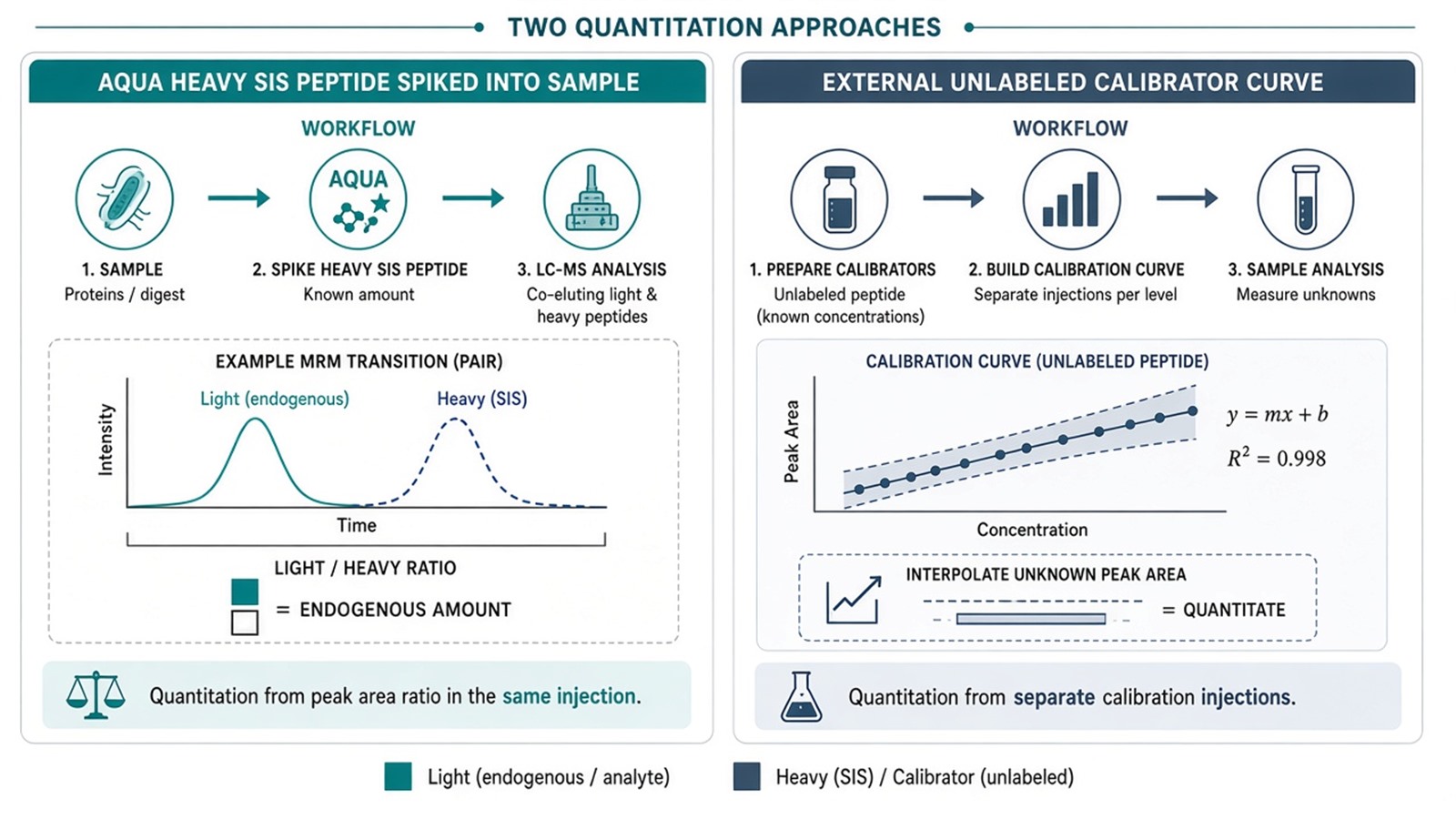
Figure 1. AQUA and external standards both aim at amount reporting, but only isotope dilution places a matched heavy control inside each sample.
Calling either route absolute without stating spike timing, calibration range, and matrix match overstates the standard name alone.
Selection Criteria for Absolute Designs
Selection question |
Prefer AQUA peptides |
Prefer external standards |
Prefer relative methods instead |
|---|---|---|---|
Is amount or concentration required? |
Yes |
Yes, if curve validation is enough |
No → LFQ, DIA, or TMT |
Is the matrix complex or variable? |
Often yes |
Only if pilot curves stay stable |
Relative discovery may be enough |
Must each sample carry an internal control? |
Yes |
No |
Not applicable |
Is panel size large and budget tight? |
Critical targets only, or hybrid |
Early screening of many surrogates |
Keep discovery open first |
Is spike before digestion part of the claim? |
Protein-level or pre-digest SIS designs |
External curve cannot capture pre-spike loss |
Redesign the claim |
Post-digestion AQUA corrects variability after the spike point. It does not automatically repair lysis or digestion losses that occurred earlier (Gerber et al. 2003). External curves inherit the same recovery limit and add between-injection response drift.
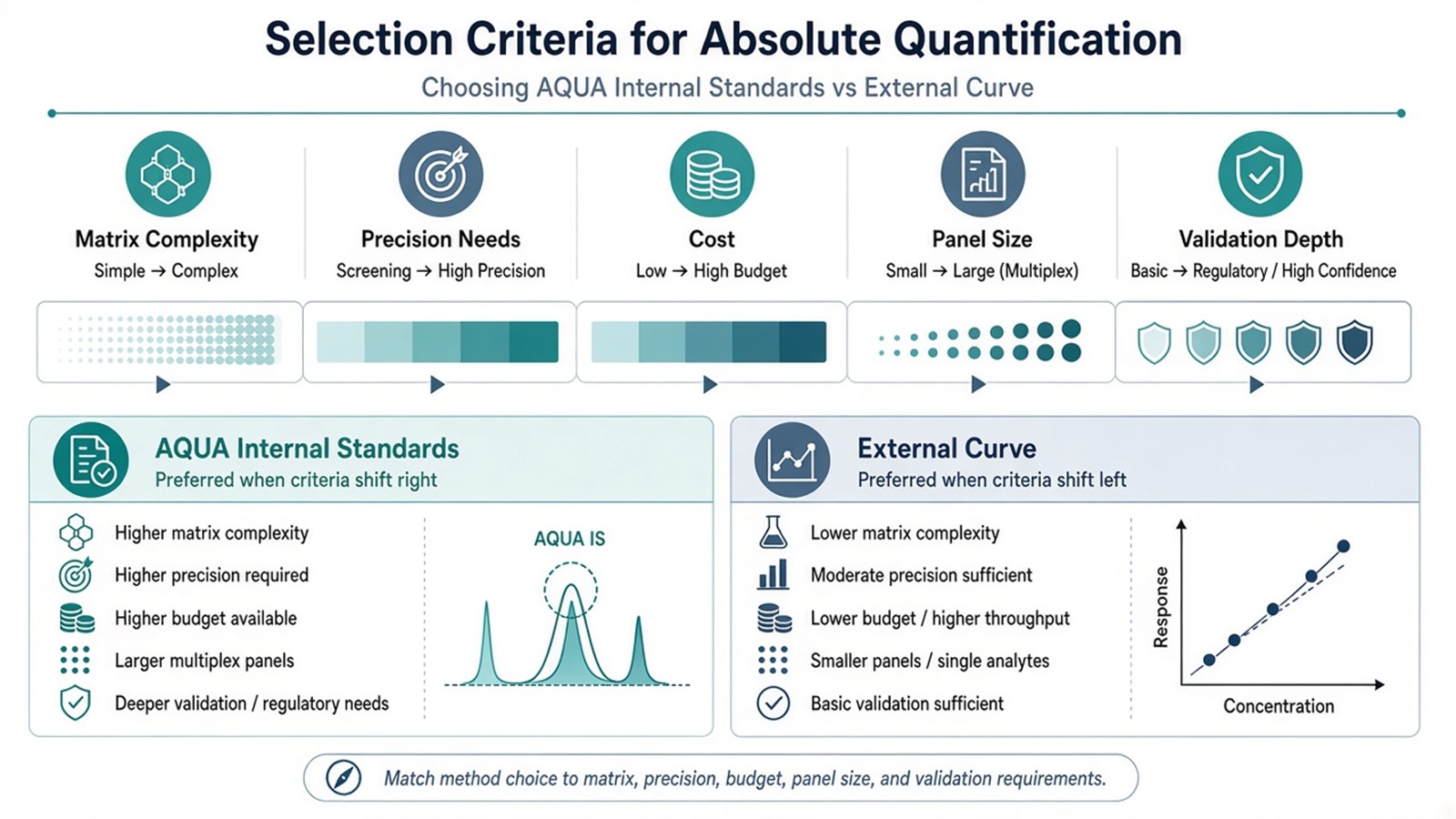
Figure 2. Choose the calibration route from matrix difficulty and reporting depth, not from reagent preference alone.
For AQUA principle and workflow, see AQUA Proteomics and Mechanism of AQUA in Protein Detection. For targeted absolute framing, see Absolute Quantification in Targeted Proteomics. For AQUA trade-offs, see Advantages and Disadvantages of AQUA Technique. For acquisition layers under absolute designs, see PRM and MRM in Targeted Proteomics: Advantages and Limitations.
Judgment Criteria: When Each Absolute Route Fits
Study need |
AQUA often fits |
External curve often fits |
Reassess |
|---|---|---|---|
Claim |
Closed-panel peptide amount with within-sample SIS |
Exploratory concentration estimate in a clean matrix |
Diagnostic cutoff without validated framework |
Matrix |
Plasma, tissue, or formulation with strong matrix effects |
Simple lysate with stable instrument response |
Recovery unknown and no pilot material |
Validation depth |
Specification, transfer, or multi-batch defensibility |
Pilot ranking before full standard investment |
Curve fails linearity or QC brackets |
Program stage |
Final validated shortlist |
Surrogate screening before ordering heavy peptides |
Inventory still open for discovery |
Prefer a hybrid when critical peptides need AQUA while secondary monitors stay on external curves during build-out. Prefer relative PRM or MRM without full calibration when confirmation trends are enough. Prefer LFQ, DIA, or TMT while candidates are still being nominated.
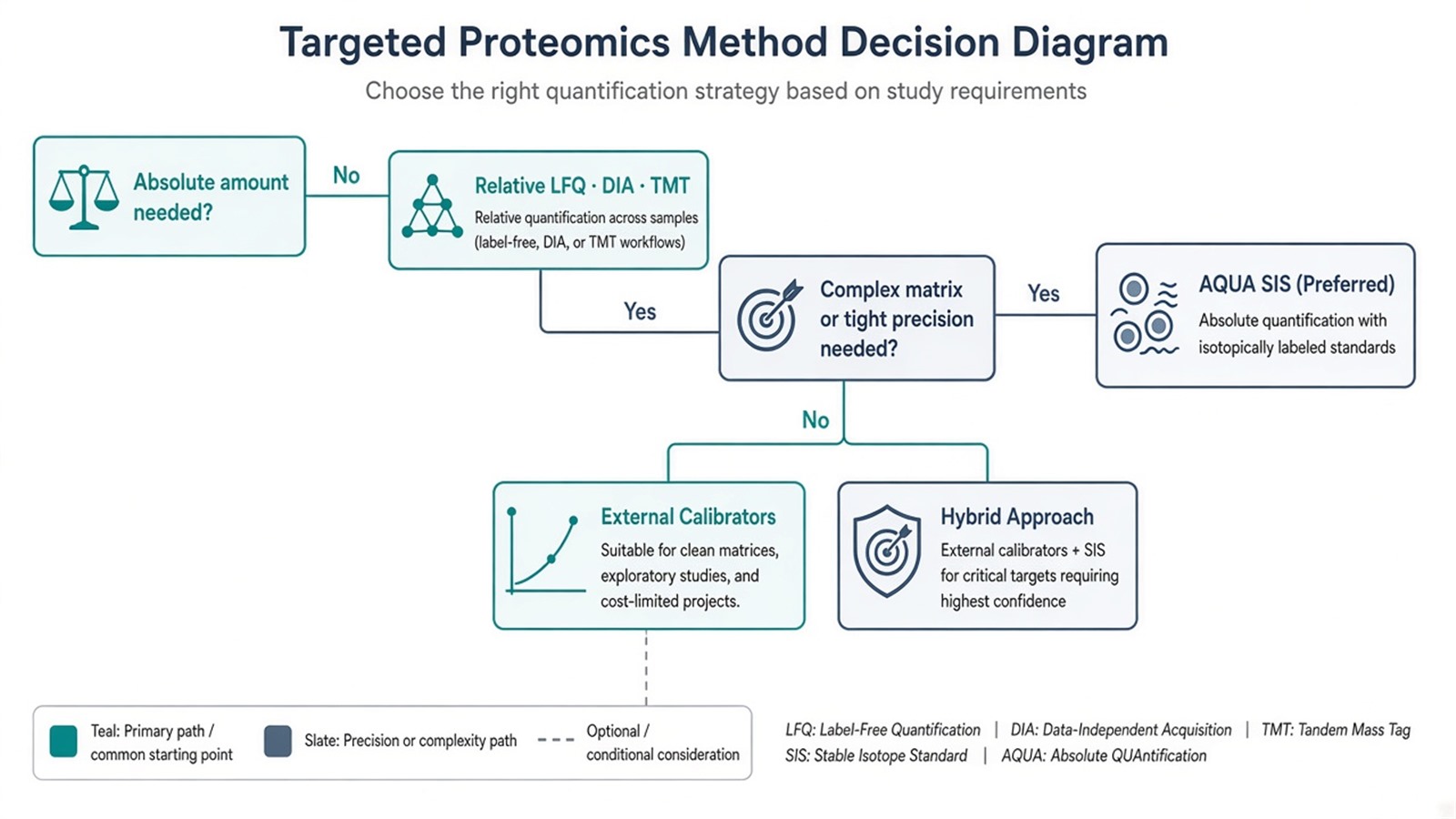
Figure 3. Absolute reporting starts only after the claim is amount-based; then matrix and precision needs decide AQUA versus external standards.
For absolute versus relative prep gates, see Absolute and Relative Quantitative Proteomics Analysis. For panel planning, see Targeted Proteomics Experimental Design and How to Plan a Targeted Proteomics Validation Study.
Limits and Application Boundaries
Neither route invents protein concentration from a poor proteotypic peptide. AQUA remains peptide-level unless digestion and enrichment support protein inference. External standards do not correct within-sample ionization the way isotope dilution can. Both need matrix-matched range, QC brackets, and declared units. Pathway enrichment is not an absolute application of either calibration model.
Typical applications:
- Plasma or tissue biomarker panels needing defended peptide concentration.
- Biopharmaceutical peptide QC where specification reporting favors SIS.
- Small clean-matrix pilots using external curves before heavy-peptide investment.
- Hybrid panels that upgrade critical targets to AQUA after external screening.
- Absolute follow-up after discovery shortlists are closed on MRM or PRM.
Diagnostic cutoffs and companion-diagnostic claims sit outside ordinary research absolute reporting unless a separately validated assay framework is in place.
Once claim type, spike or curve design, and matrix pilot rules are defined, the project can be scoped as AQUA, external calibration, or hybrid absolute quantification. Researchers can review the MtoZ Biolabs Absolute Quantitative Analysis (AQUA) Service for sample evaluation and assay planning.
Frequently Asked Questions
1. Are AQUA peptides the same as external standards?
No. AQUA peptides are heavy internal standards for isotope dilution. External standards are usually unlabeled calibrators used to build a separate response curve.
2. Which is more precise in complex matrices?
AQUA is often more precise because the heavy peptide tracks ionization inside each sample. External curves depend more on batch stability and matrix matching.
3. Can a project use both?
Yes. Hybrid designs are common: external curves for early screening, AQUA for critical or final validated targets.
4. Does AQUA automatically correct digestion loss?
Only if the standard is present before the loss you claim to correct. Post-digest spikes do not repair earlier protein losses.
5. When should I stay with relative quantification?
When fold change answers the decision and amount units are not required. Relative LFQ, DIA, TMT, or unlabeled targeted areas then fit better.
Reference
- S.A. Gerber, J. Rush, O. Stemman, M.W. Kirschner, S.P. Gygi (2003). Absolute quantification of proteins and phosphoproteins from cell lysates by tandem MS. Proc. Natl. Acad. Sci. U.S.A., 100, 6940-6945. https://doi.org/10.1073/pnas.0832254100
- V. Lange, P. Picotti, B. Domon, R. Aebersold (2008). Selected reaction monitoring for quantitative proteomics: a tutorial. Mol. Syst. Biol., 4, 222. https://doi.org/10.1038/msb.2008.61
