



An AQUA peptide assay can be fully designed yet still fail to produce a stable light-to-heavy ratio. The heavy standard peak may be weak, absent, or unstable across runs. Ratio precision may collapse while the endogenous light peptide remains easy to integrate. Neat standard response may disagree with matrix spikes. Absolute QUAntification (AQUA) peptides are sequence-matched stable isotope-labeled standards spiked at a known amount and measured with the endogenous peptide on liquid chromatography-tandem mass spectrometry (LC-MS/MS) (Gerber et al. 2003). When the heavy standard underperforms, the usual causes are purity, spike level, storage handling, spike timing, or matrix recovery of the standard itself, not instrument failure alone.
Re-running acquisition without reviewing the AQUA peptide often reproduces the same biased ratio. Absolute reporting still needs a declared calibration model and matrix-aware quality control (QC) after the standard is restored (Carr et al. 2014). Assay-level curve failures that remain after the heavy peak is healthy belong on a separate calibration recovery path.
In MtoZ Biolabs targeted offerings, AQUA peptide recovery is scoped when sequence, isotope map, spike records, chromatograms, and matrix notes are available. Service intake appears in Absolute Quantitative Analysis (AQUA) Service.
What AQUA Peptide Troubleshooting Covers
Four troubleshooting layers belong in the brief and stay separated.
Symptom layer records heavy-peak detectability, light-to-heavy replicate scatter, impurity peaks near the heavy window, and neat-versus-matrix disagreement.
Standard layer reviews sequence match, isotope pattern, purity, assigned concentration, reconstitution, aliquoting, and freeze-thaw history.
Spike layer locks amount and timing relative to digestion so the ratio measures the intended workflow segment.
Claim layer restates whether the project still needs absolute units from this surrogate, or can pause at relative confirmation while a new AQUA peptide is designed. Regulatory release language needs a separately validated method beyond a research pilot.
AQUA peptide troubleshooting restores a usable heavy reference for isotope dilution. It does not repair an unbracketed calibration curve by itself.
Failure Patterns: Purity, Spike Level, and Matrix Recovery
Weak AQUA peptide performance usually shows a recognizable pattern.
The heavy peak may sit near noise while light signal is strong. Impurity ions may enter the heavy mass or retention window and distort integration. Spike amount may be too low for stable ratio precision, or too high for the endogenous range. Working solutions may lose intact peptide after repeated freeze-thaw or unsuitable solvent. Matrix spikes may suppress heavy and light peaks differently, biasing the ratio even when both peaks remain visible. Pre-digestion and post-digestion spikes may have been mixed without revalidation.
Those patterns point to different fixes. Identity or purity failures need requalification or resynthesis. Spike-level failures need matrix titration of the heavy amount. Handling failures need fresh aliquots and documented storage. Matrix recovery failures need cleanup or matrix-matched prep before the spike amount is blamed. Principle language for AQUA peptides appears in AQUA Peptides: Principles for Absolute Quantification. Standard-selection detail appears in AQUA Peptides for Absolute Quantitation. When the heavy peak is already healthy and the curve still fails, continue with Absolute Protein Quantification Not Meeting Spec? Troubleshooting Calibration Curves, Standard Recovery, and Matrix Bias.
End-to-End Troubleshooting Workflow for an Underperforming AQUA Peptide
A practical recovery spine usually runs as follows.
- Freeze the proteotypic surrogate, reporting unit, and whether the AQUA peptide is pre- or post-digestion.
- Collect heavy chromatograms, purity or identity spectra, spike amounts, and storage records before changing settings.
- Confirm exact sequence, modification state, charge, and isotope map against the endogenous peptide.
- Inspect impurity peaks in the heavy window; requalify or resynthesize when interference cannot be resolved.
- Titrate spike level in study matrix so light and heavy peaks are both integrable across expected endogenous range.
- Review reconstitution solvent, aliquoting, and freeze-thaw history; prepare a fresh working standard if degradation is suspected.
- Compare neat and matrix spikes; revise cleanup or matrix matching when recovery bias remains after spike optimization.
- Change one factor at a time; re-run QC replicates after each change.
- If interference persists after standard recovery, test PRM fragment confirmation or design an alternate proteotypic AQUA peptide; archive lot, spike protocol, and method version before cohort reacquisition.
Steps 1 through 2 protect the evidence record. Steps 3 through 9 are the standard recovery and re-lock record. Assay design checkpoints appear in How to Design an Absolute Protein Quantification Assay. When MRM interference remains after the heavy standard is restored, route choice appears in Parallel Reaction Monitoring vs MRM: Which Fits?.
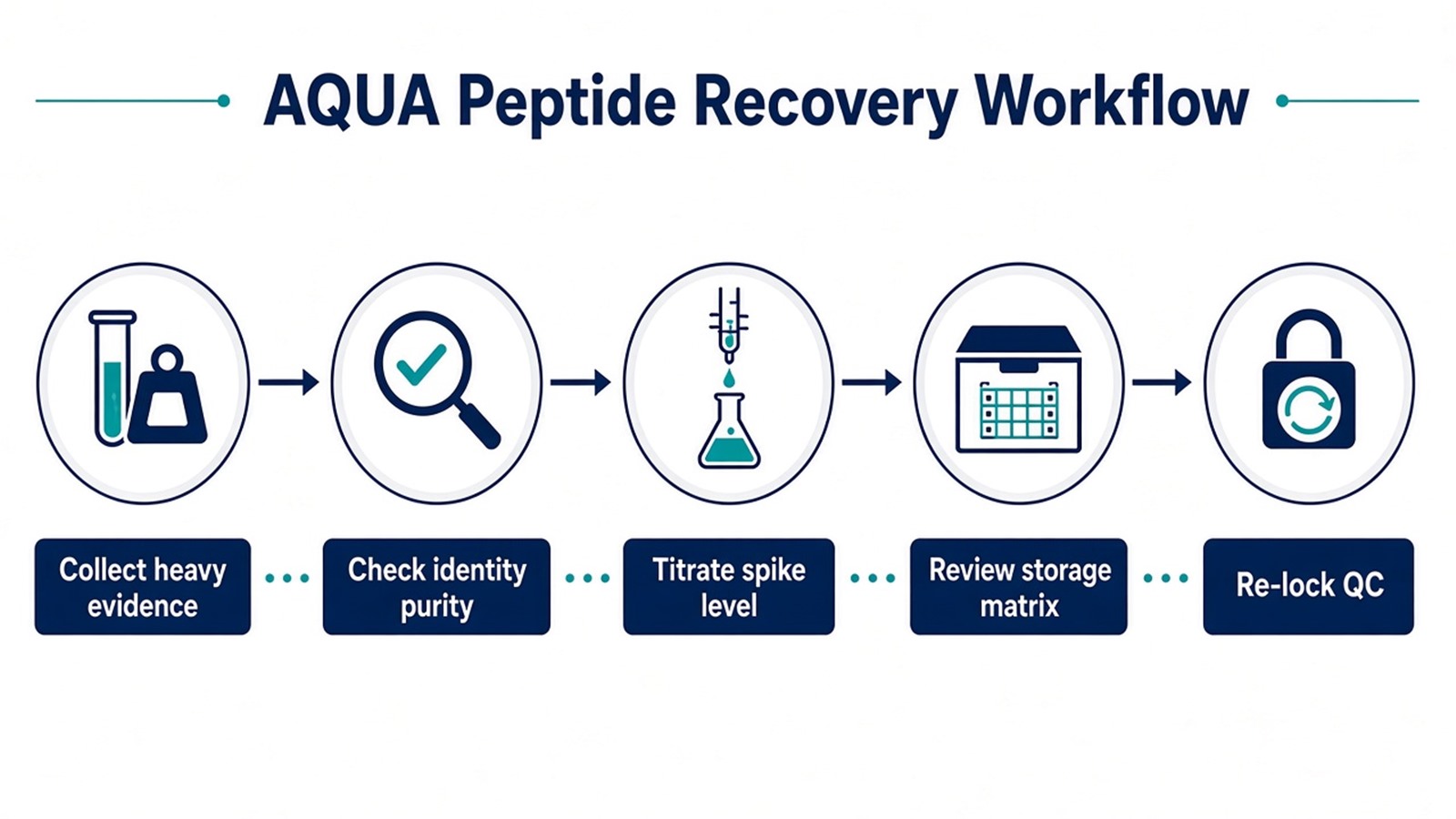
Figure 1. AQUA peptide recovery depends on identity, purity, spike level, and matrix response of the heavy standard before the cohort is rerun.
Parameters That Must Be Re-Locked for the AQUA Peptide
Layer |
Parameter that must be declared |
Failure mode if ignored |
|---|---|---|
Sequence |
Exact proteotypic match and modification state |
Wrong heavy peptide for the light surrogate |
Isotope map |
Mass shift and enrichment documentation |
Misassigned heavy channel |
Purity |
Interfering peaks in heavy window reviewed |
Impurity integrated as standard |
Assigned amount |
Stock concentration and dilution record |
Scale error across every sample |
Spike level |
Amount titrated in study matrix |
Ratio noise or compressed response |
Spike timing |
Pre-digestion or post-digestion rule |
Digestion loss misread as biology |
Storage |
Solvent, aliquots, freeze-thaw limit |
Silent degradation of working standard |
Matrix recovery |
Neat versus matrix comparison |
Buffer spike fails in study matrix |
Acquisition |
MRM transitions or PRM fragments for light and heavy |
Interference after standard looks present |
Deliverable |
Lot, spike protocol, QC notes |
Cohort rerun without a locked fix |
Limits follow the same table. A visible light peptide does not prove a valid AQUA ratio. Changing spike level without rechecking ratio precision does not restore absolute units. Copying published spike amounts into a new matrix does not transfer recovery.
What AQUA Peptide Recovery Can Support
A restored AQUA peptide supports isotope-dilution ratios for the locked surrogate under the revised spike protocol. Absolute concentration still needs a calibration model that brackets study samples after the heavy standard is usable. Modified-peptide claims require the AQUA peptide to carry the same modification state as the endogenous target.
A successful recovery usually delivers a requalified lot with documented purity and isotope map, an optimized spike amount with stable light-to-heavy QC replicates, and a decision to keep the surrogate, move acquisition to PRM, or order a new AQUA peptide for an alternate sequence. It does not authorize clinical release decisions without a separately validated method record.
Recovering the AQUA peptide restores the heavy reference. Absolute reporting still needs locked calibration after that reference is stable.
How to Choose the Next Action for a Failed AQUA Peptide
Use heavy-peak evidence, matrix comparison, and surrogate options together.
Observed problem |
Action that often fits |
Recheck before committing |
|---|---|---|
Heavy peak missing or impurity-dominated |
Requalify or resynthesize AQUA peptide |
Rerun cohort on the old lot |
Light stable, ratio imprecise |
Titrate spike level in matrix |
Change acquisition first |
Working standard drifts over days |
Fresh aliquots and storage lock |
Assume instrument drift only |
Neat spike fine, matrix spike biased |
Cleanup or matrix-matched prep |
Raise spike amount alone |
Sequence or modification mismatch |
New AQUA peptide for correct surrogate |
Force ratio from wrong heavy sequence |
Persistent interference after standard recovery |
PRM pilot or alternate proteotypic peptide |
Expand panel without matrix retest |
Heavy peak healthy, curve still fails |
Move to calibration-curve troubleshooting |
Keep adjusting only the AQUA peptide |
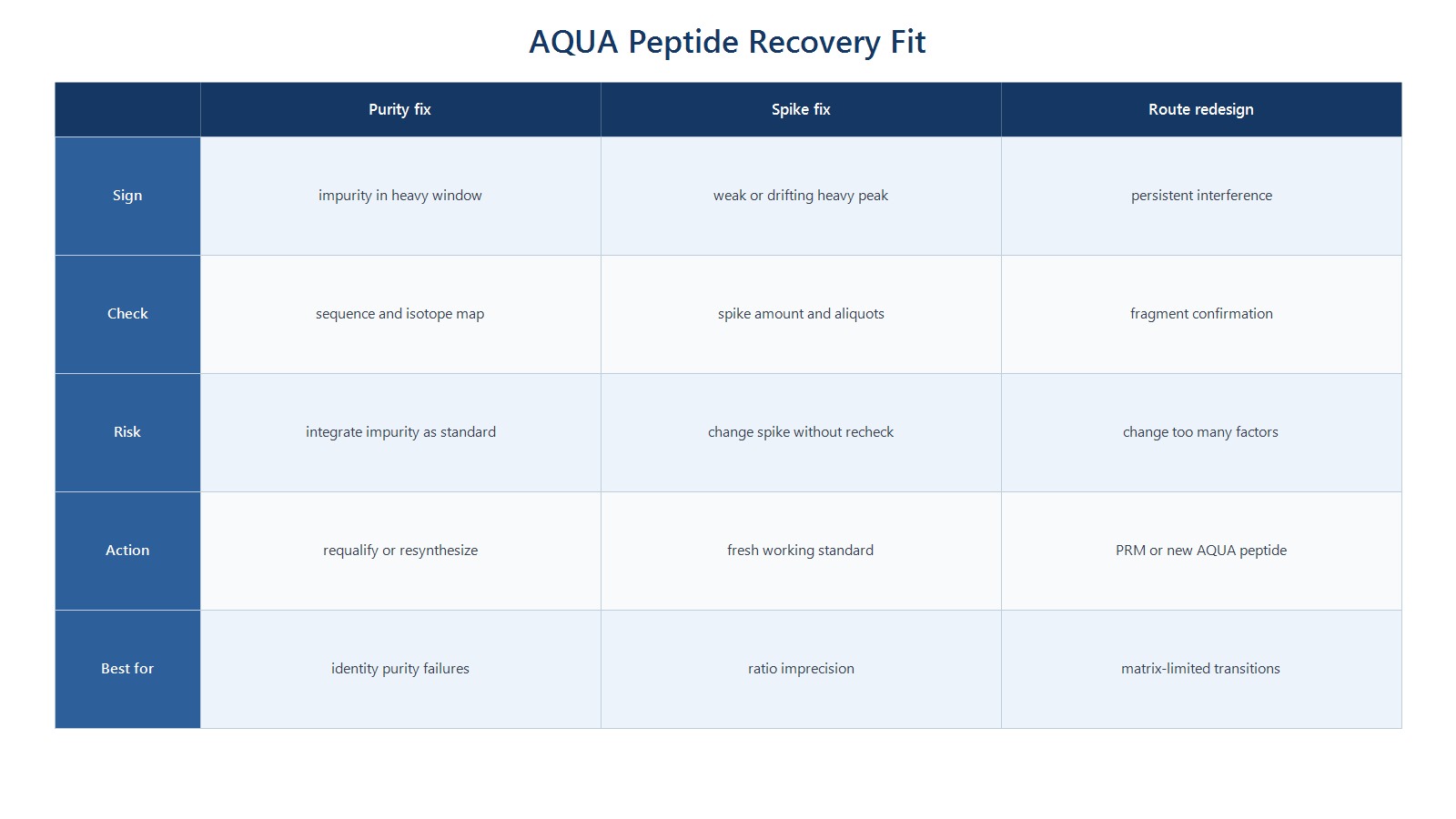
Figure 2. Choose the recovery action from the heavy-standard failure pattern; move to curve troubleshooting only after the AQUA peptide itself is usable.
Teams with heavy chromatograms, purity spectra, and spike records can review MtoZ Biolabs Absolute Quantitative Analysis (AQUA) Service when AQUA peptide recovery is declared in the project record. Targeted acquisition options appear on the Targeted Proteomics Service page when MRM and PRM both remain open.
Frequently Asked Questions
1. Why is the light peptide visible while the AQUA peptide peak is weak?
Common causes include low spike amount, standard degradation, purity issues, or matrix suppression that affects heavy signal more strongly than light signal.
2. Can spike level be changed without rechecking the assay?
Spike level changes usually require rechecking ratio precision and matrix recovery before cohort reporting.
3. Does a failed AQUA peptide always require resynthesis?
No. Handling, spike level, or matrix prep corrections may restore performance when purity and identity remain acceptable.
4. Can PRM rescue a failed MRM-based AQUA assay?
Sometimes. PRM is often considered when interference, not heavy-standard detectability, is the primary remaining issue.
5. What files help scope AQUA peptide recovery?
Heavy chromatograms, purity or identity spectra, spike amounts, storage notes, neat-versus-matrix comparisons, and reporting unit help evaluate the next fix before reordering standards.
MtoZ Biolabs can provide absolute quantitative analysis using AQUA peptides for predefined protein or peptide panels, including standard requalification support, spike-level review, matrix pilot testing, and targeted LC-MS/MS when study design and QC evidence are available.
If further evaluation of standard purity, spike level, matrix recovery, or MRM versus PRM acquisition choice is needed, project details can be submitted for a feasibility review.
Reference
- S.A. Gerber, J. Rush, O. Stemman, M.W. Kirschner, S.P. Gygi (2003). Absolute quantification of proteins and phosphoproteins from cell lysates by tandem MS. Proc. Natl. Acad. Sci. U.S.A., 100, 6940-6945. https://doi.org/10.1073/pnas.0832254100
- S.A. Carr, S.E. Abbatiello, B.L. Ackermann, C. Borchers, B. Domon, E.W. Deutsch, R.P. Grant, A.N. Hoofnagle, R. Huttenhain, J.M. Koomen, D.C. Liebler, T. Liu, B. MacLean, D.R. Mani, E. Mansfield, H. Neubert, A.G. Paulovich, L. Reiter, O. Vitek, R. Aebersold, A.J. Smith, et al. (2014). Targeted peptide measurements in biology and medicine: best practices for sample preparation, assay standardization, and assay validation. Mol. Cell. Proteomics, 13, 907-917. https://doi.org/10.1074/mcp.M113.036095
- A.C. Peterson, J.D. Russell, A.A. Klammer, P.F. Doubleday, H. Liu, J.N. Anderson, M.J. MacCoss (2012). Parallel reaction monitoring for high resolution and high mass accuracy quantitative, targeted proteomics. Mol. Cell. Proteomics, 11, 1475-1488. https://doi.org/10.1074/mcp.O112.020271
