






AP-MS Workflow: From Tagged Bait Design to Interactome Interpretation
Introduction
Affinity purification-mass spectrometry is often summarized as tag the bait, pull it down, and identify the binders. That shorthand hides the steps that decide whether an AP-MS workflow produces an interpretable interactome or a long list of resin binders and overexpression artifacts.
An AP-MS workflow starts before affinity capture. Tag choice, expression system, lysis chemistry, wash stringency, empty-tag controls, LC-MS/MS depth, and enrichment filtering all shape the final candidate list. For R&D teams comparing mutants, conditions, or pathway hubs, understanding the full AP-MS workflow is more useful than treating the method as a single black-box assay.
This article explains the AP-MS workflow step by step, highlights critical design parameters, clarifies what the data can and cannot support, and outlines the information needed before project launch.
What an AP-MS Workflow Is Designed to Deliver
An AP-MS workflow enriches a tagged bait protein and identifies co-purifying proteins by LC-MS/MS. The primary output is a filtered list of candidate interactors that associate with the bait under the chosen expression and purification conditions.
AP-MS is well suited to:
- systematic interactome mapping of tagged baits
- comparison of wild-type and mutant constructs under matched purification chemistry
- condition-dependent enrichment studies in engineered cell systems
- projects where a target-specific IP antibody is unavailable or unreliable
AP-MS is not designed to prove direct binding for every co-enriched protein. Candidates remain provisional until orthogonal assays confirm biological relevance.
End-to-End AP-MS Workflow
A practical AP-MS workflow follows a defined sequence from construct design to candidate interpretation.
1. Tagged Bait Design
The workflow begins with bait engineering. Common affinity tags include FLAG, HA, His, Strep, and GFP-related systems. Tag position, linker length, and whether the tag is N-terminal or C-terminal can affect localization, folding, and partner recovery.
Design decisions should also cover expression control. Stable lines, inducible systems, and transient expression are all used, but expression level should stay close enough to the biological question to limit overexpression-driven false partners.
2. Expression and Sample Generation
Cells or other expression systems produce the tagged bait under defined conditions. If the study compares treatments, genotypes, or time points, those contrasts must be built into sample generation rather than added only at the analysis stage.
Replicates should be planned here. Biological replicates support enrichment statistics later and reduce overinterpretation of single-run co-purifying proteins.
3. Lysis and Clarification
Lysis buffer composition determines which complexes remain intact and which contaminants are released. Detergent strength, salt concentration, nuclease use, and protease or phosphatase inhibitors all influence recovery.
Clarification removes debris before affinity capture. Incomplete clarification increases background and can destabilize downstream MS interpretation.
4. Affinity Purification
The clarified lysate is incubated with an affinity resin matched to the tag. Wash steps remove loosely associated proteins. Wash stringency is a central trade-off: gentle washes preserve weak or transient partners but raise background, while harsh washes clean the eluate but may lose biologically relevant interactors.
Empty-tag and matched control samples should be processed in parallel under identical purification chemistry.
5. Elution, Digestion, and LC-MS/MS
Bound complexes are eluted from the resin and digested into peptides for LC-MS/MS. Digestion strategy, peptide cleanup, and acquisition depth affect identification coverage for lower-abundance partners.
Quantitative or semi-quantitative MS readout is preferred over presence-or-absence calling alone, especially when comparing bait samples with empty-tag controls.
6. Filtering, Ranking, and Interpretation
Identified proteins are filtered against controls, common contaminant lists, and enrichment metrics. Ranked candidates are then interpreted in the context of bait biology, expected pathways, and planned validation assays.
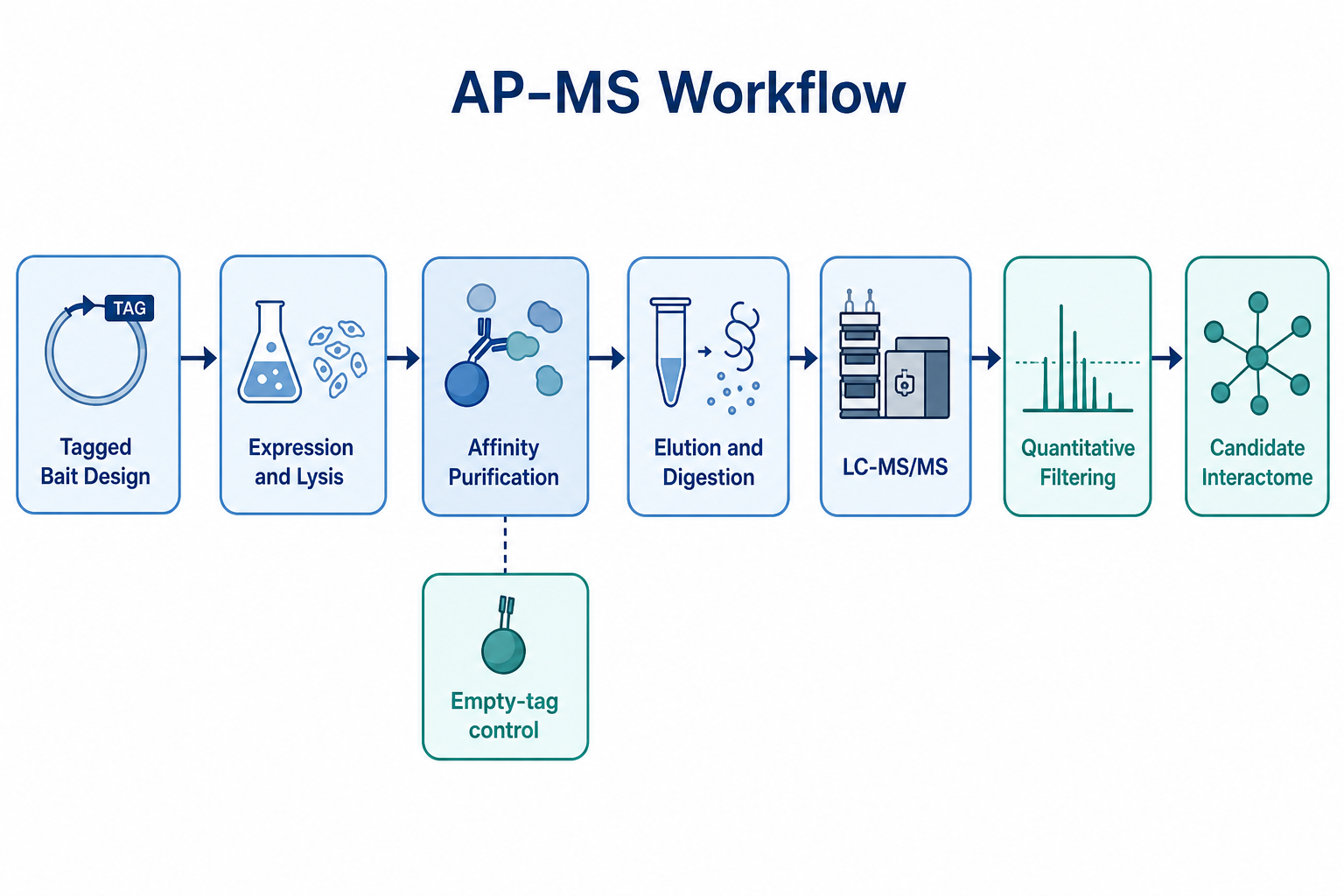
Figure 1. An AP-MS workflow links tagged bait design, affinity purification, LC-MS/MS, and quantitative filtering into one interactome discovery path.
Critical Parameters That Decide AP-MS Quality
Several parameters disproportionately affect AP-MS workflow success.
Tag and linker design influence whether the bait remains functional and accessible to partners.
Expression level influences whether recovered associations reflect native biology or overload-driven binding.
Lysis and wash chemistry determine the balance between complex preservation and background reduction.
Control design determines whether enrichment can be distinguished from tag or resin binders.
Replicate structure determines whether candidate ranking is stable enough for follow-up.
MS depth and quantification strategy determine whether modest but real enrichment is detectable.
If these parameters are undefined at the start, later bioinformatics cannot fully rescue the experiment.
Affinity Purification-Mass Spectrometry Service
Controls Required in a Credible AP-MS Workflow
Controls are part of the workflow, not an optional appendix.
Empty-tag expressing lines help identify proteins that bind the tag or purification system rather than the bait.
Untagged parental lines help separate expression-system background from tag-associated background.
Matched wash and handling conditions across bait and control samples prevent procedural bias from being mistaken for biology.
Where feasible, orthogonal genetic or mutational contrasts strengthen interpretation. For example, a binding-deficient bait mutant can help distinguish functional partners from sticky co-purifying proteins.
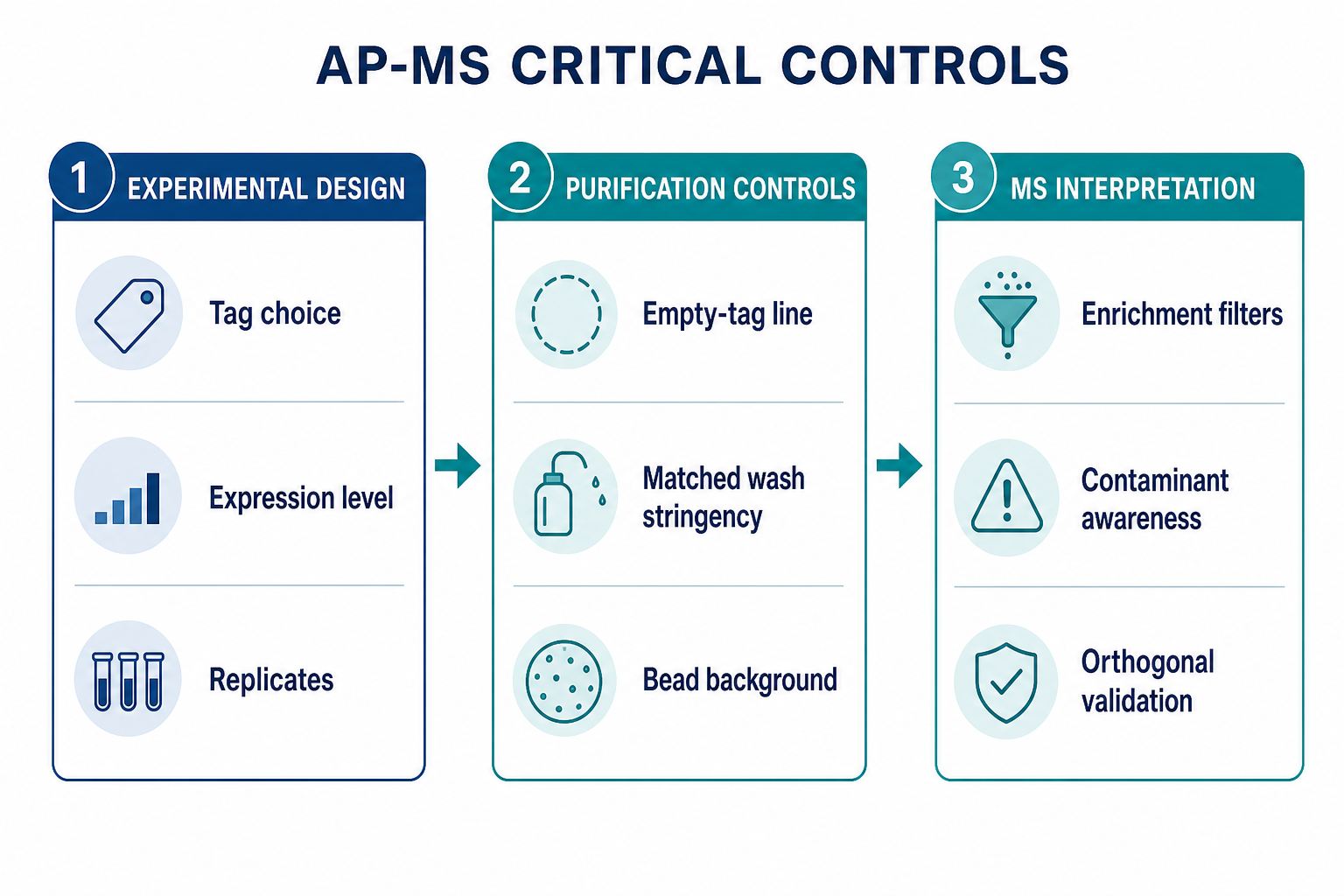
Figure 2. Credible AP-MS workflows integrate design controls, purification controls, and filtered MS interpretation before candidate prioritization.
What the AP-MS Workflow Output Should Look Like
A useful AP-MS report typically includes:
- bait recovery confirmation in the purified samples
- protein identification tables for bait and control groups
- enrichment metrics used to rank candidates
- notes on common contaminants and unresolved background
- a shortlist of priority candidates for orthogonal validation
- method details covering tag system, lysis and wash conditions, and MS acquisition strategy
Deliverables should separate strongly enriched candidates from weakly supported co-purifying proteins. Treating every identified protein as a validated interactor overstates what the AP-MS workflow can support.
AP-MS Workflow vs Related Enrichment Options
AP-MS is one of several enrichment-to-MS strategies.
IP-MS uses a target-specific antibody to capture an endogenous bait and is preferable when native context is essential and an antibody validated for IP-MS is available.
Pull-down-MS uses an immobilized recombinant bait to test binding under controlled conditions and is often better for hypothesis confirmation than for broad cellular interactome discovery.
Crosslinking or proximity labeling workflows can capture more transient or compartment-restricted associations, but they answer proximity or covalent-neighborhood questions rather than classical affinity-purified complex composition alone.
Choosing among these options depends on bait format, antibody readiness, and whether the primary goal is discovery, endogenous confirmation, or direct binding assessment.
Pull Down based Protein Analysis Service with Mass Spectrometry
Limitations and Interpretation Boundaries
An AP-MS workflow has clear boundaries.
Tagged expression can alter localization, stoichiometry, and partner selection relative to the endogenous protein.
Weak or transient interactions may be lost during washing.
Abundant sticky proteins may survive filtering if controls are incomplete.
Co-enrichment does not equal direct physical contact. Shared complex membership, indirect associations, and purification artifacts can all produce positive signals.
Candidate lists should be treated as discovery outputs that guide validation, not as final interaction maps.
Related Services
Protein-Protein Interaction Analysis Service
MS-Based Protein-Protein Interaction Analysis Service
Co Immunoprecipitation (Co-IP) Service
Project Planning Checklist for an AP-MS Workflow
Before starting, define:
- bait identity and biological question
- tag system, tag position, and expression strategy
- sample groups, replicates, and condition contrasts
- lysis and wash priorities: preserve weak partners or minimize background
- empty-tag and matched control design
- expected analytical output: discovery list, mutant comparison, or condition contrast
- orthogonal validation plan for priority candidates
MtoZ Biolabs supports AP-MS and related protein interaction analysis for teams building tagged-bait interactome studies. The technical team can review construct design, control strategy, and whether AP-MS, IP-MS, or pull-down-MS best matches the research question.
To discuss an AP-MS workflow, contact MtoZ Biolabs with your bait protein, tag system, sample type, study groups, control options, and the interactome output required for decision-making.
Frequently Asked Questions
What is the first step in an AP-MS workflow?
The first step is tagged bait design, including tag choice, tag position, and expression strategy. Purification and MS cannot compensate for a bait construct that is poorly localized or heavily overexpressed.
Why are empty-tag controls required?
Empty-tag controls help identify proteins that bind the affinity handle or resin rather than the bait. Without them, background binders are easily mistaken for specific interactors.
Can an AP-MS workflow detect weak interactions?
Sometimes, but wash chemistry and complex stability limit recovery of weak or transient partners. Softer washes may preserve more candidates while increasing background that must be filtered carefully.
Is AP-MS better than IP-MS?
Neither is universally better. AP-MS is often stronger when tagging is acceptable and antibody performance is limiting. IP-MS is often stronger when endogenous context is required and an antibody validated for IP-MS is available.
Does AP-MS confirm direct protein-protein binding?
No. AP-MS identifies co-enriched candidates. Direct binding usually requires orthogonal assays such as targeted pull-down, reciprocal enrichment, or biophysical binding tests.
Conclusion
An AP-MS workflow is a multi-step experimental system, not a single purification event. Tagged bait design, expression control, lysis and wash chemistry, empty-tag controls, LC-MS/MS acquisition, and enrichment filtering jointly determine whether the resulting interactome is usable.
Teams that define these parameters before sample generation obtain clearer candidate rankings and stronger follow-up plans. For projects centered on tagged-bait discovery, AP-MS remains a practical route to condition- and mutant-resolved interaction hypotheses when controls and validation are built into the workflow from the start.
How to order?




