






Antibody Sequencing Services: Hybridoma, Purified Antibody, or Single-Cell Input—How to Choose the Right Starting Material
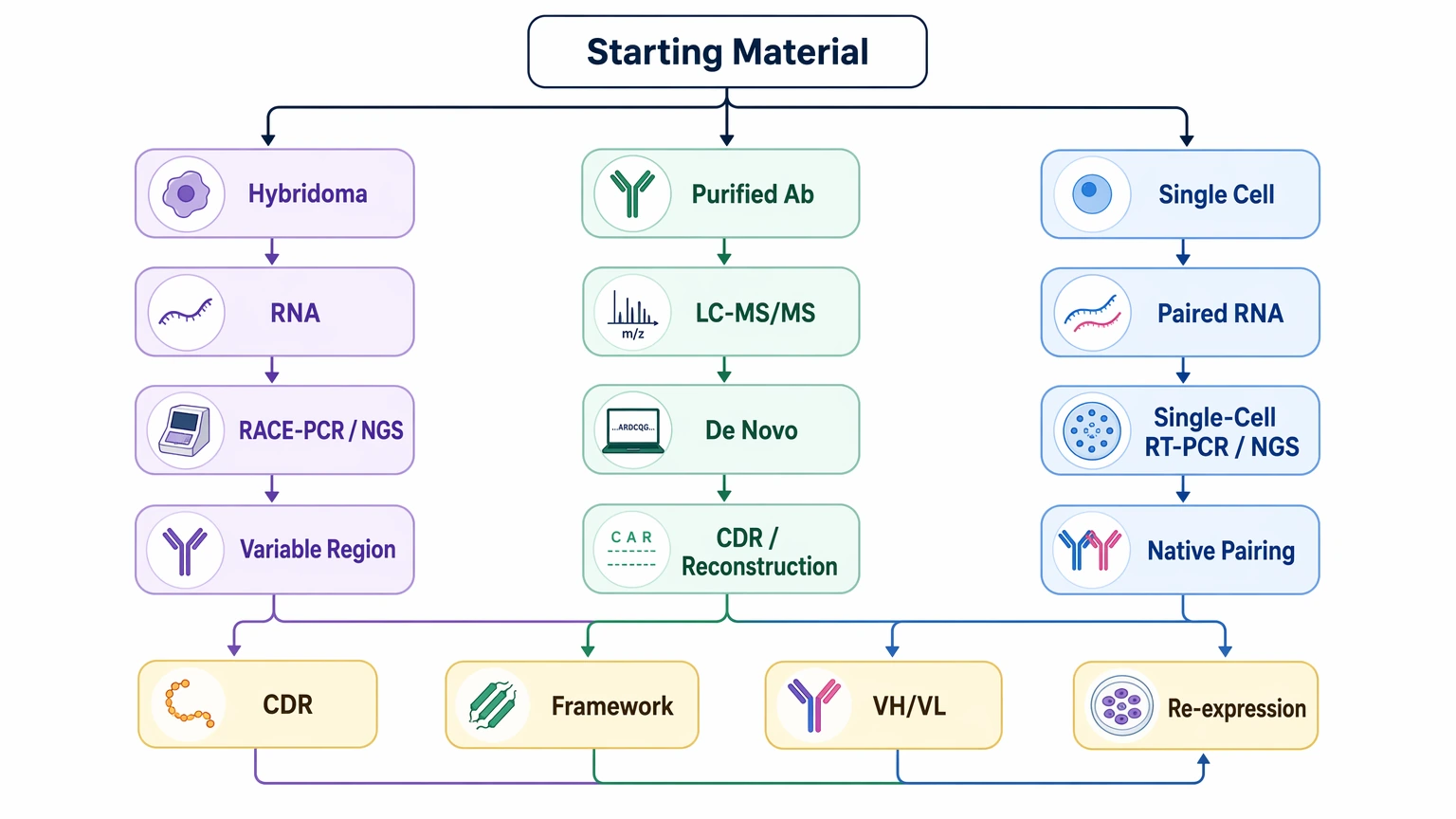
Start with hybridoma when the original clone is still available and the project needs practical recovery of a full-length variable-region sequence for downstream recombinant re-expression. Choose single-cell input when fresh antigen-specific B cell material is available and keeping native chain pairing intact is the top priority. Use purified antibody when no cells remain and protein is the only asset left, while recognizing that de novo sequencing can still support sequence recovery but usually comes with more sequence ambiguity and less direct VH/VL pairing evidence than cell-based routes.
For antibody sequencing services, the starting material is not a small submission detail. It determines whether the workflow begins with hybridoma-derived RNA, intact secreted protein analyzed by LC-MS/MS, or a single B cell workflow built to retain VH/VL pairing. That choice shapes what kind of sequence output is realistic: CDR mapping, broader framework region coverage, or a more complete antibody variable region reconstruction that can move into validation planning.
Why This Decision Usually Comes Up Late in a Project
Most teams do not ask this question at the start of antibody discovery. They usually ask it later, once an antibody becomes important enough to rescue, document, compare, or re-express. By that point, the available material is often limited by what happened earlier in the project:
- a surviving hybridoma line from an older monoclonal program
- a tube of archived purified antibody with no remaining cells
- recently sorted single-cell input from an active discovery campaign
So the real question becomes practical: which of those materials gives the clearest path to usable heavy chain and light chain sequence recovery for the next milestone?
That milestone matters. Some teams only need enough sequence information to confirm identity or annotate CDR features. Others need a full-length variable-region sequence with framework support, isotype context, and chain assignment strong enough to move into recombinant re-expression planning. When the input type and the expected deliverable do not line up, the project usually slows down during validation, not during the first sequencing step.
If your team is still comparing options, a short pre-submission checklist helps: define the sample type, decide whether native chain pairing is required, clarify whether the goal is CDR-level insight or full sequence recovery, and note whether re-expression is the next step.
The Comparison Criteria That Matter Most
Before comparing the three inputs, it helps to look at them through the same technical lens.
1. Source Identity and Sample Integrity
The first question is simple: what molecular evidence is still available? Hybridoma and single-cell input provide cellular nucleic acid, which supports transcript-based sequence recovery. Purified antibody provides secreted protein only, so the project depends on peptide evidence rather than RNA. Condition matters inside each category too. Viable cells are different from old pellets, and intact protein in a compatible buffer is different from trace material in a formulation that interferes with analysis.
2. VH/VL Pairing Confidence
For many antibody rescue projects, VH/VL pairing is the main comparison point. Single-cell input is strongest when the goal is to preserve native chain pairing from one B cell. A clean hybridoma can also support confident pairing because both chains come from the same clone source. Purified antibody is weaker here because the protein is disconnected from the producing cell, so heavy/light assignment may depend on reconstruction logic rather than direct cellular linkage.
3. Sequence Completeness Goal
A project that only needs CDR identification is not the same as one that needs a full-length variable-region sequence ready for design and handoff. Cell-based inputs usually fit full variable-region recovery better, including framework region coverage and clearer chain context. Protein-only recovery can still be useful, but it is more exposed to missing residues, isobaric substitutions, and partial reconstruction.
4. Method Fit and Validation Burden
The sample type sets the practical method range. RACE-PCR and targeted NGS fit hybridoma-derived RNA or single-cell input. LC-MS/MS with de novo sequencing fits purified antibody when no nucleic acid remains. That method choice also affects how much orthogonal validation may be needed before sequence handoff for expression work.
Direct Comparison of Hybridoma, Purified Antibody, and Single-Cell Input
The table below summarizes the main tradeoffs for project planning.
| Dimension | Hybridoma | Purified antibody | Single-cell input |
|---|---|---|---|
| Primary molecular source | Cellular RNA | Secreted protein | Cellular RNA from individual cells |
| Typical method fit | RACE-PCR, targeted NGS | LC-MS/MS, de novo sequencing | Single-cell RT-PCR, targeted NGS |
| VH/VL pairing confidence | Usually strong if clone integrity is preserved | Often indirect or ambiguous | Strongest for native chain pairing |
| Best-suited output | Full antibody variable region, CDR, framework region | CDR-focused or reconstruction-assisted recovery | Paired heavy chain/light chain recovery from specific cells |
| Main risk | Mixed clones, nonproductive transcripts, degraded RNA | Incomplete peptide coverage, sequence ambiguity, uncertain pairing | Transcript dropout, low capture efficiency, cell loss |
| Re-expression readiness | Often favorable after confirmation | Usually needs more orthogonal validation | Favorable when paired recovery is complete |
| Best-fit scenario | Legacy monoclonal with surviving clone | Archived antibody with no cells left | Fresh discovery samples where pairing matters most |
How Each Starting Material Performs in Practice
Hybridoma: Usually the First Option to Evaluate When the Clone Survives
A viable hybridoma is often the most practical input for sequence recovery. Because the project starts from cellular RNA, RACE-PCR or targeted NGS can recover the antibody variable region more directly than protein-only workflows.
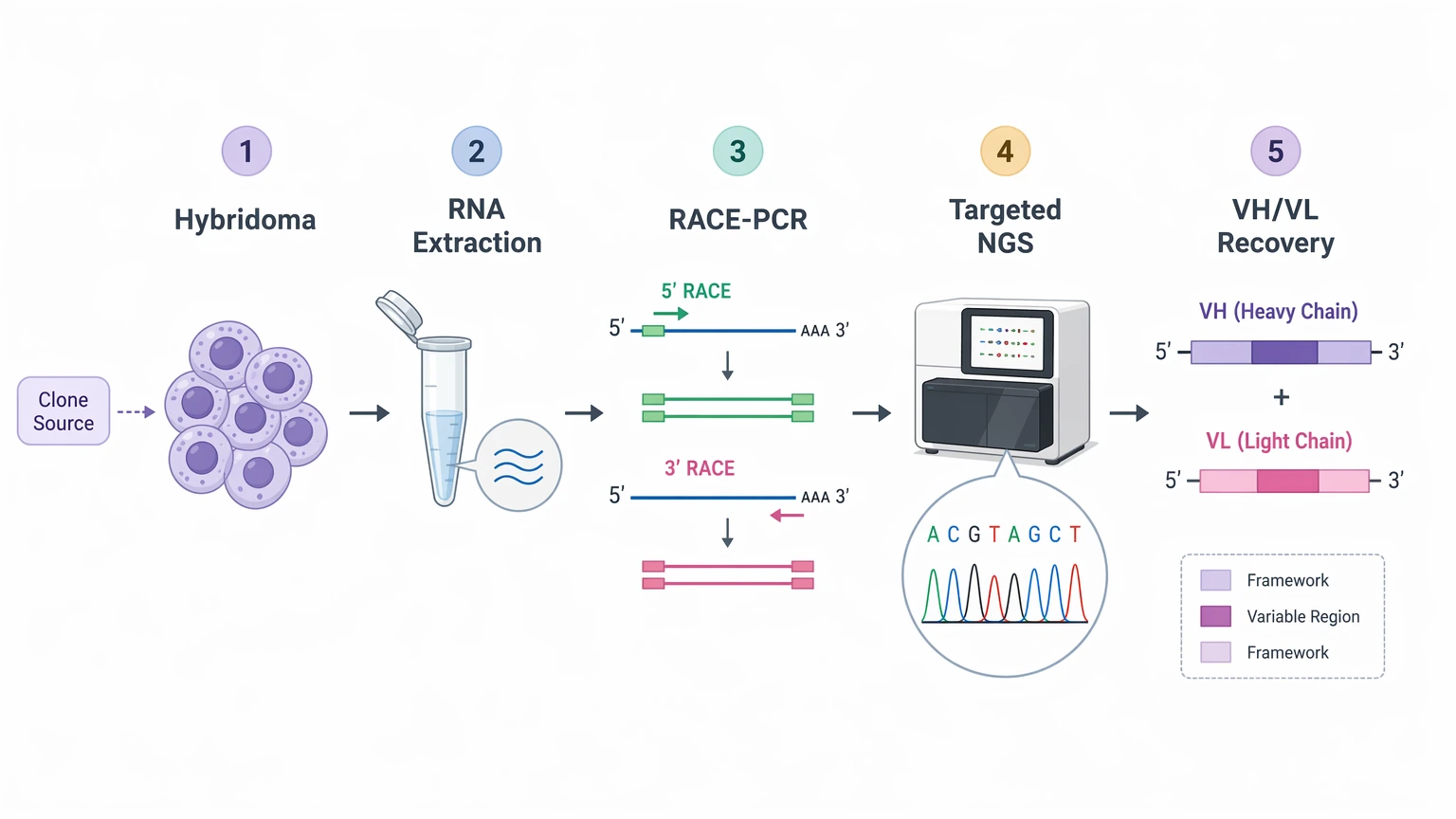
This route is especially useful when the team needs more than motif-level information. If the target deliverable is a full-length variable-region sequence with framework region support and clear heavy/light assignment, hybridoma material usually offers a cleaner path than purified antibody. It also fits projects where the next step is codon design, expression vector planning, or comparison against older records.
The main caution is clone integrity. A hybridoma is not automatically a clean input just because the line still exists. Mixed populations, nonproductive immunoglobulin transcripts, or degraded archived material can complicate interpretation. So “hybridoma available” should really mean “hybridoma available and suitable for recovery,” not an automatic green light.
Purified Antibody: The Protein-Only Recovery Route
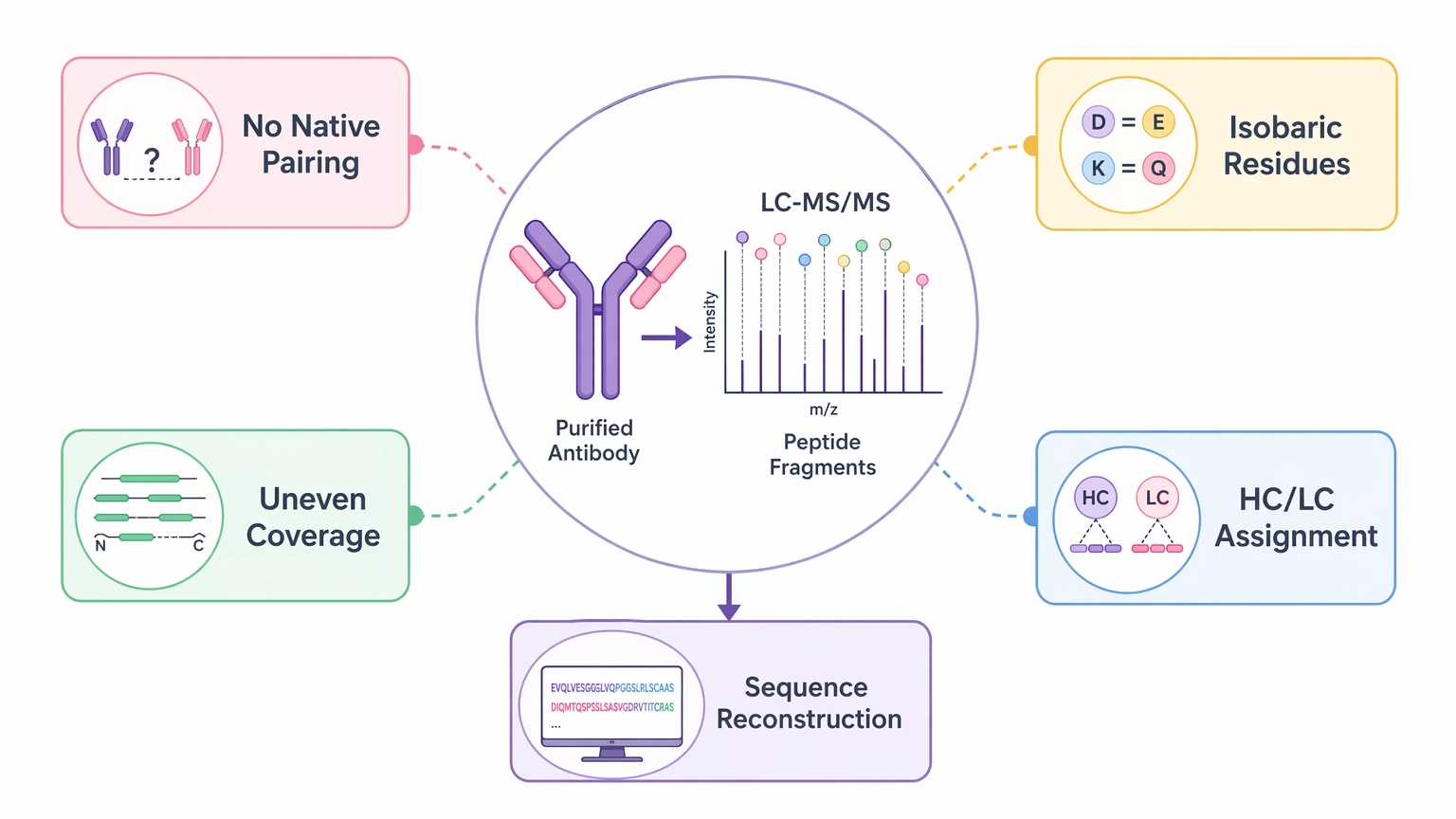
Purified antibody becomes the default starting material when the producing cells are gone. At that point, the project shifts from transcript recovery to peptide-based sequence interpretation, usually centered on LC-MS/MS and de novo sequencing.
This route can still be valuable for legacy assets. If a monoclonal antibody still matters for follow-up work but only purified protein remains, a protein-based workflow may still recover useful sequence information. That can include CDR identification, partial framework region reconstruction, or candidate assembly of a full-length variable-region sequence that is later checked through re-expression and characterization.
The tradeoffs should be stated plainly. Protein-only workflows do not preserve direct native chain pairing. They can also run into isobaric residues, uneven peptide coverage, and uncertainty when assigning one heavy chain to one light chain without supporting evidence. Put simply, purified antibody can support sequence recovery, but it usually carries more interpretation burden than cell-derived inputs.
Single-Cell Input: Best When Native Pairing Drives the Project
Single-cell input is most useful when the project begins close to cell isolation and pairing confidence matters most. If the goal is to link one heavy chain and one light chain to a single antigen-reactive cell, this route has a clear advantage.
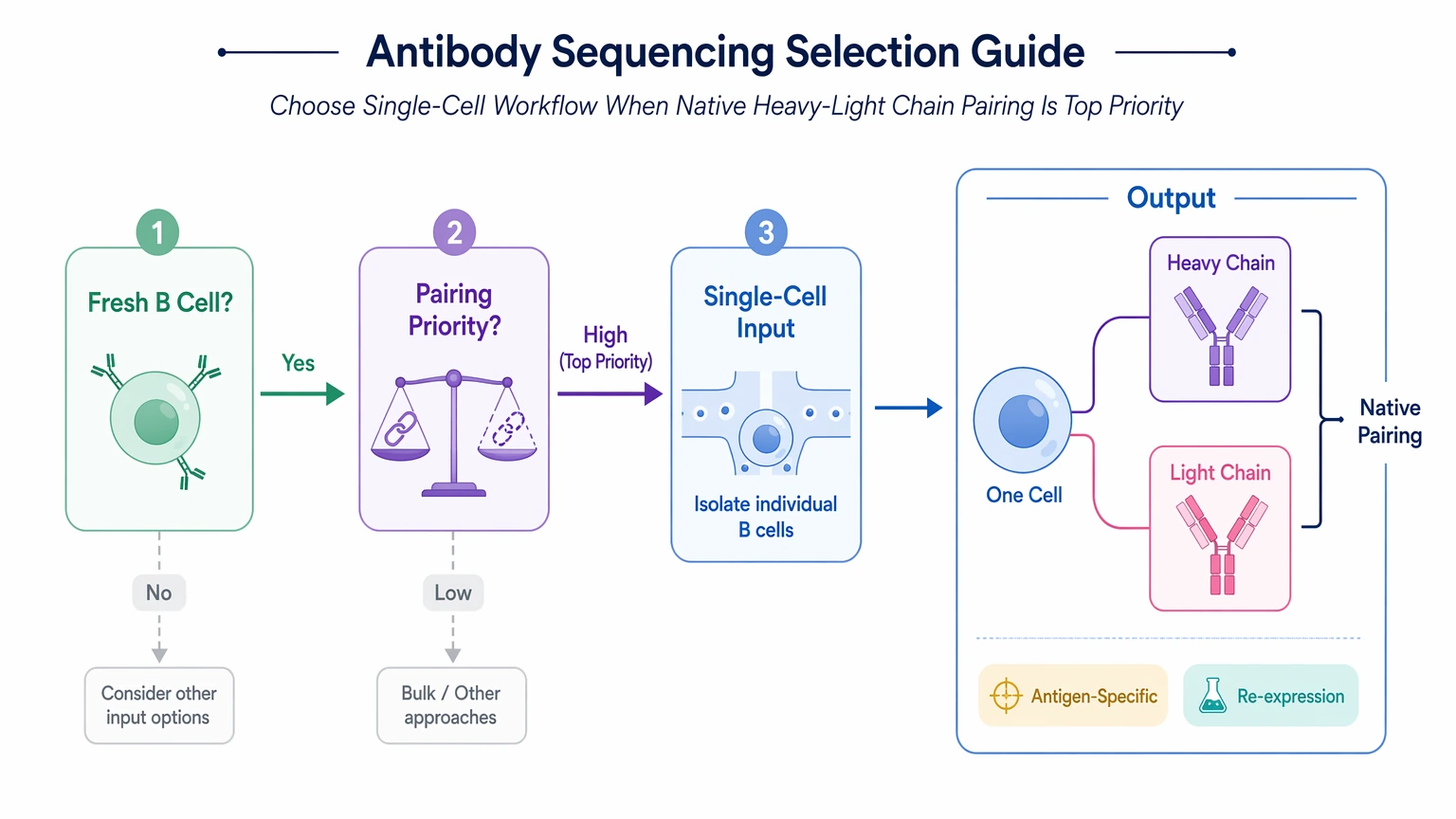
That matters in early discovery, translational screening, and follow-up programs where the team wants sequence recovery from a defined antigen-specific B cell rather than from a bulk population. Native pairing can reduce uncertainty before recombinant re-expression, especially when the project lead wants sequence evidence tied to one functional binder from the start.
The main limitation is sample fragility. Single-cell workflows depend on cell viability, sorting quality, transcript capture, and assay design. Even with a good sort, low-abundance transcripts can still drop out or only be recovered in part. This is a strong option when fresh material and careful handling are in place, but it becomes less forgiving once sample quality starts to decline.
Best Fit by Project Scenario
Legacy monoclonal with a surviving clone
Choose hybridoma first. It usually gives the most direct route to transcript-based sequence recovery and aligns well with projects that need a full-length variable-region sequence for re-expression planning.
Archived antibody with no cells remaining
Choose purified antibody and keep the deliverable realistic. This route is often strongest for protein-led recovery, CDR-focused interpretation, or reconstruction-assisted sequence assembly that will later need confirmation.
Fresh discovery campaign built around sorted B cells
Choose single-cell input when preserving VH/VL pairing is central to the project. This is usually the strongest option for linking sequence output to an individual single B cell or antigen-specific B cell.
Project needs paired sequence output for recombinant work
Prioritize the input with the clearest chain relationship. In most cases, that means single-cell input for fresh discovery material or hybridoma for legacy monoclonal assets. Purified antibody can still contribute, but usually with more downstream validation.
Sample quality is borderline and the route is not obvious
This is where consultation tends to help most. Instead of forcing the sample into a default workflow, teams should prepare the sample history, intended deliverable, and validation goal before choosing a route. If you need a technical review before submission, MtoZ Biolabs can evaluate your project against the available input type, expected sequence output, and re-expression plan.
What to Prepare Before Discussing Antibody Sequencing Services
A productive discussion usually starts with five pieces of information:
- sample type: hybridoma, purified antibody, or single-cell input
- sample condition: viable, frozen, archived, low-volume, mixed, or partially degraded
- target output: CDR-only, framework-supported variable region, or full paired sequence
- downstream use: documentation, engineering, epitope follow-up, or recombinant re-expression
- existing background: known isotype, prior binding data, chromatographic purity, or partial sequence fragments
These details help separate a project that needs “informative sequence recovery” from one that needs “expression-ready sequence recovery.” That distinction matters because the preferred starting material often changes with the validation burden.
FAQ
Can a frozen hybridoma pellet still work, or is viability required?
Viability helps, but it is not always mandatory. Some projects can move forward from archived material if the RNA is still usable. The real question is whether the sample still supports interpretable hybridoma-derived RNA recovery.
What sample details matter most for purified antibody submission?
Amount, purity, and buffer composition usually matter first. Detergents, stabilizers, and mixed protein backgrounds can complicate LC-MS/MS interpretation and reduce effective peptide coverage.
Should teams ever combine protein and cell-based evidence in one project?
Yes. A combined strategy can make sense when one input provides the main recovery route and another helps confirm chain assignment, CDR calls, or framework reconstruction. This is especially relevant for borderline legacy assets.
Is single-cell input still useful if the project needs only one antibody rather than repertoire data?
Yes. Single-cell input is not limited to repertoire-style studies. It can be a strong starting point when the goal is to recover one paired antibody sequence from a defined antigen-reactive cell population.
Does isotype information change the starting-material decision?
Sometimes. Isotype context can help with interpretation and downstream design, but it usually does not override the main decision points of pairing confidence, sequence completeness, and sample availability.
What is the most useful question to answer before contacting a provider?
Decide whether the real goal is partial sequence insight or a sequence package that can move into recombinant re-expression with manageable orthogonal validation. That answer usually narrows the workflow quickly.
Final Comparison Summary and Consultation Guidance
For antibody sequencing services, the strongest starting material usually follows a straightforward project logic: use hybridoma when the clone source is preserved, use single-cell input when native chain pairing must be retained from fresh cellular material, and use purified antibody when protein is the only recoverable asset and a reconstruction-focused workflow is acceptable. In practice, legacy monoclonal rescue, fresh B-cell programs, and archived protein-only assets do not carry the same pairing confidence, completeness expectations, or validation burden. If your team is preparing a sequence recovery project for recombinant follow-up, organize the sample history, target deliverable, and known antibody background first, then contact MtoZ Biolabs to submit your requirements and discuss which input type best fits the material you actually have.
How to order?




