






Antibody Sequencing Service: How to Evaluate a Provider for Sequence Recovery Projects
A practical antibody sequencing service should first tell you whether your sample and downstream goal fit a real sequence recovery workflow. For unknown-sequence recovery, the first priority is not instrument brand or a promised final sequence string, but whether the provider can evaluate sample suitability, explain chain-specific de novo sequencing logic, and define how uncertainty will be reported before you ship material.
That review should cover where de novo peptide sequencing is required instead of reference matching, how heavy chain and light chain evidence will be assembled, how unresolved residues will be flagged, and when orthogonal validation should be planned if recombinant expression is the endpoint. Validation is part of provider selection, not a later add-on.
Quick decision check
- Choose a provider only if it can discuss your sample before receipt.
- Ask for evidence of true de novo peptide sequencing, not only database identification.
- Require chain-specific sequence annotation, confidence score logic, and clear reporting of unresolved residues.
- Treat validation planning as part of the purchase, not an optional afterthought.
Where Provider Selection Often Breaks Down
Teams usually reach this point under time pressure. A legacy monoclonal antibody may still perform well, but the nucleic acid record is missing, incomplete, or no longer trusted. At that point, the purchase is not routine characterization. It is a project decision about whether an outside partner can recover a usable variable region sequence package from protein material.
Three mistakes come up repeatedly:
- accepting a proposal before the provider has reviewed sample condition and formulation
- assuming any mass spectrometry-based offer includes antibody-focused de novo sequencing
- judging the output by whether a final sequence string is promised, instead of whether the sequence is supported well enough for handoff or re-expression
That distinction matters because a poor fit can consume limited material and still leave the team without a sequence package that supports clone rescue, knowledge transfer, or engineering work.
Why Some Antibody Sequencing Projects Underperform
Four issues account for most weak outsourcing decisions in this area.
1. The workflow is designed for identification, not recovery of an unknown sequence
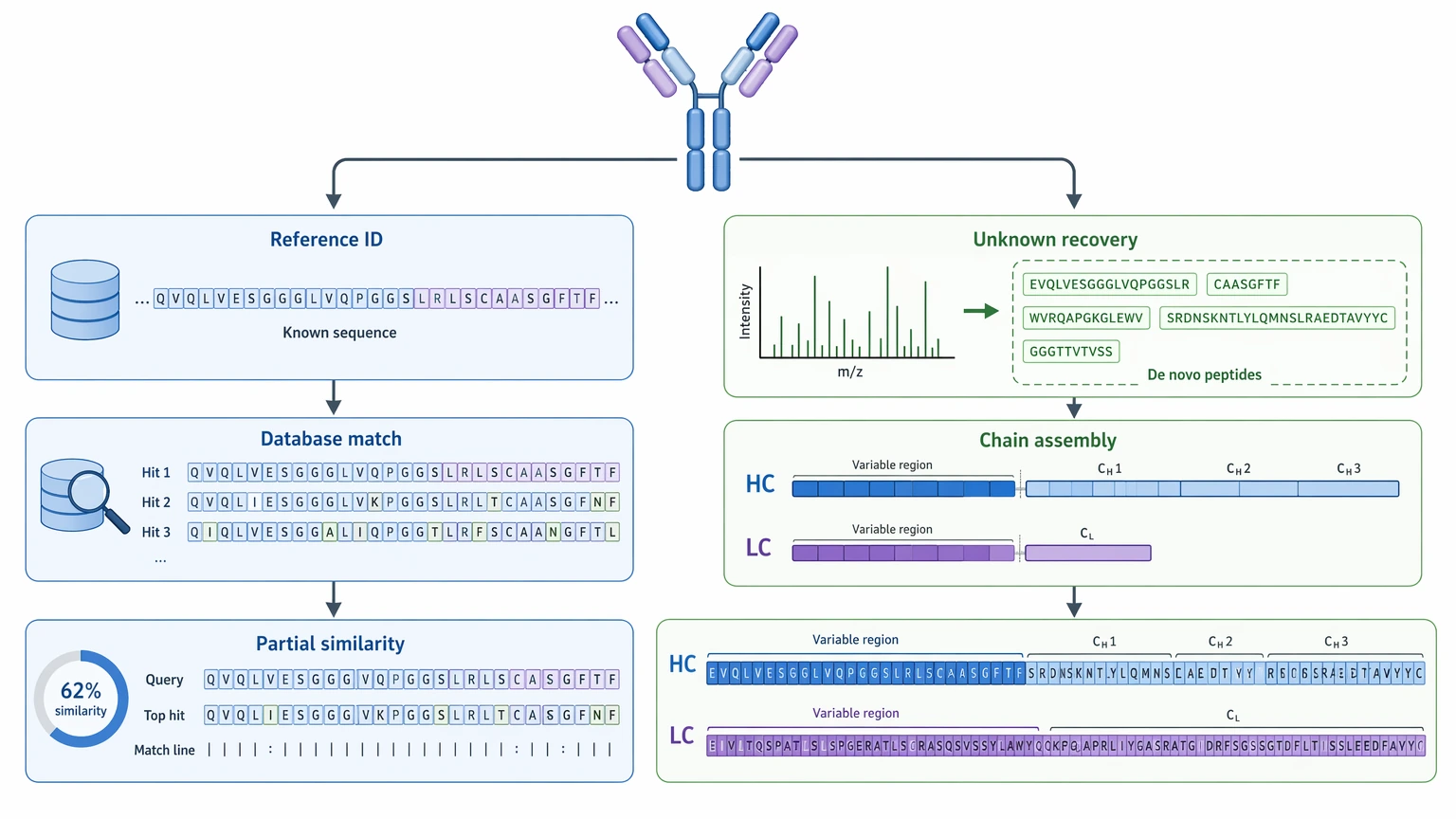
Some providers mainly confirm proteins against references. That works when a trusted sequence already exists, but it is not the same job as recovering an undocumented antibody variable region. For a proprietary or novel molecule, database-first logic may stop at partial similarity instead of producing interpretable chain reconstruction.
2. Sample suitability is not screened early enough
A purified antibody in a simple buffer behaves very differently from a stressed lot, an immobilized preparation, or material containing stabilizers, carrier proteins, or mixed antibody background. When those details surface late, the workflow often turns reactive and evidence quality suffers.
3. Uncertainty is hidden inside a clean-looking sequence
A polished report can still hide weak evidence. Buyers need to know where sequence coverage is deep, where the framework region is strongly supported, where the complementarity-determining region depends on overlapping peptide inference, and where unresolved residues remain.
4. The report is not designed for downstream use
A sequence package can be analytically interesting and still be operationally thin. If it does not include peptide evidence summaries, chain-specific output, variant flags, and follow-up recommendations, the next team has to reconstruct what the report actually means.
What You Are Really Buying
When comparing providers, the central question is not whether they offer antibody sequencing in a broad sense. It is whether they can recover a decision-ready protein sequence package from the material you have.
For this use case, the provider should be able to discuss:
- mature antibody sequence recovery rather than speculative leader sequence reconstruction
- heavy chain and light chain assignment logic
- peptide mapping and overlapping peptide support across each chain
- expected coverage in framework region and CDR-rich areas
- residue-level confidence language, including confidence score or tiered certainty
- how post-translational modification, clipping, oxidation, or glycosylation may affect interpretation
One limit should be stated plainly: LC-MS/MS evidence does not always resolve every position in an antibody, especially when isobaric residues create leucine/isoleucine ambiguity or modified peptides reduce clean MS/MS interpretation.
A Project-Planning Framework for Evaluating a Provider
Step 1: Define the handoff your team actually needs
Start with the endpoint, not the platform. A statement such as “we need chain-resolved sequences that can support recombinant recovery of a legacy monoclonal antibody” changes the vendor conversation immediately.
That endpoint should translate into expected deliverables, such as:
- assembled heavy chain and light chain outputs
- sequence annotation for supported, inferred, and unresolved positions
- sequence coverage summaries by chain
- CDR-focused evidence notes
- disclosure of leucine/isoleucine ambiguity
- recommended follow-up confirmation steps
If a vendor cannot restate the project in those terms, it is probably selling a broad analytical package rather than a sequence recovery plan.
Step 2: Standardize your sample information before requesting quotes
Use the same input sheet for every vendor. That makes technical comparisons cleaner and reduces ambiguity during early vendor discussions.
The table below helps qualify whether your starting material fits a direct antibody sequencing service workflow or needs another route first.
| Sample type | Best fit | Constraint | Next step |
|---|---|---|---|
| Purified monoclonal antibody in simple buffer | Strong candidate | Low concentration or degradation can reduce evidence depth | Ask for chain-level workflow and report structure |
| Purified antibody with surfactants or stabilizers | Often workable | Excipients may interfere with digestion or signal quality | Ask about cleanup and feasibility review |
| Hybridoma-derived material | Conditional fit | Background proteins can complicate assignment | Ask how chain attribution will be handled |
| Immobilized antibody | Case-dependent | Recovery and digestion may be more difficult | Ask for sample-specific prep logic |
| Mixed or contaminated antibody sample | Weak fit for standard recovery | Chain attribution may remain uncertain | Ask whether enrichment or another input source is preferable |
Use this table as a qualification tool, not just an intake form. A credible provider should ask about concentration, buffer composition, detergent exposure, freeze-thaw history, aggregation risk, degradation, and known lot heterogeneity.
Step 3: Verify that the workflow supports true sequence inference
Platform names alone are not enough. Ask the provider to explain the analytical logic and how de novo sequencing is used when no trusted reference sequence is available.
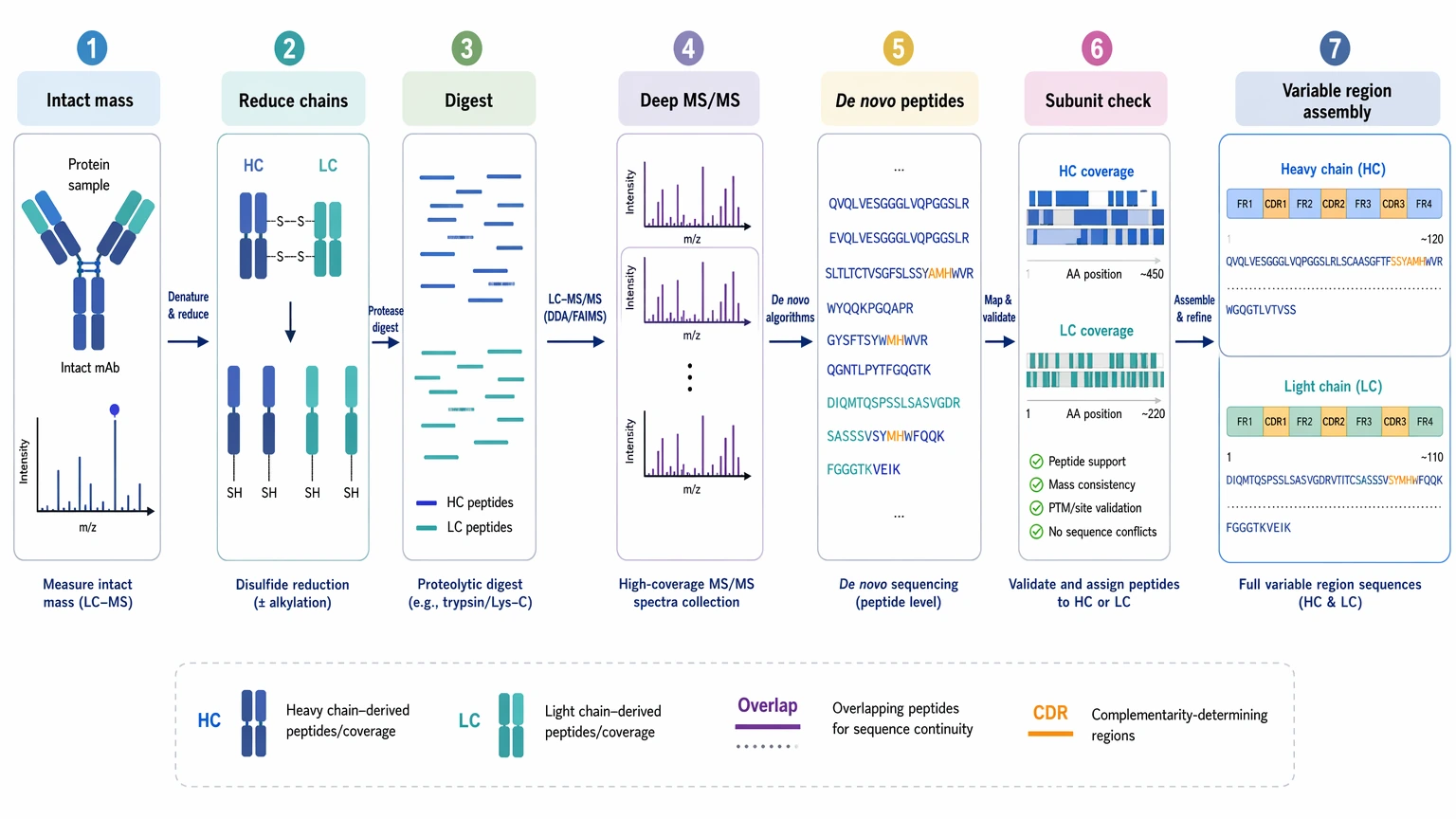
A credible antibody de novo sequencing workflow often includes:
- an intact mass check
- reduction and appropriate chain handling
- more than one digestion condition when sample allows
- deep tandem mass spectrometry acquisition
- de novo peptide sequencing for novel regions
- optional subunit analysis when it improves chain interpretation
- assembly logic tailored to antibody variable region recovery
This is where a sequence-recovery workflow separates from a characterization-only workflow. If the explanation revolves around identification against known databases, the service is probably not aligned with an unknown-sequence project.
Step 4: Judge the report by evidence depth, not by confidence in the sales call
Ask to see the final reporting structure, even if sample-specific results cannot be shared. The report should make evidence visible enough for scientific review and practical handoff.
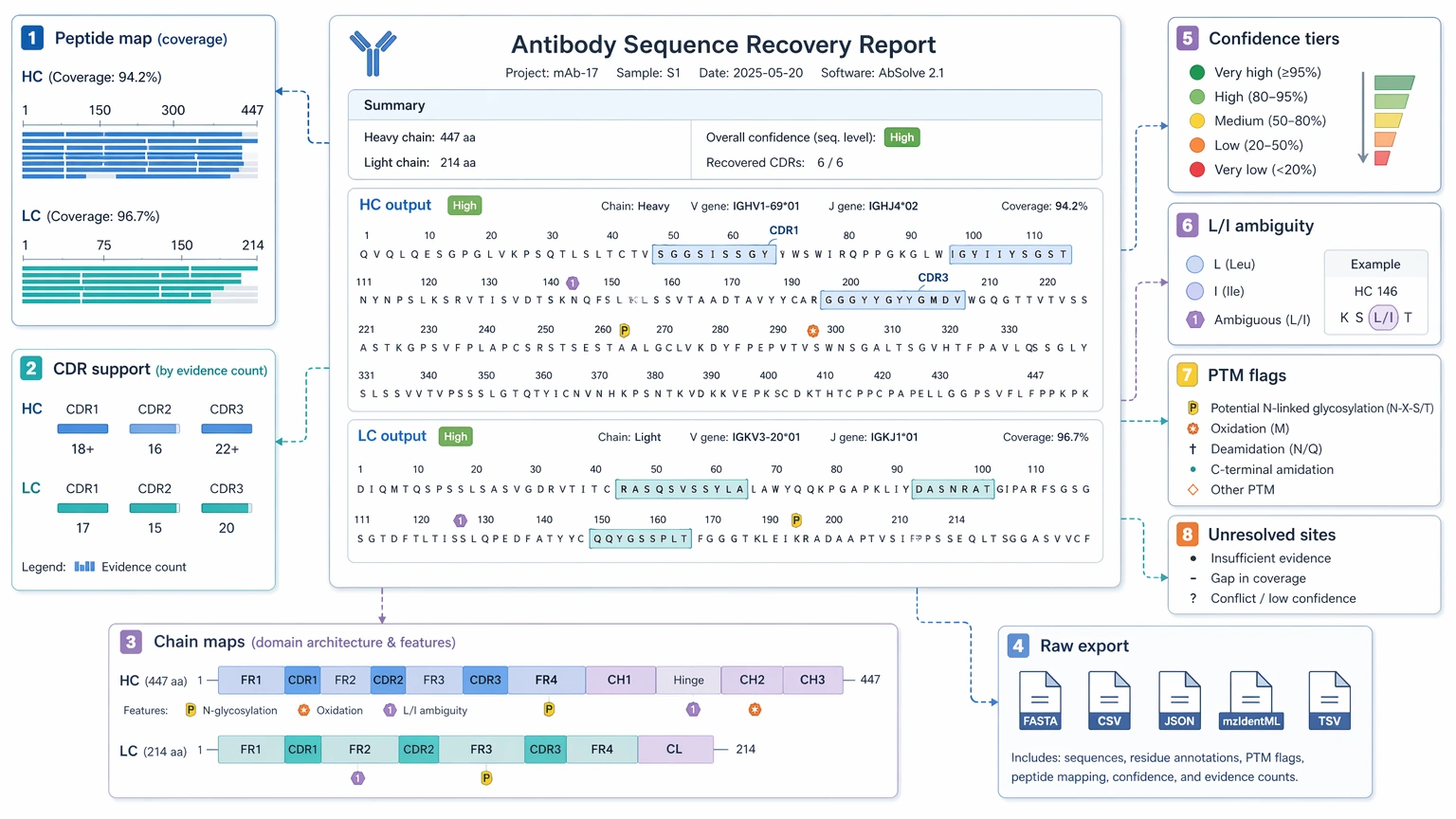
A practical report should contain:
- chain-specific assembled outputs
- peptide support maps
- CDR and framework evidence summaries
- residue-level certainty or a defined confidence score system
- annotation of isobaric residues
- explicit handling of leucine/isoleucine ambiguity
- flags for PTM-affected regions
- identification of unresolved residues
- policy on raw data or evidence export
At this stage, a provider that can discuss evidence granularity is usually easier to work with later. If your team is screening options for a limited or high-value sample, submit your requirements to MtoZ Biolabs to evaluate the project against sample condition, chain-recovery goals, and expected report depth before shipment.
Step 5: Treat validation planning as part of vendor selection
If the goal is recombinant rescue or project handoff, the analytical report is only part of the decision. Ask what happens next when sequence confidence is partial rather than assuming the first sequence package is immediately build-ready.
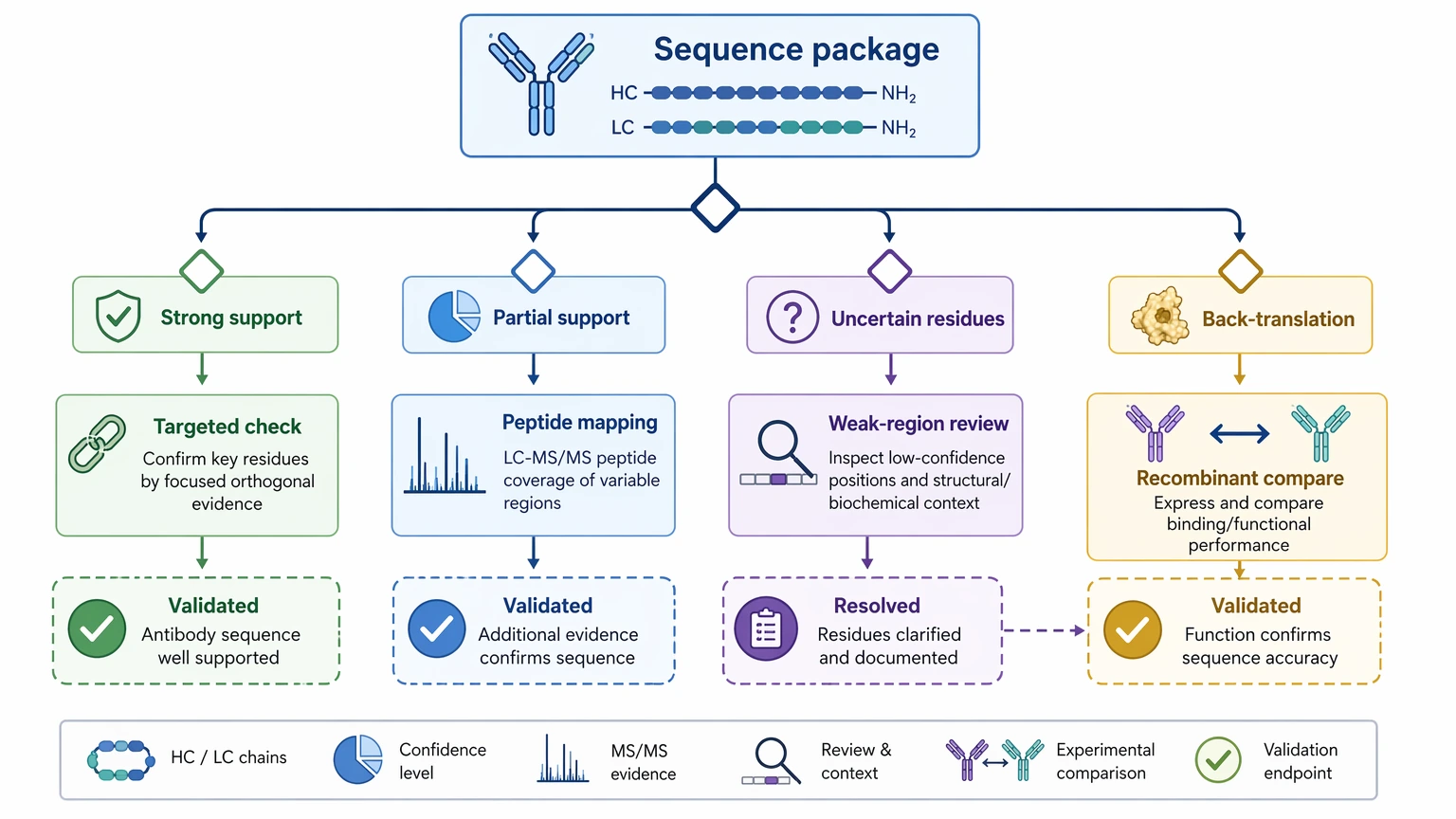
Ask whether the provider can support or recommend:
- targeted confirmation of uncertain residues
- follow-up peptide mapping against the inferred sequence
- review of weak-coverage regions
- comparison of recombinant material with the original antibody through suitable downstream assays
- sequence back-translation support for recombinant expression
A provider does not need to claim every confirmation step is done in-house. It does need to explain the decision path after the initial recovery package.
Service Routes to Consider
Expected Results and Validation Methods
The first useful result should come before wet work starts: a realistic feasibility position. You should know whether the sample is a strong, conditional, or poor candidate for direct recovery.
Immediate deliverables
Immediately after the main project, the most useful outputs are candidate heavy chain and light chain sequences, chain-level sequence annotation, peptide evidence summaries, sequence coverage views across key regions, flagged uncertainties, PTM-related complications, unresolved residues, and a written interpretation of what is ready for downstream use.
Follow-up confirmation
Keep that separate from later confirmation work. Follow-up validation may include targeted residue checks, added review of low-confidence regions, or comparison of recombinant and original antibody materials. For teams planning re-expression, the better provider is often the one that distinguishes clearly between what is ready for use and what still needs confirmation before expensive downstream work begins.
Key Cautions and Practical Limits
Sample quality or amount limits
Low-input, degraded, aggregated, or formulation-heavy samples can reduce clean peptide evidence. In some projects, the realistic goal shifts from complete recovery to partial recovery plus focused confirmation.
Controls and repeat expectations
If re-expression or lot comparison is the downstream goal, decide in advance which comparison materials or repeat analyses will be needed. A one-pass report may not answer every later question.
Batch and contamination risk
Carrier proteins, excipients, mixed antibody backgrounds, and lot heterogeneity can complicate chain assignment and reduce report clarity. Those risks should be reviewed before sample receipt, not after data collection starts.
Interpretation boundaries
Protein-based recovery does not recreate the original nucleic acid context. It reconstructs the mature protein evidence present in the sample, and incomplete MS/MS evidence can still leave inferred positions in the chain-level output.
When another route is the better next step
If trusted hybridoma material, archival nucleic acid, or a cleaner antibody source is available, another method may be more efficient than forcing a poor protein sample through a difficult recovery workflow. If your project involves uncertain sample condition, limited material, or a handoff to recombinant recovery, contact MtoZ Biolabs to discuss the sample history and evaluate your project before committing the shipment.
Conclusion
Choosing an antibody sequencing service for sequence recovery is mostly a planning decision: can the provider turn your available antibody material into a chain-resolved, evidence-backed package that another team can actually use? The most dependable review path is to confirm sample suitability first, then examine workflow credibility, reporting depth, uncertainty handling, and validation planning in that order. That approach fits legacy monoclonal antibodies, missing-record programs, biosimilar benchmark work, and clone rescue efforts where a partial but clearly annotated answer is more useful than an overconfident sequence string. For teams preparing a limited or high-value antibody project, gather the sample history, buffer details, concentration range, and downstream goal first, then request a feasibility review and consultation before shipment.
FAQ
What internal information should we prepare before the first vendor call?
Prepare sample concentration, buffer composition, known additives, storage history, lot count, and the exact downstream objective. Also note whether the goal is recombinant recovery, documentation, or comparison to another material.
If two vendors propose similar LC-MS/MS workflows, how can we still compare them?
Compare how they define confidence score, whether they provide chain-specific evidence maps, how they mark unresolved positions, and when they recommend follow-up confirmation.
Can a recovered protein sequence be used directly for expression construct design?
Not always. Mature protein evidence can inform construct design, but codon selection, signal peptide choice, and expression strategy still require interpretation beyond the MS readout.
When should we stop pushing a difficult protein sample and switch methods?
Consider switching when the sample is mixed, heavily degraded, or trapped in a formulation that undermines digestion or interpretation. A cleaner protein preparation or a nucleic acid source may reduce downstream rework.
Related Services
Main Service |
Supporting Service |
Validation Service |
Alternative Service |
How to order?




