






Antibody Sequencing: Principles, Workflows, and Applications in Antibody Discovery
Introduction
Antibody sequencing determines the amino acid sequence of immunoglobulin chains, especially the variable regions that define antigen recognition. In antibody discovery, sequence information supports clone backup, humanization, reagent redevelopment, recombinant expression, and intellectual property documentation. A team may have a functional antibody in hand, yet lack a reliable genetic record. Hybridoma cells may be lost, productivity may decline, or only purified IgG may remain from an older project.
Antibody sequencing is not a single method. Hybridoma sequencing recovers VH and VL from hybridoma-derived nucleic acids. PCR-based antibody sequencing amplifies immunoglobulin transcripts when RNA or cDNA is available. De novo antibody sequencing derives sequence information from purified antibody protein using LC-MS/MS and peptide assembly. Each route has different sample requirements, turnaround characteristics, and evidence strengths. Selecting the right workflow is central to successful antibody discovery support.
Related Services
| Recommended Service | |
|---|---|
| Antibody sequencing | |
| De novo antibody sequencing | |
| Hybridoma sequencing | |
| PCR-based sequencing | |
| MS-based antibody sequencing | |
| IgG sequencing |
Researchers planning antibody discovery support can consult MtoZ Biolabs to match sample type, chain coverage needs, and reporting format before starting a sequencing project.
What Antibody Sequencing Means in Discovery
In antibody discovery, sequencing answers a practical question: what is the primary structure of the antibody that produced the observed activity? The answer may be needed to rescue a valuable clone, rebuild expression constructs, compare leads, or document sequence ownership.
The most important regions are usually the variable heavy (VH) and variable light (VL) domains. These regions contain complementarity-determining regions (CDRs) that contact antigen. Constant regions also matter when isotype, effector function, or full IgG re-expression is part of the project plan. A strong antibody sequencing workflow should therefore define whether the project requires variable-region recovery, full-chain coverage, or both.
Major Antibody Sequencing Approaches
Antibody sequencing methods differ in sample input, readout mechanism, and dependence on genetic material.
Hybridoma sequencing uses hybridoma cells as the starting material. RNA is extracted, reverse transcribed, and immunoglobulin genes are amplified and sequenced. This route is efficient when viable hybridoma cells or high-quality RNA remain available.
PCR-based antibody sequencing amplifies antibody gene sequences from cDNA or related nucleic acid templates. It is useful when B-cell, hybridoma, or expression-cell RNA is accessible and the goal is rapid VH/VL recovery.
De novo antibody sequencing uses purified antibody protein as the input. The IgG is digested, peptides are analyzed by LC-MS/MS, and sequence tags are assembled into VH and VL regions. This route is valuable when cells are unavailable and only protein remains.
Database-assisted peptide mapping can support antibody confirmation when a reference sequence already exists. It is efficient for QC and comparability but is not a substitute for true sequence recovery when the reference is missing or uncertain.
Method Selection by Sample Type
The best sequencing route depends on what material is still available. The table below summarizes practical fit without replacing project-specific feasibility review.
| Preferred Route | Main Advantage | Main Limitation | |
|---|---|---|---|
| Viable hybridoma cells | Hybridoma sequencing | Fast genetic recovery when cells are healthy | Not useful after cell loss |
| High-quality RNA or cDNA | PCR-based antibody sequencing | Efficient VH/VL amplification | Depends on RNA integrity |
| Purified IgG only | De novo antibody sequencing | Works without genetic source | More complex MS interpretation |
| Reference sequence exists | Peptide mapping or confirmation | Efficient QC and comparability | Not ideal for unknown sequence recovery |
| Low-purity antibody sample | Purification plus sequencing | Improves confidence after cleanup |
This selection logic is especially important in antibody discovery rescue projects, where the wrong method choice can waste the only remaining sample.
Technical Workflow Overview
A typical antibody sequencing project moves from sample assessment to validated sequence output. The exact steps depend on the method, but the logic is consistent across workflows.
First, the sample type is confirmed. Hybridoma cells, RNA, or purified IgG each require a different entry point. Second, the target coverage is defined. Variable-region recovery may be enough for some discovery tasks. Full-chain documentation may be required for re-expression or regulatory support. Third, the readout method is selected. Genetic sequencing routes use amplification and Sanger or NGS readout. Protein-level routes use digestion, LC-MS/MS, and expert peptide assembly.
For protein-level antibody sequencing, the workflow usually includes antibody purification or intake, reduction and alkylation, enzymatic digestion, LC-MS/MS acquisition, de novo peptide interpretation, VH/VL assembly, CDR annotation, and report delivery. For hybridoma or PCR routes, the workflow emphasizes RNA quality, primer design, amplification, sequence trimming, and clone-level validation.
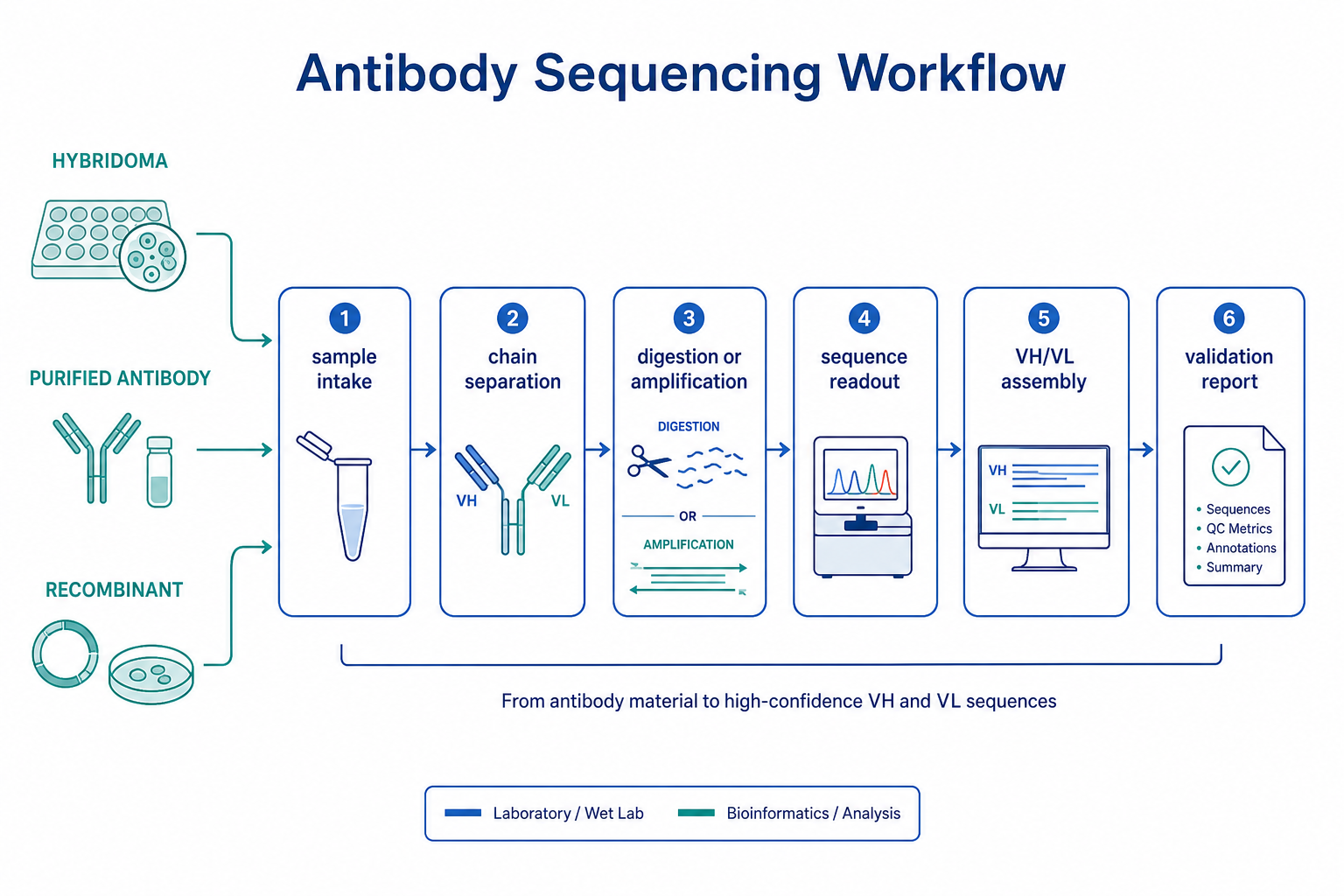
Figure 1. Antibody sequencing workflows move from sample intake through chain recovery and sequence assembly to a validated report.
Core Advantages and Current Limitations
1. Core Advantages
(1) Clone rescue and continuity.
Antibody sequencing protects discovery programs when hybridoma banks fail, productivity drops, or historical clones lack sequence records.
(2) Support for recombinant redevelopment.
Recovered VH and VL sequences enable expression vector design, humanization, and format engineering.
(3) Protein-level evidence when genetics are unavailable.
De novo antibody sequencing provides sequence information directly from purified IgG.
(4) Discovery documentation.
Sequence data supports lead comparison, reagent redevelopment, and patent-related primary structure evidence.
2. Current Limitations
(1) Sample dependence
Hybridoma and PCR routes fail when RNA or viable cells are gone. Protein-level routes depend on purity and amount.
(2) Variable-region complexity
CDR diversity, somatic mutations, and isotype differences increase interpretation difficulty.
(3) Isobaric residue ambiguity
Leucine and isoleucine may not be distinguished by routine MS workflows alone.
(4) Not every route gives full-chain coverage by default
Projects must define whether variable-region recovery or broader chain coverage is required.
Antibody sequencing is powerful, but the evidence level depends on method choice, sample quality, and validation design.
Applications in Antibody Discovery
Antibody sequencing supports multiple stages of the discovery pipeline.
1. Lead Recovery
A productive clone can be rescued when hybridoma cells are no longer available but purified antibody remains.
2. Humanization and Engineering
VH and VL sequences are starting points for framework design, CDR grafting, and affinity optimization.
3. Reagent Redevelopment
Diagnostic and research reagents can be rebuilt when the original expression system or clone record is incomplete.
4. Biosimilar and Comparability Support
Sequence confirmation helps compare expressed products against intended designs.
5. Patent and Primary Structure Documentation
Sequence evidence supports filings, tech transfer, and internal knowledge retention.
How Sequencing Fits Common Discovery Scenarios
In early discovery, sequencing may be used to archive a promising lead before instability or cell loss occurs. In lead optimization, recovered sequences support humanization and format changes. In redevelopment, protein-level sequencing may be the only option when legacy samples lack genetic records. In QC-driven workflows, peptide mapping or MS confirmation may be enough when the intended sequence is already known.
The strongest projects define the downstream use before sequencing begins. A sequence report intended for cloning design has different requirements than a report intended only for internal comparison or rescue validation.
Validation and Quality Considerations
A sequence report should be evaluated by coverage, replicate support, and biological plausibility. For genetic routes, amplification quality, primer specificity, and clean trace data matter. For protein-level routes, overlapping peptides, CDR coverage, and manual spectrum review matter.
Useful validation steps may include:
• confirming sample purity before sequencing
• checking that VH and VL lengths and framework patterns are plausible
• comparing independent digests or technical replicates when possible
• using orthogonal confirmation for critical discovery decisions
• documenting ambiguous residues or unsupported regions clearly
Transparent reporting improves usability for expression design and downstream discovery decisions.
Future Outlook
Antibody sequencing continues to benefit from improved MS sensitivity, better de novo interpretation tools, and more integrated genetic plus proteomic workflows. Discovery teams are increasingly using sequencing not only for rescue, but also as a standard step in lead documentation and reagent continuity planning. At the same time, expert review remains important because antibody sequence projects involve complex variable regions, modifications, and sample-specific constraints.
For many laboratories, outsourcing antibody sequencing provides access to method selection, optimized workflows, and reporting formats suited to discovery or redevelopment needs without building every capability internally.
Frequently Asked Questions
1. What is the difference between hybridoma sequencing and de novo antibody sequencing?
Hybridoma sequencing recovers VH and VL from hybridoma-derived nucleic acids. De novo antibody sequencing determines sequence from purified antibody protein using LC-MS/MS and peptide assembly.
2. Can antibody sequencing work if hybridoma cells are lost?
Yes, if purified IgG remains available. De novo antibody sequencing is often the primary route in that scenario.
3. Does antibody sequencing always include full constant regions?
Not always. Many discovery projects focus on VH and VL recovery. Full-chain coverage should be defined during project scoping.
4. Which method is best for antibody discovery rescue?
The best method depends on available material. Hybridoma or PCR routes are preferred when genetic material is accessible. Protein-level sequencing is preferred when only purified antibody remains.
5. How should antibody sequencing results be validated?
Validation may include replicate support, CDR coverage review, orthogonal confirmation, and clear documentation of unsupported or ambiguous regions.
Conclusion
Antibody sequencing provides the primary structure information needed to support discovery, rescue, engineering, and redevelopment. Hybridoma sequencing and PCR-based routes are efficient when genetic material is available. De novo antibody sequencing becomes essential when only purified IgG remains. The strongest outcomes come from matching the workflow to sample type, defining VH/VL coverage needs early, and validating the final sequence for the intended discovery use. Researchers planning antibody discovery sequencing projects can contact MtoZ Biolabs to review sample availability, select the appropriate route, and align the workflow with cloning, QC, or redevelopment goals.
How to order?




