






Antibody Next-Generation Sequencing vs Mass Spectrometry Antibody Sequencing: Which Fits Your Sample Source?
Choose antibody next-generation sequencing when your sample still includes an RNA-derived template from antibody-producing cells and the project needs variable region recovery, repertoire sequencing, or stronger support for heavy/light chain pairing. Choose mass spectrometry antibody sequencing when the usable material is a purified antibody or an antibody-containing protein sample and no viable cells or intact RNA remain. For many teams, that split by sample source answers the main method question right away.
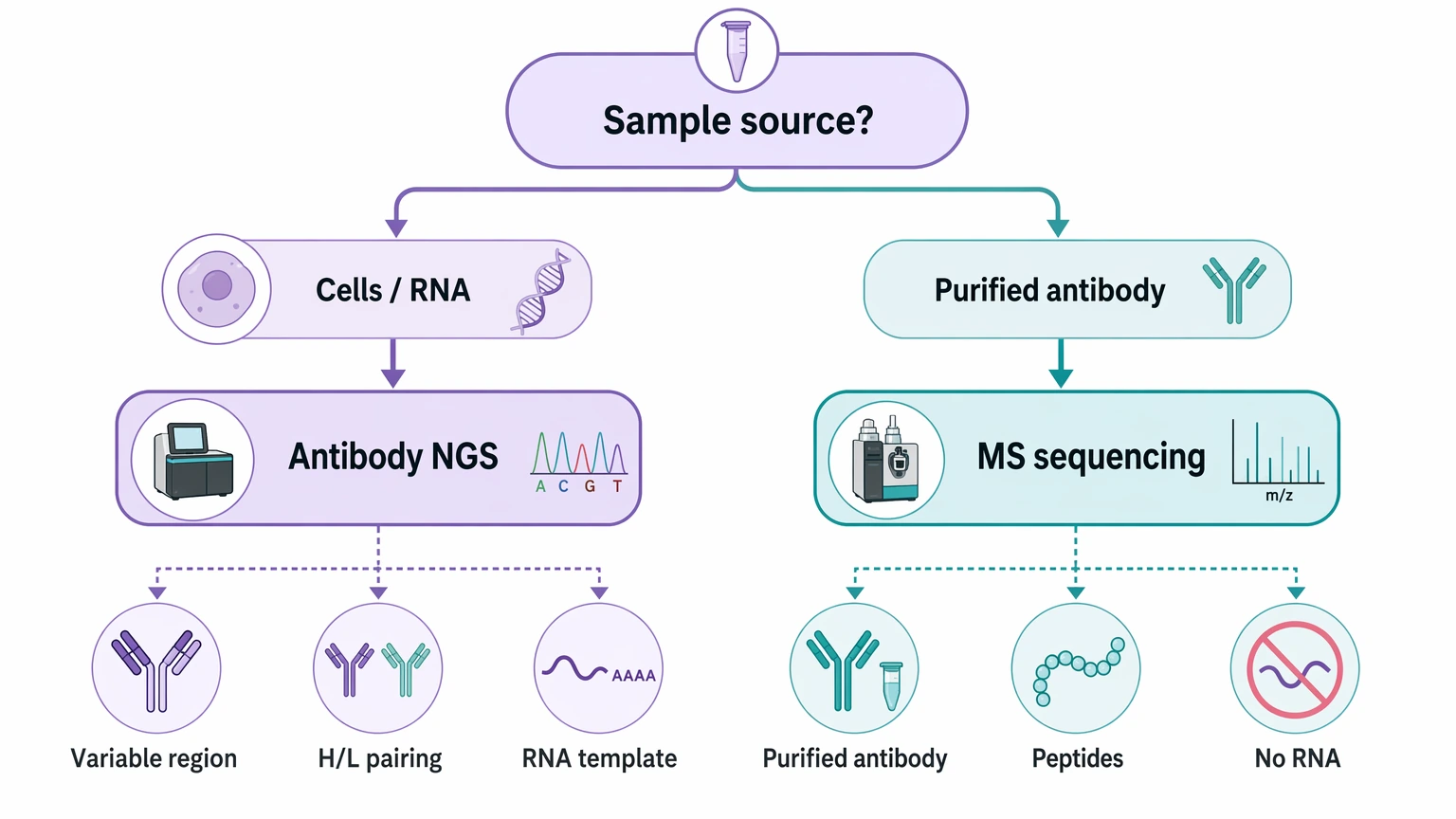
The more useful comparison is not which platform sounds more sophisticated. It is which workflow can recover the sequence information your material can actually support. A hybridoma, a single B cell, a B-cell repertoire sample, and a purified IgG vial do not preserve the same biological evidence. As a result, they do not offer the same level of antibody sequence recovery, confidence, or downstream reconstruction options.
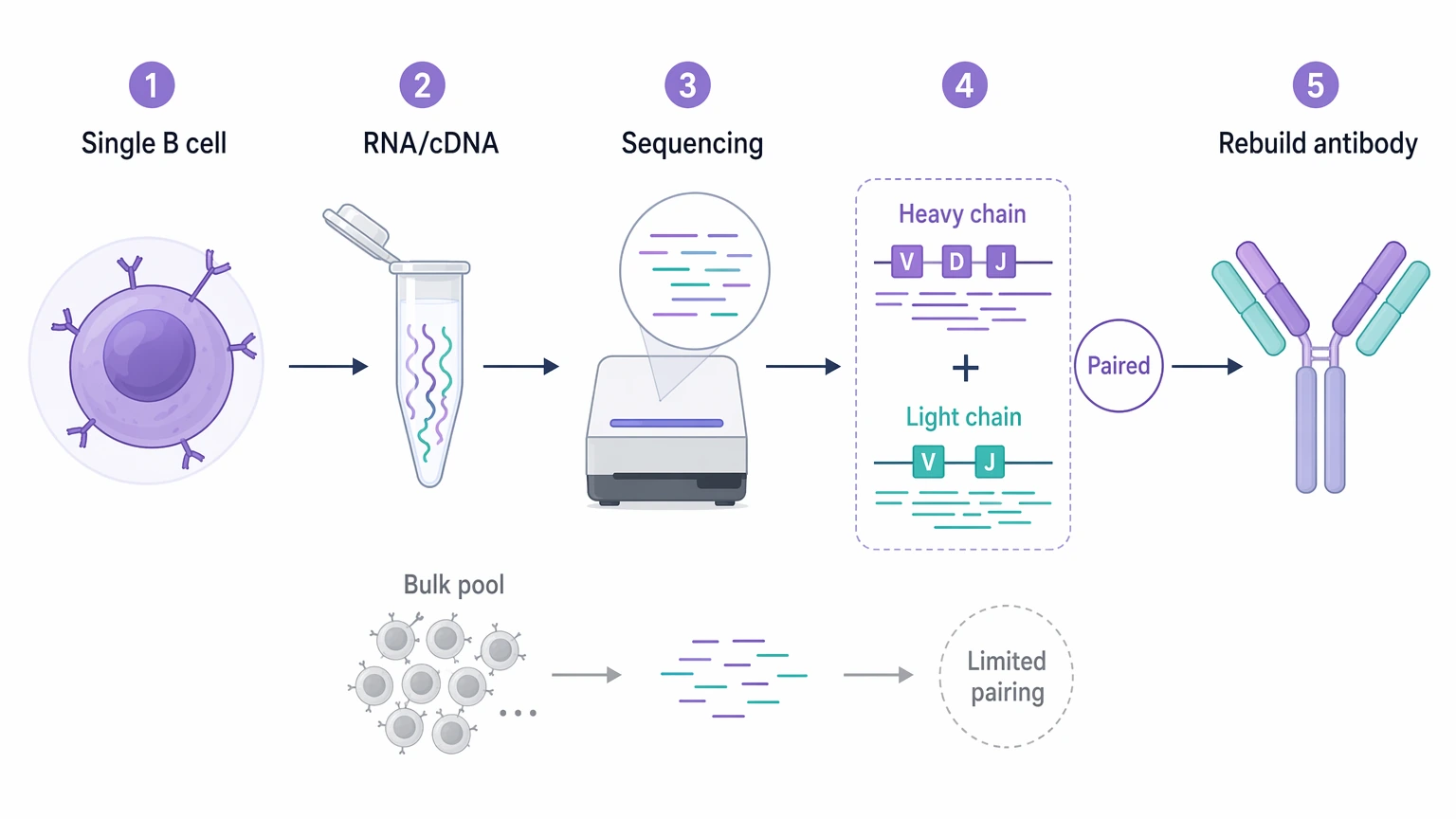
Why Sample Source Changes the Entire Decision
Two projects may both ask for “the antibody sequence” and still call for different workflows. If one team has cell-derived material, it can often work from the nucleic acid template that encoded the antibody. If another team has only a stored protein sample, the project moves from template-based recovery to protein-derived sequence evidence.
That difference shapes more than simple feasibility. It also changes the kind of output you should expect:
- clone-linked variable region candidates
- repertoire-scale clonotype data
- direct evidence from the expressed heavy chain and light chain
- confidence for recombinant re-expression
- need for follow-up validation such as peptide mapping or Sanger confirmation
One planning mistake shows up often: treating every antibody sequencing request as the same type of sequencing job. In practice, the method needs to match the physical sample, the clonality context, and the final deliverable.
The Core Difference Between the Two Approaches
Antibody next-generation sequencing starts from an RNA-derived template or cDNA generated from antibody-producing cells. It aligns best with hybridoma, sorted B-cell, or repertoire-derived material. This route is often the most direct one when the goal is clone-focused sequence recovery or population-level repertoire analysis.
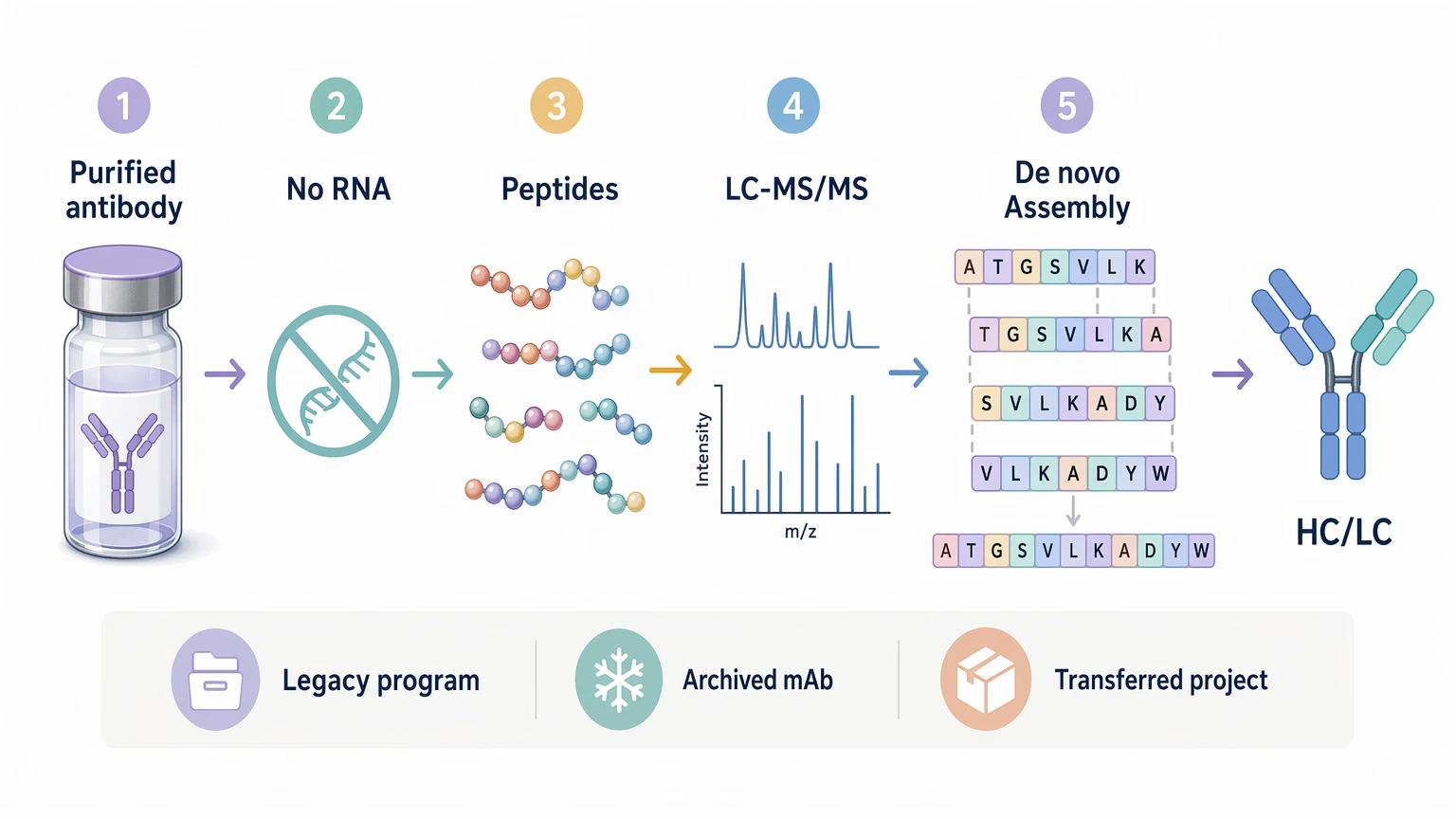
Mass spectrometry antibody sequencing starts from the antibody protein itself. It is the practical option when only a purified antibody or an enriched antibody fraction is available. Rather than reading the original nucleic acid template, it reconstructs sequence information from peptides generated during sample preparation, often using de novo peptide sequencing and peptide mapping logic.
Neither method is better in every case. Each one answers a different question from a different starting material.
Four Decision Dimensions That Matter Most
Input Type: Template Access vs Protein Access
This is the first and strongest filter. If you still have cells, RNA, or cDNA, antibody next-generation sequencing is usually the more direct path. If you only have purified protein, mass spectrometry antibody sequencing becomes the realistic choice because NGS cannot reconstruct an RNA-derived template from protein alone.
Heavy/Light Chain Pairing
Many projects do not just need sequence fragments. They need chain pairing that is solid enough to support clone reconstruction. Hybridoma and single-cell formats usually support heavy/light chain pairing more directly than bulk repertoire material. MS-based workflows read the expressed molecule, but chain assignment can still require interpretation when sequence coverage is incomplete or the sample contains more than one antibody species.
Recovery Scope Across CDR and Framework Region
Some projects only need CDR confirmation. Others need near-complete variable region recovery across both the CDR and framework region for re-expression planning. Antibody next-generation sequencing often fits these needs naturally when the source material is cell derived. MS can recover useful sequence information from purified antibody, but the output may still include uncertain residues or uneven peptide support across the variable domains.
Mixed Population vs Single Clone Context
A B-cell repertoire sample and a purified monoclonal antibody answer different biological questions. Repertoire sequencing is built to profile populations, clonotype abundance, and diversity. It should not be treated as a shortcut for exact recovery of one defined antibody from a mixed source. When the target is one expressed antibody molecule, the decision framework should change with it.
Sample-Source-First Comparison Table
The table below compares the methods based on the material you actually have, not platform marketing language.
| Sample source | Better fit | Typical deliverable | Main advantage | Main limitation |
|---|---|---|---|---|
| Hybridoma | Antibody next-generation sequencing | Heavy chain and light chain variable region candidates | Direct access to an RNA-derived template from a mostly single clone | Requires viable cells or recoverable RNA |
| Single B cell | Antibody next-generation sequencing | Pairing-aware heavy chain/light chain candidates | Better chain linkage than bulk pools | Low input increases handling risk |
| B-cell repertoire or PBMC-derived B-cell pool | Antibody next-generation sequencing | Clonotype tables and repertoire-level variable region data | Strong fit for population analysis | Native chain pairing may be limited in bulk formats |
| Repertoire RNA or cDNA | Antibody next-generation sequencing | Repertoire sequencing output with clonotype structure | Direct fit for library-based sequencing | Not ideal when one exact antibody is the only target |
| Purified antibody | Mass spectrometry antibody sequencing | Peptide-supported sequence assembly and protein-derived sequence evidence | Works when no cells or usable RNA remain | Coverage gaps and residue ambiguity may remain |
| Antibody-containing mixed protein fraction | Mass spectrometry antibody sequencing, case dependent | Peptide mapping with sequence interpretation | Possible salvage route for legacy material | Background complexity can reduce confidence |
When Antibody Next-Generation Sequencing Is Usually the Better Fit
Hybridoma Projects
A hybridoma is often the cleanest starting point for clone-level recovery. If viable cells, extracted RNA, or preserved cDNA are available, antibody next-generation sequencing usually provides the most direct path to the heavy chain and light chain variable region sequences needed for clone reconstruction. It also tends to fit well with downstream recombinant re-expression planning.
Single B Cell Projects
For a single B cell, the main advantage is chain context. Because the input is cell linked, the sequencing strategy can preserve stronger pairing logic than bulk repertoire workflows. That matters when the goal is to rebuild one antibody rather than survey a population.
Repertoire Discovery Projects
If the scientific question is about diversity, expansion, or candidate ranking across a B-cell repertoire, antibody next-generation sequencing is the right platform. It can characterize clonotype structure at scale, but the output still needs to be read as repertoire data, not as automatic confirmation of one expression-ready antibody sequence.
If your team is sorting through mixed cell-derived projects and needs to decide between repertoire profiling and clone-ready recovery, you can submit your requirements to MtoZ Biolabs to evaluate the sample type, expected deliverable, and validation plan before selecting a sequencing route.
When Mass Spectrometry Antibody Sequencing Becomes the Practical Choice
Purified Antibody Salvage
A purified antibody often makes the decision straightforward: MS becomes the likely path because the project no longer has access to the original RNA-derived template. This is common in legacy therapeutic programs, archived monoclonal materials, or transferred projects where only the protein stock remains.
What MS Can Recover Well
Mass spectrometry antibody sequencing can provide molecule-level evidence from the actual expressed antibody. That matters when the key question is, “What sequence most likely produced this purified antibody?” In those cases, de novo peptide sequencing and peptide mapping can support reconstruction of the heavy chain and light chain variable domains.
What to Plan for Realistically
MS-based recovery does not always produce even support across every residue. Some peptides cover regions densely, while others leave sparse support. Certain substitutions can remain ambiguous, and full-chain assembly may take interpretation. For re-expression projects, teams often add orthogonal checks instead of treating the first assembled sequence as final.
What Each Method Means for Re-Expression Readiness
For recombinant re-expression, sequence confidence is not just a question of having many reads or many peptides. What matters is whether the final candidate set is coherent enough to move into construct design and expression testing.
Antibody next-generation sequencing often supports that handoff more directly when hybridoma or single-cell material is available. The genetic template maps naturally to sequence reconstruction. By contrast, MS-based sequencing is especially useful when the expressed protein is the only recoverable evidence, but the path to expression constructs may require extra review of uncertain positions, chain assignment logic, or orthogonal confirmation.
That is why “sequence found” and “re-expression ready” should not be treated as the same outcome.
A Practical Selection Path by Sample and Goal
Use this shorter decision path when screening projects:
- Hybridoma + clone recovery goal: start with antibody next-generation sequencing
- Single B cell + pairing-sensitive goal: start with antibody next-generation sequencing
- B-cell repertoire + diversity analysis goal: use repertoire sequencing
- Purified antibody + no cells or RNA left: start with mass spectrometry antibody sequencing
- Mixed incoming program portfolio: split the workflow by sample source instead of forcing one method across all projects
That kind of sample-first triage usually cuts avoidable delays, especially when outsourced work needs to be scoped before sample shipment.
Validation Questions to Settle Before You Commit
Before choosing a workflow, clarify five points internally:
- Is the sample cell derived, protein derived, or both?
- Is the target one antibody or a mixed repertoire?
- Do you need native or pairing-aware heavy/light chain information?
- Is the output meant for analysis only, or for recombinant re-expression?
- What validation step will you accept if sequence ambiguity remains?
Those questions usually matter more than the platform brand or instrument type. They define what success looks like for the project.
Comparison Summary and Consultation Guidance
Antibody next-generation sequencing and mass spectrometry antibody sequencing solve different sequence recovery problems because they start from different evidence types. NGS is usually the better fit for hybridoma, single B cell, and B-cell repertoire material when an RNA-derived template is available and the project needs variable region recovery, repertoire sequencing, or stronger support for heavy/light chain pairing. MS is usually the better fit for purified antibody and other protein-only scenarios, where the project must rely on protein-derived sequence evidence and accept that some positions may need extra confirmation. For teams planning antibody sequence recovery across mixed sample sources, contact us to evaluate your project with MtoZ Biolabs and share the sample origin, purification state, existing data, and re-expression goal before locking in the sequencing route.
FAQ
Can antibody next-generation sequencing work if I only have purified antibody and no cells?
No. Antibody next-generation sequencing requires an RNA-derived template or derived cDNA. If the project has only purified protein, the workable sequencing path is usually protein based.
Does MS-based sequencing preserve native heavy/light chain pairing automatically?
Not automatically. MS reads the expressed antibody and can provide chain-level evidence, but pairing confidence still depends on sample purity, peptide support, and how the sequence assembly is interpreted.
Is repertoire sequencing the right choice for recovering a historical monoclonal antibody?
Usually not if the antibody itself is the only remaining material. Repertoire sequencing describes a cell population, while a historical purified monoclonal antibody is a protein-only salvage problem.
What extra validation is most common before recombinant re-expression?
Teams often use Sanger confirmation for cell-derived candidates or peptide mapping against reconstructed sequences for protein-derived candidates. Expression testing may still be needed to confirm that a proposed heavy chain and light chain pair behaves as expected.
How pure does a purified antibody sample need to be for MS sequencing to be useful?
Higher purity usually improves interpretability because it reduces overlapping peptide signals from background proteins or additional antibody species. Mixed fractions can still be workable, but they increase the burden of sequence interpretation.
What information should I send with a method-selection inquiry?
Send the sample source, whether RNA or cDNA exists, whether purified antibody is available, the apparent clonality of the sample, the intended output format, and whether recombinant re-expression is the downstream goal.
How to order?




