






Antibody Diversity And Specificity Analysis vs ELISA: Method Selection and Research Use Cases
Quick Answer
Use ELISA when the study only needs a binding readout against a known coated antigen and the decision is limited to ranking, screening, or comparing relative reactivity. Use antibody diversity and specificity analysis with LC-MS/MS when the project needs to determine which antibodies or targets generate the signal, resolve a mixed antibody population, assess cross-reactivity, interpret proteoform differences, or recover evidence for an unknown protein or peptide target. In many programs, the practical workflow is ELISA for fast comparison, followed by LC-MS/MS and, when needed, de novo peptide sequencing or de novo protein sequencing for molecular interpretation.
Decision Snapshot
| If your main question is... | Best starting method | Why |
|---|---|---|
| Do samples bind a known coated antigen? | ELISA | Fast comparative binding readout |
| Which target is actually being recognized? | LC-MS/MS | Supports target identification with peptide evidence |
| Are multiple antibody species contributing to the signal? | LC-MS/MS | Better suited to antibody diversity and mixed-sample interpretation |
| Are positive ELISA results masking off-target binding? | LC-MS/MS, often after ELISA | Helps assess cross-reactivity and co-enriched proteins |
| Is the sequence novel, truncated, or PTM-rich? | LC-MS/MS with de novo support | Database search alone may be incomplete |
Use the table as a screening guide, then confirm the fit against the available sample, spectra, and validation goal.
What Each Method Actually Answers
These methods answer different questions.
ELISA asks whether binding produces a measurable signal in the chosen assay format. The output may be optical density, endpoint titer, or an EC50-style comparative value. That is enough when the antigen is known, plate presentation is controlled, and the project only needs relative comparison.
Antibody diversity and specificity analysis asks what is interacting, how heterogeneous that interaction is, and what evidence supports the call. The workflow may include immunocapture, affinity enrichment, LC-MS/MS, tandem mass spectrometry, database search, and de novo interpretation when reference sequences are incomplete.
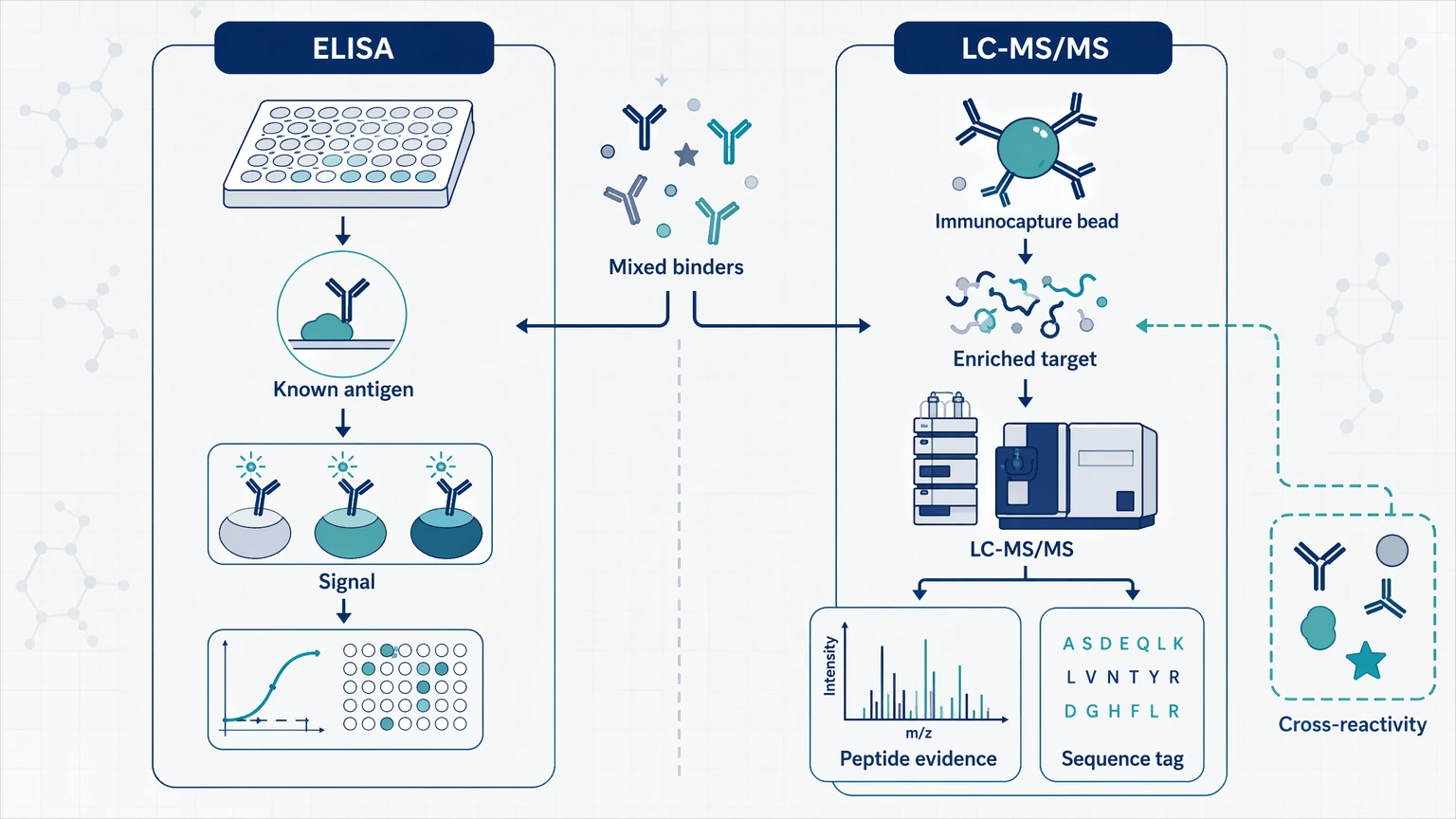
A positive ELISA result does not show whether one clone or a mixed antibody population drives the signal, whether cross-reactivity is involved, whether the bound material is a distinct proteoform, whether mutation, truncation, or a post-translational modification (PTM) changes interpretation, or whether a database search is missing the relevant sequence. That difference in readout is what separates the two methods.
When ELISA Is Usually Enough
ELISA is often the right first step when the question is operational rather than molecular.
Choose ELISA alone when the coated antigen is known, the goal is to rank clones, sera, or conditions, the sample matrix is simple, and you do not need target identification or peptide-level evidence. Typical examples include early clone screening, lot comparison, and serum reactivity studies against a predefined antigen panel.
| Scenario | Recommended workflow | Main limitation |
|---|---|---|
| Known recombinant antigen, clone ranking | ELISA | No sequence or target evidence |
| Batch-to-batch binding comparison | ELISA | Explains signal difference poorly |
| Simple yes/no reactivity screen | ELISA | Limited cross-reactivity interpretation |
| Defined antigen panel in early triage | ELISA | Does not resolve antibody diversity |
If the study decision ends with a comparative binding number, ELISA is usually enough.
Service Routes to Consider
For this project scenario, readers usually compare these service routes before requesting a quote or submitting samples.
When Diversity and Specificity Analysis Becomes Necessary
ELISA becomes incomplete when the team needs a molecular explanation instead of a plate signal.
LC-MS/MS-based antibody diversity and specificity analysis is a better fit when the study must characterize antibody diversity across serum, plasma, or enriched fractions; investigate antibody specificity beyond a single signal; distinguish on-target binding from cross-reactivity; identify an unknown protein or peptide target; compare binders that all look positive in ELISA; or assess sequence variation, engineered regions, truncation, or PTM-related binding differences.
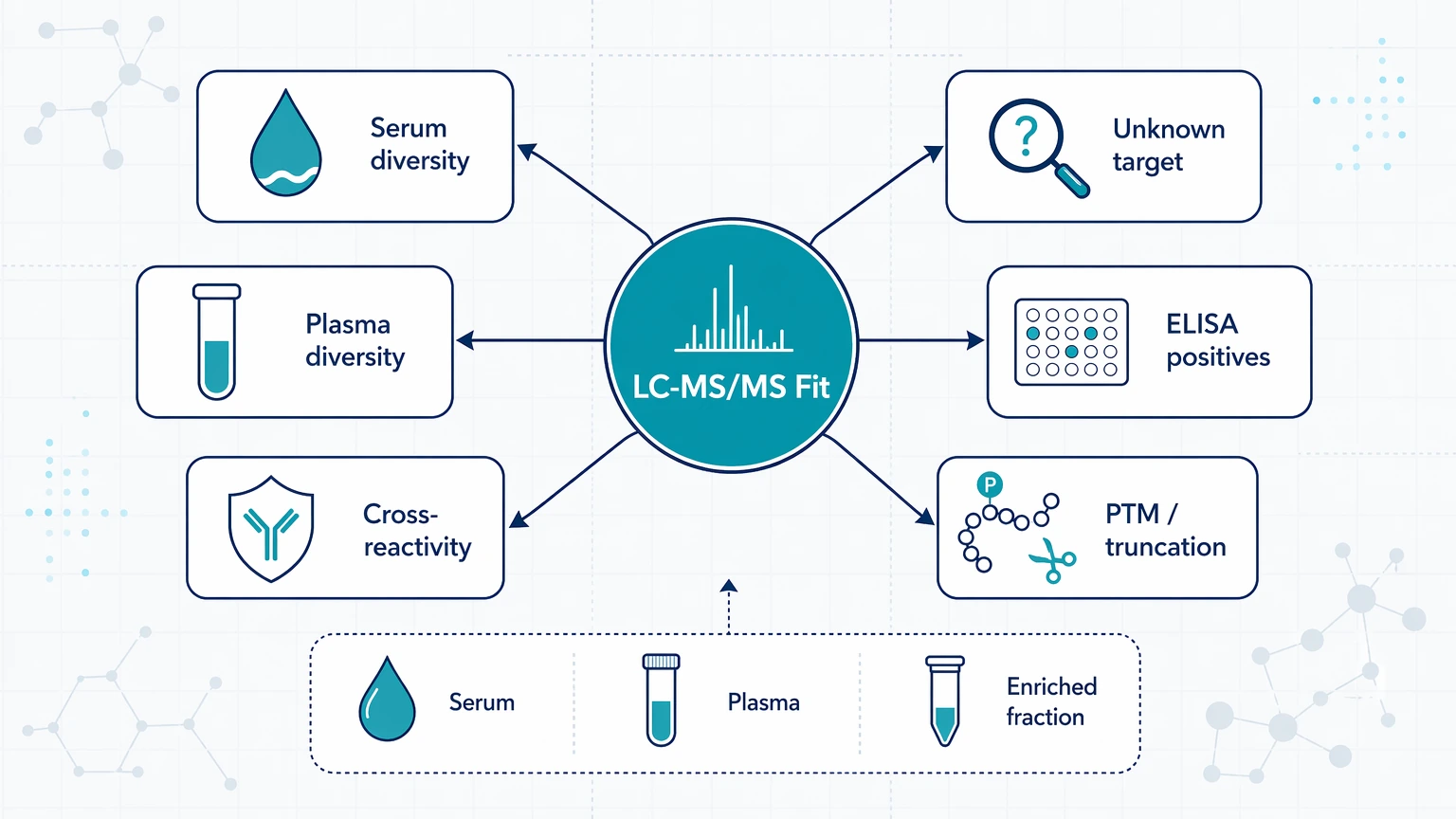
This comes up often in antibody engineering and translational assay development. Several candidates may appear similar by ELISA, while peptide-level evidence shows that they enrich different targets, pull down background proteins, or favor different proteoforms.
How Unknown Sequence Content Changes Method Choice
Unknown sequence content is one of the clearest reasons to move beyond ELISA.
A plate assay assumes that the relevant target is already known and represented correctly on the plate. That assumption breaks down when the captured material includes novel peptides, incomplete species annotations, mutation-bearing variants, splice differences, truncations, or PTM-rich targets. In those cases, database search may return only partial assignments or rank a near match above the real one.
That is where de novo peptide sequencing and de novo protein sequencing add value. Instead of relying only on reference entries, the analysis uses fragment-ion evidence to build a sequence tag and support candidate interpretation directly from MS/MS data.
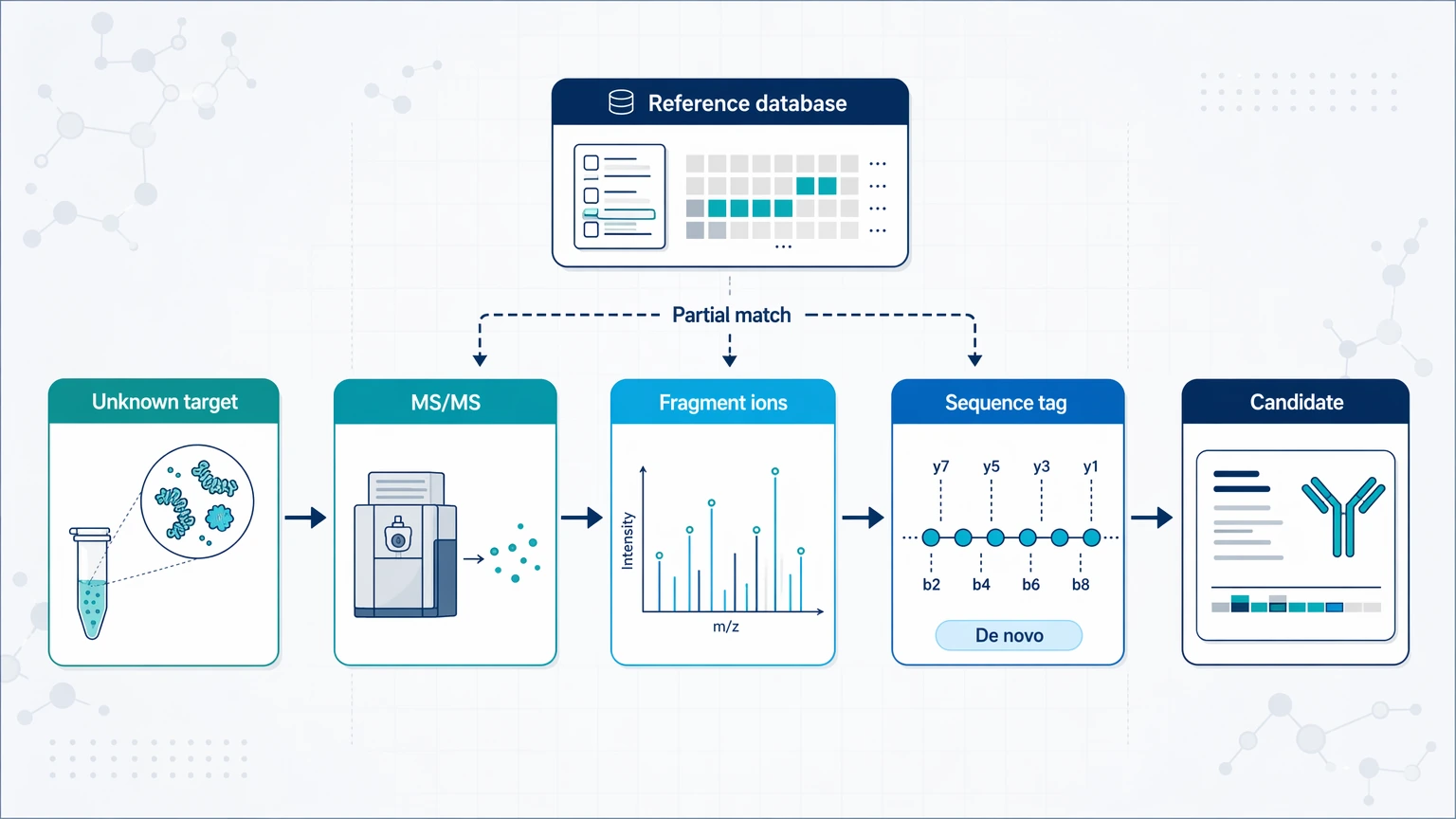
This still does not remove all ambiguity. Sparse spectra, complex modification patterns, and highly homologous sequence families can leave more than one plausible interpretation. A de novo-supported result is best read as evidence-ranked interpretation rather than automatic proof of a final full sequence.
| Sample type or situation | Better fit | What changes the decision |
|---|---|---|
| Purified monoclonal antibody vs known antigen | ELISA first | Main need is comparative binding readout |
| Serum or plasma with broad reactivity | LC-MS/MS after or alongside ELISA | High sample complexity and possible mixed binders |
| Affinity-captured unknown binder | LC-MS/MS with database search and de novo support | Target identity is not established |
| PTM-rich or truncated target fraction | LC-MS/MS | Proteoform differences may matter more than total signal |
| Existing MS/MS files with weak database hits | Re-interpret with de novo support | Sequence novelty or incomplete databases may be limiting |
Use the table as a screening guide, then confirm the fit against the available sample, spectra, and validation goal.
Side-by-Side Comparison of Deliverables
A useful comparison is binding readout versus interpretive evidence package.
ELISA deliverables
- optical density or similar signal output
- titer or relative reactivity comparison
- condition, clone, or sample ranking
- optional competition or panel-based follow-up within immunoassay format
LC-MS/MS-based deliverables
- candidate target list with ranking logic
- peptide-spectrum match evidence
- unique peptide counts
- sequence coverage
- observed PTM or proteoform features
- de novo sequence tag results where database support is weak
- interpretation notes for cross-reactivity
- recommendations for orthogonal validation
If the team needs to explain why a signal appears, the second deliverable is usually the more useful one.
Recommended Research Workflow for Comparison Projects
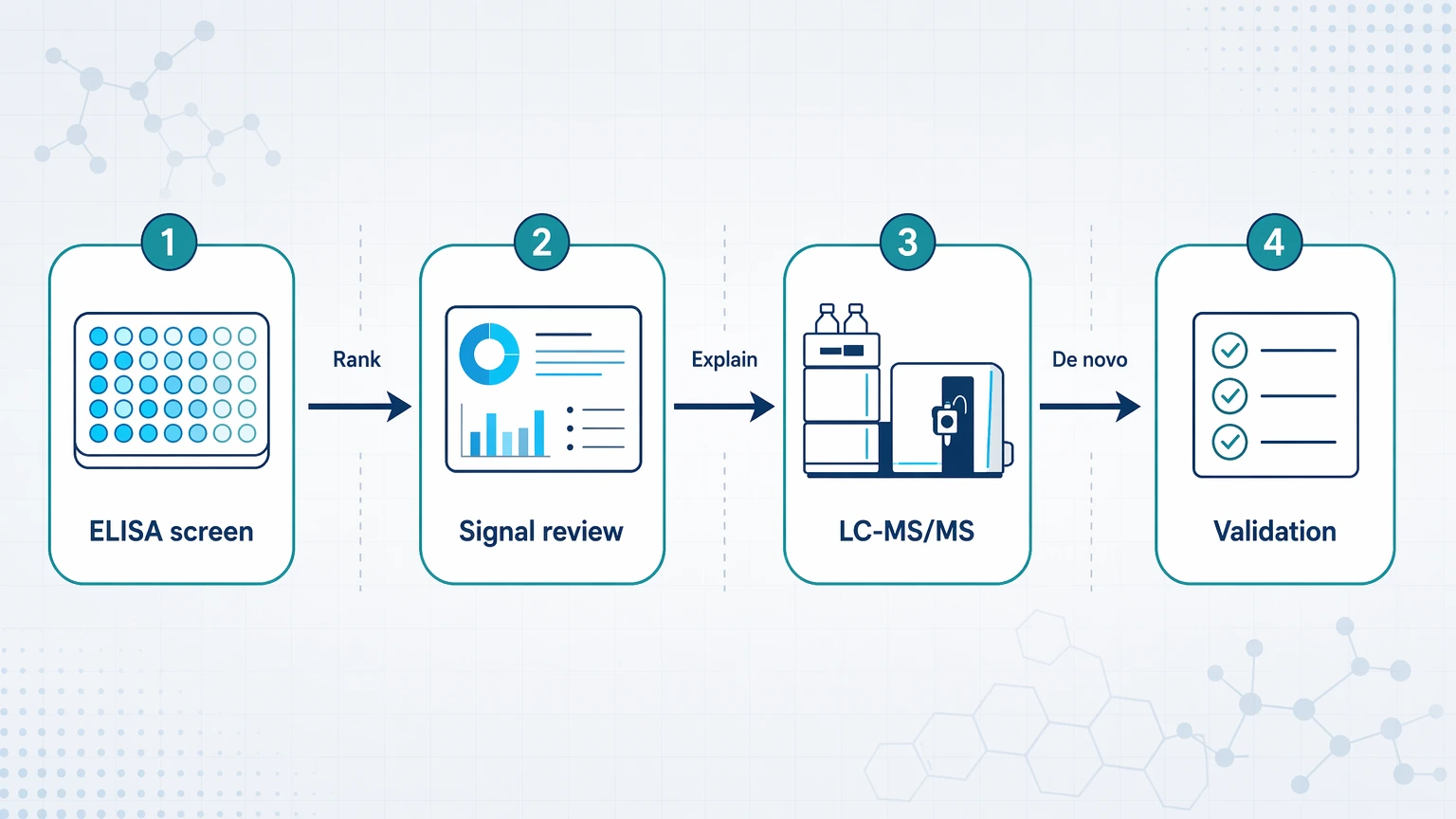
For most comparison-stage studies, a staged workflow works better than a strict either-or choice.
-
Start with ELISA for screening or ranking
Use ELISA for a fast binding readout across clones, sera, antigen formats, or enrichment conditions. -
Escalate to LC-MS/MS when the signal needs explanation
Move to specificity analysis when ELISA does not resolve target identity, cross-reactivity, or diversity within the responding population. -
Add de novo interpretation when database search is incomplete
This is most useful for unknown targets, mutation-bearing sequences, noncanonical regions, or incomplete species databases. -
Plan orthogonal validation around the exact uncertainty
Follow-up should test the remaining question rather than repeat the same experiment in another format.
At the workflow-selection stage, teams can submit your requirements to MtoZ Biolabs to evaluate your project when they need help matching sample type, LC-MS/MS workflow, de novo support level, and expected report structure before analysis starts.
Expected Results and Validation Methods
Immediate outputs and confirmation steps are not the same thing.
Immediate deliverables
ELISA usually produces a comparative binding readout. LC-MS/MS-based analysis may produce a candidate list, peptide-spectrum match summaries, unique peptide evidence, sequence coverage, PTM observations, and de novo-derived sequence tag information. These outputs support decisions, but they do not always settle identity or specificity on their own.
Follow-up confirmation
After the initial report, confirmation often includes targeted MS for specific peptides or proteoform-associated signals, Western blot or immunoblot for an orthogonal protein check, competitive binding assays, repeat immunocapture or affinity enrichment with improved controls, and secondary immunoassays using a refined antigen panel.
A practical rule is to validate the part of the result that still carries the most risk. If the report narrows the answer to a protein family but not one exact member, the next experiment should focus on family-discriminating peptides instead of running another broad discovery assay.
Key Cautions and Practical Limits
Method choice should reflect what can block a clean answer.
Sample quality or amount limits
Low input, degraded material, and poorly enriched fractions can reduce MS interpretability. ELISA can be more forgiving for simpler questions, but it still depends on stable antigen presentation and controlled assay conditions.
Controls and repeat expectations
Specificity statements are more defensible when capture controls, blank matrices, isotype controls, or replicate enrichments are included. One positive run is rarely enough to support a broad claim of exclusive binding.
Batch effects and contamination risk
Co-enriched background proteins, carryover, keratin contamination, reagent-derived signals, or plate-coating variability can distort interpretation. In mixed samples, apparent target identification may reflect enrichment bias rather than true primary binding.
Interpretation boundaries
A positive ELISA result does not prove molecular identity. A strong LC-MS/MS candidate list does not automatically prove direct binding to one exact species. Homologous proteins, shared peptides, PTMs, and incomplete sequence references can all narrow confidence.
When another method or outside support is the better next step
If the study needs precise epitope localization, cell-based functional confirmation, or confident discrimination among nearly identical proteoforms, another method may be needed after ELISA or LC-MS/MS. If a dataset already exists but confidence is limited by database-search failure or ambiguity in unique peptide evidence, contact MtoZ Biolabs to discuss the study and align the next step with the sample, spectra quality, and validation goal.
Research Use Cases That Clarify the Choice
A few scenarios make the choice clearer:
- Clone ranking against a stable antigen: ELISA first.
- Serum study with heterogeneous response: ELISA for overall reactivity, then LC-MS/MS if antibody diversity matters.
- Unknown pull-down target: LC-MS/MS first, often with de novo support.
- Positive ELISA with unexplained off-target biology: specificity analysis to assess cross-reactivity and co-enriched proteins.
- PTM-sensitive binding question: LC-MS/MS because the relevant target may exist as more than one proteoform.
FAQ
Can a strong ELISA signal justify saying the antibody is specific?
Not by itself. A strong signal shows binding under that assay format, but it does not rule out related proteins, altered antigen presentation, or shared motifs. If reporting language matters, use wording such as "the antibody showed binding to the coated antigen under the tested ELISA conditions." Stronger specificity claims usually need cross-reactivity testing or peptide-level target evidence.
What should we look for in an MS report before accepting target identification?
Start with unique peptide evidence, not only the top-ranked protein name. Check whether the peptide-spectrum match quality is consistent across those peptides, whether sequence coverage is concentrated in one region or distributed across the candidate, and whether homologous proteins could explain the same spectra. If de novo sequence tag results are included, use them to see whether they support the same candidate or suggest an unrepresented variant.
When should we not conclude that a PTM changes antibody binding?
Do not make that call from PTM detection alone. The modification may be present without driving the binding difference, or it may track with another structural feature. A stronger case needs a comparison design, such as modified versus unmodified target fractions, targeted validation of the modified peptide, or a follow-up binding experiment that isolates the PTM-related variable.
If ELISA and LC-MS/MS disagree, which result should guide the next experiment?
Treat the mismatch as useful information. ELISA may reflect binding to a plated antigen conformation, while LC-MS/MS may reflect what was enriched in solution or in a complex matrix. The next experiment should test that gap directly by reviewing antigen format, enrichment controls, and whether the candidate target is present in the ELISA setup. In reporting, avoid saying one method overrides the other until the difference is explained.
Final Decision Guidance
Choose ELISA when the study ends with comparative reactivity against a known antigen and no peptide-level evidence is needed. Choose antibody diversity and specificity analysis when the project must resolve molecular identity, mixed binders, sequence novelty, proteoform-related differences, or cross-reactivity that a binding readout cannot settle. In many translational immunology and antibody engineering projects, the efficient plan is staged: screen with ELISA, then use LC-MS/MS only where the decision needs deeper interpretation. If your team is defining sample suitability, expected deliverables, or the likely value of de novo support, prepare the sample context, target uncertainty, and reporting goal first, then seek consultation before submission.
How to order?




