






Antibody CDR Sequencing vs Full Variable Region Sequencing: What Do You Need for Engineering Work
For de novo antibody sequencing projects, antibody CDR sequencing is usually enough only when the next engineering step is tightly focused on paratope hypotheses and framework uncertainty will not change the first construct decision. If the project involves humanization, CDR grafting, sequence transfer, developability review, or any redesign where framework context could change the readout, you generally need full variable region sequencing for both the heavy chain variable region (VH) and light chain variable region (VL).
That distinction matters because protein-only recovery from purified antibody material rarely produces the same level of confidence across every region. A sequencing report may recover complementarity-determining regions (CDR1, CDR2, CDR3) well enough for early design thinking, yet still leave framework regions (FR1-FR4), Vernier residues, chain pairing logic, or residue-level confidence unresolved in ways that affect what you should build next.
Quick Decision Block
Use this rule set near the start of planning:
- Choose antibody CDR sequencing when the immediate task is local, exploratory, and tolerant of some sequence ambiguity outside the binding loops.
- Choose full variable region sequencing when framework residues, germline inference, chain pairing, or non-CDR liabilities could change engineering choices.
- Escalate from CDR-only to full recovery if the first LC-MS/MS readout shows weak support near loop bases, heavy-chain CDR3 uncertainty, or ambiguity in framework positions tied to redesign decisions.
A simple way to frame the choice is this: do you need sequence information to generate hypotheses, or do you need sequence information to justify a construct design?

Where Teams Usually Face This Decision
This question usually comes up when a team inherits an antibody as protein material rather than as a verified clone or a reliable DNA record. Common examples include archived formulation lots, legacy discovery reagents, partially documented internal candidates, or transferred assets entering a new expression or display workflow.
In that situation, the pressure is not just to recover sequence. It is to recover the minimum sequence scope that is still fit for engineering purpose. A narrow scope can move faster, but it can also create rework if later review shows that framework context changed the right redesign path. A broader scope asks more from the sequencing workflow, but it lowers the chance that early engineering decisions are built on incomplete assumptions.
CDR Sequencing vs Full Variable Region Sequencing at a Glance
The table below supports the first triage decision.
| Scenario | Recommended workflow | Key limitation | Validation need |
|---|---|---|---|
| Early paratope comparison within a known antibody family | antibody CDR sequencing | Framework-dependent effects may remain hidden | Targeted confirmation of critical CDR residues |
| Exploratory affinity maturation centered on heavy-chain CDR3 | antibody CDR sequencing, then expand if needed | Nearby VH support may change loop interpretation | Peptide remapping around CDR3 and adjacent FRs |
| CDR grafting or humanization | full variable region sequencing | CDR-only scope does not support FR1-FR4 review or Vernier residues | Orthogonal validation of design-critical framework positions |
| Sequence rescue for re-expression or platform transfer | full variable region sequencing | Weak chain assignment can derail VH/VL reconstruction | Chain-specific peptide evidence and construct back-check |
| Developability liability review | full variable region sequencing | Non-CDR liabilities stay largely invisible in a CDR-only readout | PTM-aware peptide mapping and targeted confirmation |
| Germline inference and back-mutation planning | full variable region sequencing | CDR-only data cannot support reliable framework comparison | Germline comparison plus review of low-confidence residues |
The practical takeaway is straightforward: if missing framework context could change the construct, full variable region sequencing is usually the safer place to start.
What Antibody CDR Sequencing Can Support
Antibody CDR sequencing is most useful when the engineering question is narrow and local. In those cases, the goal is not to certify a full reconstruction, but to recover the loop information that matters most for the next experiment.
Best-fit use cases include:
- comparing paratope motifs across related candidates
- forming first-round affinity maturation ideas
- prioritizing a heavy-chain CDR3 hypothesis
- triaging a scarce sample before deeper recovery work
This approach is easier to defend when some framework context already exists from another source, or when the first design cycle will stay exploratory rather than transfer-ready.
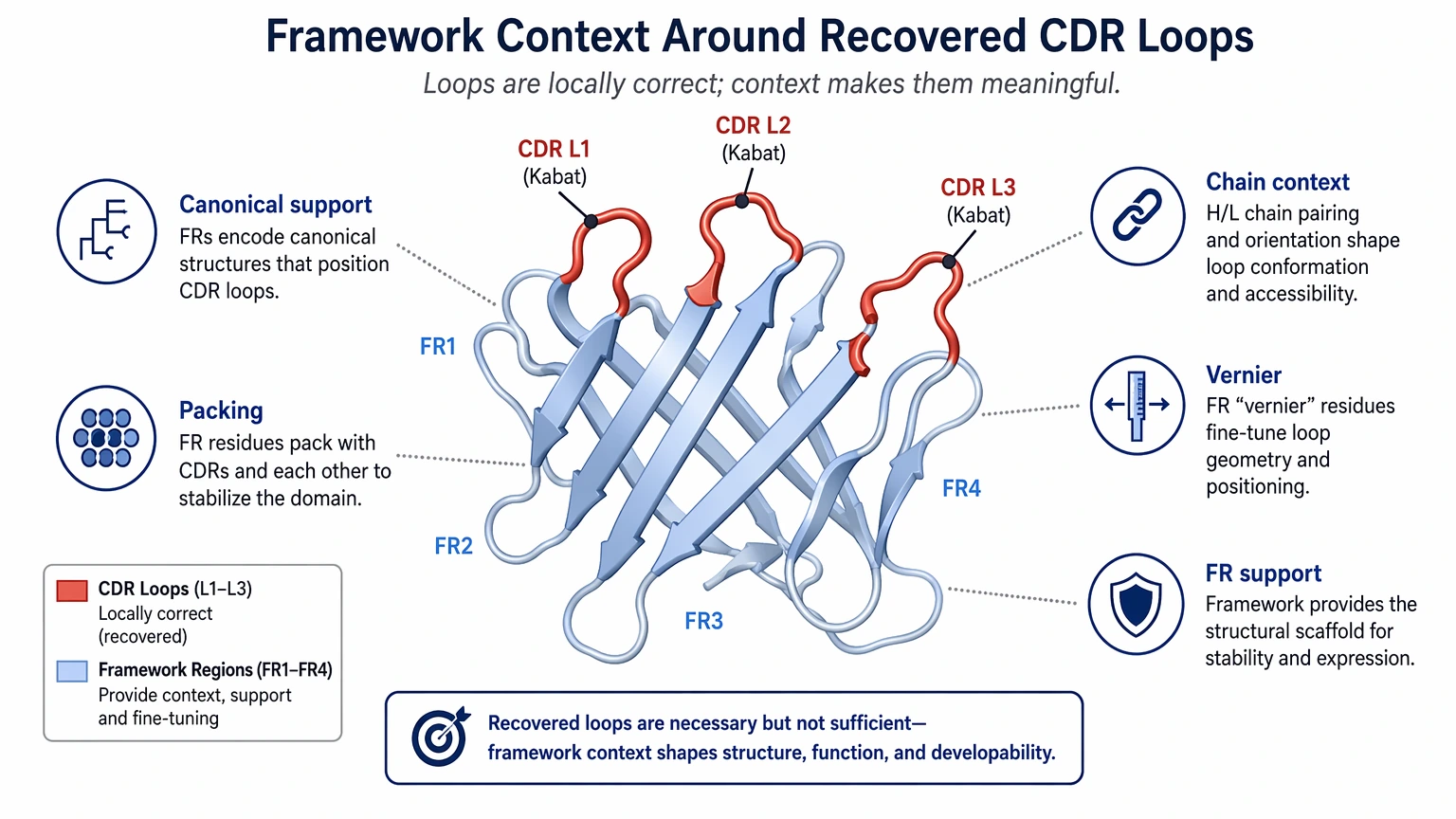
The main risk is that teams sometimes treat recovered loops as if they were independent design modules. In practice, loop behavior is shaped by surrounding framework regions, canonical support, packing interactions, and chain-specific context. A CDR sequence may be correct at the local peptide level and still be incomplete as an engineering input.
Why Full Variable Region Sequencing Changes the Engineering Readout
Full variable region sequencing covers both VH and VL across complementarity-determining regions and framework regions. For engineering teams, that added scope is not just more sequence length. It changes what can be interpreted with confidence.
Humanization and CDR grafting
Humanization depends on more than loop boundaries. Teams need framework regions (FR1-FR4) to assess germline inference, CDR grafting choices, Vernier residues, and back-mutation logic. Without that context, a graft may preserve the nominal CDR set while losing the structural environment that supported binding.
Sequence rescue and transfer
If the goal is to re-express a legacy antibody or move it into a new platform, full VH and VL recovery is often the practical minimum. A useful report needs chain pairing support and chain-specific assembly logic, not just isolated peptide tags.
Service Routes to Consider
For this project scenario, readers usually compare these service routes before requesting a quote or submitting samples.
Developability review
Many developability liabilities sit outside the binding loops. Oxidation, deamidation, atypical PTM exposure, and other framework-linked risks are hard to review from a CDR-only deliverable.
Germline-aware redesign
Projects involving resurfacing, framework cleanup, or back-mutation planning need broader framework evidence. Without it, germline comparison becomes speculative rather than decision-grade.
What the LC-MS/MS Evidence Must Show
The second decision is whether a sequencing result is actionable for engineering rather than merely useful for identification.
| Evidence | What it supports | Limitation | Follow-up |
|---|---|---|---|
| Peptide coverage across CDR1-CDR3 | Local loop recovery | Gaps can hide key substitutions | Multi-enzyme remapping |
| Coverage across FR1-FR4 | Framework-aware interpretation | Digestion bias can leave blind spots | Complementary protease strategy |
| MS/MS fragmentation ladders | residue-level confidence | Weak ion series reduce certainty | Manual review or targeted confirmation |
| Heavy- and light-chain peptide separation | chain pairing support | Shared motifs can still confuse assembly | Chain-specific validation |
| PTM-aware peptide mapping | Distinguishes modification from sequence change | PTMs can mask true residue calls | Site-focused reanalysis |
| isoleucine/leucine ambiguity annotation | Honest sequence ambiguity reporting | Some positions remain unresolved by routine LC-MS/MS | Orthogonal validation or construct testing |
One limit should always be stated plainly: de novo antibody sequencing from LC-MS/MS does not guarantee uniform sequence confidence across all residues, and MS/MS fragmentation alone may not fully resolve isoleucine/leucine ambiguity, PTM-confounded sites, or low-coverage segments. Database-search failure is often why de novo reconstruction is needed in the first place, but de novo assembly still has to be read position by position.
Decision Guidance by Engineering Goal
If the goal is affinity maturation
Start with antibody CDR sequencing only when the first round is truly paratope-focused and framework uncertainty will not decide which variants get built. If the readout shows uncertainty near loop bases or framework-supported conformational positions, expand to full variable region sequencing before locking a variant panel.
If the goal is humanization
Choose full variable region sequencing from the start. Humanization decisions require framework review, germline inference, and visibility into Vernier residues. CDR-only recovery may support an early discussion, but it is weak support for donor framework selection.
If the goal is sequence rescue
Choose full variable region sequencing unless the project is still in triage. Sequence rescue is not just about recovering recognizable motifs. It is about producing a reconstruction that can support re-expression, transfer, and downstream design work.
If the goal is staged project triage
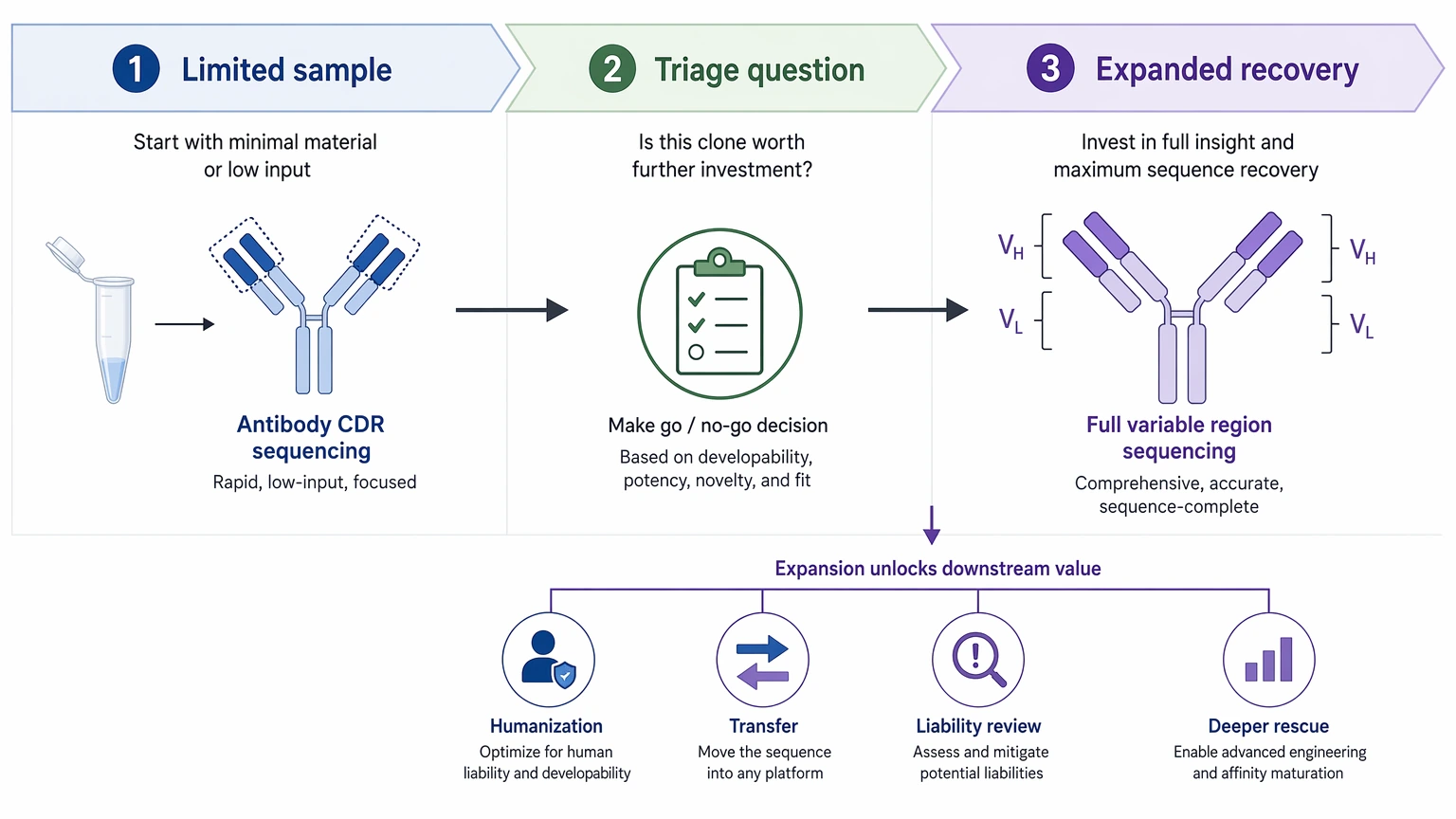
A staged workflow is often reasonable. Start with antibody CDR sequencing when sample is limited and the first question is whether the asset deserves deeper rescue. Move to full variable region sequencing once the project enters humanization, transfer, or liability review.
Expected Results and Validation Methods
An engineering-facing sequencing deliverable should separate immediate outputs from follow-up confirmation.
Immediate deliverables
A useful initial report should include:
- recovered CDR or VH/VL sequence scope
- peptide mapping coverage across the exact regions used for decisions
- residue-level confidence annotations
- explicit sequence ambiguity flags
- chain-specific evidence supporting heavy- versus light-chain assignment
- PTM notes where modification may affect sequence calling
These items let the team decide whether the sequence is fit for the next engineering step, or whether additional recovery is needed first.
Follow-up confirmation
Follow-up confirmation should focus on positions that could change design decisions, such as:
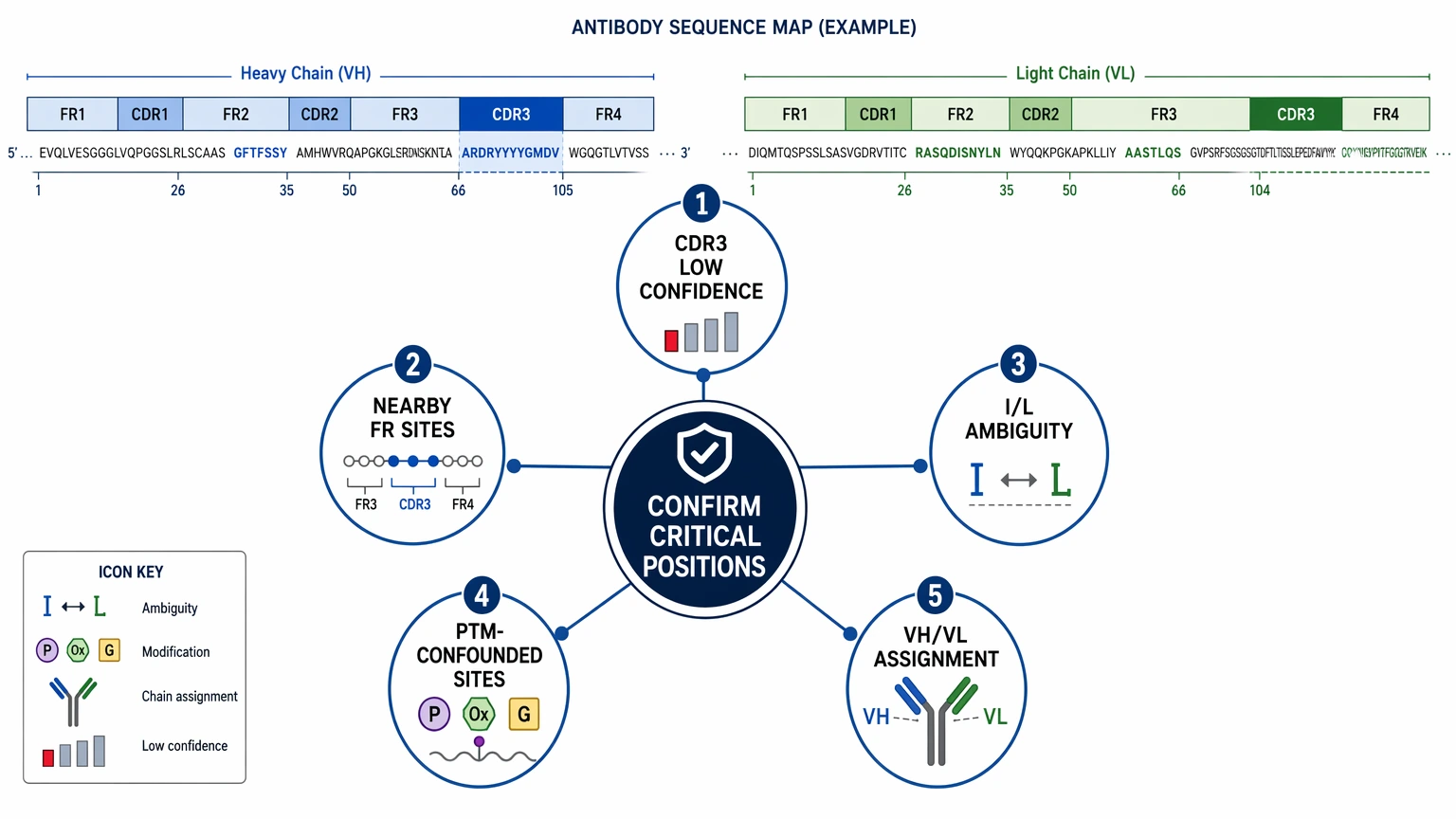
- low-confidence residues in CDR3 or nearby framework positions
- framework sites used in humanization or back-mutation logic
- unresolved isoleucine/leucine ambiguity at design-critical positions
- PTM-confounded sites that might be mistaken for substitutions
- chain assignment questions that could alter VH/VL pairing
Common orthogonal validation options include targeted LC-MS/MS confirmation, peptide remapping with complementary proteases, later clone recovery if it becomes available, and construct-level back-checking after synthesis.
Key Cautions and Practical Limits
Before treating either workflow as engineering-ready, keep these limits in view:
- Sample quality and amount limits: degraded archive material, formulation excipients, and low-input samples can narrow peptide coverage and increase local uncertainty.
- Controls and repeat expectations: a single sequencing pass may identify priorities, but design-critical residues often deserve targeted re-checking rather than blind acceptance.
- Batch and contamination risk: background proteins, carryover, or mixed antibody material can complicate chain-specific interpretation.
- Interpretation boundaries: a consensus sequence is not the same as uniform proof across every residue; sequence ambiguity must stay visible in the report.
- When another method is the better next step: if a project requires clone-ready certainty at multiple unresolved framework positions, outside support or an expanded validation workflow is often more efficient than forcing a weak LC-MS/MS dataset to answer everything.
If your internal team is deciding whether CDR-only recovery is enough or whether a broader de novo antibody sequencing plan is warranted, you can submit your requirements or contact MtoZ Biolabs to evaluate your project around sample suitability, LC-MS/MS evidence strength, and the validation burden before design work begins.
Service Routes to Consider
When the sequencing scope is still under debate, it helps to align the request with the engineering output you need rather than with a generic sequencing label. For example, a triage-stage request may center on antibody CDR sequencing and targeted confirmation, while a transfer or humanization project may need broader VH/VL reconstruction plus coverage review.
- Antibody CDR Sequencing Service
- Antibody Sequencing Service | Mass spectrometry
- AAE-nanoLC-MS/MS Antibody Coverage Analysis Service
- LC-MS/MS-Based Targeted Site Validation Service
Conclusion and Project Guidance
For engineering work, antibody CDR sequencing is best treated as a narrow decision tool, while full variable region sequencing is the stronger foundation when framework context could alter design choices. CDR-only recovery can support early paratope-focused planning, especially in staged projects with limited material. Full VH and VL recovery becomes the better fit when the next step involves humanization, CDR grafting, sequence rescue, developability liabilities, or framework-aware transfer. For teams working from purified protein, archived material, or incomplete legacy records, the most useful path is to match the sequencing scope, confidence review, and validation plan to the exact construct decision ahead. If that decision is still unresolved, contact MtoZ Biolabs to discuss the sample, engineering goal, and confirmation needs so the project can start with a sequence scope that matches the real redesign risk.
FAQ
Can CDR-only recovery support patent-landscape or lineage discussions?
Only at a very rough level. CDR-focused data may hint at relatedness, but framework regions usually carry much of the information needed for lineage interpretation, germline comparison, and sequence transfer decisions.
When does VL information become just as important as VH information?
VL becomes critical when loop support, chain pairing, expression behavior, or developability concerns could change the design. Projects sometimes focus heavily on heavy-chain CDR3, but VL context can still alter binding retention after grafting or rescue.
Is multi-enzyme digestion worth requesting up front?
It often is when the project needs full variable region sequencing rather than local loop tags. Complementary proteases can improve peptide mapping across difficult regions and reduce the chance that one digestion pattern leaves a design-critical blind spot.
What is the most useful format for handing a sequencing report to an engineering team?
The most useful format is not just a consensus sequence. It should pair the proposed sequence with peptide evidence, confidence annotations, ambiguity calls, chain assignment notes, and a short list of residues that need follow-up confirmation.
If later clone recovery becomes possible, does that make the protein-level work irrelevant?
No. Protein-level de novo antibody sequencing can still accelerate triage, identify the highest-risk ambiguous positions, and guide which parts of the later clone sequence need the closest review against the original material.
How should teams treat ambiguous residues during construct design?
They should rank them by engineering impact. An ambiguous residue in a noncritical framework position may be tolerable in early triage, while ambiguity in a Vernier residue, CDR base, or liability hotspot usually deserves confirmation before committing to a redesign.
How to order?




