






Advantages and Disadvantages of MRM/PRM Techniques
After a discovery experiment, a laboratory often holds a short protein list that still needs fragment-level confirmation in a complex digest. Parallel reaction monitoring (PRM) isolates scheduled precursor ions and records a high-resolution fragment-ion spectrum for each of those precursors. The practical advantages are post-acquisition fragment choice and better discrimination of some co-isolated background. The matching costs are a closed precursor list, a duty cycle set by MS2 fill and scan time, and isolation windows that can still admit interference. Multiple reaction monitoring (MRM) on a triple quadrupole is a different bargain.
Why PRM Trade-offs Appear After the Precursor List Is Closed
PRM is a targeted method. Precursors must be named before acquisition, usually from a discovery matrix, a spectral library, or a pathway panel. The scientific question has already shifted from which proteins can be observed to whether a defined peptide set can be measured with enough fragment evidence to support a group comparison. Generic claims such as high sensitivity or comprehensive scanning stop helping here, because PRM does not record an untargeted proteome and does not collect every precursor in the sample.
Peterson et al. 2012 described PRM on a quadrupole-Orbitrap as precursor isolation followed by parallel detection of all product ions at high resolution and high mass accuracy. That design is why method development can be lighter than MRM transition picking, and why some unit-resolution interferences can be separated after the run. Researchers can refer to PRM LC-MS Targeted Proteomics for how a scheduled LC-MS assay is built from that acquisition model. It is also why Orbitrap fill time and transient length limit how many precursors fit in one chromatographic peak. For a principal investigator, the decision is whether that fragment-rich, multiplex-limited assay matches the remaining samples and the claim required for the paper.
How PRM Turns a Scheduled Precursor into a Peak Area
Proteins are digested, most often with trypsin, and proteotypic peptides are treated as surrogates. In a quadrupole-Orbitrap or quadrupole-time-of-flight instrument, quadrupole 1 (Q1) isolates a precursor m/z window. The precursor is fragmented in a collision cell. The high-resolution analyzer then records product ions from that precursor in one MS2 event. Quantitative traces are extracted from selected fragment chromatograms, usually as peak area. Fragments that show interference can be dropped after inspection, because the spectrum was stored.
Q1 isolation is still a window, commonly on the order of 0.7 to 2 Th in published PRM methods. Co-isolated ions can fragment together with the target. High-resolution detection can separate many of those fragments by accurate mass. It cannot invent a unique precursor if two peptides share the isolation window and yield overlapping fragments. Automatic gain control, maximum fill time, and resolution setting decide how many ions are accumulated and how long each MS2 costs. Those parameters, together with the scheduled retention-time window, set the usable panel size.
A PRM signal is the extracted peak area of selected fragments from a scheduled precursor.
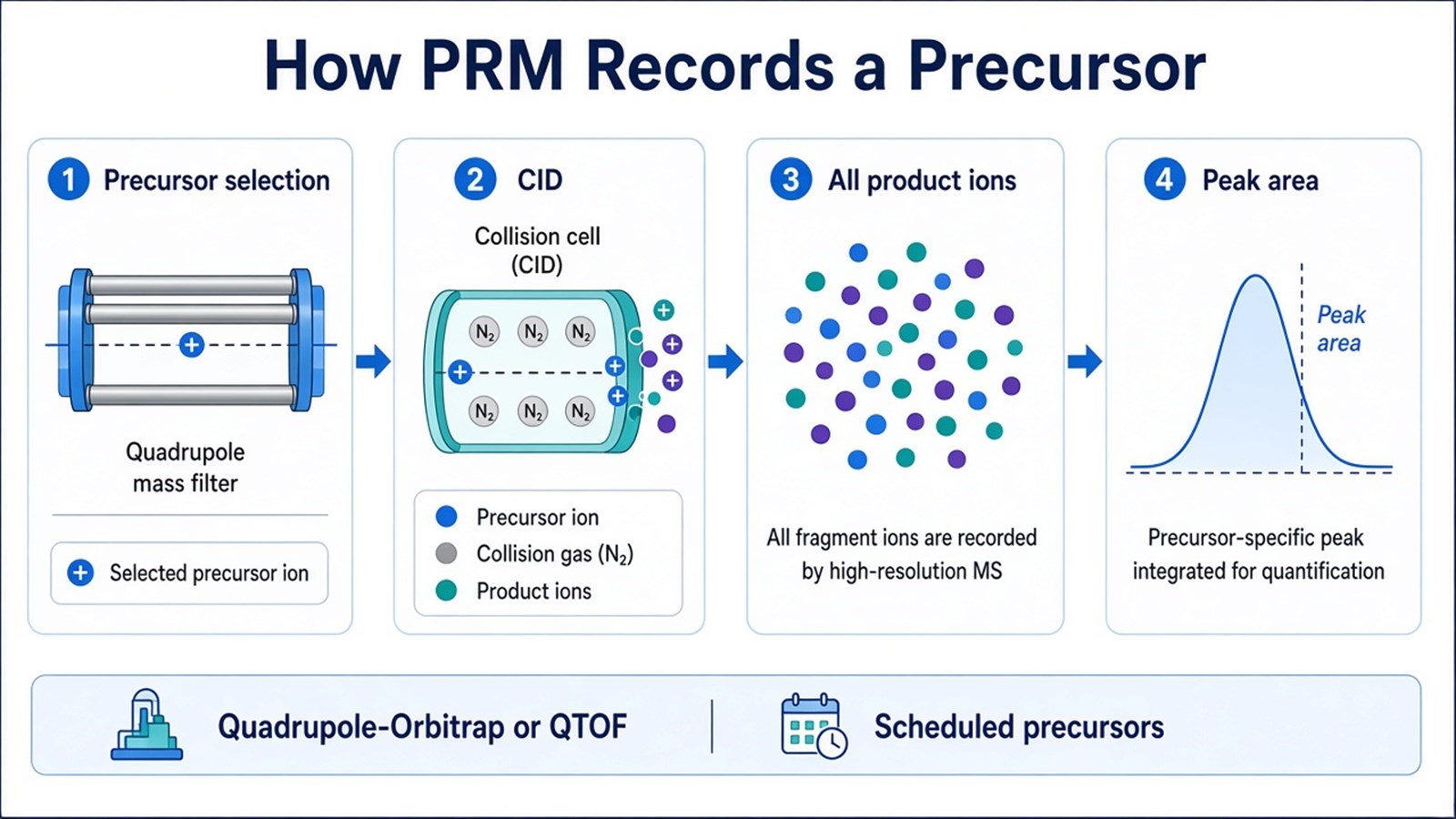
Figure 1. PRM isolates a scheduled precursor, records its product ions at high resolution, and quantifies from extracted fragment peak areas.
Advantages That Hold After Assay Conditions Are Set
PRM advantages are conditional. They appear when the precursor list is closed, chromatography can hold peptides in their schedule windows, and fragments will be reviewed in the study matrix.
Full fragment evidence without preselecting every transition
MRM requires chosen precursor-to-product pairs before the cohort is queued. PRM stores the fragment spectrum of each scheduled precursor, so quantitative and qualifier ions can be selected or replaced during data review (Peterson et al. 2012). That flexibility shortens early method development and helps when a library spectrum is incomplete. It does not remove the need to confirm that the extracted traces are free of interference in the real digest.
High-resolution discrimination in complex matrices
Accurate-mass fragments can separate product ions that would share a unit-resolution Q3 window on a triple quadrupole. Shi et al. 2016 placed PRM as a high-resolution alternative when sample complexity produces co-eluting background. The gain is for the extracted fragments that are resolved. A noisy precursor isolation still lowers the useful ion current of the target. Plasma and other high-dynamic-range matrices may still need enrichment or more input.
Sequence-defined measurement without an antibody
PRM measures a peptide sequence and its fragments. A new target can be added if a precursor can be scheduled and ionized. Antibody availability does not gate the assay. Specificity problems move to shared peptides, missed cleavage, variable modifications, and isolation-window interference. Modified peptides, including phosphorylation, often benefit from seeing the full fragment set when site-discriminating ions must be checked.
Relative comparison, with amount only when an SIS is present
Same-peptide peak areas can support a fold-change comparison when digestion, loading, and chromatography stay comparable. Absolute amount or concentration requires a matched stable isotope-labeled internal standard (SIS). The heavy peptide supports fragment co-elution checks and ratio calculation. It does not correct digestion that failed before the standard was added.
Limitations That Change the Experimental Plan
A scheduled precursor list cannot recover unknown proteins
Only precursors that were placed on the inclusion list are fragmented in PRM. Abundant proteins outside that list stay invisible. PRM is not a discovery acquisition mode. Data-dependent acquisition (DDA) or data-independent acquisition (DIA) remains the route when the protein inventory is still open. Calling PRM comprehensive because all fragments of a precursor are recorded confuses fragment coverage with proteome coverage.
Cycle time limits the panel
Each MS2 event consumes fill time and analyzer time. Adding precursors shortens points across the chromatographic peak or forces extra injections. Large, mature panels that must run many times on a triple quadrupole can still favor MRM after transitions are clean. PRM is often the better next experiment for a small or medium set in a difficult matrix, where fragment confirmation is the scarce resource.
Isolation interference and fill-time trade-offs still exist
High resolution does not cancel a wide Q1 window. Automatic gain control can fill with matrix ions and leave few target ions for the transient. Narrower isolation, longer fill, or fewer concurrent precursors can restore fragment quality and will reduce multiplex capacity. Those parameters belong in the method record with the peak-area table.
Data review is heavier than a two-transition chromatogram
PRM files contain full MS2 traces for every scheduled precursor. Extracting, picking fragments, and documenting interference takes more review time than integrating a small MRM transition list. Software such as Skyline is a common environment for that work. It is not a substitute for matrix-matched fragment QC.
How to Judge Whether PRM Is the Next Assay
The useful test is whether the precursor list is closed, whether fragment confirmation is needed in the study matrix, and whether the panel fits one PRM duty cycle.
|
Study condition |
PRM is often useful |
Reassess before locking the method |
|---|---|---|
|
Target definition |
Precursors can be named and scheduled |
Proteins of interest are still unknown |
|
Interference risk |
Complex digest where unit-resolution transitions are untrusted |
Clean matrix and already validated MRM transitions |
|
Panel size |
Small to medium set that fits the MS2 cycle |
So many precursors that peak sampling collapses |
|
Method development time |
Fragments still need to be chosen or swapped |
A locked QQQ panel will be repeated at large scale |
|
Quantification claim |
Same-peptide relative comparison, or amount with SIS |
Copy number across different proteins, or amount without SIS |
|
Adjacent option |
High-resolution targeted confirmation after discovery |
Open-proteome discovery; keep DDA or DIA |
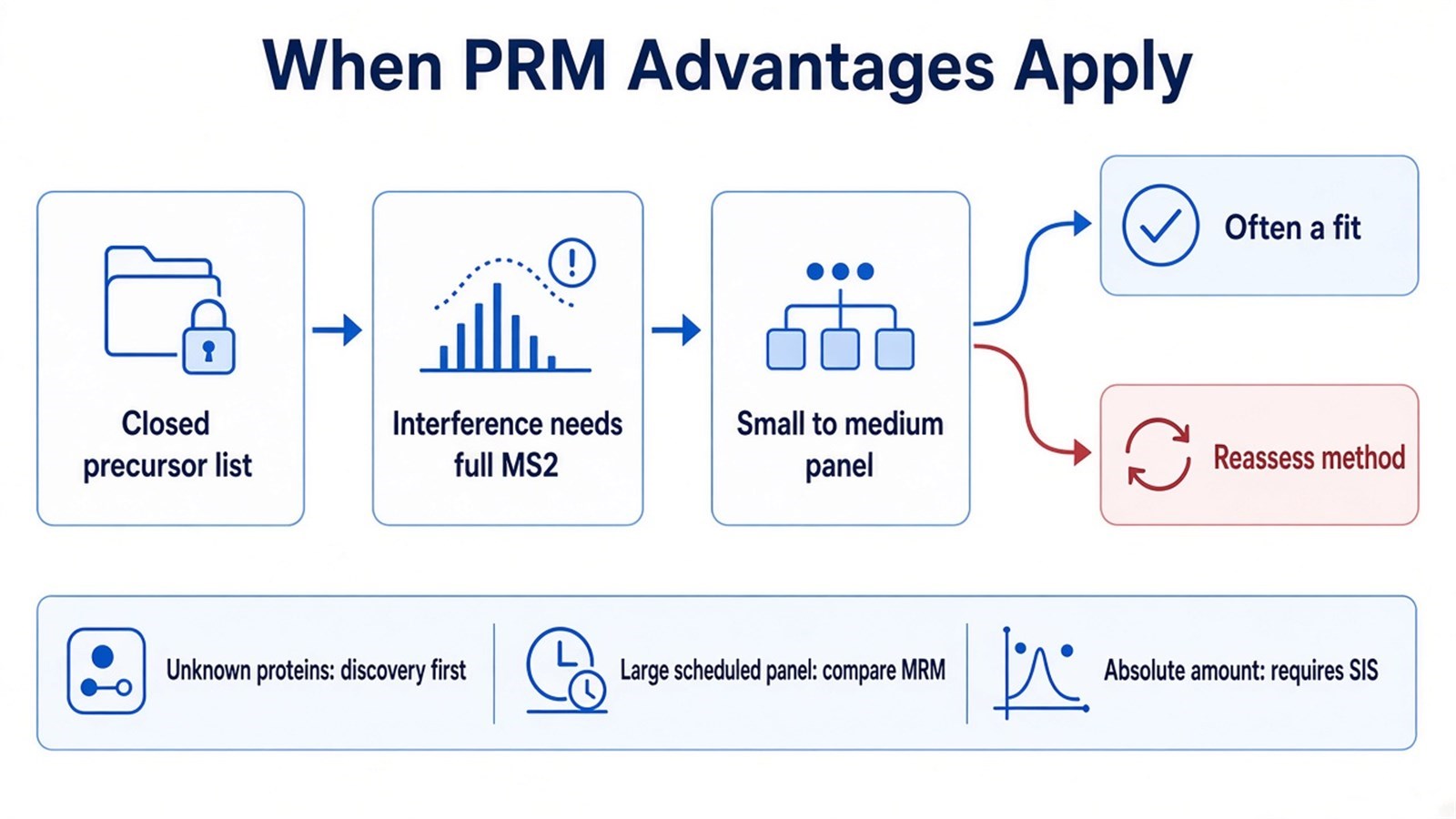
Figure 2. PRM advantages apply when precursors are closed, fragment confirmation is required, and the panel still fits the MS2 cycle time.
In MtoZ Biolabs targeted proteomics offerings, PRM and MRM/SRM are separate acquisition choices. PRM is typically run on a high-resolution quadrupole-Orbitrap or Q-TOF class instrument. MRM/SRM is typically run on a triple quadrupole. Sensitivity should be compared in the study matrix. Instrument class alone does not rank the two methods. If names do not yet exist, discovery acquisition should stay in place.
If the remaining task is a large, scheduled QQQ panel, researchers can refer to Advantages and Disadvantages of Multiple Reaction Monitoring for a more detailed trade-off framework.
Researchers who already have a defined precursor list can also review the MtoZ Biolabs Parallel Reaction Monitoring (PRM) Service for project-specific feasibility and analysis planning.
Frequently Asked Questions
1. Does PRM measure every protein in the sample?
PRM measures scheduled precursors only. All product ions of those precursors can be recorded in the MS2 event. Proteins that were never placed on the inclusion list are not quantified, even if they are abundant.
2. Is PRM always more sensitive than MRM?
No general ranking holds across matrices and panel sizes. High-resolution fragments can improve selectivity in complex samples, which may lower the usable limit for some peptides (Peterson et al. 2012; Shi et al. 2016). Triple-quadrupole MRM can still deliver more points across a peak for a large, scheduled panel. Compare the two methods on the peptides and matrix that matter for the study.
3. Does every PRM assay require isotope-labeled standards?
Relative comparison of the same peptide can proceed without an SIS if digestion and chromatography remain comparable. Amount or concentration claims need a matched heavy peptide or protein standard added at a point that matches the claim.
4. Can PRM replace a discovery DDA or DIA experiment?
PRM cannot recover proteins outside the inclusion list. Keep DDA or DIA while new names are still required. Move to PRM when the precursor list can be frozen and fragment-level confirmation is the next task.
5. How many peptides can one PRM method include?
The number is set by chromatographic peak width, resolution, fill time, and how many MS2 events must sample each peak. A small candidate set after discovery often fits one method. A large panel may need extra injections or a later MRM translation once fragments are chosen.
MtoZ Biolabs can provide parallel reaction monitoring and targeted proteomics analysis for predefined protein or peptide panels, including relative quantification and isotope-assisted absolute quantification when the study design requires matched internal standards.
If further evaluation of precursor lists, matrix interference, panel size, or PRM versus MRM routing is needed, project details can be submitted for a feasibility review.
How to order?




