



PRM LC-MS Targeted Proteomics
A PRM study begins with a defined precursor list, retention-time scheduling, and a quantification strategy appropriate to the intended comparison or amount measurement.
When to Use PRM LC-MS for Defined Protein Targets
PRM is a targeted method. Precursors are selected before acquisition, usually from discovery proteomics, a spectral library, or a predefined pathway panel. The main question is whether suitable peptides can be monitored reproducibly in the study matrix. Peterson et al. (2012) described quadrupole-Orbitrap PRM as precursor isolation followed by high-resolution, high-mass-accuracy measurement of product ions. Gallien et al. (2012) demonstrated how retention-time scheduling and MS2 acquisition settings affect the assay.
PRM is suitable for measuring predefined peptide targets rather than surveying the proteome for new protein candidates. Peptide specificity depends on sequence uniqueness, digestion efficiency, modifications, and interference from co-isolated ions. Site-defined modified peptides can also be monitored, with enrichment considered where the target abundance and matrix require it.
For an overview of method selection, see .
How an LC-MS PRM Assay Is Built
Proteins are typically digested with trypsin, and suitable peptides are selected as surrogates for the parent proteins. Selection considers sequence uniqueness, established precursor charge states, detectable fragments, and potential missed cleavages or variable modifications.
Peptides are separated by reversed-phase LC. During each scheduled retention-time window, the quadrupole isolates the selected precursor m/z range. The precursor undergoes fragmentation, often by HCD or CID, and a high-resolution analyzer records its product ions. Quantitative chromatograms are extracted from selected fragment ions, and interfering fragments can be excluded during data review.
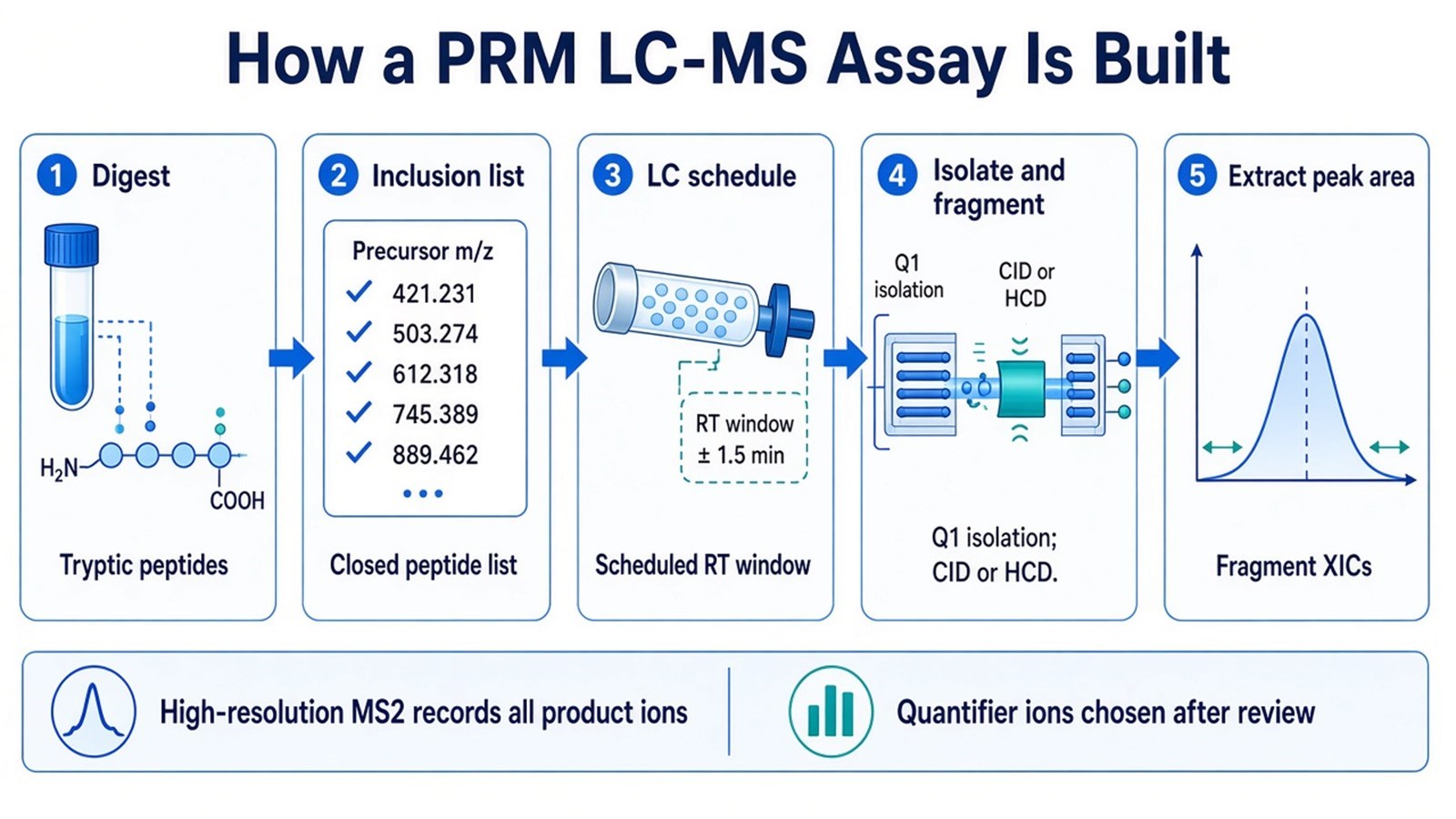
Figure 1. A PRM LC-MS assay moves from peptide selection and scheduled LC-MS/MS acquisition to fragment-ion peak-area extraction.
PRM permits quantitative and confirming fragment ions to be selected after acquisition, reducing the need to preselect every transition as in MRM. The precursor list, collision energy, isolation width, accumulation time, and retention-time windows still require optimization in the study matrix. Skyline is one software option for chromatogram inspection and integration.
Parameters That Determine Panel Capacity and Quantification
The precursor isolation window controls which ions enter fragmentation. In published methods, window widths around 0.7–2 Th are commonly reported, although the choice depends on the instrument and sample. Co-isolated peptides may contribute interfering fragments. Resolution, accumulation time, and chromatographic peak width jointly determine how frequently the method can monitor each precursor.
Scheduled acquisition monitors each precursor near its expected elution time and helps distribute MS2 acquisition time across the gradient. Retention-time variation, narrow scheduling windows, or too many concurrent targets can reduce the number of measurements across a peak. Larger panels may require separate injections or a different acquisition design.
Relative quantification can compare the same peptide across samples when preparation, loading, and chromatography are sufficiently consistent. Estimating an absolute peptide amount requires an appropriate calibration strategy; matched stable isotope-labeled standards are commonly used to support analyte-to-standard ratios. The point at which a standard is added determines which preparation steps it can correct. Using more than one suitable peptide per protein, where feasible, strengthens protein-level interpretation.
PRM is commonly implemented on high-resolution quadrupole-Orbitrap or quadrupole-time-of-flight platforms, whereas MRM/SRM generally uses triple-quadrupole instruments. Sensitivity and panel capacity depend on the target peptides, matrix, and acquisition settings rather than instrument category alone.
Choosing PRM, Discovery Proteomics, or MRM
PRM is a practical follow-up when target peptides have already been nominated and the study requires sequence-specific fragment evidence. DDA or DIA acquisition is more suitable when additional protein candidates are still being sought. For a large, established panel measured repeatedly, MRM may provide a more efficient acquisition approach once the transitions are validated.
| PRM LC-MS often fits | Consider another approach when | |
|---|---|---|
| Target definition | Target peptides and precursor ions are known | The protein inventory is still open |
| LC schedule | Concurrent precursors can be sampled across each peak | The panel exceeds available MS2 cycle capacity |
| Matrix | Fragment-ion review helps assess interference | A validated MRM panel already meets the study needs |
| Quantification | Relative comparison or calibrated amount measurement | Calibration or sample controls are insufficient for the intended claim |
| Modified peptides | Target sequence and modification site are defined | The study seeks unknown modification sites |
| Next method | Targeted verification after discovery |
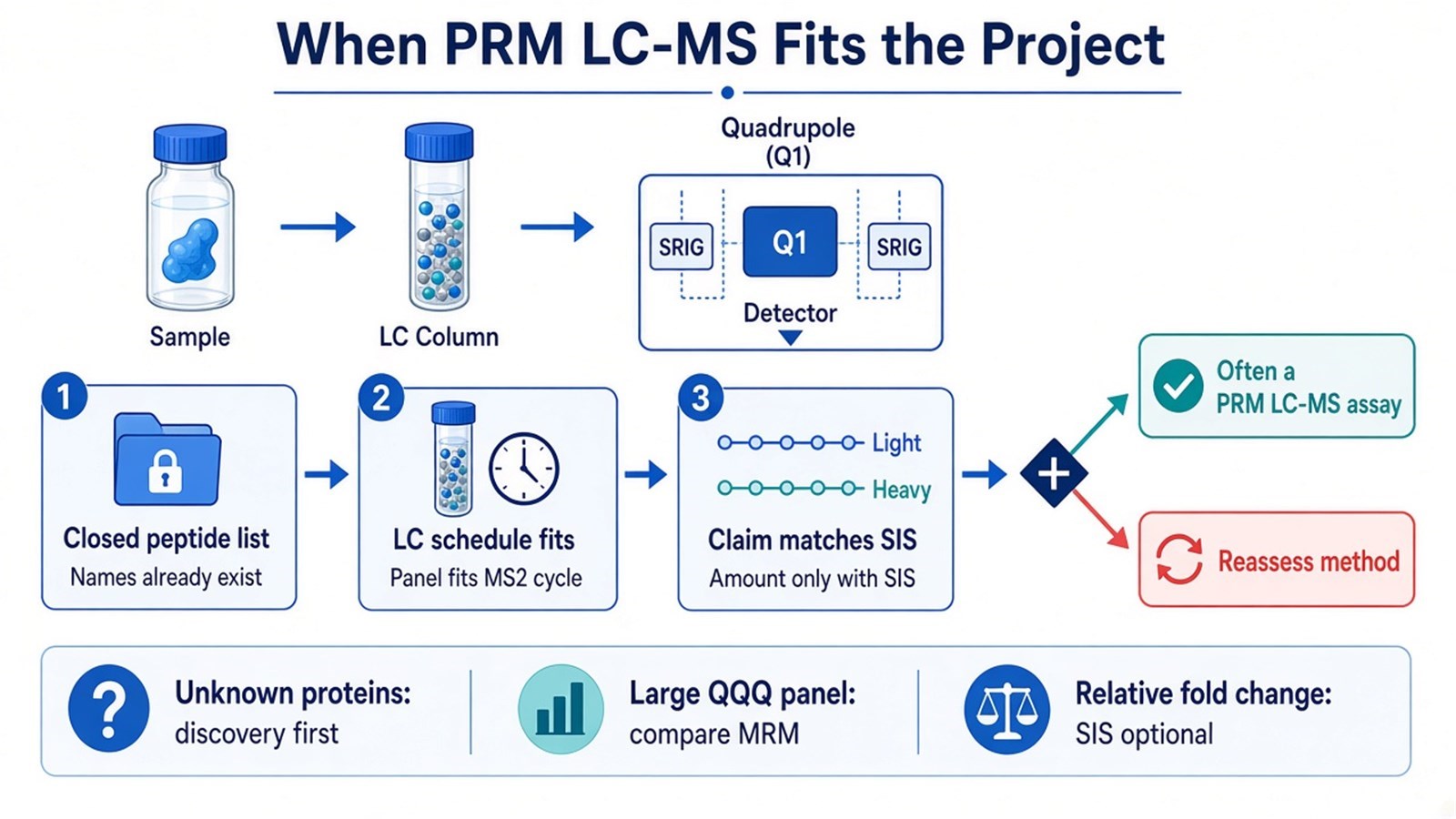
Figure 2. Target definition, acquisition capacity, and quantification strategy help determine whether a PRM assay fits the project.
For projects involving a large, established triple-quadrupole panel, see .
Researchers with a defined peptide list can review the MtoZ Biolabs for project planning. For a comparison of targeted acquisition approaches, see the .
Frequently Asked Questions
1. Does PRM LC-MS quantify protein concentration from a full scan?
PRM measures selected peptide precursors using extracted fragment-ion chromatograms. Relative peak areas support comparisons across samples. Absolute concentration requires suitable calibration, including appropriate standards and sample-volume information.
2. Can PRM measure proteins outside the target list?
PRM acquisition focuses on predefined precursors. If new protein candidates need to be discovered, DDA or DIA can be used to develop the target list before a PRM follow-up.
3. How many peptides can one PRM LC-MS method include?
Panel capacity depends on chromatographic peak widths, MS2 resolution and fill time, scheduled retention windows, and the required number of measurements across each peak. Large panels may need multiple injections.
4. Does every PRM assay require isotope-labeled standards?
Isotope-labeled standards are optional for many relative comparisons. Calibrated absolute quantification typically uses matched internal standards or another validated calibration approach appropriate to the requested measurement.
5. Can PRM replace Western blot for a short protein list?
PRM provides sequence-specific peptide measurements without requiring an antibody, while Western blot detects immunoreactive proteins or bands. Selection depends on the analyte, sample matrix, and whether peptide-level or protein-band information is needed.
MtoZ Biolabs offers parallel reaction monitoring and targeted proteomics services for predefined protein or peptide panels. The appropriate relative or calibrated quantification workflow can be discussed according to the study design and available standards.
If you have a target list, sample type, anticipated panel size, and quantification objective, you can submit these details for project-specific feasibility review.
Support Documents
Protein Quantification for Deeper Discovery
Gain a clearer understanding of protein quantification approaches and their applications in studying protein abundance changes by downloading our detailed brochure.
