






Advancing Antibody Research: The Power of Polyclonal Antibody Sequencing
Introduction
Polyclonal antibodies remain essential in immunology, diagnostics, and reagent production, yet many research programs still treat them as black-box reagents. A critical polyclonal antibody may be referenced by catalog number alone. A new lot may be adopted without evidence that its clonal composition matches the prior batch. An assay may fail after reagent renewal, and the team cannot determine whether the problem is protocol drift, antigen change, or unseen antibody lot variation. A discovery program may depend on immune sera without sequence-level documentation of the dominant responding clonotypes.
Polyclonal antibody sequencing changes this situation by converting heterogeneous antibody mixtures into sequence evidence that supports documentation, comparison, and informed experimental design. Rather than relying only on titer, Western blot performance, or ELISA signal, researchers can capture dominant clonotypes, compare production lots, and build a stronger foundation for reproducibility and redevelopment.
This article explains how polyclonal antibody sequencing advances antibody research, where it adds the most value, and how teams can use sequence data to strengthen reagent control and project decisions.
Why Undocumented Polyclonal Reagents Create Research Risk
Polyclonal antibodies are produced from multiple B-cell clones that respond to an immunogen. That biological diversity is useful for robust detection, but it also creates variability that is difficult to see with routine QC.
Lot-to-lot differences may reflect animal response, immunization schedule, purification method, or storage history rather than a single stable molecular entity. Assay performance can shift when clonal composition changes even if total immunoglobulin concentration appears similar. Critical experiments may become difficult to reproduce when the exact reagent used in the original study is no longer available or not fully characterized. Transition from polyclonal reagents to recombinant alternatives is slower when no sequence information exists for the dominant binders.
These risks are often invisible until a failed replication, a comparability issue, or a reagent replacement forces the problem into view.
What Polyclonal Antibody Sequencing Adds to Research Programs
Polyclonal antibody sequencing extracts sequence information from mixed antibody samples using mass spectrometry-based de novo, middle-down, intact profiling, or hybrid workflows. The goal is not always to define every clone in the mixture. The research value often comes from identifying dominant clonotypes, documenting batch differences, and creating sequence records that support future decisions.
Sequencing adds a molecular identity layer to polyclonal reagents that traditional QC cannot supply. It supports reagent documentation with traceable sequence evidence. It enables lot comparison when assay drift or performance change is suspected. It improves reproducibility by linking experimental outcomes to defined clonotype profiles. It creates a bridge toward recombinant expression when a defined antibody reagent becomes necessary for scale-up, licensing, or long-term consistency.
For antibody research teams, this shifts polyclonal reagents from undocumented inputs into characterizable assets.
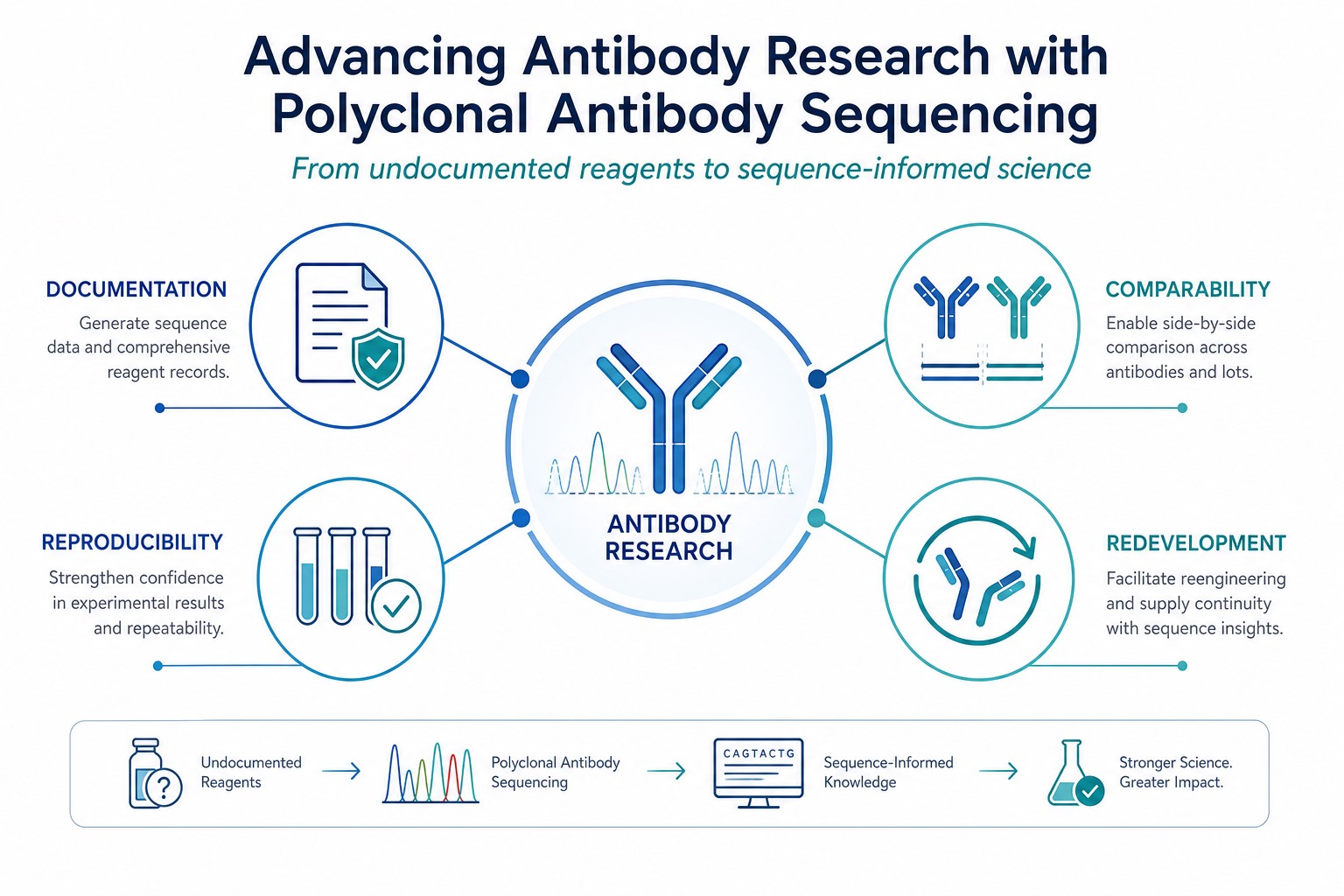
Figure 1. Polyclonal antibody sequencing advances research by adding documentation, comparability, reproducibility, and redevelopment value to heterogeneous reagents.
Reagent Documentation and Audit Readiness
One of the strongest research benefits of polyclonal antibody sequencing is documentation.
Laboratories often maintain polyclonal antibodies for years across multiple projects, collaborators, and publication cycles. Without sequence records, reagent identity depends on supplier labels, internal naming, and performance notes that may be incomplete. Sequencing creates a durable record of dominant clonotypes associated with a specific lot or purification batch. That record supports internal audit trails, method transfer, and long-term archive strategy.
Documentation is especially valuable for custom immunization projects, in-house purified sera, and reagents used in regulated or high-stakes research settings where reagent traceability strengthens data credibility.
Batch Comparability and Lot Change Control
Polyclonal antibody sequencing is powerful when lot change is unavoidable.
Research teams frequently need to compare a new production lot against a reference lot after supplier change, inventory renewal, or internal re-immunization. Functional assays may show subtle shifts that are hard to interpret without molecular evidence. Sequencing can reveal whether dominant clonotypes remain consistent, whether new clonotypes appear, or whether major sequence drift has occurred.
This supports informed lot acceptance decisions rather than blind replacement. It also helps distinguish true reagent change from protocol variation, antigen preparation differences, or sample matrix effects.
Related Services
Mass Spectrometry Based Antibody Sequencing Service
Antibody De Novo Sequencing Service
Mono Poly Clonal Antibody De Novo Sequencing for Drug R&D
Antibody Sequence Analysis Service
Research groups seeking to document or compare polyclonal reagents can consult MtoZ Biolabs to review sample type, sequencing depth, and reporting options matched to the research goal.
Reproducibility Across Projects and Collaborations
Reproducibility improves when sequence evidence links a reagent to experimental outcomes.
Internal teams can associate assay performance with a defined clonotype profile rather than with a generic reagent name. Collaborators can receive clearer reagent records that reduce ambiguity during method transfer. Publication supplements can include stronger molecular support for critical antibody reagents when appropriate. Long-running projects can track whether reagent drift contributes to changing results over time.
Polyclonal antibody sequencing does not eliminate biological complexity, but it gives researchers a concrete reference point when reproducibility questions arise.
Sequence-Informed Experimental Design
Sequencing also supports better experiment planning before assays fail or drift.
Knowing dominant clonotypes helps teams decide whether an existing polyclonal reagent is suitable for a new application requiring higher specificity. Sequence evidence can guide epitope binning, cross-reactivity review, and antigen design when immune response breadth must be understood. When a project outgrows polyclonal reagent variability, recovered sequences provide a starting point for recombinant redevelopment rather than restarting immunization from zero.
This makes polyclonal antibody sequencing not only a retrospective QC tool but also a forward-looking research planning resource.
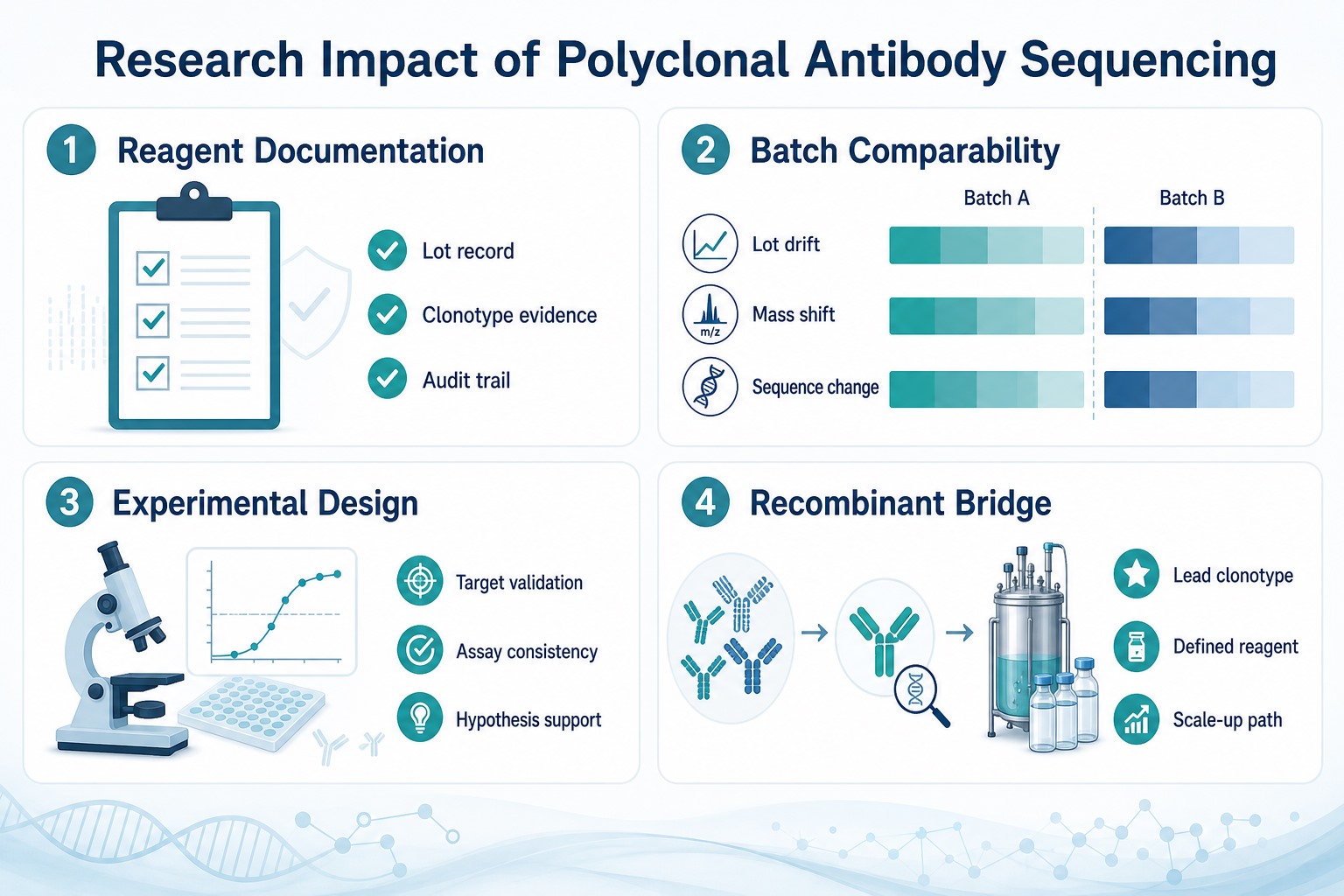
Figure 2. Polyclonal antibody sequencing supports reagent documentation, batch comparability, sequence-informed experimental design, and recombinant redevelopment planning.
From Polyclonal Discovery to Defined Reagents
A major long-term research benefit is the path from mixed immune reagents to defined molecular tools.
Polyclonal antibodies are excellent for early discovery because they sample diverse immune responses. They become limiting when reproducibility, scalability, or regulatory expectations require a defined reagent. Sequencing identifies lead clonotypes that can be engineered into recombinant monoclonal or oligoclonal formats. This preserves valuable immune response information while reducing lot variability.
For antibody research programs, sequencing is often the bridge between exploratory polyclonal use and structured reagent development.
Research Value by Application Area
Polyclonal antibody sequencing adds value across several research settings.
|
Application Area |
Research Problem |
Value from Sequencing |
|---|---|---|
|
Immunology and vaccine research |
Undefined immune repertoire in sera |
Dominant clonotype identification |
|
Diagnostic reagent development |
Lot variability affects assay consistency |
Batch comparability and documentation |
|
Custom antigen purification workflows |
Critical reagent lacks molecular record |
Sequence archive for long-term use |
|
Assay troubleshooting |
Performance change after lot switch |
Evidence for reagent drift vs protocol issue |
|
Biopharma discovery support |
Need path to recombinant reagent |
Lead sequence recovery for redevelopment |
The strongest return usually appears when the reagent is critical to project conclusions or used repeatedly across time and sites.
When Polyclonal Antibody Sequencing Is Worth the Investment
Not every polyclonal reagent requires full sequencing, but several scenarios justify the investment.
Sequence when the reagent is central to published findings or long-term program decisions. Sequence when lot changes repeatedly affect assay performance. Sequence when method transfer or collaboration requires stronger reagent identity records. Sequence when redevelopment into recombinant form is likely within the project timeline. Sequence when immune response characterization itself is part of the scientific question.
Routine catalog antibodies used in low-stakes screening may need only standard performance QC. Critical or custom polyclonal reagents benefit most from sequence-level support.
Core Research Advantages and Practical Limits
Core Research Advantages
Stronger reagent identity beyond titer and blot performance.
Sequence evidence adds molecular context that functional QC alone cannot provide.
Better control of lot change and reagent drift.
Researchers can compare batches with defined sequence records rather than assumptions.
Improved reproducibility and collaboration.
Shared sequence documentation reduces ambiguity across teams and project phases.
Bridge to recombinant redevelopment.
Dominant clonotypes become actionable starting points for defined reagent engineering.
Practical Limits
Low-abundance clones may remain unresolved.
Sequencing usually captures dominant or most relevant clonotypes rather than the entire repertoire.
Sample enrichment often improves outcomes.
Affinity-purified or class-enriched samples typically yield stronger sequence evidence than unfractionated sera.
Sequencing complements but does not replace functional validation.
Binding performance still requires appropriate immunoassay confirmation.
Applications That Benefit Most
Polyclonal antibody sequencing delivers the clearest research value in several settings.
Immunology programs use sequencing to characterize immune responses when hybridoma generation is not feasible or not yet planned. Diagnostic and assay development groups use it to stabilize reagent control across changing lots. Academic core facilities use it to archive critical custom antibodies used by multiple labs. Biologic discovery teams use it to preserve sequence options before transitioning to recombinant formats. Contract research and translational groups use it to strengthen reagent traceability in multi-study workflows.
In each case, the common theme is that sequence data turns polyclonal reagents into research assets with documented molecular identity.
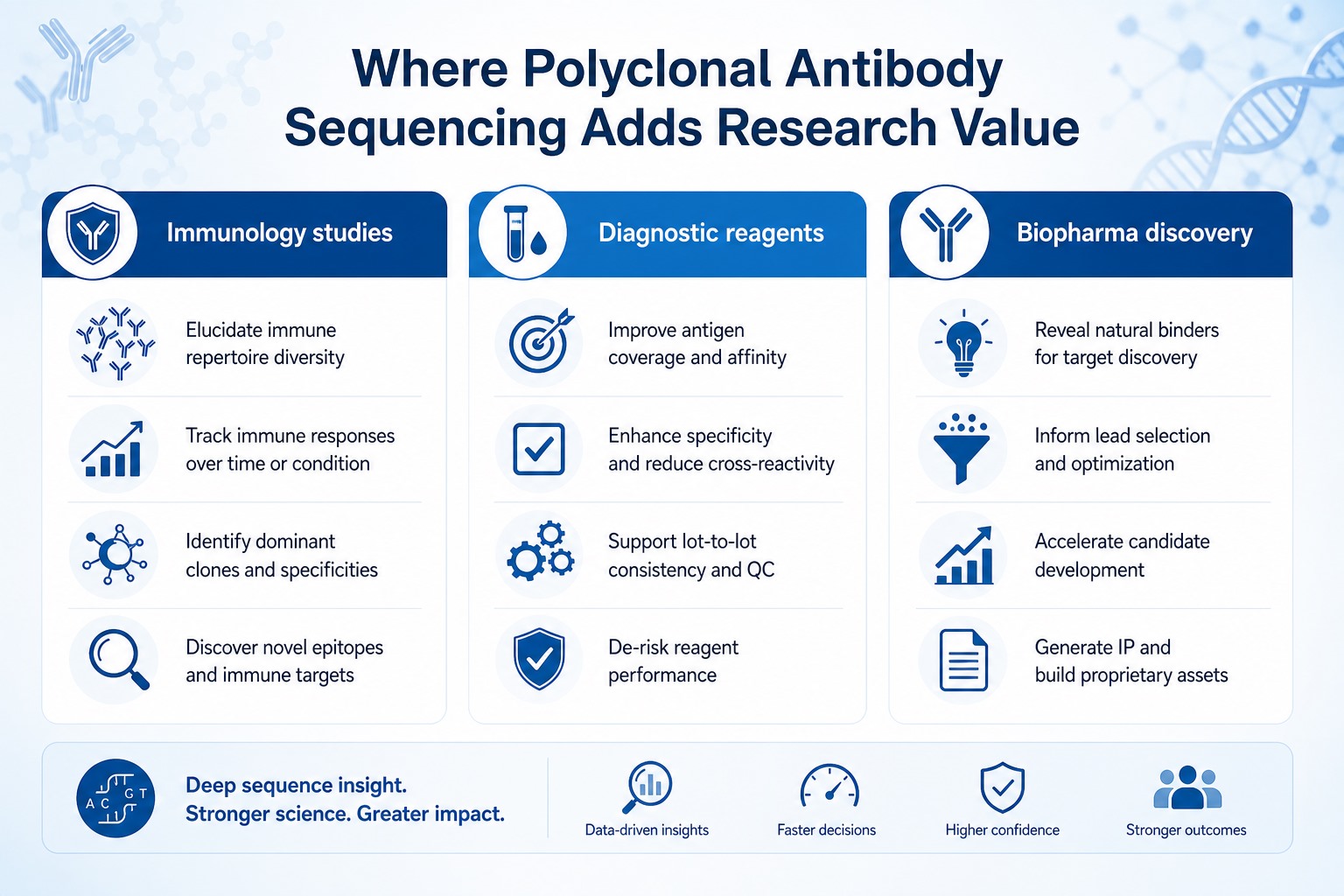
Figure 3. Polyclonal antibody sequencing adds research value in immunology, diagnostic reagent development, and biopharma discovery workflows.
Frequently Asked Questions
1. How does polyclonal antibody sequencing advance antibody research?
It provides sequence evidence for heterogeneous reagents, supporting documentation, lot comparison, reproducibility, and redevelopment planning.
2. Is sequencing useful only for custom polyclonal antibodies?
Custom and critical reagents benefit most, but any polyclonal reagent central to long-term research can gain value from sequence documentation.
3. Can sequencing help when a new lot performs differently?
Yes. Comparing sequence profiles between lots can reveal clonal drift that functional QC alone may not explain.
4. Does polyclonal sequencing replace recombinant antibody development?
No. It often enables recombinant development by identifying lead clonotypes worth expressing and validating.
5. What deliverable should research teams expect?
Typical deliverables include dominant clonotype sequences, batch comparison summaries, and documentation suitable for internal reagent records or redevelopment planning.
Conclusion
Polyclonal antibody sequencing advances antibody research by giving heterogeneous reagents a documented molecular identity. It supports reagent traceability, batch comparability, reproducibility across projects, and sequence-informed planning for recombinant redevelopment. For teams that depend on polyclonal antibodies in critical assays, immune studies, or long-running discovery programs, sequencing transforms an undocumented reagent into a research asset with lasting value.
Programs that sequence key polyclonal reagents before lot change, publication, or redevelopment reduce risk and move more confidently into the next experimental stage. Researchers exploring polyclonal antibody sequencing for documentation or comparability can contact MtoZ Biolabs to review sample requirements and reporting options suited to their project. For groups preparing to move from polyclonal reagents to defined recombinant alternatives, MtoZ Biolabs can also help connect sequencing output with antibody redevelopment strategy.
How to order?




