



Quantitative proteomics routes fail when the reporting goal is chosen after data are acquired. Absolute protein quantification expresses named analytes in defined amount units after isotope dilution and matrix calibration. Relative quantitation compares abundance or fold change across predefined groups without anchoring every row to a specification limit. Label-free quantification (LFQ) on unlabeled discovery injections profiles the proteome to nominate candidates before any panel or calibrator investment (Gerber et al. 2003; Bantscheff et al. 2012). The guide below matches AQUA, MRM/PRM, and label-free LFQ routes to reporting goals with workflow, parameters, limits, and project choice. It is not a platform preference essay, not a clinical diagnostic promise, and not a substitute for an internal validation protocol.
Route choice starts with one sentence the deliverable must support: concentration in ng/mL or fmol, fold change on a closed list, or open relative profiling. Mixing those sentences on one table is the usual over-read failure mode.
In MtoZ Biolabs offerings, absolute work often pairs AQUA-style stable isotope-labeled (SIS) peptides with targeted MRM or PRM, relative work uses PRM/MRM or LFQ on declared contrasts, and staged programs document handoffs between discovery and targeted blocks.
Absolute versus relative framing appears in Absolute and Relative Quantitative Proteomics Analysis. Three-axis routes appear in Protein Quantification Method.
Relative Versus Absolute Reporting in Quantitative Proteomics
Four reporting scenarios belong in the brief.
Specification-driven reporting needs concentration units against a limit or acceptance range. Calibrated targeted MS with SIS is the usual absolute path.
Comparative group analysis needs fold change or rank on a frozen contrast. Relative MRM, PRM, or LFQ fits when the claim unit stays relative.
Candidate discovery needs an open protein list shortened by evidence. Unlabeled LFQ or other discovery chemistry supplies candidates, not specification tables.
Staged programs run discovery, relative targeted screening, then absolute calibration when units become mandatory.
Reporting goal selects route. Instrument brand or software name does not.
Amount mechanism detail appears in Absolute Protein Quantification Mass Spectrometry. Enrollment context appears in Exploring Quantitative Analysis in Proteomics.
Label-Free LFQ in the Relative Quantitation Route Map
Label-free LFQ is the common relative discovery route on separate unlabeled liquid chromatography-tandem mass spectrometry (LC-MS/MS) injections (Cox et al. 2014).
Chemistry is unlabeled through injection. Quantification compares aligned MS1 precursor areas or unlabeled data-independent acquisition (DIA) fragment traces after false discovery rate (FDR) control.
LFQ outputs are relative contrasts across predefined groups in one study. They do not report molar amount on named peptides without later SIS or parallel reaction monitoring (PRM) calibration.
LFQ fits when the target list is open, enrollment is staggered, and breadth matters before calibrator synthesis.
LFQ limits include missing values in data-dependent acquisition (DDA), batch sensitivity, and no specification-style units without a new assay block.
Label-free LFQ is relative discovery quantitation, not absolute protein quantification unless a separate calibrated targeted block is declared.
LFQ spine appears in LFQ. Service scope appears in Label-Free Quantitative Proteomics Service. Tradeoffs appear in Advantages of Label-Free Proteomics Analysis.
Relative Targeted Quantitation With MRM and PRM
Multiple reaction monitoring (MRM) and selected reaction monitoring (SRM) record scheduled precursor-product pairs on triple quadrupole systems (Lange et al. 2008). Parallel reaction monitoring (PRM) records high-resolution product-ion spectra after precursor isolation (Peterson et al. 2012).
Relative targeted quantitation fits when the peptide panel is closed and fold change across groups is sufficient. Internal normalization or light-only PRM peaks can support relative contrasts without a full calibration curve.
Relative MRM/PRM does not remove matrix suppression. Panel size remains bounded by cycle time and chromatography width.
PRM principle appears in From Principles to Applications: A Comprehensive Overview of PRM Technology. MRM services appear in SRM-MRM Quantitative Proteomics Services.
Absolute Quantification With AQUA and Targeted Assays
Absolute protein quantification uses isotope dilution: a known heavy analog spiked into the sample, ratio to light analyte, and a calibration model in the study matrix (Gerber et al. 2003).
AQUA-style SIS peptides added at or after digestion calibrate that peptide surrogate. QconCAT or protein-level standards change what the amount represents across extraction and digestion steps.
Targeted MRM or PRM usually records light-heavy pairs on the closed list. Absolute claims need curve design, quality control (QC) samples, and documented spike timing aligned to the claim sentence.
Absolute work fits specification limits, cross-batch concentration alignment, and stoichiometry questions when standards and matrix validation are in scope.
AQUA services appear in Absolute Quantitative Analysis (AQUA) Service. Mechanism appears in Mechanism of AQUA in Protein Detection.
End-to-End Workflow Matched to Reporting Goal
Workflow branches on the frozen reporting sentence.
Label-free LFQ discovery spine.
- Confirm open contrast and relative profiling claim.
- Match prep; acquire separate unlabeled injections.
- Search, normalize, and test frozen groups.
- Export candidate list with versioned processing.
- Plan targeted or absolute block if units or a short panel are next.
Relative MRM or PRM spine.
- Close peptide panel from discovery or prior evidence.
- Match prep across arms; build schedule with realistic cycle time.
- Acquire targeted runs with documented normalization plan.
- Test predefined contrast; archive method version.
Absolute AQUA plus targeted spine.
- Close analyte list and amount claim unit.
- Design SIS spikes and matrix calibration levels.
- Validate curve, recovery, and interference on pilot matrix.
- Acquire cohort with QC bracketing; report amounts with curve metadata.
Staged handoffs require a new analysis record when chemistry, calibration, or processing chain changes.
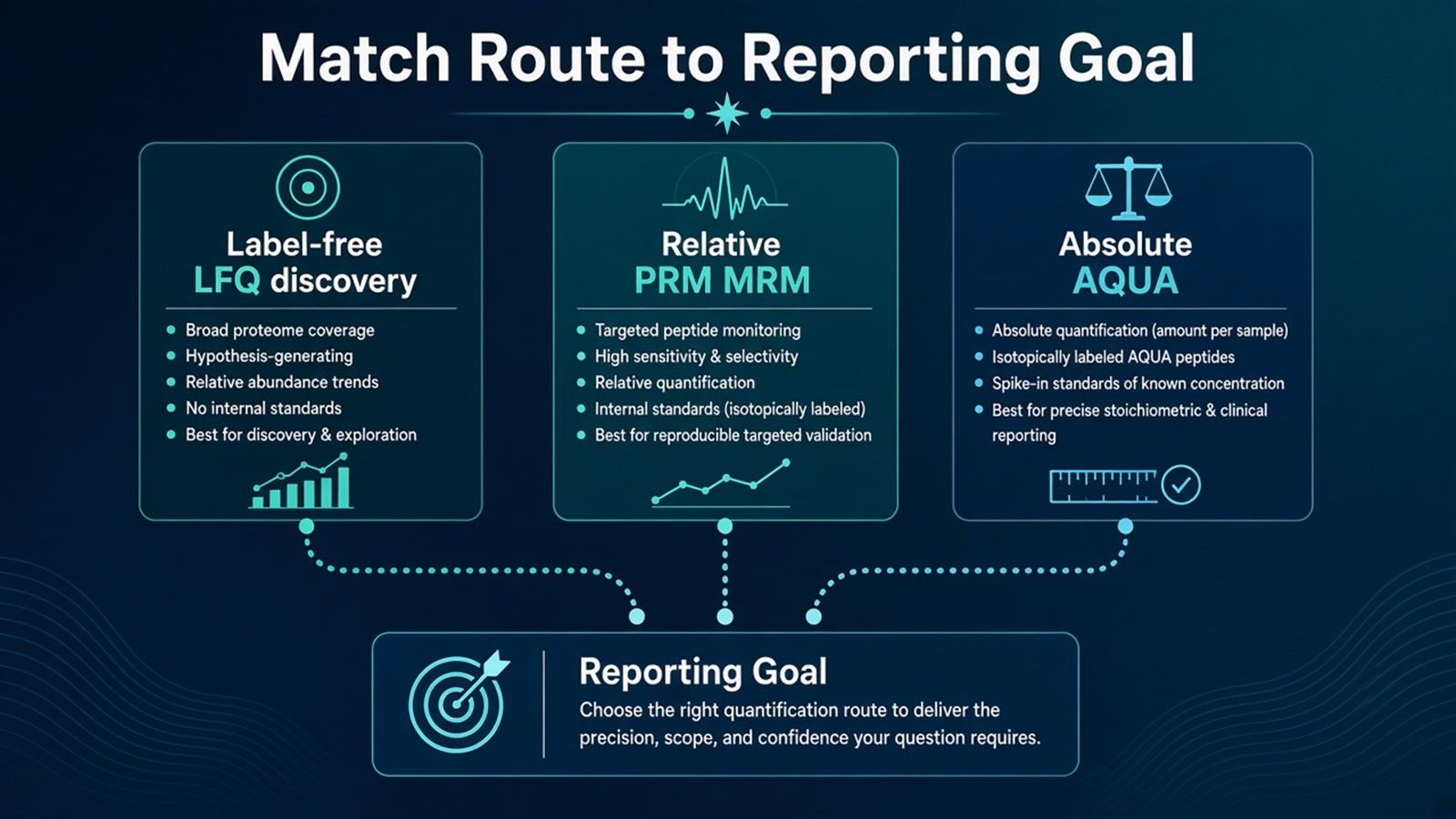
Figure 1. Reporting goal selects discovery LFQ, relative targeted MS, or calibrated absolute MS; staged programs document each block.
Validation planning appears in How to Plan a Targeted Proteomics Validation Study. DIA-to-PRM handoff appears in Application of DIA-PRM Proteomics.
Parameters That Must Be Locked by Route
Route |
Parameter that must be declared |
Failure mode if ignored |
|---|---|---|
LFQ discovery |
Contrast, normalization, missing-value policy |
Open fishing without groups |
Relative PRM/MRM |
Panel version, schedule, normalization |
Moving targets mid cohort |
Absolute AQUA |
SIS level, spike time, curve range |
Peptide amount misread as tissue concentration |
All routes |
Matched prep on every arm |
False biology from prep drift |
Staged |
Handoff record between blocks |
Mixed claims on one table |
QC |
Pool or bracket pattern |
Undetected drift |
Statistics |
Contrast frozen before tuning |
Post hoc relabeling |
Limits follow the same table. LFQ tables cannot be renamed absolute without calibration. Relative PRM cannot certify diagnostic cutoffs without validation design. Absolute curves do not fix an undefined contrast from discovery.
Absolute in targeted context appears in Absolute Quantification in Targeted Proteomics.
How to Match AQUA, MRM/PRM, and Label-Free LFQ to Your Project
Reporting goal |
Route that often fits |
Recheck before committing |
|---|---|---|
Open proteome, relative profiling |
Label-free LFQ |
LFQ ratios as ng/mL |
Fold change on closed panel |
Relative PRM or MRM |
Panel still moving |
Concentration versus limit |
AQUA plus targeted MS |
Discovery intensity as amount |
Staggered enrollment |
LFQ separate injections |
Same-day TMT assumption |
Specification after candidates |
Stage LFQ then absolute |
Skip relative panel when unwarranted |
Interference-heavy matrix |
PRM fragment review |
Unvalidated MRM transitions |
Biologics HCP amount |
Absolute with matrix QC |
Relative LFQ as release test |
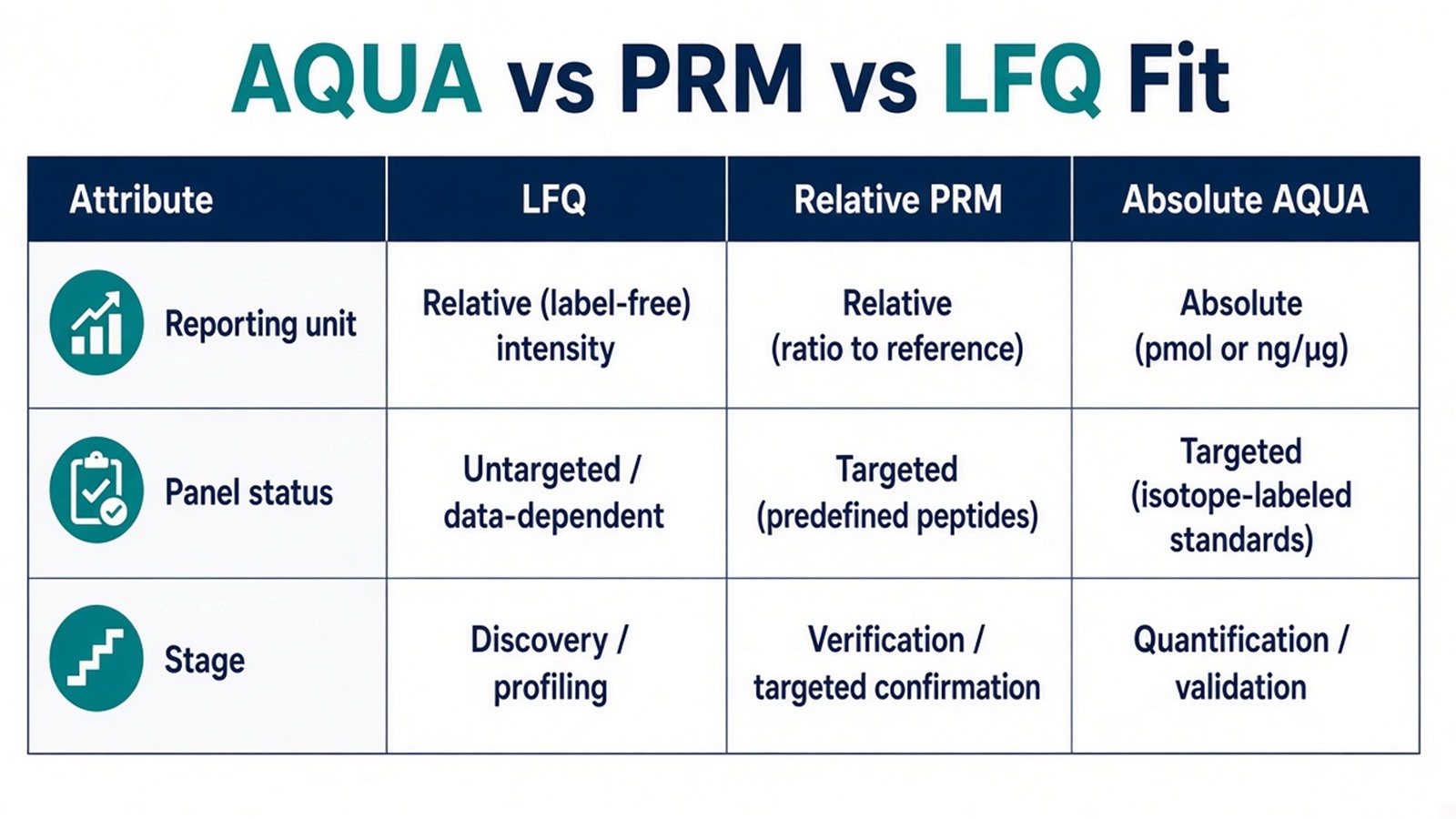
Figure 2. Choose LFQ for open relative discovery, relative targeted MS for closed-panel fold change, and AQUA-targeted MS for amount units.
PRM versus MRM choice appears in PRM vs MRM: Comparative Analysis in Quantitative Proteomics. Targeted portfolio appears in Targeted Proteomics Service.
Teams with reporting sentence, matrix notes, and panel status can review MtoZ Biolabs Absolute Quantitative Analysis (AQUA) Service, Parallel Reaction Monitoring (PRM) Service, and Label-Free Quantitative Proteomics Service when routes are declared in the project record.
Frequently Asked Questions
1. Is absolute protein quantification the same as AQUA?
AQUA is a common absolute strategy using SIS peptides. Absolute protein quantification is the reporting goal of amount in defined units, which may use AQUA, QconCAT, or other standard designs.
2. Can a project start with label-free LFQ and move to absolute AQUA?
Yes. Staged programs are common. Each stage needs a documented handoff and a claim unit matched to the route.
3. Does relative PRM avoid calibrator synthesis?
Relative PRM often runs light-only or ratio-normalized panels without a full amount curve. Calibrators become necessary when concentration units are required.
4. When should PRM replace MRM in an absolute panel?
When interference or fragment confirmation needs high-resolution product-ion review after MRM optimization attempts in the study matrix.
5. Does label-free LFQ replace absolute QC assays?
No. LFQ discovers or profiles relatively. Absolute QC or specification reporting needs calibrated targeted design when amount is the deliverable.
MtoZ Biolabs can compare absolute, relative targeted, and label-free LFQ routes when reporting goal, matrix, and panel status are documented before sample scaling.
If further evaluation of a matrix pilot, staged handoff design, or PRM versus MRM fit is needed, project details can be submitted for a feasibility review.
Reference
- S.A. Gerber, J. Rush, O. Stemman, M.W. Kirschner, S.P. Gygi (2003). Absolute quantification of proteins and phosphoproteins from cell lysates by tandem MS. Proc. Natl. Acad. Sci. U.S.A., 100, 6940-6945. https://doi.org/10.1073/pnas.0832254100
- M. Bantscheff, S. Lemeer, H.U. Haab, B. Kuster (2012). Quantitative mass spectrometry in proteomics: a critical review. Anal. Bioanal. Chem., 404, 939-965. https://doi.org/10.1007/s00216-012-5892-4
- J. Cox, M.Y. Hein, C.A. Luber, I. Paron, M. Mann (2014). Accurate proteome-wide label-free quantification by delayed normalization and maximal peptide ratio extraction, termed MaxLFQ. Mol. Cell. Proteomics, 13, 2513-2526. https://doi.org/10.1074/mcp.M113.031031
- V. Lange, P. Picotti, B. Domon, R. Aebersold (2008). Selected reaction monitoring for quantitative proteomics: a tutorial. Mol. Syst. Biol., 4, 222. https://doi.org/10.1038/msb.2008.61
- A.C. Peterson, J.D. Russell, A.A. Klammer, P.F. Doubleday, H. Liu, J.N. Anderson, M.J. MacCoss (2012). Parallel reaction monitoring for high resolution and high mass accuracy quantitative, targeted proteomics. Mol. Cell. Proteomics, 11, 1475-1488. https://doi.org/10.1074/mcp.O112.020271
