






Why Are There Too Many Background Proteins in AP-MS Data?
Introduction
An AP-MS dataset with hundreds of proteins is not always a successful interactome experiment. When the list is dominated by ribosomal subunits, cytoskeletal proteins, chaperones, RNA-binding proteins, and other recurring contaminants, the problem is not simply that AP-MS found many proteins—it is that background overwhelms bait-specific signal and makes prioritization difficult.
Too many background proteins in AP-MS data usually means the enrichment worked well enough to produce an eluate, but specificity filtering has not yet separated sticky carryover from meaningful co-enrichment. LC-MS/MS sensitivity, mild wash conditions, overexpressed baits, missing controls, and reporting of raw identifications all contribute to long contaminant-heavy lists. This article explains why AP-MS data can contain too many background proteins and how to triage overcrowded results into a usable candidate shortlist.
Why Long Protein Lists Are Common in AP-MS
AP-MS begins with affinity enrichment, not pure bait-only material, so some background proteins always co-purify. LC-MS/MS is highly sensitive and can detect low-level contaminants that remain after washing alongside true partners. Discovery workflows often report all proteins meeting identification thresholds before control subtraction or enrichment ranking, and mild lysis or gentle washes preserve weak interactors but also retain more nonspecific binders.
Overexpressed tagged baits increase local protein concentration and can amplify sticky associations, while deep acquisition or long gradients sample the eluate thoroughly and increase the number of background identifications even when bait recovery is acceptable. A long list therefore does not automatically mean the experiment captured a large interactome—it often means the dataset has not yet been reduced to bait-specific enrichment evidence.
Signs the List Is Dominated by Background
Several patterns suggest background overload rather than a broad true interactome:
- The same abundant proteins appear in bait and empty-tag control samples at similar levels
- Ribosomal, cytoskeletal, heat-shock, and keratin-associated proteins occupy the top ranks
- Many proteins have been reported as common contaminants in unrelated AP-MS studies using similar tags or beads
- The list length changes little when control subtraction is applied because controls were missing or mismatched
- Expected bait-specific partners, if any, are buried below abundant sticky proteins without enrichment ranking
- Replicates show unstable prey profiles dominated by the same high-abundance contaminants
These patterns point to a triage problem—the raw identification output is too permissive for direct biological interpretation.
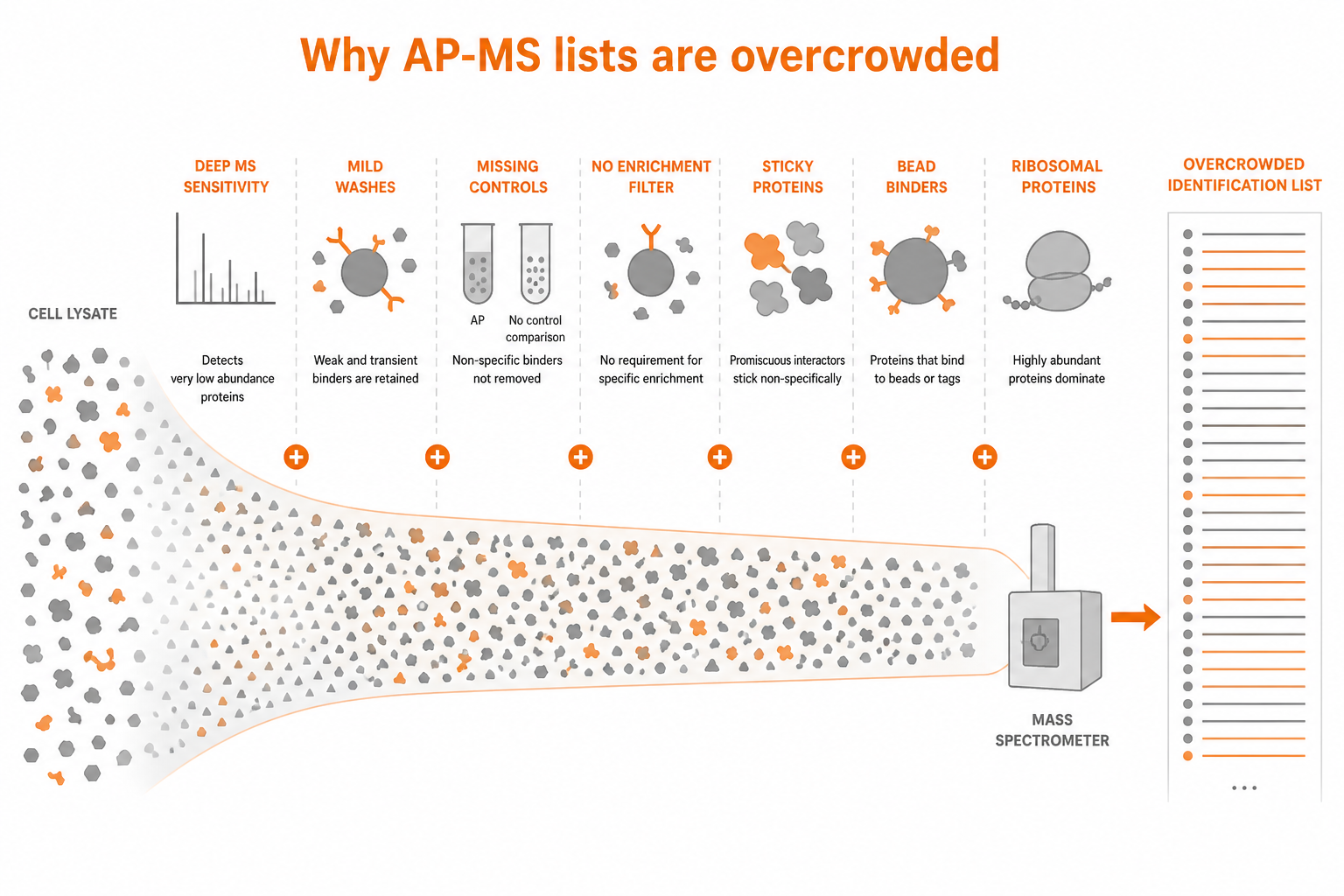
Figure 1. Sensitive LC-MS/MS, mild washes, and unfiltered identifications often produce long background-heavy AP-MS lists.
Main Reasons Background Proteins Inflate AP-MS Data
Background inflation in AP-MS usually traces to a few recurring mechanisms, each suggesting a different response:
- Bead, resin, and tag-associated binders: proteins that stick to affinity supports or epitope tags appear in many unrelated AP-MS experiments and inflate list length when no empty-tag or equivalent control is available to subtract them
- Abundant lysate carryover: highly expressed cellular proteins can survive washing and dominate MS output, especially when wash stringency is low or bait expression is high
- Overexpression-driven sticky associations: tagged bait overexpression can increase nonspecific co-purification without reflecting endogenous complex membership
- Missing or mismatched controls: without parallel controls processed under the same conditions, every identification remains in the candidate pool
- Reporting identifications without enrichment ranking: raw protein tables treated as interactomes include proteins that were detected but not enriched over background
- Deep MS on low-specificity enrichments: increasing MS depth on a weakly specific eluate mainly adds more background identifications rather than revealing true low-abundance partners
Some of these are analysis problems; others require experimental revision.
When Too Many Background Proteins Indicate an Experimental Problem
Background is expected, but extreme background can signal design issues—empty-tag controls may be missing or processed differently from bait samples, wash conditions may be unusually mild relative to the specificity required for the project, or bait expression may be far above endogenous levels without inducible control. Bead lots, wash volumes, or handling can differ between bait and control arms, and the eluate may have been analyzed by MS without any prior check of bait recovery or control parity.
In these cases, repeating enrichment with matched controls and adjusted wash strategy may shorten the list more effectively than filtering alone. When controls are strong and bait recovery is reproducible, the issue may be primarily triage and ranking rather than complete experimental failure.
Triage Workflow for Overcrowded AP-MS Lists
Overcrowded data becomes usable when analysis focuses on specificity rather than list length. Start from the raw identification table but do not treat it as the final interactome. Subtract or contrast against matched empty-tag, isotype, bead-only, or unrelated bait controls as appropriate to the design, then rank remaining proteins by enrichment over control rather than by total spectral count alone when quantitative data are available.
Require replicate support for candidates that will enter validation or reporting, apply contaminant frequency filters only after project-specific control contrast has been evaluated, and shortlist a manageable number of prey proteins with biological coherence and a defined validation route. The goal is not zero background proteins—it is a ranked set small enough to interpret and validate.
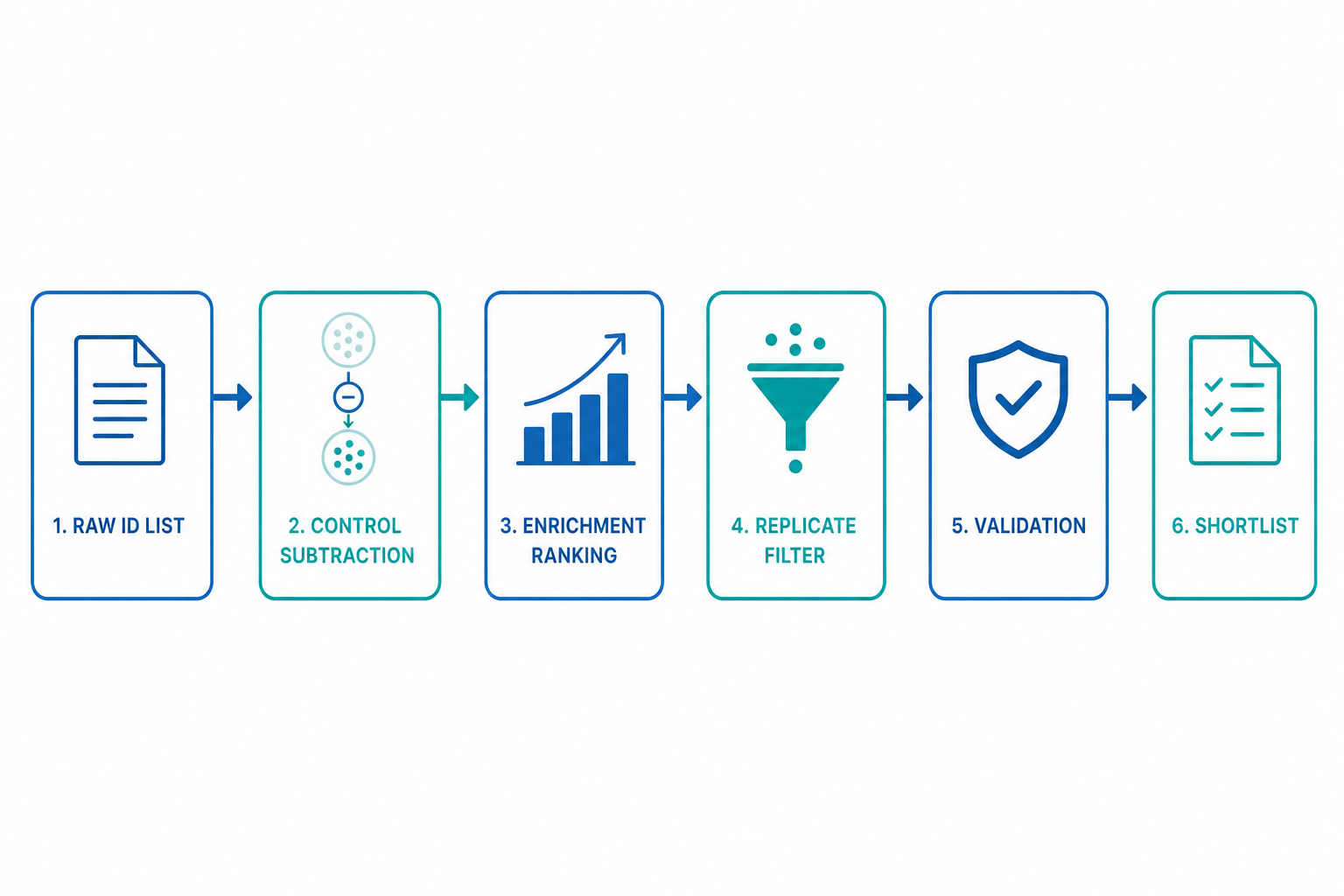
Figure 2. Triage overcrowded AP-MS data with control contrast, enrichment ranking, replicate support, and shortlist planning.
Background Source and Best Response
|
Background source |
Why the list grows |
Best first response |
|---|---|---|
|
Bead or tag binders |
Contaminants appear in many AP-MS runs |
Empty-tag or format-matched control subtraction |
|
Abundant lysate proteins |
Mild washes retain carryover |
Review wash stringency and enrichment ranking |
|
Overexpression artifacts |
Nonspecific associations increase |
Lower expression or inducible bait |
|
No control arm |
All IDs remain candidates |
Repeat with matched control |
|
Raw ID reporting |
No specificity filter applied |
Rank by bait-control enrichment |
|
Deep MS on weak eluate |
More contaminants detected |
Improve specificity before deeper acquisition |
Use the table to decide whether triage alone is enough or whether enrichment design should be revised.
How Filtering Changes What "Too Many" Means
Filtering does not create interactors—it prioritizes proteins most likely to be bait-specific. Control enrichment thresholds remove proteins that appear equally in bait and control, replicate consistency filters reduce one-run sticky proteins, and contaminant databases remove frequent laboratory and AP-MS background proteins after project controls are applied. Biological review should follow quantitative filtering, not replace it.
Over-filtering can remove low-abundance true partners; under-filtering leaves the list unusably long. The filter stringency should match the project claim—discovery projects may keep a broader ranked list, while mechanism or publication-focused projects usually require stricter shortlist criteria.
What Not to Do With Background-Heavy AP-MS Data
Several common responses make overcrowded lists worse:
- Treating every identified protein as a candidate interactor without control contrast
- Selecting validation targets by alphabetical order, highest total abundance, or pathway convenience alone
- Assuming a longer list means a better experiment
- Repeating LC-MS/MS on the same low-specificity eluate without changing enrichment or controls
- Ignoring empty-tag signal that matches bait signal for sticky proteins
- Publishing network figures built from unfiltered identifications
Background-heavy data can still be useful when triaged properly—it becomes misleading when reported without specificity analysis.
Affinity Purification-Mass Spectrometry Service
MS-Based Protein-Protein Interaction Analysis Service
Related Services
Next Step
Affinity Purification-Mass Spectrometry Service
Request support to rank bait-specific candidates from background-heavy AP-MS data or revise control design before repeat enrichment.
Complementary
Co-Immunoprecipitation Protein Interaction Analysis Service
Use to validate a filtered shortlist rather than testing dozens of background-dominated identifications.
Alternative
IP-MS Protein Interactomics Analysis Service
Consider when endogenous bait capture may reduce tag-associated background relative to tagged AP-MS in the current system.
What to Send for a Background-Triage Review
Provide the following when asking for help with an overcrowded AP-MS list:
- Bait format and control arms used in the experiment
- Approximate list length before and after any filtering attempted
- Examples of top-ranked proteins in bait and control samples
- Replicate structure and whether sticky proteins repeat across runs
- Evidence of bait recovery and whether empty-tag signal mirrors bait signal for top contaminants
- The number of candidates the project can realistically validate
MtoZ Biolabs can help determine whether the dataset needs stronger filtering, revised controls, or repeated enrichment.
Frequently Asked Questions
1. Is a long AP-MS protein list always bad?
No. Long lists are common before control subtraction and ranking. The issue is whether background proteins dominate the list after specificity analysis.
2. Can deep LC-MS/MS cause too many background proteins?
Yes. Greater MS depth on a weakly specific enrichment mainly increases detection of low-level contaminants unless specificity filtering is applied.
3. Do empty-tag controls reduce list length?
Matched empty-tag controls help remove tag and bead-associated proteins and support bait-control enrichment ranking.
4. Should I validate more proteins when the list is long?
No. Background-heavy lists should be triaged first. Validation should focus on ranked bait-specific candidates.
5. When should I repeat the enrichment instead of filtering?
Repeat when controls are missing, bait and control handling differ materially, or empty-tag profiles closely mirror bait profiles for most top proteins.
Conclusion
Too many background proteins in AP-MS data usually reflect the sensitivity of enrichment plus MS combined with incomplete specificity analysis, not necessarily a useless experiment. Bead binders, tag-associated proteins, abundant carryover, overexpression artifacts, and unfiltered identifications all inflate list length.
The practical response is triage: use matched controls, enrichment ranking, replicate support, and a defined shortlist rather than treating the raw identification table as an interactome. When controls are weak or enrichment specificity is poor, experimental revision may be required before deeper MS or large-scale validation. Researchers facing background-heavy AP-MS data can review the Affinity Purification-Mass Spectrometry Service page or contact MtoZ Biolabs with control details and top protein ranks for triage support.
How to order?




