






Why Are Known Interacting Proteins Missing from IP-MS Results?
Introduction
A known interacting protein can be absent from IP-MS results even when the run was technically successful. Partners validated elsewhere may be lost during harsh washing, differ in antibody or cell context, fall below MS reporting cutoffs, or be removed by isotype control subtraction when they co-purify nonspecifically.
Absence in one IP-MS design is weak evidence for “no interaction.” Confirm target recovery first, compare your protocol to the validating experiment, inspect raw peptide data, and use targeted Co-IP if the biological claim depends on that partner. The cause summary, diagnostic questions, and risk table below help distinguish technical false negatives from condition-specific loss.
Missing Known Partners Is Not the Same as a Failed IP-MS Run
A useful troubleshooting frame separates three situations: the target was not recovered and neither expected nor unexpected preys should be interpreted confidently; the target was recovered but the expected partner is absent while other proteins appear in the list; or the expected partner was detected in raw data but removed by filtering, missing-value rules, or isotype control subtraction. These situations require different responses, and missing known partners most often belongs to the second or third category when target recovery is acceptable.
IP-MS reports proteins that co-purify with the target under the exact immunoprecipitation and analysis conditions used. A partner validated elsewhere may not appear if those conditions differ from the prior assay, cell state, or antibody context.
Reason 1. The Interaction Did Not Survive Lysis or Washing
IP-MS is biased toward associations that remain intact through extraction and washing. Harsh detergents, high salt washes, or long wash sequences can dissociate weak or transient partners before elution. Literature interactions detected by Co-IP under mild conditions may disappear in IP-MS if the purification stringency is higher, even when the same antibody class is used.
Complex subunits may require native-like lysis while the current protocol prioritizes low background over complex preservation. If a known partner is labile under the chosen conditions, its absence may reflect technical loss rather than absence in the cell. Review wash count, buffer composition, and whether the expected partner was previously detected under similar stringency.
Reason 2. The IP Context Differs from the Validated Interaction
Known partners are often reported under conditions that do not exactly match the current IP-MS experiment. A different antibody clone, epitope, cell line, species, treatment state, or overexpression context can change which partners co-purify. A partner validated by targeted Co-IP with one antibody lot may not appear in discovery IP-MS with another lot or under different lysis conditions.
Epitope masking by complex formation or post-translational modifications can also reduce capture efficiency for the target and indirectly change prey recovery profiles. A missing known partner may mean the current IP context does not reproduce the validated interaction environment rather than that the partner never associates with the target protein class. Compare antibody design, biological system, and sample state against the source of prior interaction evidence.
Reason 3. The Partner Was Present but Below MS Detection or Reporting Cutoffs
IP-MS identification depends on peptide sampling and project reporting rules. Low-abundance preys may generate too few spectra to pass protein inference thresholds, shared peptides may be assigned to homologs or isoforms rather than the expected protein name in the report, and quantitative filtering may remove proteins present in target IP and isotype control without strong enrichment contrast even when the partner truly co-purified weakly. Missing-value handling in comparative analyses can hide partners detected in only one replicate.
Before concluding that a known partner is absent, check raw peptide evidence and unfiltered identification lists when available.
Reason 4. Isotype Control Subtraction or Filtering Removed the Expected Partner
Filtering is a common hidden cause of missing known partners. If the expected partner enriches in both target IP and isotype control at similar levels, control subtraction may correctly remove it as nonspecific background even though the protein co-purified. Aggressive contaminant lists may remove proteins previously seen in unrelated IP or AP-MS studies, frequency filters across multi-bait panels may exclude a partner that appears with many antibodies in the same system, and replicate-consistency rules may drop a biologically real but sporadic partner seen in only one run.
Ask whether the partner was removed during filtering rather than never captured during immunoprecipitation.
Reason 5. Biological State or Timing Mismatch
Interactions can be condition-specific. The expected partner may associate only after stimulation, during a cell-cycle phase, or in a specific differentiation state not represented in the current sample. A drug, starvation, or stress condition used in the current experiment may dissolve a complex seen under basal literature conditions, and time from treatment to lysis can determine whether a transient partner is still bound when IP begins.
Missing known partners may reflect sample timing rather than method failure. Review whether IP-MS sample generation matched the biological state used in prior validation experiments.
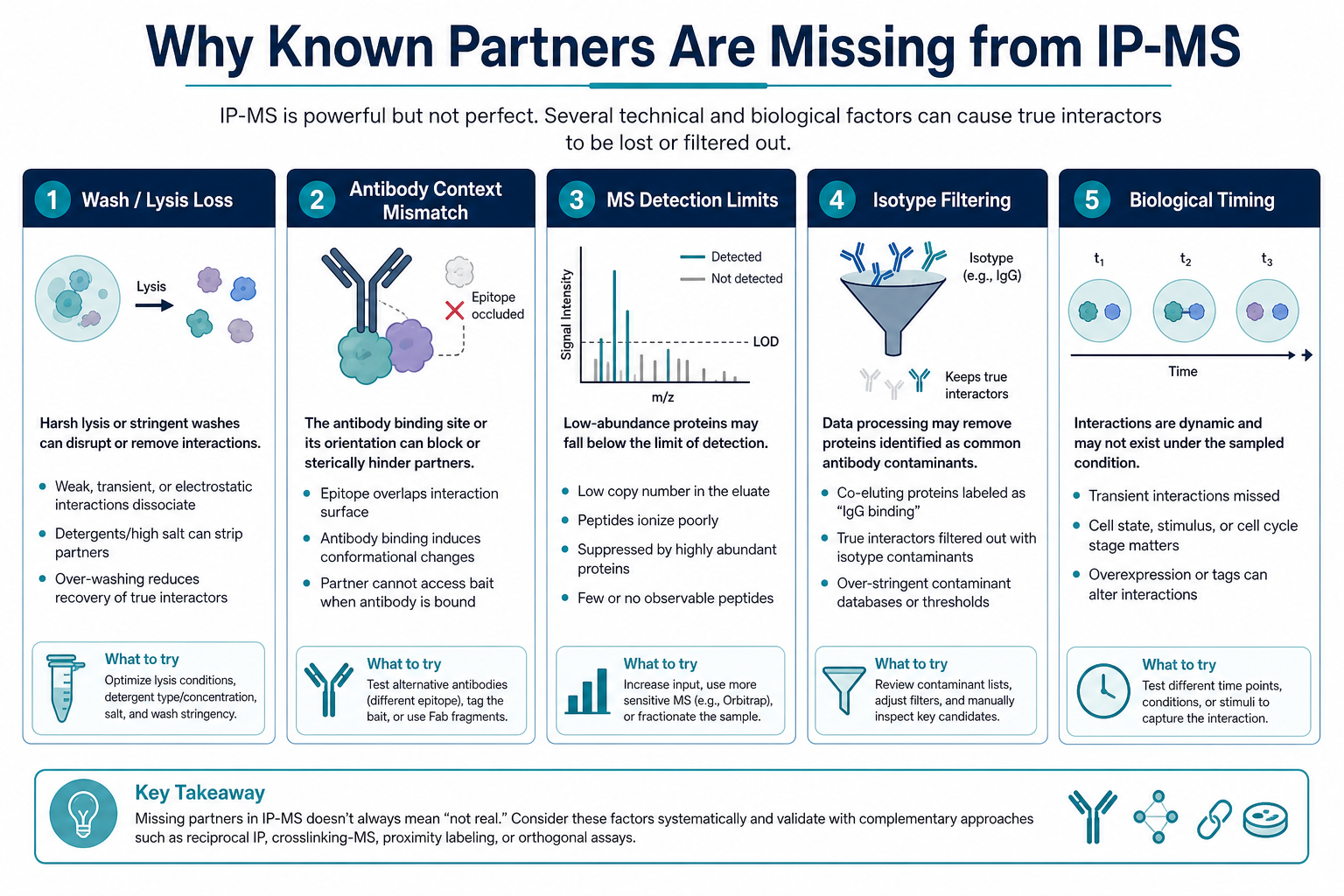
Figure 1. Known interacting proteins can be lost during washing, changed IP context, MS detection limits, isotype filtering, or biological state mismatch.
Diagnostic Questions to Ask Before Repeating the Experiment
Work through these questions in order when an expected partner is absent:
- Was target recovery confirmed independently of the prey list?
- Were lysis and wash conditions comparable to those used in prior validation experiments?
- Does the current capture antibody and sample state match the validated interaction context?
- Does raw peptide evidence support the expected protein even if it is absent from the filtered table?
- Did the partner appear in isotype control arms at similar levels, triggering background subtraction?
- Was the sample collected in the correct treatment, time point, or cell state?
- Would a milder wash or alternative lysis condition plausibly preserve the expected interaction class?
Positive answers narrow the problem to filtering or biology; negative answers suggest protocol revision before strong absence claims.
False Negative Risk by Interaction Type
Different interaction classes are missed for different reasons.
|
Interaction type |
Common reason for IP-MS absence |
Practical response |
|---|---|---|
|
Stable complex subunit |
Harsh wash or incomplete lysis |
Test milder extraction and washing |
|
Transient signaling partner |
Dissociation before capture |
Shorten handling time or adjust wash |
|
Membrane-associated partner |
Detergent incompatibility |
Revise membrane extraction strategy |
|
Co-IP WB validated partner |
Different IP or MS conditions |
Compare protocol and inspect raw data |
|
Low-abundance prey |
MS depth or filter cutoff |
Review raw data and input amount |
|
Sticky background-like partner |
High isotype control signal |
Re-evaluate specificity filtering |
The table supports troubleshooting, not automatic protocol changes without pilot evidence.
How to Respond Without Overinterpreting Absence
Missing a known partner should not immediately be reported as proof of no interaction. Absence in one IP-MS run under one condition set is weak evidence for biological disruption unless target recovery and protocol fidelity are strong. If the project depends on the expected partner, targeted Co-IP or western blot for that prey may be the fastest confirmation step.
If the partner is weak or transient, repeating IP-MS with adjusted wash or lysis may be more informative than forcing validation of unrelated high-ranking candidates. If raw data suggest weak prey presence, revise filtering before concluding the partner was not enriched. The goal is to distinguish a technical false negative from a condition-specific biological change.
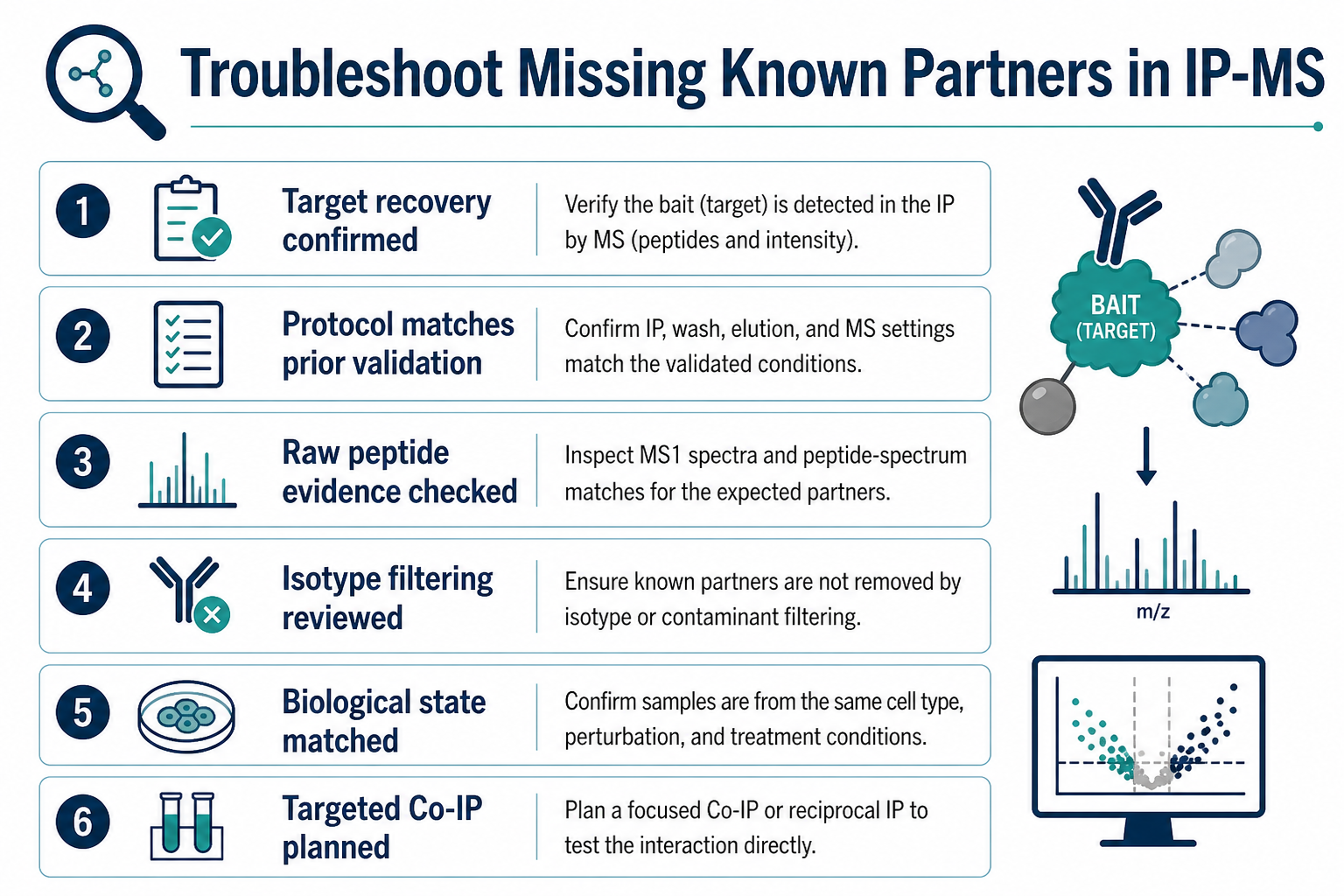
Figure 2. Troubleshoot missing known partners by checking recovery, IP context, raw MS evidence, isotype filtering logic, and biological timing.
When to Revise IP-MS Design Versus Validate Orthogonally
Revise IP-MS design when target recovery is acceptable but protocol conditions likely excluded the expected interaction class. Consider orthogonal validation when the biological claim depends on one known partner and IP-MS absence could reflect detection limits rather than true loss. Consider a combined plan when the expected partner is one node in a broader discovery project—IP-MS can still nominate additional candidates while targeted validation tests the known partner directly.
Do not repeat the same IP-MS design repeatedly without changing the variable most likely responsible for prey loss.
What to Provide for a Missing-Partner Review
Include the following information when requesting technical input:
- Name of the expected interacting protein and source of prior validation such as literature, Co-IP, or prior MS
- Target protein, capture antibody, cell system, and treatment state used in the current IP-MS run
- Evidence of target recovery and isotype control arm results
- Whether the expected protein appeared in raw peptide data or only disappeared after filtering
- Lysis, wash, and elution conditions relative to the prior validating experiment if known
- Replicate structure and whether absence is consistent across runs
MtoZ Biolabs can help determine whether the missing partner likely reflects protocol loss, filtering, IP context, or a biologically meaningful change.
Frequently Asked Questions
1. Does a missing known partner mean the IP-MS experiment failed?
Not necessarily. The experiment may have worked while the expected partner was lost during washing, not sampled by MS, filtered out, or absent in the current biological context.
2. Why would a Co-IP western blot partner be missing from IP-MS?
Co-IP western blot and IP-MS may use different wash stringency, MS depth, filtering rules, and sample states. A partner seen by targeted detection is not guaranteed to appear in every IP-MS design.
3. Should I lower filtering thresholds to recover expected interactors?
Review raw data first. Lowering thresholds can restore weak true partners but may also reintroduce background proteins that isotype controls were meant to remove.
4. Can transient interactors be detected by IP-MS?
Sometimes, but transient partners are more likely to be lost during washing or lysis. Absence is common for weak or dynamic associations unless conditions are tuned for retention.
5. Can isotype control subtraction explain a missing known partner?
Yes. If the partner appears at similar levels in target IP and isotype control, filtering may correctly remove it as nonspecific background even though it co-purified.
6. What is the best next step when one expected partner is missing?
Confirm target recovery, compare protocol and IP context to prior evidence, inspect raw peptide support, and use targeted Co-IP for the expected prey if the biological claim depends on it.
Related Services
Co-Immunoprecipitation Protein Interaction Analysis Service
Test whether a known partner co-enriches with the bait when IP-MS results do not show the expected protein.
IP-MS Protein Interactomics Analysis Service
Review capture antibody choice, wash strategy, and repeat conditions when expected partners are missing from IP-MS output.
Affinity Purification-Mass Spectrometry Service
Use when the expected partner was validated with a tagged bait and AP-MS may better reproduce that context.
Conclusion
Known interacting proteins can be missing from IP-MS results for reasons that do not invalidate the entire experiment. Wash stringency, antibody and sample context, MS detection limits, isotype control subtraction, and biological timing all change which partners appear in the final list. Absence should be interpreted as condition-specific co-purification failure unless supported by strong recovery data and appropriate controls.
The most useful response is diagnostic rather than assumptive: confirm target recovery, compare the current design to prior validation conditions, inspect raw peptide evidence, and use targeted validation when a known partner is central to the project claim. Researchers troubleshooting missing interacting proteins in IP-MS can review the IP-MS Protein Interactomics Analysis Service page or contact MtoZ Biolabs with target details, expected partner information, and filtering history for technical review.
How to order?




