






Why Are Low-Abundance Lysosomal Proteins Hard to Detect?
Introduction
Many lysosome projects fail at detection long before pathway interpretation begins. A team may already know the target protein is lysosome-related, yet bulk cell or tissue proteomics still misses it. Another team may see only a few expected markers and wonder whether low-abundance lysosomal proteins are simply outside the reach of LC-MS/MS.
Low-abundance lysosomal proteins are hard to detect mainly because they are diluted by far more abundant cellular proteins in whole-sample proteomes. Lysosome enrichment proteomics improves the chance of recovery by increasing organelle-associated protein representation before LC-MS/MS, but enrichment is an attempt-based strategy, not a guarantee. This article explains the detection problem, why enrichment helps, and how to judge feasibility before committing a full cohort.
The Core Problem: Abundance Competition in Bulk Proteomes
Mass spectrometry preferentially detects peptides that are present at usable levels after digestion. In whole-cell or whole-tissue lysates, cytoskeletal proteins, metabolic enzymes, and other high-abundance species consume sequencing capacity. Lysosomal proteins that are present at low copy number, restricted to a small organelle compartment, or recovered inefficiently after lysis can fall below practical detection.
This creates a common project tension. The biological question is organelle-specific, but the submitted material is bulk. When low-abundance lysosomal proteins are the real targets, bulk proteomics often answers a different question than the one the team intended.
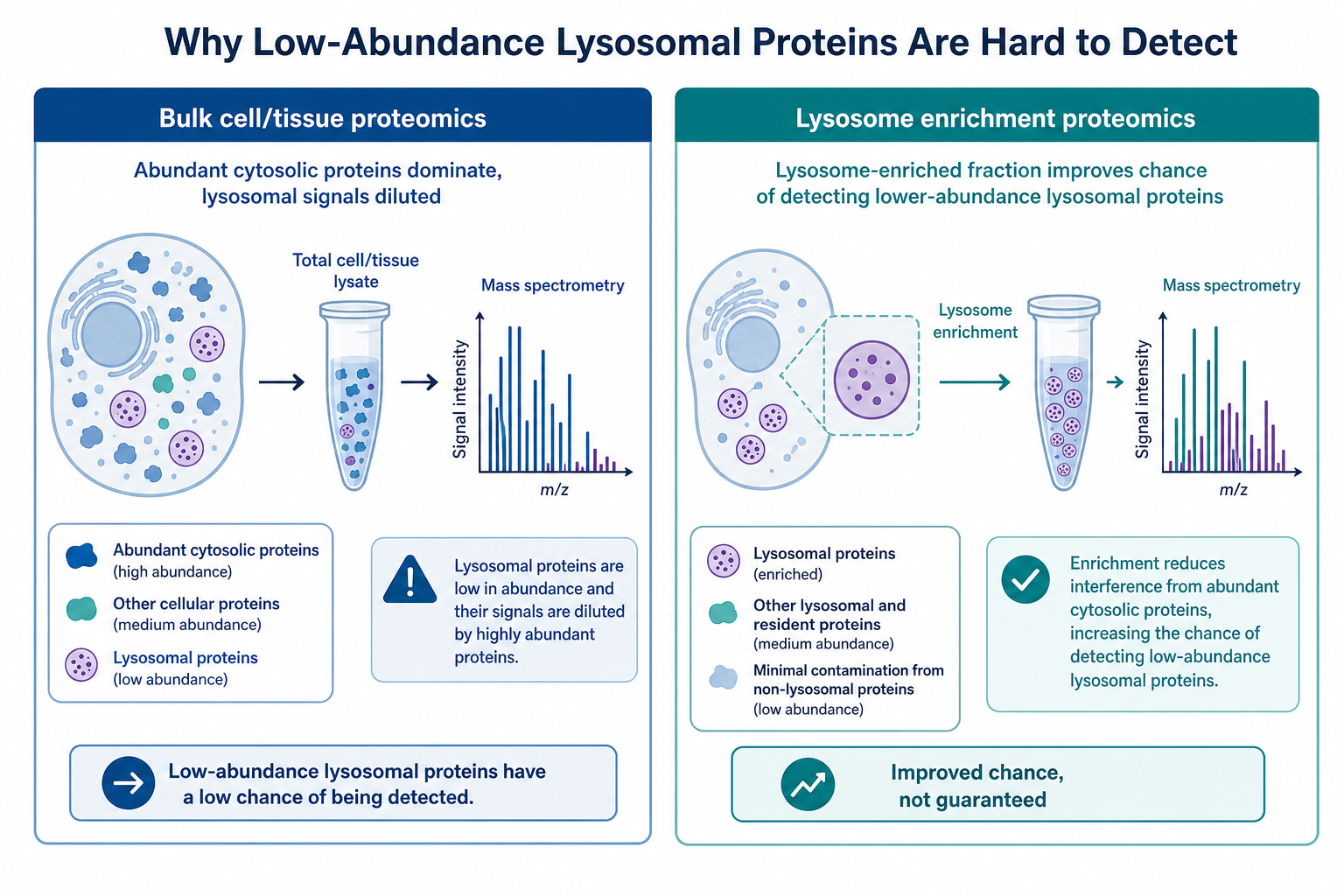
Figure 1. In bulk lysates, abundant cellular proteins can mask low-abundance lysosomal signals. Lysosome enrichment improves detection chance but does not guarantee recovery.
Why Lysosomal Proteins Are Especially Easy to Miss
Several biological and technical factors combine.
Lysosomes occupy a limited fraction of total cellular protein mass, so organelle-restricted proteins start at a disadvantage in bulk mixtures.
Some lysosomal proteins are membrane-associated, hydrophobic, or otherwise difficult to recover uniformly during extraction and digestion.
Dynamic biological states such as autophagy flux, storage burden, or stress responses can further lower the abundance of selected targets in a given condition.
Enrichment quality varies. Incomplete lysosome recovery or co-isolation of other compartments changes which proteins dominate the final preparation.
LC-MS/MS depth is finite. Even strong acquisition methods cannot fully compensate when the target remains a tiny fraction of total peptide input.
These factors explain why marker-level Western blot evidence and proteome-level detection are not interchangeable.
How Lysosome Enrichment Proteomics Changes Feasibility
Lysosome enrichment proteomics starts from lysosome-enriched material rather than bulk lysate. By increasing the relative contribution of organelle-associated proteins, enrichment can raise the chance that low-abundance lysosomal proteins become detectable by Label-free, DIA, or TMT workflows.
Enrichment is most useful when:
- the claim depends on lysosome-associated proteins rather than whole-cell composition
- bulk proteomics already failed or is expected to dilute the target class
- matched enrichment can be applied across comparison groups
- protein input from the enriched fraction is adequate for LC-MS/MS
Enrichment is not useful as a promise of universal recovery. Low-abundance targets may still be missed after enrichment, especially when starting material is limited or the protein is intrinsically difficult to detect.
What Can Be Tried, and What Should Not Be Promised
For feasibility planning, the practical position is clear.
Detection of low-abundance lysosomal proteins can be attempted through lysosome enrichment proteomics.
Enrichment is required for this attempt. Bulk-only designs are usually the wrong first choice when the target class is organelle-restricted and low in abundance.
Effect is not guaranteed. Projects should define success criteria in advance, such as recovery of expected lysosome markers, usable identification depth for the enriched fraction, or detection of a predefined priority list.
If targets remain undetectable after enrichment and adequate input, the next step is usually claim revision, orthogonal assays, or a narrower targeted follow-up plan rather than repeated bulk discovery runs.
Diagnostic Path Before Project Commitment
Use a short feasibility sequence before locking the cohort.
- Confirm that the biological claim is lysosome-associated rather than bulk proteome-wide.
- Confirm whether starting material is cells, tissue, or an already enriched lysosome fraction.
- Confirm whether enrichment can be performed in the service path or must be completed by the client.
- Confirm approximate sample amount and whether enriched protein yield can reach the planning range.
- Confirm QC expectations, including Western blot readiness for lysosome markers such as LAMP1 or LAMP2.
- Decide whether Label-free, DIA, or TMT best fits the comparative design after enrichment feasibility is clear.
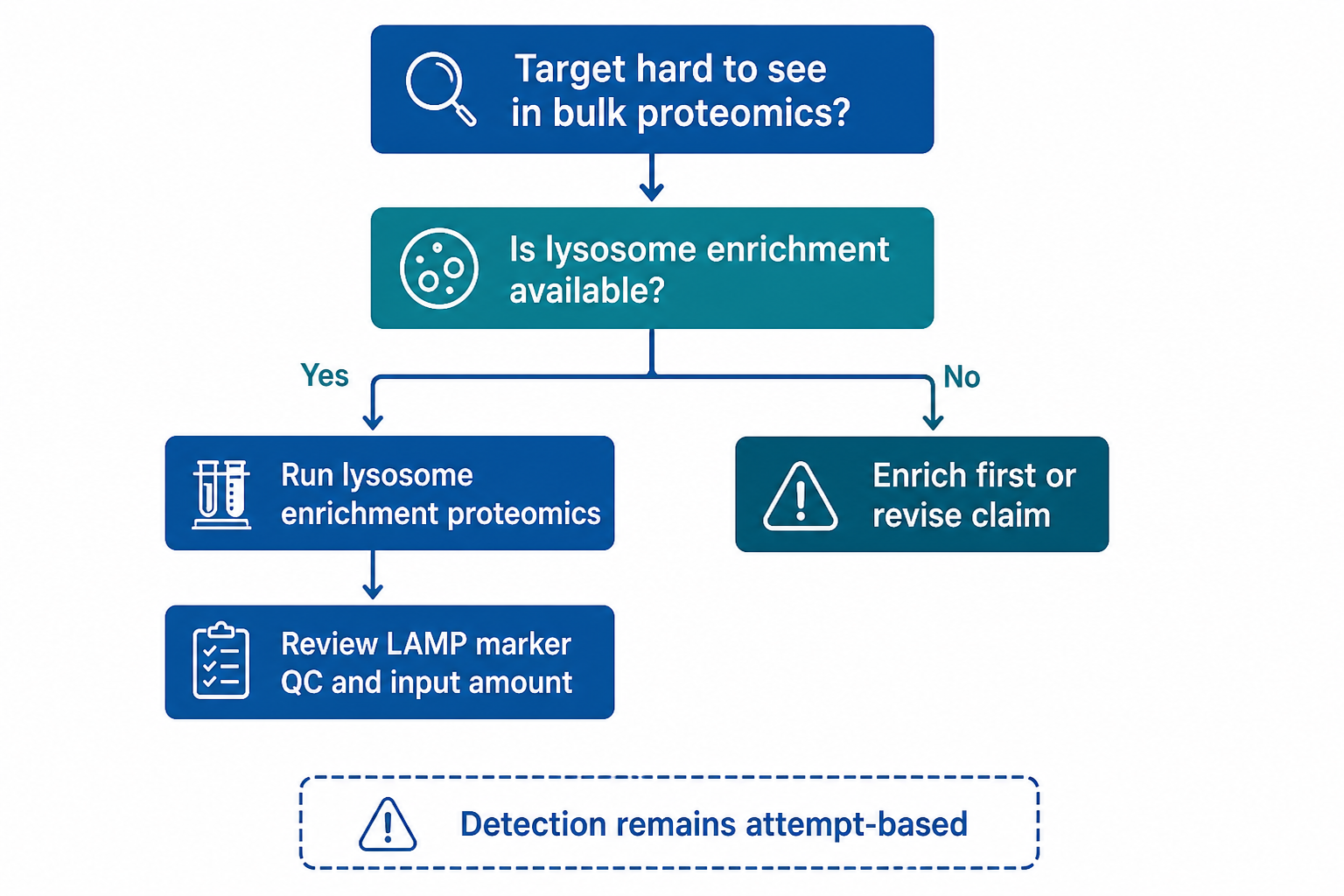
Figure 2. When bulk detection is unlikely, lysosome enrichment proteomics is the practical attempt path, with marker QC and input amount reviewed before LC-MS/MS.
Sample and Design Conditions That Improve the Attempt
For cell lines, primary cells, fresh tissue, and frozen tissue, lysosome enrichment can be included before proteomics. A commonly used approach is centrifugal column-based rapid isolation suitable for downstream LC-MS/MS.
For serum, plasma, CSF, urine, and similar fluids, clients should complete lysosome-component separation before submission. Enrichment from these fluids is outside the standard laboratory enrichment path.
Suggested planning amounts include about 1 x 10^7 cells per sample, 20 to 50 mg tissue per sample, or 20 to 50 ug protein from client-enriched fractions. Store samples at −80°C and ship on dry ice. Avoid repeated freeze-thaw and mass spectrometry-incompatible additives.
Western blot positivity for LAMP1 or LAMP2 is a practical readiness check after enrichment. Additional organelle-contamination panels are not recommended as a default requirement before omics. If localization context is needed later, subcellular localization analysis can be considered after proteomics rather than as a pre-omics purity expansion.
Corrective Strategies When Targets Stay Undetectable
Increase or verify enrichment quality and enriched protein input before repeating acquisition.
Switch from an inventory claim to a narrower priority-protein claim if only a subset of targets matters.
Consider quantification redesign only after enrichment feasibility is established. Label-free, DIA, and TMT cannot create peptides that were never recovered.
Use orthogonal methods for critical low-abundance targets when discovery MS remains negative.
Revise biological expectations when the protein may be too low, too unstable, or too poorly recovered for proteome-level detection under current material limits.
Related Services
Mitochondrial Proteomics Services
What to Prepare for a Low-Abundance Feasibility Review
Before requesting lysosome enrichment proteomics, assemble:
- target protein class and why bulk detection is expected to fail
- sample type, species, and enrichment status
- approximate cell, tissue, or enriched-protein amount
- comparison groups and replicates, if any
- available marker QC plans such as LAMP1 or LAMP2
- whether success means marker-supported enrichment, broader identification, or detection of named priority proteins
MtoZ Biolabs supports lysosome enrichment proteomics for suitable cell and tissue inputs, intake of client-enriched fractions, LC-MS/MS by Label-free, DIA, or TMT, and bioinformatics interpretation. For low-abundance targets, the team can help judge whether enrichment is a reasonable attempt and what limits should be accepted before the study begins.
To discuss detection feasibility for low-abundance lysosomal proteins, contact MtoZ Biolabs with your target list, sample type, enrichment status, available amount, and the decision the proteomics result must support.
Frequently Asked Questions
Why are low-abundance lysosomal proteins hard to detect in bulk samples?
They are diluted by much more abundant cellular proteins, so their peptides often fall below practical LC-MS/MS detection in whole-cell or whole-tissue mixtures.
Does lysosome enrichment proteomics guarantee detection?
No. Enrichment improves the chance of detection and is the recommended attempt path, but recovery is not guaranteed for every low-abundance target.
Can quantification mode alone solve the problem?
No. Label-free, DIA, and TMT help comparative measurement after proteins are recovered. They do not replace enrichment when the target class is underrepresented in bulk input.
What QC is useful before omics?
Western blot positivity for lysosome markers such as LAMP1 or LAMP2 is a practical readiness check for enriched fractions.
What if body-fluid samples are the only available material?
Lysosome-component separation should be completed by the client before submission. Standard laboratory enrichment for those fluids is not part of the path described here.
Conclusion
Low-abundance lysosomal proteins are hard to detect because bulk proteomes are dominated by other protein classes. Lysosome enrichment proteomics is the practical way to improve detection odds by increasing organelle-associated representation before LC-MS/MS.
The correct planning posture is cautious and specific: enrichment can be attempted, marker QC and input amount should be reviewed, and success should not be promised in advance. Teams facing this detection bottleneck can review feasibility with MtoZ Biolabs and decide whether an enrichment-first proteomics design is justified for the current targets and samples.
How to order?




