






Lysosomal Proteomics Service
MtoZ Biolabs provides a Lysosomal Proteomics Service to identify, quantify, and characterize lysosome-associated proteins from cells and tissues using optimized lysosome enrichment workflows and high-resolution LC-MS/MS. The service supports lysosome biology, autophagy and endolysosomal trafficking research, disease mechanism studies, and drug discovery by delivering lysosome proteomics evidence.
Introduction
Lysosomes are acidic, enzyme-rich organelles responsible for macromolecule degradation, nutrient recycling, membrane turnover, and signaling coordination. Beyond their classical role in catabolism, lysosomes serve as regulatory hubs that integrate trafficking, stress responses, immune functions, and metabolic adaptation. Lysosomal proteins include luminal hydrolases, membrane transporters, receptors, and trafficking regulators. Lysosomal proteomics helps us study how these proteins change and function within the lysosome, providing a clear view of what's happening in this important cellular compartment.
Lysosomal proteomics plays a critical role in disease research, particularly in understanding disorders associated with lysosomal dysfunction, such as lysosomal storage diseases, neurodegenerative conditions, and metabolic syndromes. Lysosomal proteomics is often needed when whole-cell proteomics lacks resolution for organelle-specific changes. Many lysosomal proteins are low abundance, highly glycosylated, membrane-embedded, or dynamically recruited under stimulation. In addition, lysosome composition can shift rapidly with nutrient status, lysosomal stress, infection, or genetic perturbation. A lysosome-focused workflow helps capture these changes with higher specificity and interpretability.
Lysosomal Proteomics Service at MtoZ Biolabs
MtoZ Biolabs delivers a modular service that can be configured for discovery, comparative quantification, or deeper characterization. Lysosome enrichment and MS strategy are selected based on sample type, study objective, and the level of lysosome specificity required.
1. Lysosomal Protein Identification
This module establishes a confident lysosome-associated protein list with quality checks that support downstream biology.
💠High-confidence protein identification from lysosome-enriched fractions.
💠Annotation-ready outputs that distinguish core lysosomal components from co-enriched proteins.
💠Optional comparison against matched whole-cell lysate to assess enrichment patterns.
2. Quantitative Lysosomal Proteomics
This module supports between-group comparisons.
💠Relative quantification across conditions using label-free or DIA-style quantitative strategies.
💠Experimental designs that support dose-response and time-course lysosomal remodeling.
💠Prioritized differential protein outputs to guide follow-up validation.
3. Lysosomal Protein Characterization
This module adds structural or modification-aware readouts when lysosomal biology requires deeper evidence.
💠Membrane protein-friendly preparation to improve coverage of lysosomal transporters and receptors.
💠Protein complex and pathway context reporting to support mechanistic interpretation.
Workflow of Lysosomal Proteomics Service
1. Study Alignment and Sample Strategy
Target biology, sample type, group design, and enrichment approach are defined.
2. Lysosome Enrichment
Lysosome-enriched fractions are prepared with purity and yield checks appropriate to the project.
3. Protein Extraction and Digestion
Sample preparation is optimized for membrane-rich organelle fractions.
4. High-Resolution LC-MS/MS Acquisition
Data are collected using an acquisition mode matched to the study, such as discovery or quantitative profiling.
5. Data Processing and Interpretation
Identification, quantification, and lysosome-focused interpretation are delivered with clear summaries.
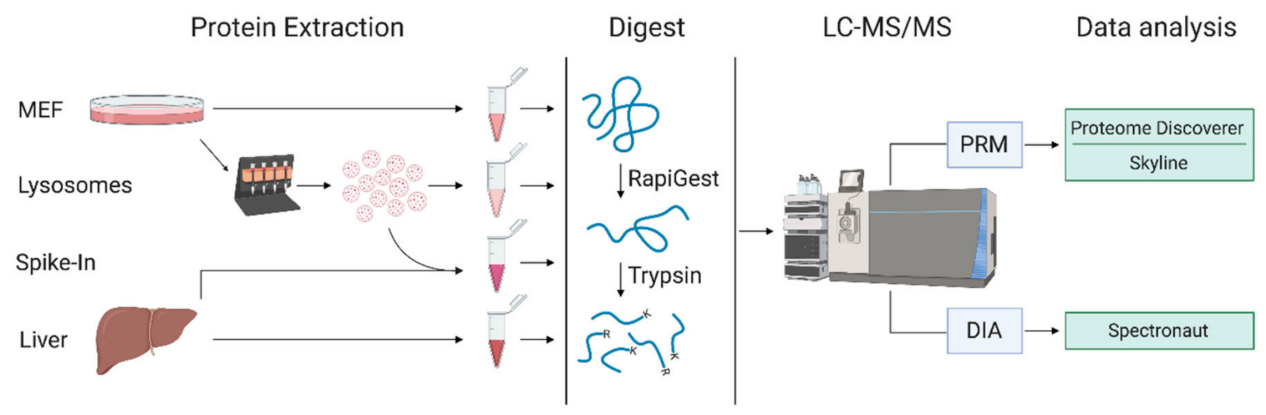
Mosen, P. et al. Proteomes. 2021.
Figure 1. Targeted Quantification of the Lysosomal Proteome in Complex Samples
Why Choose MtoZ Biolabs
☑️Advanced platforms support high-sensitivity lysosome-focused proteomics in complex matrices.
☑️Scientific expertise helps align enrichment strategy, quantitative design, and interpretation with your biology question.
☑️Custom study plans match your sample constraints, throughput needs, and downstream validation goals.
☑️High-quality data are supported by QC checkpoints and control-driven analysis logic.
☑️Customer support stays responsive from experimental planning through final delivery and follow-up.
Applications of Lysosomal Proteomics Service
1. Neuroscience and Neurodegeneration
Lysosomal proteomics helps resolve endolysosomal and autophagy-related protein changes that are often diluted in whole-cell measurements, supporting studies of protein clearance, trafficking defects, and neuronal stress.
2. Lysosomal Storage and Rare Disease Research
Profiling lysosome-enriched fractions enables direct assessment of luminal hydrolases, transporters, and accessory factors, helping connect genotype to pathway disruption and potential biomarkers.
3. Cancer Biology
Altered lysosomal trafficking, proteolysis, and nutrient adaptation can be reflected in lysosomal protein remodeling, providing mechanism-oriented evidence for tumor metabolism and therapy response studies.
4. Immunology and Infection
Lysosomes sit at the center of antigen processing and host-pathogen interactions, and lysosomal proteomics captures compartment-specific changes during immune activation or infection-driven remodeling.
5. Metabolic Disease and Organelle Stress
Shifts in lysosomal transport and degradation programs can indicate changes in nutrient sensing and cellular homeostasis, making the service useful for metabolic pathway and stress-response research.
6. Drug Discovery and Safety Assessment
The service supports MOA and liability work by tracking lysosome-associated protein changes linked to lysosomotropism, trafficking disruption, or degradation pathway perturbation.
FAQ
Q1: What types of samples are suitable?
We accept various sample types, including:
-
Cultured cells or primary cells from defined conditions
-
Fresh or frozen tissues
-
Subcellular fractions or lysosome enriched preparations when available
If you have special or limited material, we can assess feasibility and optimize a suitable workflow.
Q2: How should I prepare my samples?
1. Keep collection and handling consistent across groups and process samples cold to preserve organelle integrity
2. Avoid repeated freeze-thaw cycles, aliquot as needed, and label tubes clearly with ID, group, and replicate
3. Store samples at -80°C whenever applicable and ship on dry ice with secure packaging
4. Provide a sample sheet including organism, sample type, and your research objective so analysis can be aligned
For more information, please refer to Sample Submission Guidelines for Proteomics and Sample Submission Guidelines for Metabolomics.
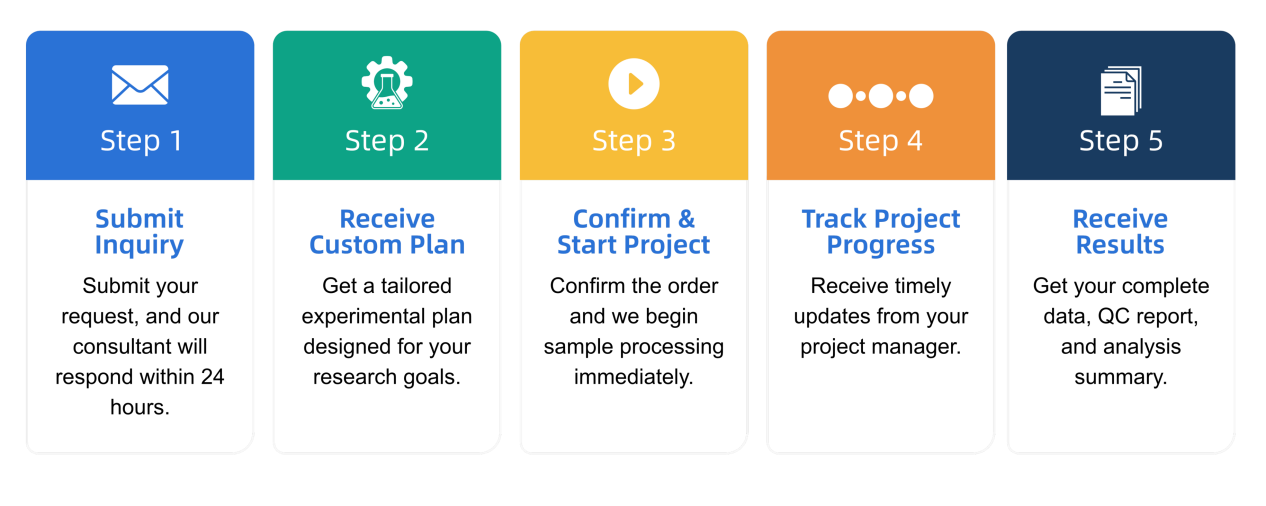
Q3: What is the service general workflow?
Q4: What data formats are provided?
1. Raw data: vendor MS raw files plus optional mzML
2. Processed tables: XLSX or CSV (protein IDs with gene symbols, peptide evidence, quantitative metrics, lysosome enrichment indicators, and comparative statistics)
3. Figures and QC: PDF plus PNG or TIFF (QC summaries, replicate correlation, PCA, volcano plots, heatmaps, and lysosome marker evaluation when applicable)
4. Report and methods: concise PDF covering workflow parameters, results summary, and interpretation notes, with instrument settings and software versions for reproducibility
Additional formats can be provided upon request to meet specific analysis or publication requirements.
Start Your Project with MtoZ Biolabs
Contact us to discuss your experimental design or request a quote. Our technical specialists are available to provide a free business assessment.
How to order?




