






What Is the AP-MS Technique?
Introduction
Protein interaction projects often start with a bait and an open question. Which proteins associate with this kinase under stimulation? Which partners change when a disease mutation is introduced? Which factors remain with a scaffold after affinity capture? Literature and vendor pages may refer to the AP-MS technique, pull-down MS, or tagged interactome workflows without clarifying what the abbreviation means or whether the method fits the current bait design.
The AP-MS technique, or affinity purification mass spectrometry, is an interaction proteomics approach that enriches a bait protein together with associated proteins and identifies the recovered material by LC-MS/MS. The technique is widely used for bait-centered discovery, but it is not interchangeable with every immunoprecipitation or pull-down experiment. This article explains what the AP-MS technique is, the research question it is built to answer, and how to judge whether it matches your bait format, controls, and validation plan before you commit to a project design.
What Research Question Does AP-MS Answer?
A practical way to understand AP-MS is to start with the question it addresses: which proteins are recovered with this bait under defined enrichment conditions? That question is narrower than mapping every physical contact in a cell. AP-MS converts bait-directed enrichment into a proteomics readout, and proteins that co-purify with the bait become candidate interaction partners. Negative controls and replicate comparison then help separate bait-specific enrichment from bead binders, tag-associated proteins, and other background.
AP-MS does not replace targeted validation. It helps generate a ranked candidate list that can guide reciprocal Co-IP, mutagenesis, proximity labeling, or functional follow-up. If your project already has one predefined partner and only needs yes-or-no confirmation, a focused Co-IP or pull-down assay may be more direct than full AP-MS discovery.
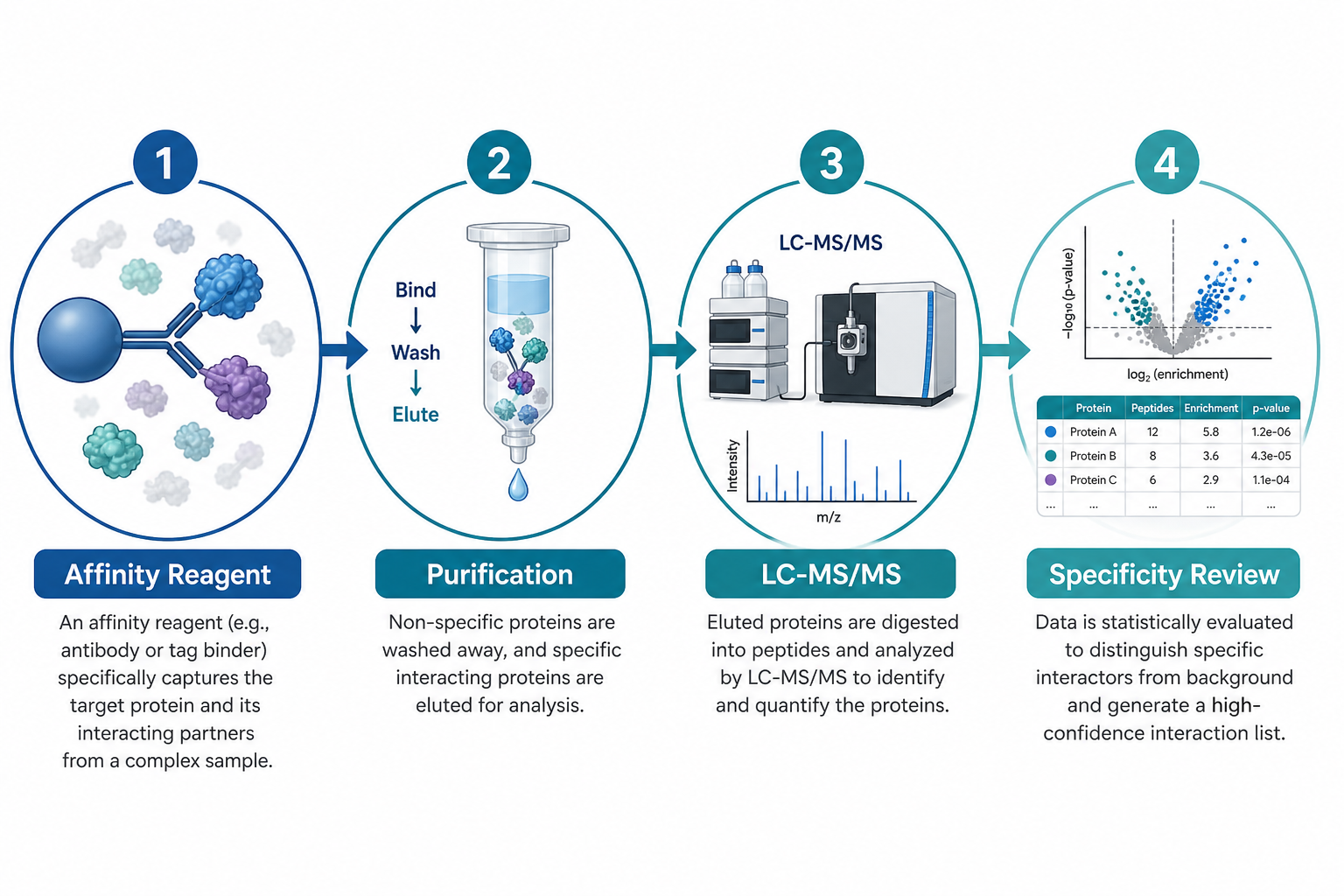
Figure 1. AP-MS links bait-directed affinity capture to LC-MS/MS identification of co-enriched proteins as candidate interactors.
How AP-MS Is Defined in Interaction Proteomics
AP-MS combines two linked steps: selective enrichment of a bait protein and mass spectrometry identification of proteins in the enriched material. The bait is usually captured through an affinity handle. Common formats include epitope-tagged recombinant proteins purified from cell lysate, immobilized fusion baits used in pull-down experiments, or related tagged-bait enrichment designs processed for MS. After binding and washing, captured proteins are eluted, digested into peptides when needed, and analyzed by LC-MS/MS. Database searching assigns peptide and protein identities, and comparison with control purifications supports candidate ranking.
The term AP-MS is often used broadly in protein interaction literature. Pull-down MS, tagged Co-IP MS, and bait purification followed by LC-MS/MS share the same core logic: enrich first, identify by MS second. What defines AP-MS as a project type is not a single bead chemistry or tag name. It is the use of affinity enrichment to concentrate bait-associated proteins before proteomics analysis.
This scope matters for service suitability. AP-MS is designed for bait-centered discovery and comparative enrichment analysis. It is not the same as whole-proteome profiling of unfractionated lysate, nor is it a structural method that maps contact surfaces directly.
What Defines the AP-MS Technique?
The AP-MS technique rests on four linked components that distinguish it from standalone Co-IP or unfractionated proteomics. The affinity reagent captures the bait through epitope tags, immobilized recombinant bait, or antibody capture of endogenous targets, and that choice determines which bait enters the experiment and which control design is required. The purification step enriches associated proteins through binding, washing, and elution, where wash stringency is a core technique parameter because it balances interaction recovery against nonspecific carryover.
The mass spectrometry step converts enriched proteins into peptide evidence by LC-MS/MS, and database searching assigns protein identities from fragment ion spectra. MS depth affects how completely the eluate is sampled. The specificity review step compares bait and control purifications to rank candidate interactors; without this contrast, the technique returns identifications but not interaction hypotheses. Weak design in any one component limits the value of the others, so the AP-MS technique is an integrated enrichment-plus-MS workflow, not a generic pull-down followed by optional MS.
What AP-MS Delivers and What It Does Not Prove
AP-MS output is typically a protein identification list from bait enrichments, often with quantitative or semi-quantitative comparison against controls. The deliverable supports hypotheses about which proteins co-enrich with the bait under the tested conditions. From a single enrichment experiment, teams can nominate many candidate partners, compare bait purifications across treatments, mutants, or time points when capture chemistry remains matched, and reduce dependence on prey-specific antibodies during the discovery phase.
Several conclusions remain outside direct AP-MS proof, however. Co-enrichment does not by itself establish direct binary binding, because indirect complex members, weakly associated proteins, and residual contaminants can appear in the same list. Tagged-bait AP-MS reflects the tagged construct and expression context used in the experiment, and results may differ from endogenous complex organization in cells or tissues. A long identification list without matched controls is difficult to interpret, because background subtraction is part of the scientific value, not an optional cleanup step. Treat AP-MS results as candidate interaction evidence until orthogonal assays support the biological claim you intend to make.
When AP-MS Is a Good Fit
AP-MS is most appropriate when the project needs bait-centered discovery rather than confirmation of one known partner alone. Researchers may consider AP-MS in the following situations:
- Tagged-bait interactome discovery when epitope tagging is acceptable and empty-tag controls can be included
- Complex or pathway neighborhood mapping when a defined bait can be enriched reproducibly and the goal is a shortlist of associated proteins
- Comparative interaction analysis across wild-type and mutant baits, drug treatments, or stimulation states under matched purification conditions
- Candidate generation before orthogonal validation when the next step includes reciprocal IP, domain mapping, or functional assays on prioritized proteins
- Systematic bait panels when multiple related constructs must be processed with comparable enrichment chemistry
In these cases, AP-MS fits because the central decision is which proteins co-enrich with the bait strongly enough to enter a validation shortlist.
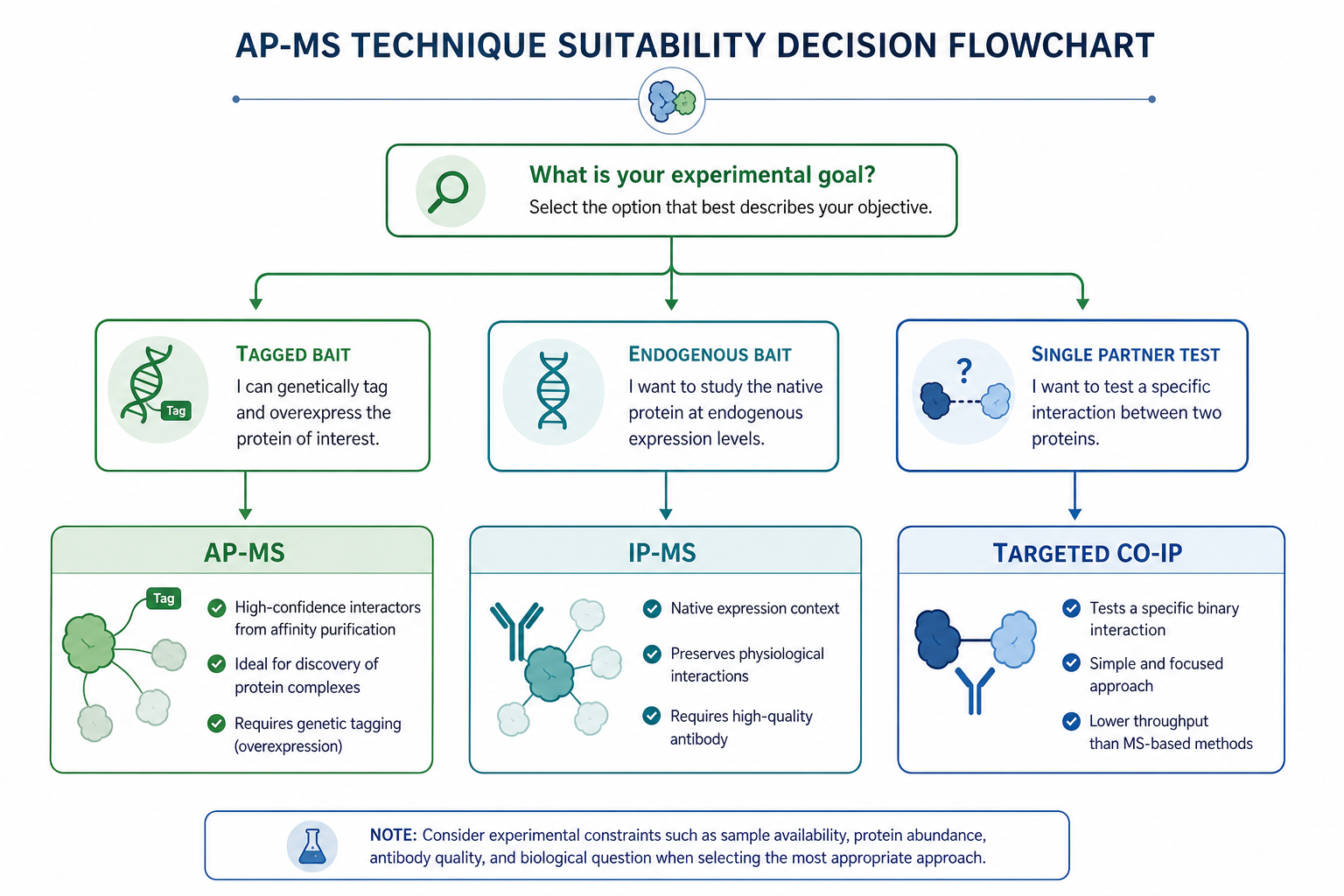
Figure 2. AP-MS suitability depends on bait format, discovery versus confirmation goals, and whether endogenous capture is required.
When AP-MS May Not Be the Right Starting Point
AP-MS is not the best entry point for every interaction question. If the bait must remain endogenous and tagging would distort biology, antibody-based IP-MS may be more appropriate when a suitable capture antibody is available. If the project goal is confirmation of one predefined partner, targeted Co-IP or pull-down validation may be faster and more interpretable than discovery-scale AP-MS.
When no negative control design is feasible, AP-MS data may be difficult to filter beyond a raw identification list. If the key interaction is highly transient and unlikely to survive planned wash conditions, AP-MS may under-recover the partners you care about unless the enrichment design is adjusted with that risk in mind. If the research question is global proteome composition rather than bait-associated proteins, unfractionated proteomics is the better starting route. These limits are not failures of the method. They define where a different workflow should be evaluated first.
How AP-MS Relates to IP-MS and Pull-Down MS
AP-MS overlaps with related interaction workflows, but the starting material and main risks differ.
|
Workflow |
Typical bait format |
Primary suitability question |
Main interpretation risk |
|---|---|---|---|
|
AP-MS |
Tagged or engineered bait |
Can I discover proteins that co-enrich with this designed bait? |
Tag effects, overexpression artifacts, empty-tag background |
|
IP-MS |
Endogenous bait via antibody |
Can I enrich the native bait and identify co-purifying proteins? |
Antibody performance, isotype background, epitope occlusion |
|
Pull-down MS |
Immobilized recombinant bait |
Can I identify proteins that bind this bait in vitro or in lysate? |
Nonspecific binders, buffer-specific artifacts |
|
Targeted Co-IP |
One or few known partners |
Can I confirm enrichment of predefined targets? |
Limited discovery scope |
The table supports early method screening. A full AP-MS versus IP-MS project comparison requires bait-specific control planning and should be treated as a separate evaluation step.
Affinity Purification-Mass Spectrometry Service
IP-MS Protein Interactomics Analysis Service
Related Services
Alternative
IP-MS Protein Interactomics Analysis Service
Use when the bait must remain endogenous and antibody capture is the preferred enrichment route.
Complementary
Co-Immunoprecipitation Protein Interaction Analysis Service
Use to validate prioritized candidates from an AP-MS shortlist with targeted interaction assays.
Next Step
Affinity Purification-Mass Spectrometry Service
Review service scope, sample expectations, and project fit after confirming that AP-MS matches the current bait design.
What to Confirm Before Requesting AP-MS Support
Before evaluating vendors or ordering constructs, confirm five project elements. Define the bait format and whether tagging is acceptable for the biological question. Plan matched negative controls such as empty-tag lines, bead-only purifications, or equivalent background models processed in parallel. State whether the project needs discovery, differential comparison, or a focused shortlist for validation.
Identify the sample types and enrichment status available now versus what still needs to be generated. Decide which orthogonal assay will test the highest-priority candidates if AP-MS returns a list rather than a single partner. Teams that can describe these elements can move from what is AP-MS to a concrete project assessment more efficiently. MtoZ Biolabs can review bait design, control strategy, and whether AP-MS or an alternative interaction workflow better matches the current study phase.
Frequently Asked Questions
1. What is the AP-MS technique?
The AP-MS technique is affinity purification mass spectrometry. A bait protein is enriched from a complex sample, associated proteins are recovered through binding and washing, and the eluate is identified by LC-MS/MS with comparison against controls.
2. What does AP-MS stand for?
AP-MS stands for affinity purification mass spectrometry. The technique enriches a bait protein and associated proteins, then identifies the recovered proteins by LC-MS/MS.
3. Is AP-MS the same as pull-down mass spectrometry?
The terms overlap in practice. Both usually mean affinity enrichment of a bait followed by MS identification of co-purifying proteins. Project suitability depends more on bait format, controls, and the interaction question than on the label used in a methods section.
4. Can AP-MS prove direct protein-protein binding?
No. AP-MS shows co-enrichment under defined capture conditions. Direct binding or in vivo relevance typically requires orthogonal validation such as reciprocal Co-IP, domain mapping, or functional testing.
5. Do I need a tagged bait for AP-MS?
Tagged-bait enrichment is the most common AP-MS format because it supports reproducible capture and empty-tag controls. Endogenous-bait projects often align more closely with IP-MS when a suitable antibody is available.
6. What should I prepare before contacting a service provider?
Prepare the bait format, sample type, planned controls, comparison groups, and the validation approach for top candidates. That information supports a meaningful suitability review before samples are submitted.
Conclusion
The AP-MS technique is an interaction proteomics method built to answer a bait-centered question: which proteins co-enrich with this bait under defined enrichment conditions? It is valuable for discovery, comparative interactome analysis, and candidate shortlist generation when controls and validation are planned from the start.
AP-MS is less appropriate when the project requires endogenous bait capture without tagging, confirmation of one predefined partner only, or interpretation without matched background controls. In those cases, IP-MS, targeted Co-IP, or a revised experimental design may be the better first step. Researchers who have defined a bait and need to judge whether AP-MS fits the current interaction question can review the Affinity Purification-Mass Spectrometry Service page or contact MtoZ Biolabs with bait format, control plan, sample status, and validation goals for a project suitability assessment.
How to order?




