






What is LC-MS vs LC-MS/MS?
Introduction
Proteomics quotes, instrument menus, and published methods often list LC-MS and LC-MS/MS side by side without explaining the difference clearly. A collaborator may request LC-MS analysis when the project actually requires peptide sequence identification. A service description may say LC-MS/MS when only precursor ion monitoring is needed. Researchers also encounter variant spellings such as LC-MS MS or LC-MSMS, which add to the confusion.
LC-MS and LC-MS/MS are related but not interchangeable terms. LC-MS couples liquid chromatography to mass spectrometry and measures precursor ion mass and intensity. LC-MS/MS adds a second mass analysis stage in which selected ions are fragmented to produce sequence-informative product ions. In proteomics, this distinction determines whether a project can identify unknown peptides, quantify known targets, or both.
This article explains what LC-MS and LC-MS/MS each mean, how they differ in measurement and reporting, and how to choose the appropriate approach for a proteomics project.
What LC-MS Means
LC-MS stands for liquid chromatography coupled to mass spectrometry. In proteomics, peptides or proteins enter the system after sample preparation and, in most workflows, enzymatic digestion.
Liquid chromatography separates peptides in time so that fewer analytes are ionized at once. The mass spectrometer then records the mass-to-charge ratio (m/z) and signal intensity of peptide ions as they elute from the column. These survey scans produce precursor ion chromatograms that show which peptides are present and how intensely they are detected.
LC-MS therefore provides a measurement of peptide mass and abundance without necessarily generating fragment ion spectra. This is sufficient for some targeted quantitation workflows in which peptide identity is already established and only intensity monitoring is required.
What LC-MS/MS Means
LC-MS/MS adds tandem mass spectrometry to the LC-MS platform. After a precursor ion is selected and isolated, the instrument fragments it in a collision cell or similar device and records the resulting product ions in a second MS stage.
The product ion pattern reflects peptide sequence structure. Database search software compares observed MS/MS spectra with predicted fragment ions from protein sequence databases and assigns peptide-spectrum matches. This fragmentation step is what enables confident peptide sequence identification in discovery proteomics, PTM localization, and biologics peptide mapping.
LC-MS/MS is therefore LC-MS plus a fragmentation and second analysis stage. The extra MS step is why the technique is also called tandem mass spectrometry or MS/MS.
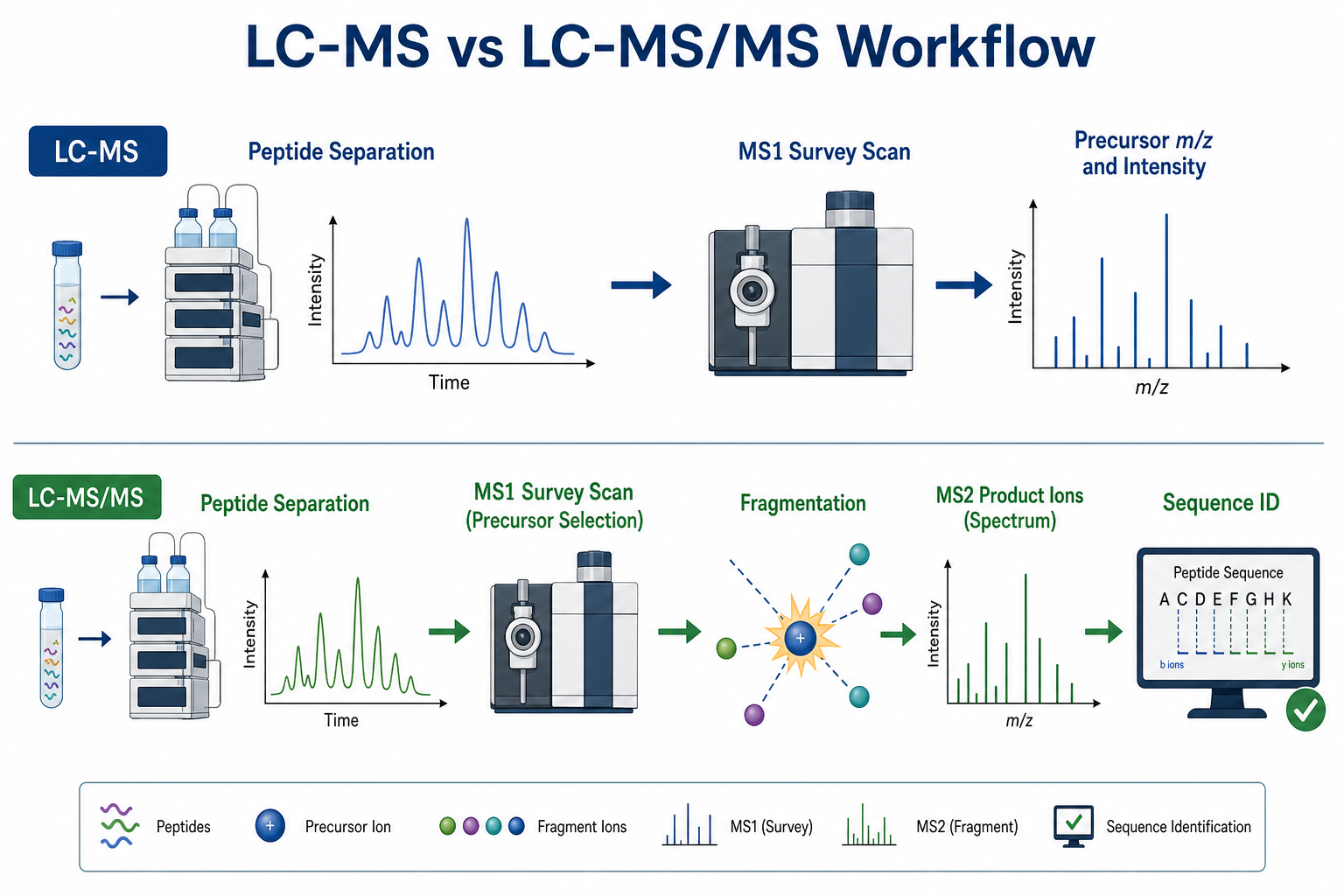
Figure 1. LC-MS measures precursor ion m/z and intensity, while LC-MS/MS adds precursor isolation, fragmentation, and product ion analysis for sequence identification.
LC-MS versus LC-MS/MS: Key Differences
The two techniques share the same chromatography and first MS stage. The difference lies in whether fragmentation is performed and how the resulting data are interpreted.
|
Feature |
LC-MS |
LC-MS/MS |
|---|---|---|
|
MS stages |
One MS measurement (MS1) |
Two MS stages (MS1 plus MS2) |
|
Main data |
Precursor m/z and intensity |
Precursor plus fragment ion spectra |
|
Sequence evidence |
Limited without fragmentation |
Strong when fragment ions are interpretable |
|
Primary proteomics use |
Targeted quantitation of known peptides |
Protein and peptide identification |
|
Typical output |
Ion chromatograms, intensity traces |
Peptide-spectrum matches, protein lists |
|
Common acquisition |
Selected ion monitoring, PRM survey |
DDA, DIA, PRM with fragmentation |
|
Project examples |
Biomarker panel monitoring |
Discovery profiling, PTM mapping, peptide mapping |
Researchers should confirm whether a project requires LC-MS/MS identification or LC-MS-based intensity measurement because the instrument setup, analysis time, and reporting format differ.
How Each Technique Measures Peptides
In LC-MS, the mass spectrometer performs repeated survey scans across the LC gradient. Each detected precursor ion is recorded with its m/z value, retention time, and intensity. Software can extract ion chromatograms for specific m/z values and compare intensities across samples for quantitation.
In LC-MS/MS, the instrument alternates between survey MS scans and fragmentation of selected precursors. In data-dependent acquisition, the most intense ions are chosen for MS/MS in each cycle. In data-independent acquisition, predefined m/z windows are fragmented systematically. In targeted PRM, only predefined peptide precursors and transitions are monitored with fragmentation.
The additional MS/MS step increases spectral complexity and data volume but provides the sequence evidence needed for protein identification and modification localization.
Related Services
Protein Identification Service
Protein Identification Service by Tandem Mass Spectrometry
Label-Free Quantitative Proteomics Service, MS Based
Teams unsure whether their project requires LC-MS or LC-MS/MS can consult MtoZ Biolabs to review sample type, reporting goal, and the acquisition mode best matched to identification or quantitation needs.
When LC-MS Alone Is Sufficient
LC-MS without routine fragmentation is appropriate when peptide identity is already confirmed and the project goal is reproducible intensity measurement.
Targeted proteomics assays that monitor a defined peptide panel by PRM or selected reaction monitoring often use LC-MS measurement of known transitions. Pharmacokinetic or biomarker follow-up studies that track previously validated peptides may require only precursor or transition intensity data. Process monitoring workflows that compare peptide signal stability across manufacturing batches may not need new identification in every run.
In these settings, LC-MS provides efficient measurement because the instrument does not spend cycle time acquiring MS/MS spectra for peptides that are already characterized.
When LC-MS/MS Is Required
LC-MS/MS is required when peptide or protein identity must be established from the data or when modification sites must be localized.
Discovery proteomics projects that profile cell lysates, tissues, or biofluids without prior knowledge of the protein content depend on MS/MS fragmentation for database searching. PTM studies that map phosphorylation, glycosylation, or other modifications require fragment ions that bracket modified residues. Biologics peptide mapping projects that confirm therapeutic protein sequence coverage rely on LC-MS/MS to assign peptides against a reference sequence. Unknown protein identification from gel bands or pull-down experiments requires tandem MS evidence to assign peptide-spectrum matches.
|
Project Goal |
Recommended Approach |
Reason |
|---|---|---|
|
Identify proteins in a complex lysate |
LC-MS/MS with DDA or DIA |
Sequence evidence required for database matching |
|
Quantify a validated peptide panel |
LC-MS or LC-MS/MS PRM |
Known targets; intensity is the primary readout |
|
Map phosphorylation sites |
LC-MS/MS after enrichment |
Fragment ions support site localization |
|
Confirm antibody peptide coverage |
LC-MS/MS peptide mapping |
Sequence assignment against reference protein |
|
Compare abundance across treatment groups |
LC-MS/MS with quantitation mode |
Identification plus intensity in one workflow |
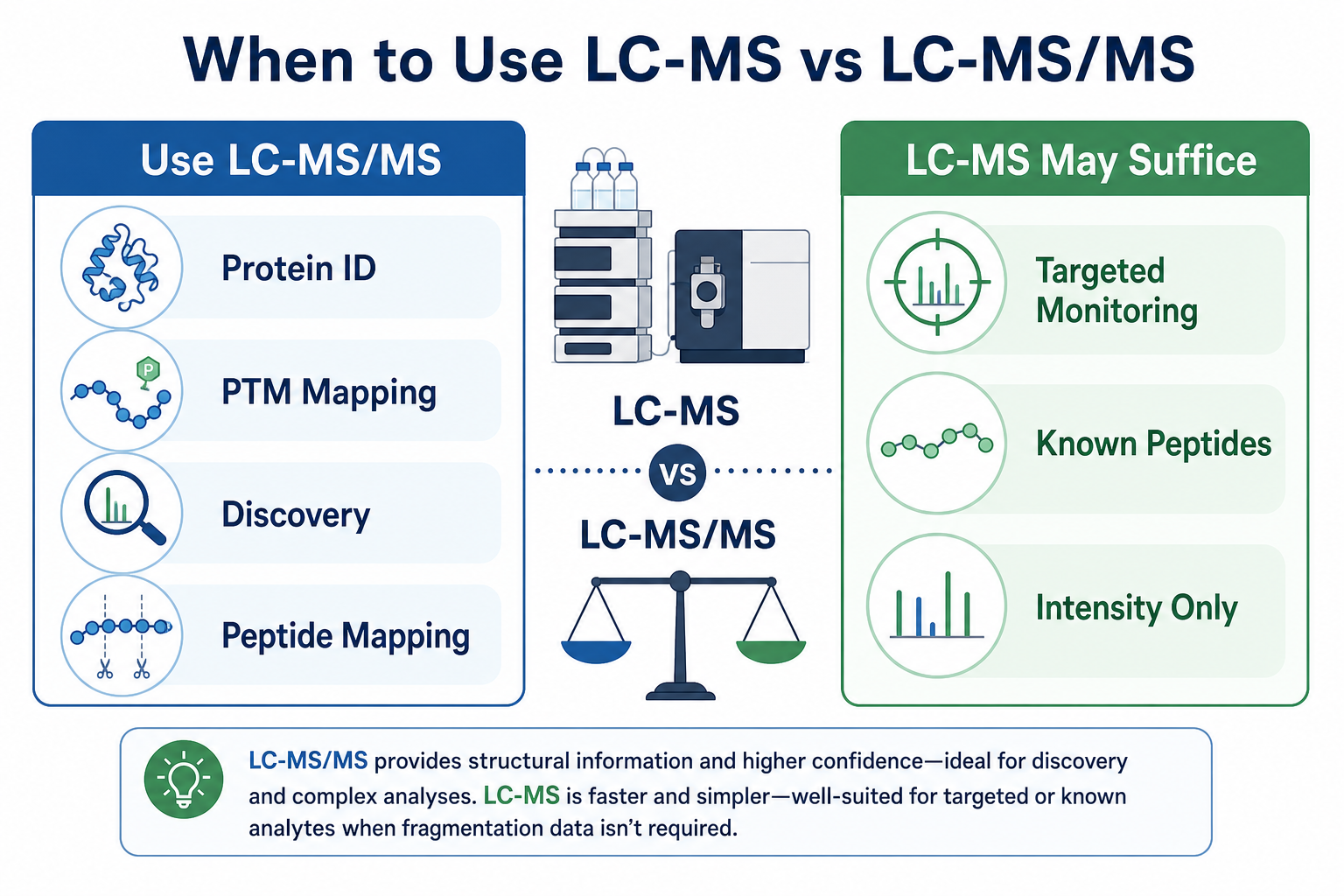
Figure 2. LC-MS/MS is required for identification, PTM mapping, and discovery projects, while LC-MS may suffice for targeted monitoring of known peptides.
Terminology Clarification
Several terms describe the same or closely related concepts, which contributes to confusion.
LC-MS refers to liquid chromatography coupled to a single-stage mass spectrometry measurement. LC-MS/MS, LC-MSMS, and LC-MS MS all refer to liquid chromatography coupled to tandem mass spectrometry. MS/MS and MS2 describe the second fragmentation and analysis stage. Tandem mass spectrometry is the general name for instruments that perform sequential mass analysis steps.
In proteomics literature, LC-MS/MS is the most common term for workflows that combine chromatographic separation with precursor measurement and fragmentation. LC-MS alone is used when referring to precursor-level measurement without emphasizing the fragmentation step.
Practical Implications for Project Planning
The LC-MS versus LC-MS/MS choice affects project scope, cost, and reporting format.
LC-MS/MS discovery experiments generate larger raw data files and require database searching, false discovery rate filtering, and protein inference steps. LC-MS targeted monitoring produces more compact datasets focused on predefined transitions. Service quotes that list LC-MS/MS usually include identification or fragmentation-based analysis, while LC-MS may indicate quantitation-only measurement.
Researchers should specify the expected deliverable when requesting proteomics analysis. A protein identification list, a PTM site table, a peptide coverage map, or a targeted panel intensity report each implies a different balance of LC-MS and MS/MS acquisition.
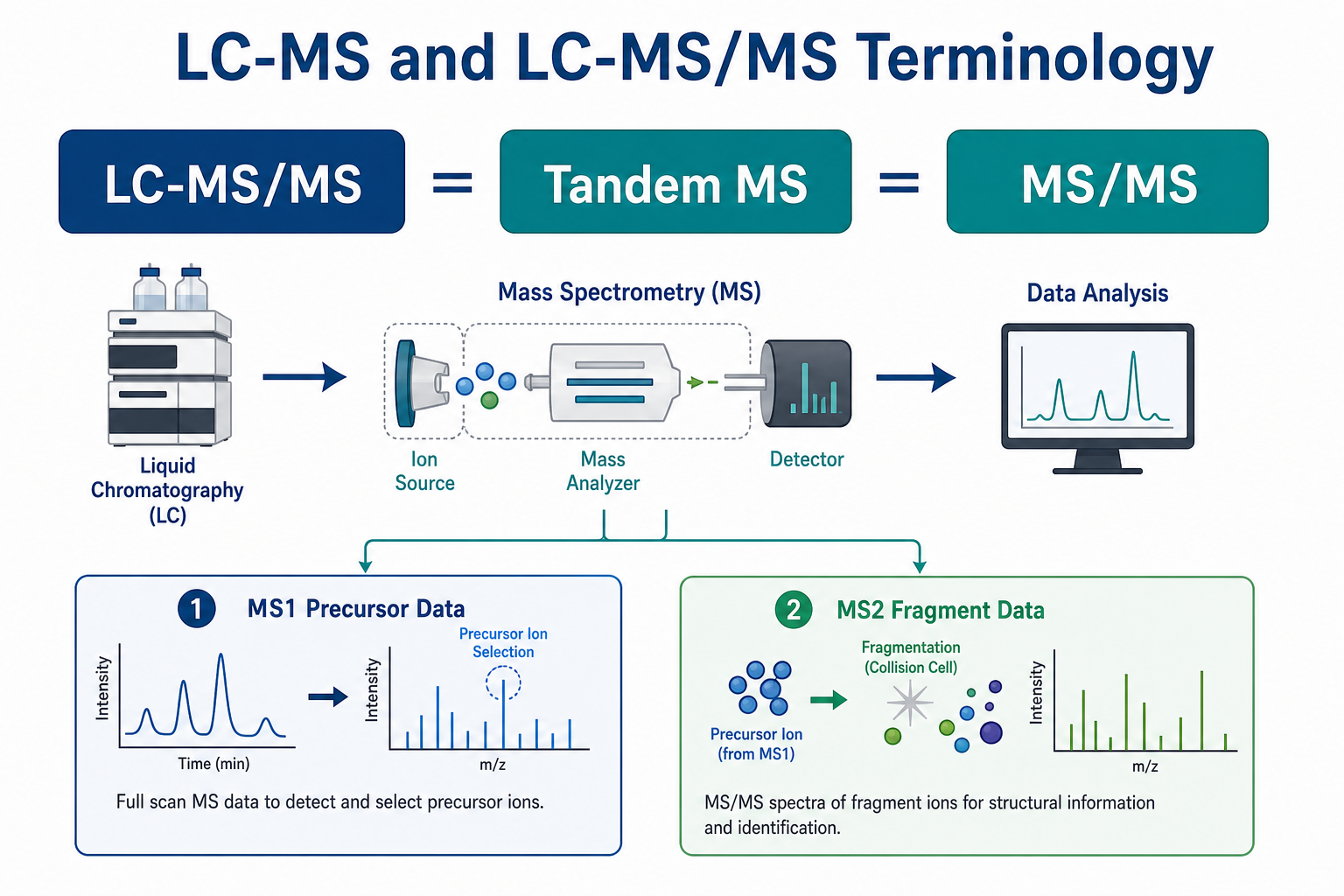
Figure 3. LC-MS and LC-MS/MS terminology maps to MS1 survey measurement, MS2 fragmentation, and different proteomics reporting outputs.
Frequently Asked Questions
1. What is the difference between LC-MS and LC-MS/MS?
LC-MS measures precursor peptide ions by mass and intensity. LC-MS/MS adds a fragmentation step that generates product ions used for peptide sequence identification.
2. Is LC-MS/MS the same as LC-MS MS or LC-MSMS?
Yes. LC-MS/MS, LC-MS MS, and LC-MSMS all refer to liquid chromatography coupled to tandem mass spectrometry with a second fragmentation stage.
3. Can LC-MS identify proteins without LC-MS/MS?
LC-MS alone provides limited sequence evidence. Most protein identification projects in proteomics require LC-MS/MS fragmentation for confident peptide assignment.
4. When is LC-MS enough for a proteomics project?
LC-MS may be sufficient when peptides are already known and the goal is targeted quantitation or monitoring of defined transitions without new identification.
5. Does LC-MS/MS also support protein quantitation?
Yes. LC-MS/MS is commonly used for both identification and quantitation. Peptide ion intensities from MS1 or fragment-level measurements support relative or absolute quantitation depending on the labeling strategy.
Conclusion
LC-MS and LC-MS/MS are closely related proteomics platforms that differ in one critical step. LC-MS measures precursor peptide ions for mass and intensity recording. LC-MS/MS adds fragmentation and product ion analysis to support sequence identification, modification mapping, and discovery-scale protein profiling. Choosing between them depends on whether the project requires new peptide identification or focused measurement of already characterized targets.
Understanding this distinction helps researchers interpret method descriptions, evaluate service proposals, and plan experiments with the correct reporting expectations. Teams planning a proteomics project can contact MtoZ Biolabs to determine whether LC-MS quantitation or LC-MS/MS identification and quantitation is the appropriate analytical path.
How to order?




