






What Is Immunoprecipitation Mass Spectrometry and When Is It Used?
Introduction
Immunoprecipitation mass spectrometry (IP-MS) captures a bait protein with an antibody, then identifies co-purifying proteins by LC-MS/MS. It fits projects that need bait-centered partner discovery or comparison around a native or endogenous bait when isotype controls and validation are planned from the start.
IP-MS is not the right first choice when you only need to confirm one known partner, when no suitable bait antibody exists, or when tagging plus empty-tag AP-MS would give cleaner control design. The sections below define what IP-MS delivers, compare it with AP-MS and targeted Co-IP, and outline when to use it versus when to choose another route.
What Immunoprecipitation Mass Spectrometry Is
Immunoprecipitation mass spectrometry, often abbreviated IP-MS, is an interaction proteomics workflow built on two linked steps. A bait protein is captured from lysate or extract with a specific antibody, associated proteins are recovered through binding and washing, and the enriched material is identified by LC-MS/MS. Proteins that co-purify with the bait become candidate interaction partners. Matched isotype or nonspecific antibody controls, replicate comparison, and enrichment ranking then help separate bait-specific recovery from antibody background and abundant lysate carryover.
IP-MS answers a bait-centered question: which proteins co-enrich with this bait when it is captured by antibody under defined IP conditions? That question is broader than confirming one predefined partner by western blot, and narrower than proving direct binary binding for every identified protein. IP-MS is most valuable when the project needs candidate nomination or comparative co-enrichment analysis around an antibody-captured bait rather than immediate proof of a single contact.
How IP-MS Differs from Co-IP and AP-MS
Three interaction workflows are often compared at project start. They share enrichment logic but differ in bait format, controls, and typical study goal.
|
Workflow |
Bait capture |
Primary control model |
Typical study goal |
|---|---|---|---|
|
IP-MS |
Antibody against endogenous or expressed bait |
Isotype or nonspecific IgG |
Discover or compare proteins co-purifying with native bait |
|
AP-MS |
Epitope tag or engineered affinity handle |
Empty-tag or equivalent |
Discover or compare proteins co-purifying with tagged bait |
|
Targeted Co-IP |
Antibody against bait |
Isotype control often used |
Confirm one or few predefined prey proteins |
Co-IP alone usually ends with targeted detection of selected prey proteins. Adding LC-MS/MS converts the experiment into an open discovery or comparative readout without requiring prey-specific antibodies for every candidate. AP-MS and IP-MS both produce identification lists, but control design and bait context differ. Empty-tag controls from tagged AP-MS workflows do not replace isotype controls in antibody IP designs.
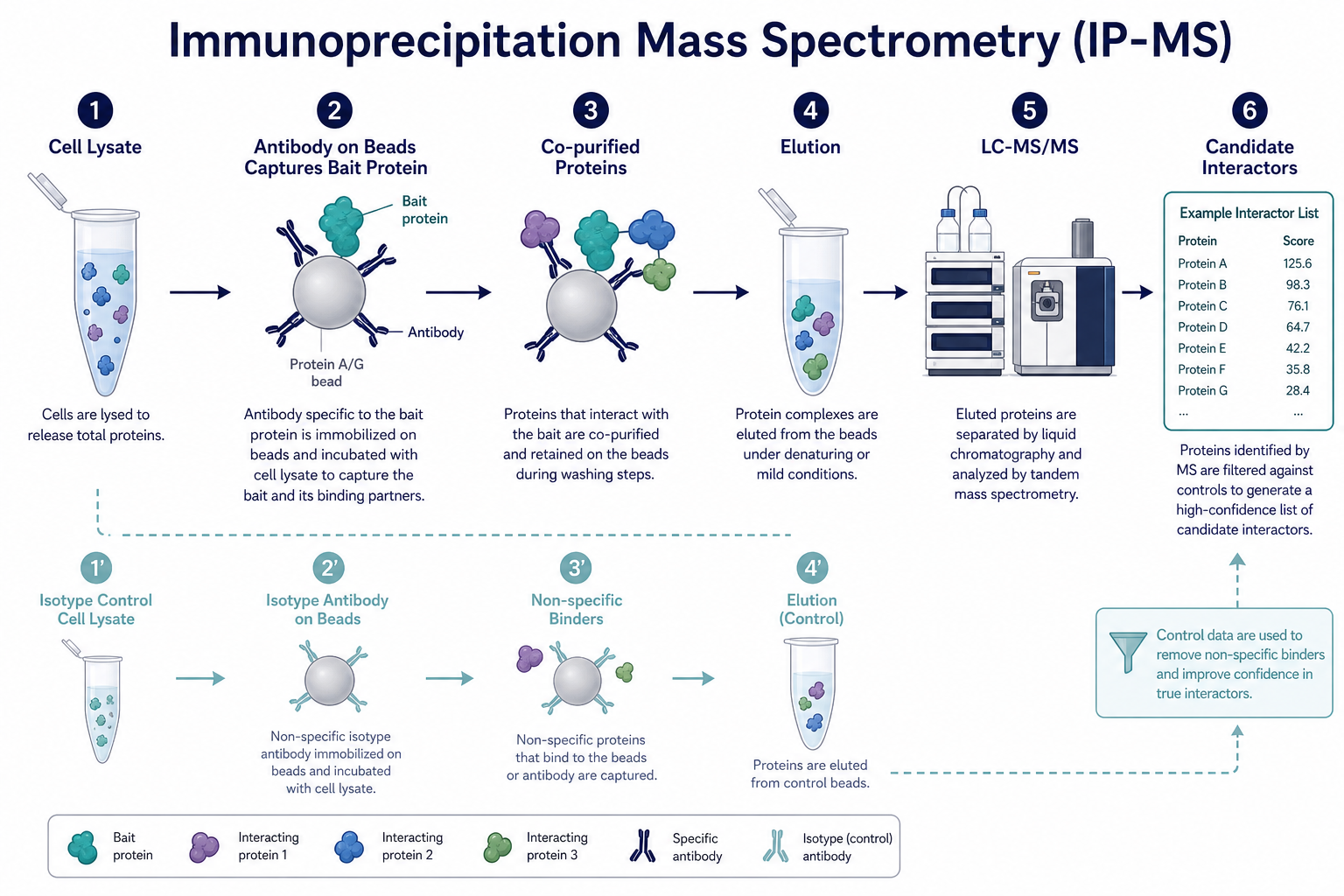
Figure 1. IP-MS links antibody capture of a bait protein to LC-MS/MS identification of co-purifying candidate interaction partners.
Core Components of an IP-MS Workflow
IP-MS project quality depends on four linked components working together rather than on MS depth alone.
Antibody capture determines which bait enters the experiment and how specifically it is enriched. Capture antibody performance, epitope accessibility under lysis conditions, and nonspecific immunoprecipitation background all affect interpretability. The purification step enriches associated proteins through binding, washing, and elution; wash stringency balances interaction recovery against lysate carryover and antibody-associated background.
LC-MS/MS converts enriched proteins into peptide evidence and assigns identities through database searching. MS sampling depth affects how completely the eluate is analyzed. The specificity review step compares bait IP with isotype or nonspecific controls to rank candidate interactors. Without that contrast, IP-MS returns identifications but not defensible interaction hypotheses. Weak design in any component limits the value of the others.
What IP-MS Delivers and What It Does Not Prove
IP-MS output is typically a protein identification list from bait immunoprecipitations, often with quantitative or semi-quantitative comparison against isotype controls. The deliverable supports hypotheses about which proteins co-purify with the bait under the tested IP conditions. From a well-controlled experiment, teams can nominate candidate partners, compare bait purifications across treatments or time points when capture chemistry remains matched, and reduce dependence on prey-specific antibodies during the discovery phase.
Several conclusions remain outside direct IP-MS proof. Co-purification does not by itself establish direct binary binding, because indirect complex members, weakly associated proteins, and residual contaminants can appear in the same list. Antibody-captured bait reflects the epitope, lysis, and wash conditions used in the experiment, and results may differ from interaction organization detected by other methods. A long identification list without matched isotype controls is difficult to interpret because background subtraction is part of the scientific value, not an optional cleanup step. Treat IP-MS results as candidate interaction evidence until orthogonal assays support the biological claim you intend to make.
When IP-MS Should Be Used
IP-MS should be used when the interaction project needs bait-centered discovery or comparative co-enrichment analysis and the bait can be captured reproducibly by antibody. Typical use cases include:
- Discovering proteins associated with an endogenous bait when tagging is unacceptable or unavailable
- Mapping interaction neighborhoods around a natively expressed bait in cell lines, primary cells, or relevant extracts when antibody performance supports enrichment
- Comparing bait-associated proteins across treatment, stimulation, or disease states under matched IP chemistry
- Generating ranked interactor shortlists before reciprocal Co-IP, domain mapping, or functional follow-up
- Studying baits where antibody IP is already validated for enrichment even if prey space is still unknown
In these contexts, IP-MS is appropriate because the scientific output is a filtered candidate set from native bait capture rather than a final binding proof.
When IP-MS Should Not Be the First Choice
Several project designs are poorly served by starting with IP-MS. If the only goal is to confirm one known prey protein, targeted Co-IP with western blot or an equivalent readout is usually faster and easier to interpret than discovery-scale IP-MS. If no suitable bait antibody exists or epitope access is poor under required lysis conditions, IP-MS feasibility is weak until capture performance is validated.
When tagging is acceptable and empty-tag controls are feasible, tagged AP-MS may offer more reproducible control design for systematic discovery panels. When no isotype or nonspecific control can be processed in parallel, IP-MS data may remain a raw identification list with limited specificity value. If the project requires direct binding proof for publication or mechanism figures, discovery IP-MS can precede those claims but cannot replace validation. If the key interaction is highly transient and unlikely to survive planned wash conditions, IP-MS may under-recover the partners of interest unless enrichment design is adjusted with that risk in mind.
IP-MS Versus AP-MS and Targeted Co-IP at Project Start
Method routing should follow bait format and study goal rather than literature habit alone.
|
Study situation |
Better first route |
Why |
|---|---|---|
|
Endogenous bait, validated capture antibody |
IP-MS |
Native bait context without required tagging |
|
Tagged bait, empty-tag control feasible |
AP-MS |
Reproducible tag-system control design |
|
One known partner to confirm |
Targeted Co-IP |
Direct yes-or-no enrichment test |
|
Treatment remodeling around native bait |
IP-MS with matched isotype controls |
Condition contrast with antibody capture |
|
Multi-bait tagged panel in same system |
AP-MS |
Matched tag and control framework across baits |
The comparison supports early suitability screening. Bait-specific antibody validation and control planning still require a separate technical review before samples are generated.
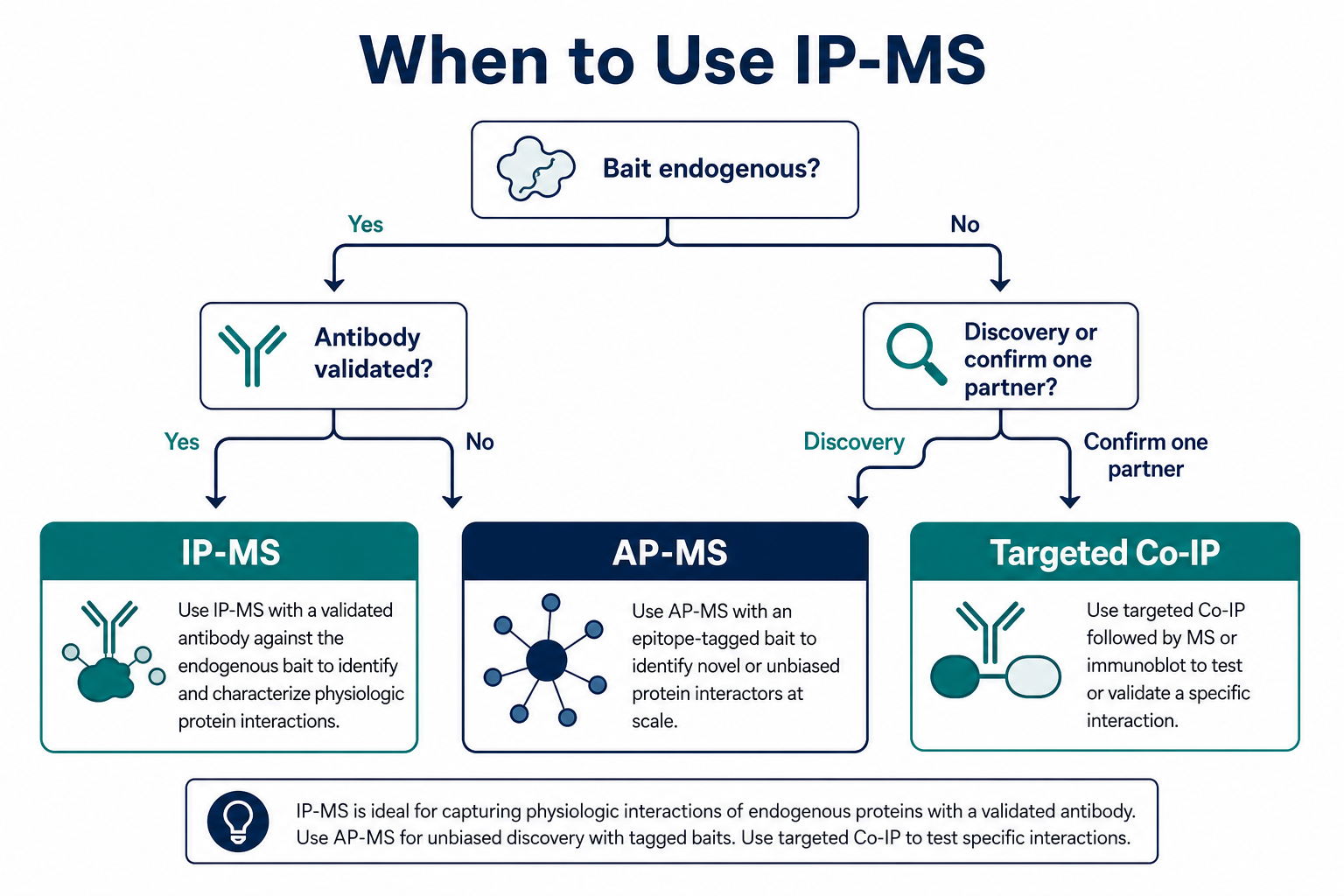
Figure 2. IP-MS suitability depends on bait format, antibody capture feasibility, control design, and whether the project needs discovery or confirmation.
Where IP-MS Fits in an Interaction Project Timeline
IP-MS is often most useful at the discovery or comparison stage of a protein interaction program. In early discovery, it generates a bait-centered candidate list from antibody capture of the native or expressed bait. In mid-stage comparison, it supports treatment, stimulation, or time-point contrasts when IP chemistry remains matched across arms. In later validation, prioritized candidates move to reciprocal Co-IP, domain mapping, pairwise binding assays, or functional readouts.
Teams get the most value when they decide upfront whether the current phase needs discovery, comparison, or confirmation. Using IP-MS where confirmation of one partner is the only goal often adds cost and interpretation complexity without improving the answer.
What to Confirm Before Requesting IP-MS Support
Before evaluating vendors or ordering experiments, confirm five project elements. Define whether the bait is endogenous or expressed and whether antibody capture is validated for enrichment under the planned lysis conditions. Plan matched isotype or nonspecific IgG controls processed in parallel with bait IP samples. State whether the project needs discovery, differential comparison, or a focused shortlist for validation.
Identify sample types and whether lysates, enriched eluates, or full workflow support is required. Decide which orthogonal assay will test the highest-priority candidates if IP-MS returns a list rather than a single partner. Teams that can describe these elements can move from what is IP-MS to a concrete project assessment more efficiently. MtoZ Biolabs can review bait context, antibody control strategy, and whether IP-MS or an alternative interaction workflow better matches the current study phase.
Frequently Asked Questions
1. What is immunoprecipitation mass spectrometry?
Immunoprecipitation mass spectrometry, or IP-MS, is a workflow in which a bait protein is captured by antibody immunoprecipitation, co-purifying proteins are recovered through binding and washing, and the eluate is identified by LC-MS/MS with comparison against matched controls.
2. Is IP-MS the same as Co-IP?
Co-IP refers to antibody capture of a bait and associated proteins. IP-MS adds LC-MS/MS identification of co-purifying proteins rather than targeted detection of predefined prey proteins alone.
3. When should I choose IP-MS over AP-MS?
Choose IP-MS when endogenous or native bait capture by antibody is required and tagging is unacceptable or unavailable. Choose AP-MS when tagged-bait enrichment with empty-tag controls is feasible and preferred for the project design.
4. Can IP-MS prove direct protein-protein binding?
No. IP-MS shows co-enrichment under defined IP conditions. Direct binding or in vivo relevance typically requires orthogonal validation such as reciprocal Co-IP, domain mapping, or functional testing.
5. What controls are required for IP-MS?
Isotype matched or nonspecific IgG controls processed in parallel with bait IP samples are the standard background model for antibody capture IP-MS.
6. What should I prepare before contacting a service provider?
Prepare bait context, capture antibody information, planned isotype controls, sample type, comparison groups, and the validation approach for top candidates.
Related Services
IP-MS Protein Interactomics Analysis Service
Review IP-MS scope, isotype control requirements, and project fit when antibody capture of a native bait is the planned route.
Affinity Purification-Mass Spectrometry Service
Use when tagged-bait enrichment with empty-tag controls fits better than endogenous antibody IP-MS.
Co-Immunoprecipitation Protein Interaction Analysis Service
Follow IP-MS candidate nomination with targeted co-enrichment assays on selected partners.
Conclusion
Immunoprecipitation mass spectrometry is an interaction proteomics method built to answer a bait-centered question: which proteins co-purify with this antibody-captured bait under defined IP conditions? It is valuable for discovery, comparative interactome analysis, and candidate shortlist generation around endogenous or natively expressed baits when isotype controls and validation are planned from the start.
IP-MS is less appropriate when no suitable bait antibody exists, when confirmation of one predefined partner only is the goal, or when interpretation must proceed without matched control immunoprecipitations. In those cases, targeted Co-IP, tagged AP-MS, or a revised experimental design may be the better first step. Researchers who have defined a bait and need to judge whether immunoprecipitation mass spectrometry fits the current interaction question can review the IP-MS Protein Interactomics Analysis Service page or contact MtoZ Biolabs with bait context, antibody plan, control design, and validation goals for a project suitability assessment.
How to order?




