






What Is AP-MS and When Should It Be Used for Protein Interaction Studies?
Introduction
Protein interaction studies begin with different goals. One team needs to confirm binding between two defined proteins. Another needs to discover partners around a kinase. A third needs to compare interaction neighborhoods before and after drug treatment. All three may encounter AP-MS in literature, yet only some should start there.
AP-MS, or affinity purification mass spectrometry, is a bait-centered interaction proteomics workflow. A bait protein is enriched from lysate or extract, associated proteins are recovered through binding and washing, and the eluate is identified by LC-MS/MS with comparison against controls. For protein interaction studies, the method is most valuable when the project needs candidate nomination or comparative co-enrichment analysis rather than immediate proof of a single binary contact.
This article explains what AP-MS is in a PPI context and when it should be used for protein interaction studies based on study type, bait format, and validation requirements.
What AP-MS Is in Protein Interaction Research
In protein interaction studies, AP-MS answers a bait-centered question: which proteins co-enrich with this bait under defined capture conditions? The workflow links affinity enrichment to proteomics identification. Proteins recovered with the bait become candidate interaction partners, and negative controls, replicate comparison, and enrichment ranking then separate bait-specific recoveries from bead binders, tag-associated proteins, and abundant background.
AP-MS is not a universal PPI method. It is an interaction discovery and comparison tool that produces candidate evidence. Direct binding, in vivo relevance, and functional coupling require additional assays in most protein interaction programs.
PPI Study Types and Method Routing
Protein interaction studies differ by the claim they must support, and method choice should follow that claim:
- Discovery studies aim to identify candidate partners around a bait; AP-MS is commonly used here when tagging is acceptable and controls can be included
- Confirmation studies aim to test one or a few predefined partners, where targeted Co-IP or pull-down assays are often more direct than AP-MS discovery
- Comparative studies aim to detect partner changes across mutants, treatments, or time points; AP-MS fits when purifications are matched and quantitative contrast is planned
- Complex mapping studies aim to survey components associated with a tagged subunit or scaffold; AP-MS can nominate components but does not by itself define stable complex architecture
- Mechanistic studies aim to support binding mechanism or functional coupling claims; AP-MS may generate a shortlist, but orthogonal validation is usually required before strong PPI claims are made
Routing a PPI project to the wrong study category is one of the most common reasons AP-MS is chosen too early or too late.
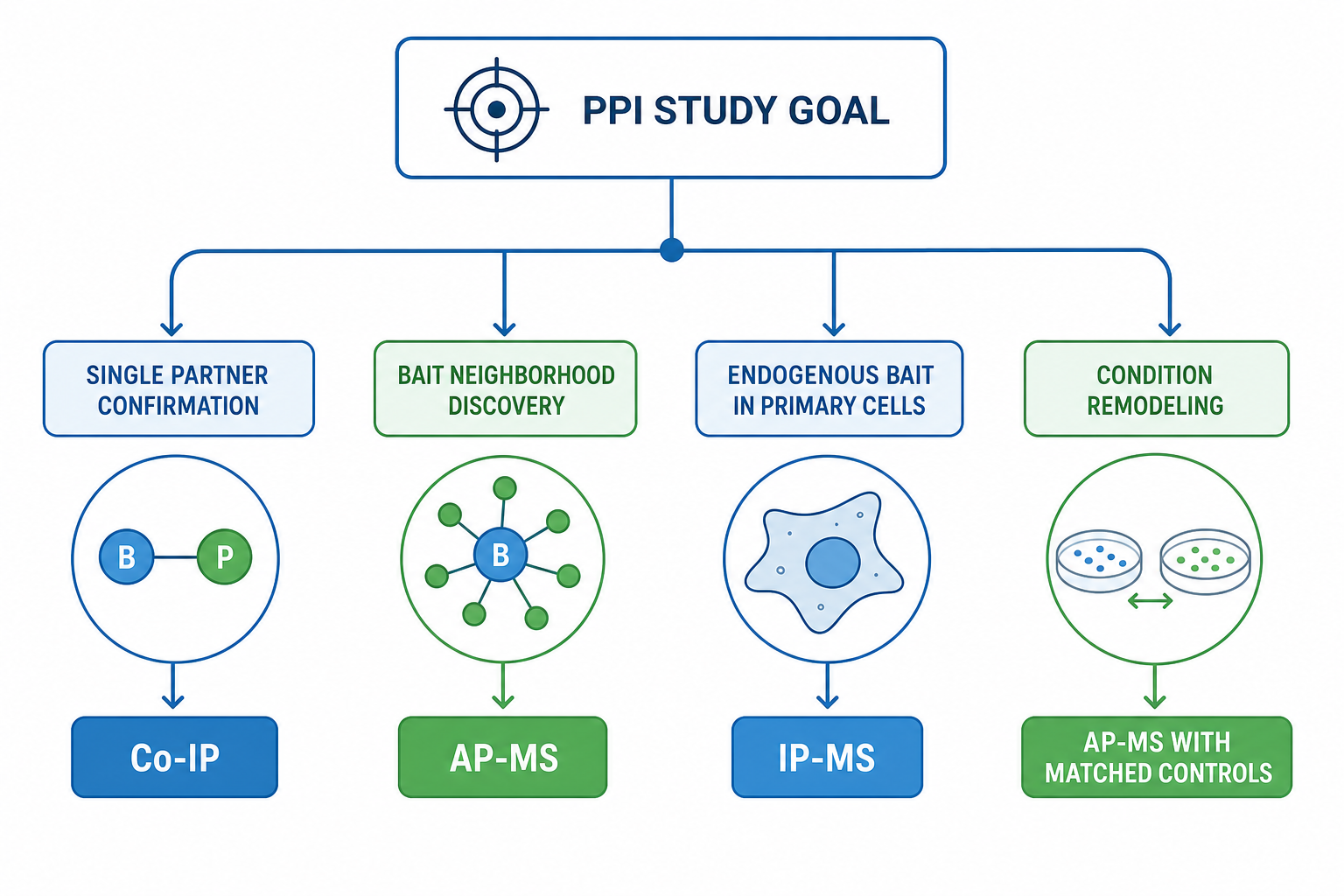
Figure 1. AP-MS fits many PPI discovery and comparison goals but is often not the first choice for single-partner confirmation or endogenous bait studies without a suitable alternative design.
When AP-MS Should Be Used for Protein Interaction Studies
AP-MS should be used when the PPI study needs bait-centered candidate discovery or comparative co-enrichment analysis and the experimental design can support control-based interpretation. Typical use cases include:
- Discovering proteins associated with a tagged bait when empty-tag or equivalent controls are feasible
- Comparing wild-type and mutant bait purifications under matched expression and purification chemistry
- Measuring stimulus, inhibitor, or compound treatment effects on bait-associated proteins across matched arms
- Building ranked interactor shortlists before reciprocal Co-IP, domain mapping, or functional follow-up
- Running pathway panels where multiple related baits must be processed with comparable enrichment design
In these PPI contexts, AP-MS is appropriate because the scientific output is a filtered candidate set rather than a final binding proof.
When AP-MS Should Not Be the First Choice
Several protein interaction study designs are poorly served by starting with AP-MS. If the only goal is to confirm one known prey protein, targeted Co-IP or pull-down validation is usually faster and easier to interpret. If the bait must remain endogenous in primary cells or tissue and tagging would distort the PPI question, IP-MS may be more appropriate when a suitable capture antibody exists.
When no negative control design is feasible, the result may remain a raw identification list with limited PPI value. If the project requires direct binding proof for publication or mechanism figures, discovery AP-MS can precede those claims but cannot replace validation. If the key PPI is highly transient and unlikely to survive the planned wash conditions, the enrichment strategy must be intentionally designed for that interaction class. These are routing decisions, not judgments about AP-MS quality. The method is strong in the right PPI context and inefficient in the wrong one.
AP-MS Versus IP-MS and Co-IP in PPI Studies
Protein interaction studies often narrow to three practical routes. AP-MS uses tagged or engineered bait enrichment plus LC-MS/MS identification and is strongest for systematic discovery and matched comparative PPI designs. IP-MS uses antibody capture of an endogenous or expressed bait plus LC-MS/MS identification and is strongest when native bait context matters and antibody performance supports enrichment. Targeted Co-IP uses antibody capture with one or a few predefined readouts and is strongest for confirmation rather than broad discovery.
|
PPI study goal |
Best first route |
Why |
|---|---|---|
|
Tagged bait partner discovery |
AP-MS |
MS readout without prey-specific antibodies |
|
Endogenous bait in native context |
IP-MS |
Antibody capture without required tagging |
|
Confirm one known partner |
Targeted Co-IP |
Direct yes-or-no enrichment test |
|
Mutant-dependent partner loss |
AP-MS with matched baits |
Comparative co-enrichment |
|
Treatment-induced PPI remodeling |
AP-MS with matched arms |
Condition contrast across purifications |
The comparison supports PPI method routing at project start. Detailed bait-specific planning still requires control design review.
Affinity Purification-Mass Spectrometry Service
IP-MS Protein Interactomics Analysis Service
Where AP-MS Fits in a PPI Project Timeline
AP-MS is often most useful at the discovery or comparison stage of a protein interaction program. In early discovery, it generates a bait-centered candidate list from complex lysate or extract. In mid-stage comparison, it supports mutant, treatment, or time-point contrasts when capture chemistry remains matched. In later validation, prioritized candidates move to reciprocal Co-IP, domain mapping, pairwise binding assays, or functional readouts.
Teams get the most value when they decide upfront whether the current PPI phase needs discovery, comparison, or confirmation. Using AP-MS where confirmation is the only goal often adds cost and interpretation complexity without improving the answer.
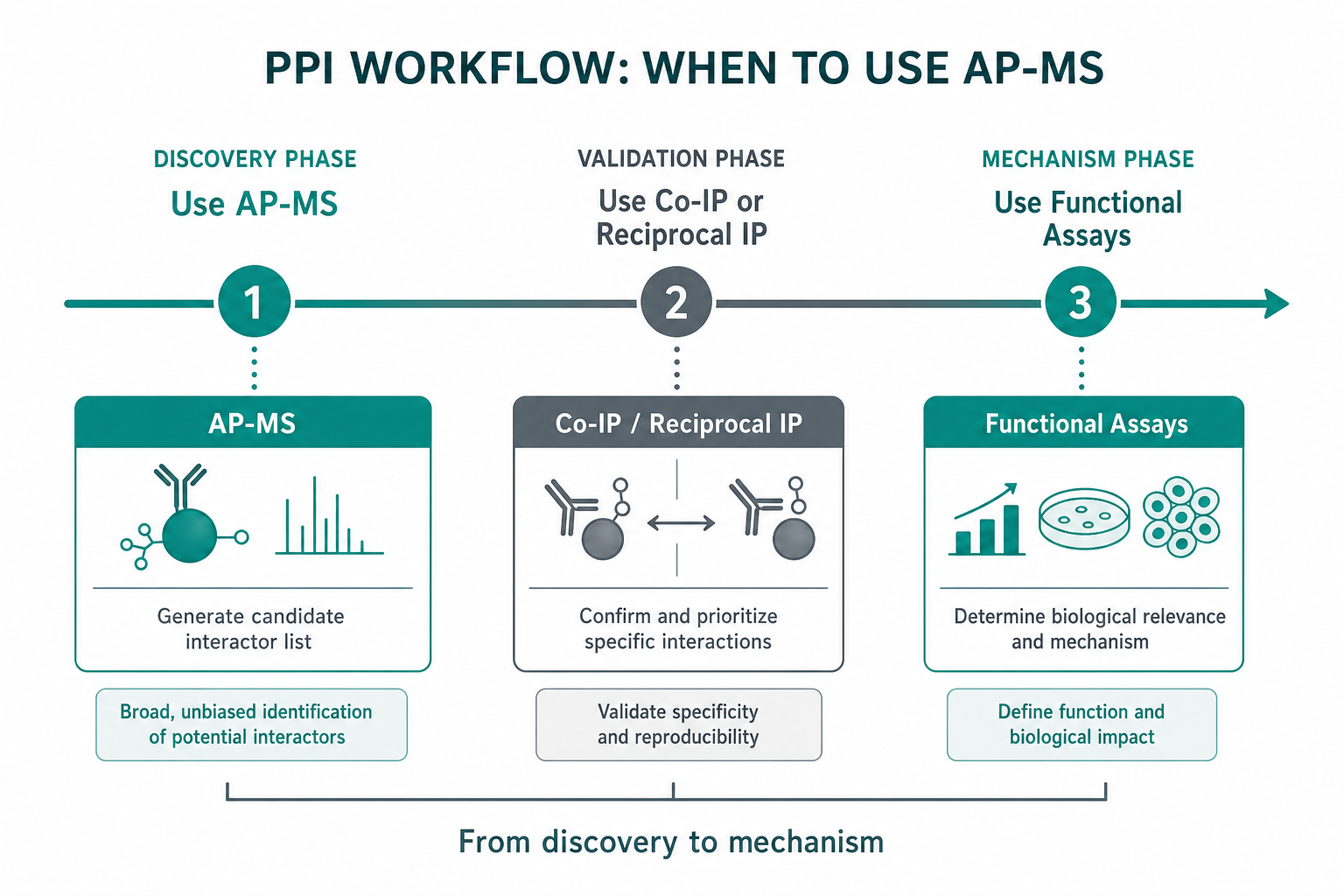
Figure 2. AP-MS is commonly used for PPI discovery and comparison, while confirmation and mechanism claims usually require later validation steps.
Related Services
Alternative
IP-MS Protein Interactomics Analysis Service
Use for endogenous bait protein interaction studies when antibody capture is preferred over tagged AP-MS.
Complementary
Co-Immunoprecipitation Protein Interaction Analysis Service
Use after AP-MS candidate nomination to confirm selected PPIs with targeted interaction assays.
Next Step
Affinity Purification-Mass Spectrometry Service
Review AP-MS scope when PPI discovery or comparative interactome analysis is the current study phase.
Questions to Ask Before Choosing AP-MS for a PPI Study
Four questions clarify whether AP-MS should be used now. Does the PPI study need discovery, comparison, or confirmation? Is tagged bait acceptable, or must the bait remain endogenous? Can matched negative controls be processed in parallel with the bait purifications? What validation assay will test the highest-priority candidates if AP-MS returns a list?
If the answer to the first question is confirmation alone, AP-MS is usually not the best first step. If the answer to the third question is no, AP-MS data may be difficult to interpret as PPI evidence. MtoZ Biolabs can review PPI study goals and recommend whether AP-MS, IP-MS, or targeted Co-IP better matches the current phase.
Frequently Asked Questions
1. What is AP-MS in protein interaction studies?
AP-MS is affinity purification mass spectrometry used to enrich a bait protein and identify co-purifying proteins by LC-MS/MS. In PPI research, it supports candidate discovery and comparative co-enrichment analysis.
2. When should AP-MS be used for PPI discovery?
Use AP-MS when you need to identify proteins associated with a bait, can include matched controls, and plan to validate selected candidates with orthogonal PPI assays.
3. Is AP-MS enough to prove a protein-protein interaction?
No. AP-MS supports candidate nomination and comparative enrichment claims. Direct PPI proof usually requires reciprocal Co-IP, binding assays, or other validation.
4. Should I choose AP-MS or IP-MS for my PPI project?
AP-MS fits tagged-bait discovery or systematic comparative designs. IP-MS is the better route when endogenous bait capture is required and a suitable antibody is available.
5. Can AP-MS compare PPI changes after drug treatment?
Yes, when bait recovery and purification chemistry are matched across treatment and control arms and quantitative contrast is planned from the start.
Conclusion
AP-MS is a bait-centered interaction proteomics method that identifies proteins co-enriched with a defined bait under controlled capture conditions. For protein interaction studies, it should be used when the project needs discovery or comparative PPI analysis and can support control-based interpretation.
AP-MS should not be the default first step for single-partner confirmation, endogenous bait studies without a viable tagging strategy, or projects that require direct binding proof without follow-up validation. Matching the PPI study type to AP-MS, IP-MS, or targeted Co-IP improves both efficiency and interpretability. Researchers planning protein interaction studies can review the Affinity Purification-Mass Spectrometry Service page or contact MtoZ Biolabs with bait format, PPI goal, and validation plans for a suitability assessment.
How to order?




