






Understanding AP MS: A Comprehensive Guide
Introduction
Researchers encounter AP-MS long before they feel confident interpreting it. A collaborator shares an interactor spreadsheet. A paper reports bait-centered enrichment with dozens of associated proteins. A service proposal mentions LC-MS/MS identification of co-purifying partners. The method name is familiar, yet the evidence type is easy to misread.
Understanding AP-MS means understanding what kind of data the method produces and which conclusions those data can support. Affinity purification mass spectrometry does not return a validated interaction network. It returns bait-centered co-enrichment evidence that must be filtered against controls, reviewed for replicate support, and matched to an appropriate validation plan. This guide explains how to read AP-MS results responsibly, where interpretation limits appear, and how to decide what to validate next.
What Type of Evidence AP-MS Actually Produces
AP-MS identifies proteins recovered with a bait after affinity enrichment and LC-MS/MS analysis. The core evidence unit is co-enrichment under defined capture conditions, not confirmed binding. At the identification level, AP-MS shows that peptide evidence for a prey protein was detected in a bait purification sample. At the comparative level, it shows that a prey protein is enriched relative to a negative control, a related bait, or another experimental condition when quantitative analysis is available. At the hypothesis level, it supports a candidate interaction model that still requires orthogonal testing before stronger claims are made.
These levels are not interchangeable. Detecting a protein in one bait sample is weaker evidence than reproducible enrichment against matched controls, and enrichment against controls is still weaker evidence than direct binding confirmation by reciprocal Co-IP, domain mapping, or a pairwise binding assay. Understanding AP-MS starts with keeping those evidence levels separate in project discussions and figure captions.
How Enrichment Logic Shapes Interpretation
AP-MS results reflect the bait, the capture chemistry, and the comparison design used to generate them. Four factors shape how the data should be read:
- Bait format determines which protein enters the experiment; tagged constructs, endogenous antibody capture, and immobilized recombinant baits each create different interpretation contexts, and a prey enriched with an overexpressed tagged bait may not behave the same way around the endogenous protein
- Wash and lysis conditions determine which associations survive purification; mild conditions retain more candidates and more background, while stringent conditions improve specificity but can remove weak or transient partners, so a missing protein may reflect dissociation during washing rather than biological absence
- Control design determines whether enrichment is bait-specific; empty-tag lines, bead-only purifications, isotype controls, and unrelated baits each define a different background model, and without that contrast abundant contaminants can be mistaken for interactors
- Comparison structure determines whether differential claims are possible; treatment, mutant, and time-point contrasts require matched capture chemistry across all arms, and technical differences in bait recovery can create false differential edges
Understanding AP-MS therefore means reading the result in light of the enrichment experiment that created it, not treating the protein list as a context-free interaction map.
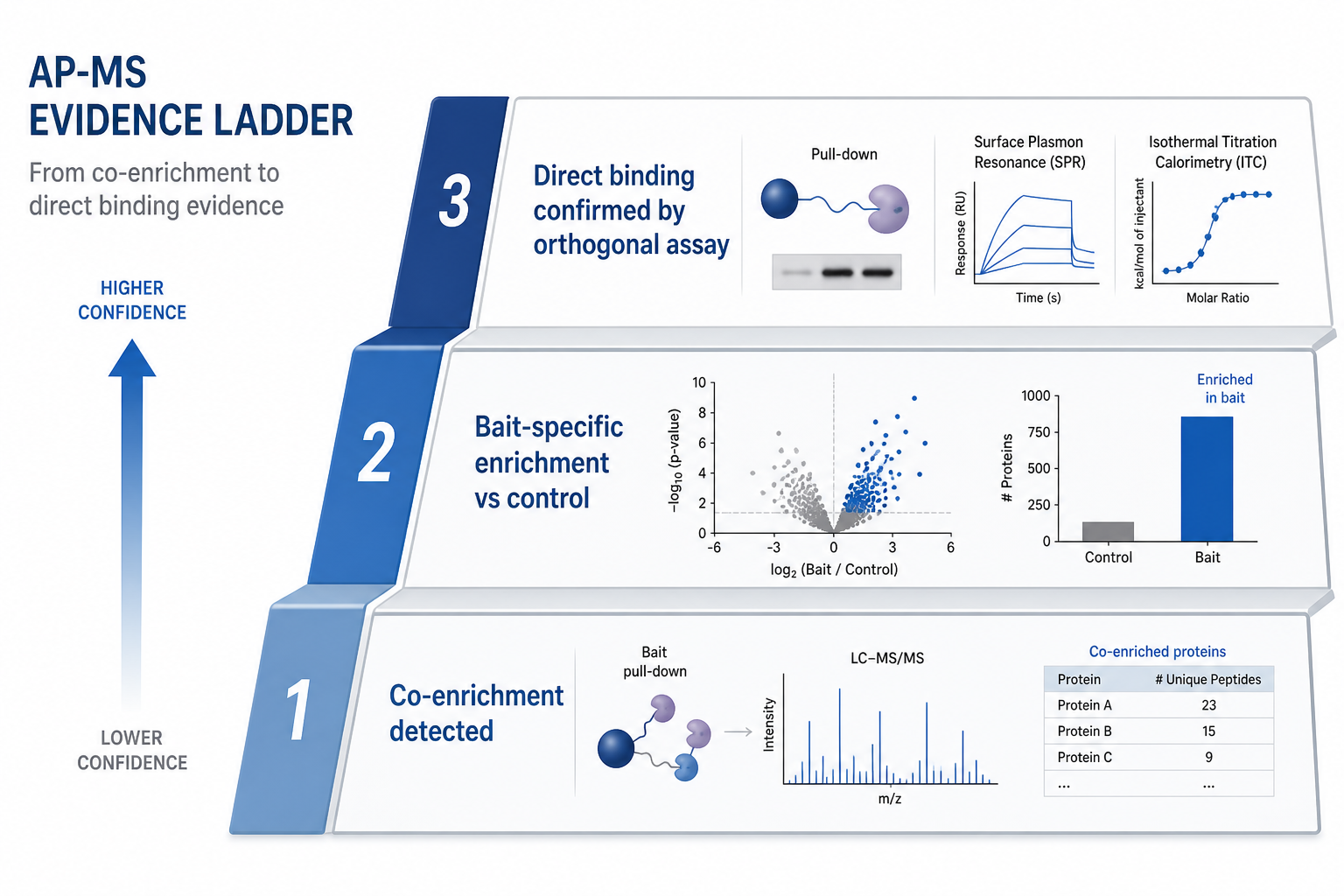
Figure 1. AP-MS supports co-enrichment detection first, bait-specific enrichment with controls second, and direct binding claims only after orthogonal validation.
Reading an AP-MS Dataset: What to Review First
Before building biological narratives from an AP-MS table, review five dataset elements. Check bait recovery across all samples in the comparison, because low or uneven bait enrichment weakens every prey-level conclusion tied to that purification. Check which controls were processed in parallel, since the control type defines what specificity claim is possible. An empty-tag control supports different filtering logic than a bead-only control or an unrelated bait.
Check whether replicates exist for bait and control arms, because reproducible prey recovery across replicates is one of the strongest practical filters against sporadic background. Check whether quantitative contrast was used: presence in the bait sample alone is not equivalent to enrichment relative to control, and fold change, statistical scoring, or equivalent ranking methods change which candidates are defensible. Check how contaminants were handled, because literature-curated background lists and project-specific control distributions both matter, and a protein can be identified in AP-MS without being a meaningful interactor candidate. These review steps convert a raw identification list into an interpretable AP-MS dataset.
Claim Types AP-MS Can and Cannot Support
Different statements require different evidence strength. AP-MS is often sufficient for discovery-stage claims and insufficient for mechanistic or contact-level claims without follow-up.
|
Claim type |
Typical AP-MS support |
Common overreach |
|---|---|---|
|
Protein detected in bait eluate |
Supported at identification level |
Calling every detection an interactor |
|
Bait-specific enrichment vs control |
Supported when controls and replicates are matched |
Ignoring empty-tag or bead background |
|
Condition-dependent co-enrichment |
Supported with matched purifications across arms |
Treating technical recovery differences as biology |
|
Direct binary binding |
Not supported without orthogonal assay |
Labeling all co-enriched proteins as direct binders |
|
Functional coupling in cells |
Not supported by AP-MS alone |
Inferring pathway activity from one bait list |
|
Stable complex membership |
Partially supported under native-like enrichment |
Equating one purification with permanent complex identity |
The table is a claim filter, not a workflow checklist. The same AP-MS dataset may support a discovery shortlist while remaining insufficient for a binding mechanism figure.
Misinterpretation Risks Specific to AP-MS
Several errors appear repeatedly when teams first interpret AP-MS data. Treating every identified protein as a validated interactor ignores control contrast and replicate support. Equating co-enrichment with direct binding overlooks indirect complex members and copurifying contaminants that survive washing. Assuming AP-MS maps in vivo contact sites conflates enrichment recovery with spatial or structural interaction evidence.
Using one bait list to support broad pathway remodeling overstates what a bait-centered experiment can show without condition contrasts or functional readouts. Dismissing the entire dataset because background proteins are present misses the point that AP-MS interpretation depends on ranking specificity, not eliminating every contaminant. Understanding AP-MS includes recognizing these failure modes early enough to adjust figures, wording, and validation plans before results are shared externally.
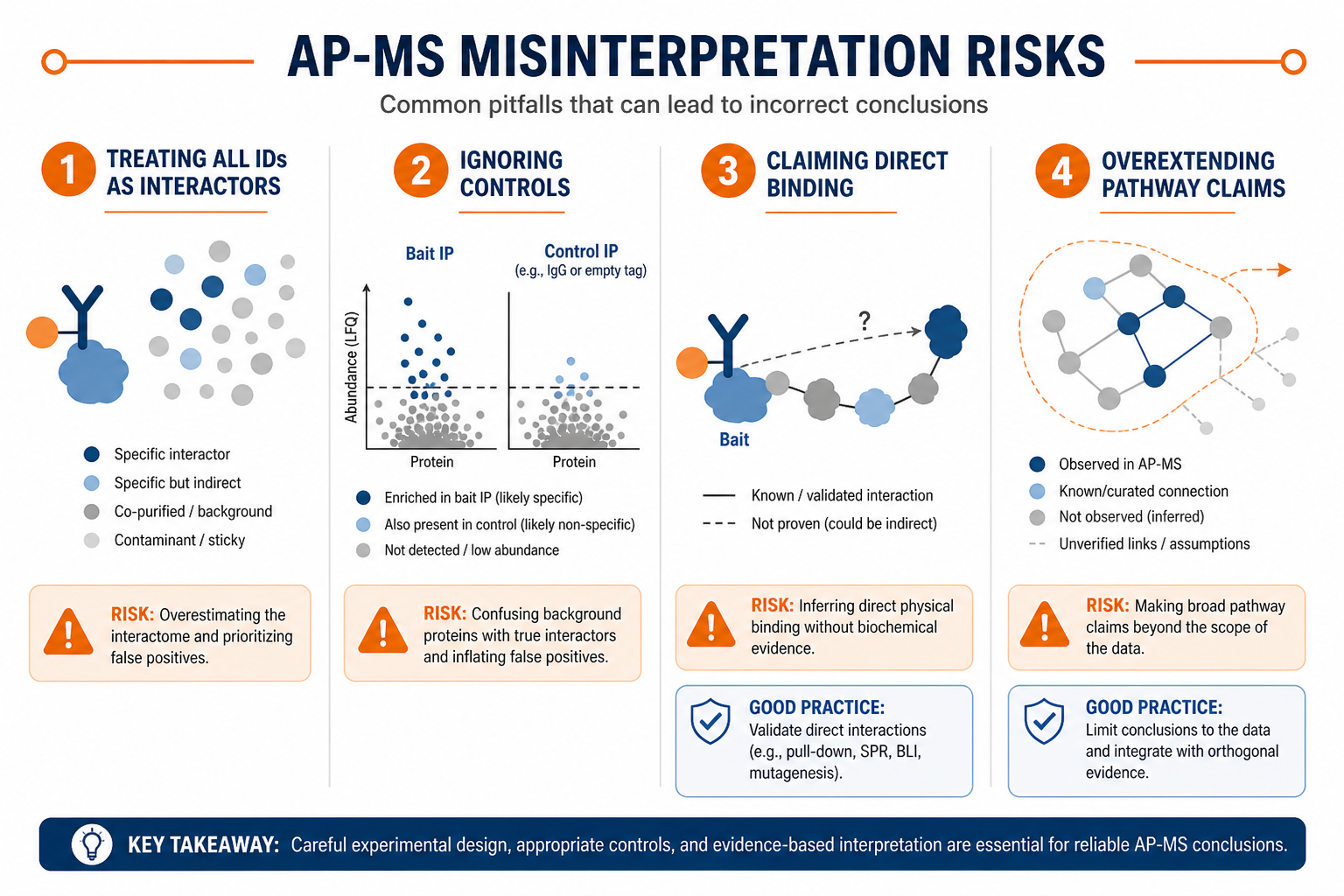
Figure 2. Responsible AP-MS interpretation requires control contrast, proportional claim language, and validation for high-strength interaction statements.
When AP-MS Evidence Needs Orthogonal Support
Orthogonal validation is not an optional cleanup step for weak projects. It defines which AP-MS candidates can support stronger biological claims. Reciprocal Co-IP or pull-down testing is commonly used when a prey must be shown to enrich the bait in the reverse direction. Domain or mutation mapping helps test whether enrichment depends on a specific bait surface or binding motif.
Pairwise binding assays such as surface plasmon resonance, biolayer interferometry, or equivalent methods support direct interaction claims that AP-MS alone cannot make. Functional readouts become necessary when the project goal is biological mechanism rather than candidate nomination. Proximity labeling or cross-linking MS may be considered when transient or weak associations are biologically important but poorly represented in standard AP-MS enrichments. The validation choice should follow the claim: discovery projects may stop at a ranked shortlist, while mechanism projects should plan orthogonal support before AP-MS samples are processed when possible.
Affinity Purification-Mass Spectrometry Service
Co-Immunoprecipitation Protein Interaction Analysis Service
Related Services
Complementary
Co-Immunoprecipitation Protein Interaction Analysis Service
Use to test reciprocal enrichment or confirm selected AP-MS candidates with targeted interaction assays.
Alternative
IP-MS Protein Interactomics Analysis Service
Use when endogenous bait capture is required and antibody performance supports IP-MS rather than tagged AP-MS.
Next Step
Affinity Purification-Mass Spectrometry Service
Consult on follow-up AP-MS design, control strategy, or validation-oriented project planning after reviewing current result limits.
Questions to Ask Before Presenting AP-MS Results
A practical interpretation checklist helps teams move from understanding AP-MS to defensible reporting. What control types were matched to the bait format? Which prey proteins remain after control subtraction and replicate review? Which candidates are reproducible rather than single-run detections?
What claim level does the figure or manuscript text actually require? Which top candidates have a defined orthogonal validation route? Teams that can answer these questions are ready to use AP-MS as discovery evidence rather than as a substitute for interaction proof. MtoZ Biolabs can help review bait recovery, control design, and whether the current dataset supports the intended claim level.
Frequently Asked Questions
1. Does AP-MS prove protein-protein interactions?
AP-MS shows co-enrichment under defined capture conditions. It supports candidate interaction hypotheses but does not by itself prove direct binding or in vivo functional coupling.
2. Why do strong AP-MS lists still contain background proteins?
Affinity enrichment is imperfect. Beads, tags, and abundant lysate proteins can co-purify. Interpretation depends on control contrast and ranking, not on expecting a background-free list.
3. Can I compare AP-MS results across treatment groups?
Yes, when bait recovery, capture chemistry, and analysis depth are matched across arms. Uneven bait enrichment can create false condition-dependent changes.
4. How should AP-MS candidates be prioritized?
Prioritize prey proteins with reproducible enrichment over controls, coherent biological context, and a feasible validation assay. Single-run detections without control contrast should be treated cautiously.
5. When should I request help interpreting AP-MS data?
Request review when the project moves from candidate discovery to binding claims, manuscript figures, or validation planning and the control design or claim level is uncertain.
Conclusion
Understanding AP-MS means understanding co-enrichment evidence, control-dependent specificity, and the gap between candidate nomination and validated interaction proof. The method is valuable when teams treat identification, enrichment, and binding confirmation as separate claim levels.
AP-MS supports discovery, comparative bait-centered analysis, and validation shortlist generation when results are interpreted with matched controls and proportional language. It does not replace orthogonal assays for direct binding, functional mechanism, or complex structure claims. Researchers preparing to report AP-MS data or plan follow-up validation can review the Affinity Purification-Mass Spectrometry Service page or contact MtoZ Biolabs with bait recovery details, control design, and the claim level the project requires.
How to order?




