






TMT Proteomics: Tandem Mass Tag-Based Relative Quantification
TMT proteomics is a label-based quantitative proteomics approach that uses isobaric tandem mass tags to enable multiplexed comparison of protein abundance across different samples. After peptides from different samples are labeled and pooled, LC-MS/MS analysis detects sample-specific reporter ions released during fragmentation. The reporter ion intensities are used to calculate relative protein abundance changes within a defined experimental comparison (Thompson et al., 2003).
TMT is commonly used for relative protein quantification when multiple samples need to be compared within a coordinated experimental design. It is particularly suitable for studies with predefined groups and a clear comparison objective. The choice between TMT and other quantitative strategies, such as label-free approaches, depends on factors including sample structure, study design, and quantitative requirements. Researchers who already have a defined sample set, defined groups, and a relative comparison objective can also review the MtoZ Biolabs TMT Quantitative Proteomics Service for project-specific feasibility and analysis planning.
What TMT Quantification Is Designed to Answer
TMT is designed for coordinated relative comparison inside one multiplex. After labeling and pooling, peptides from different channels co-elute, and reporter intensities support ratios for the same peptide and protein across those channels. The scientific claim is usually a within-study group contrast, not a molar concentration and not a ranking of different proteins by copy number.
TMT is well suited for studies with predefined groups and replicates that can be organized within a coordinated multiplex design. When sample numbers require multiple TMT batches, shared reference samples or other bridging strategies may be needed to support comparison across batches. When absolute protein amounts are required, targeted quantification with standards and calibration should be considered. If multiplex labeling is not suitable for the study design, label-free quantitative approaches may provide an alternative.
How TMT Labeling and Reporter-Ion Quantification Work
Digests are assigned to channels and labeled with isobaric reagents of matching total mass. The labeled peptides are pooled, separated by liquid chromatography, and fragmented. During fragmentation, channel-specific reporter ions are released and recorded. Relative ratios are calculated from those reporter intensities after identification and quantitative processing.
In MtoZ relative-discovery offerings, TMT workflows are typically acquired in data-dependent acquisition (DDA) so that reporter ions are measured from fragmentation of labeled precursors. Acquisition mode and labeling chemistry remain separate planning axes: DDA describes precursor selection, while TMT describes how samples are chemically coded into one mixture.
Ratio quality still depends on labeling completeness, channel balance, co-isolation interference, and batch design. Primary-amine buffers are reviewed because labeling targets peptide amines. Incomplete labeling, unbalanced loading, or a contrast aligned with a single channel position can distort the apparent biology.
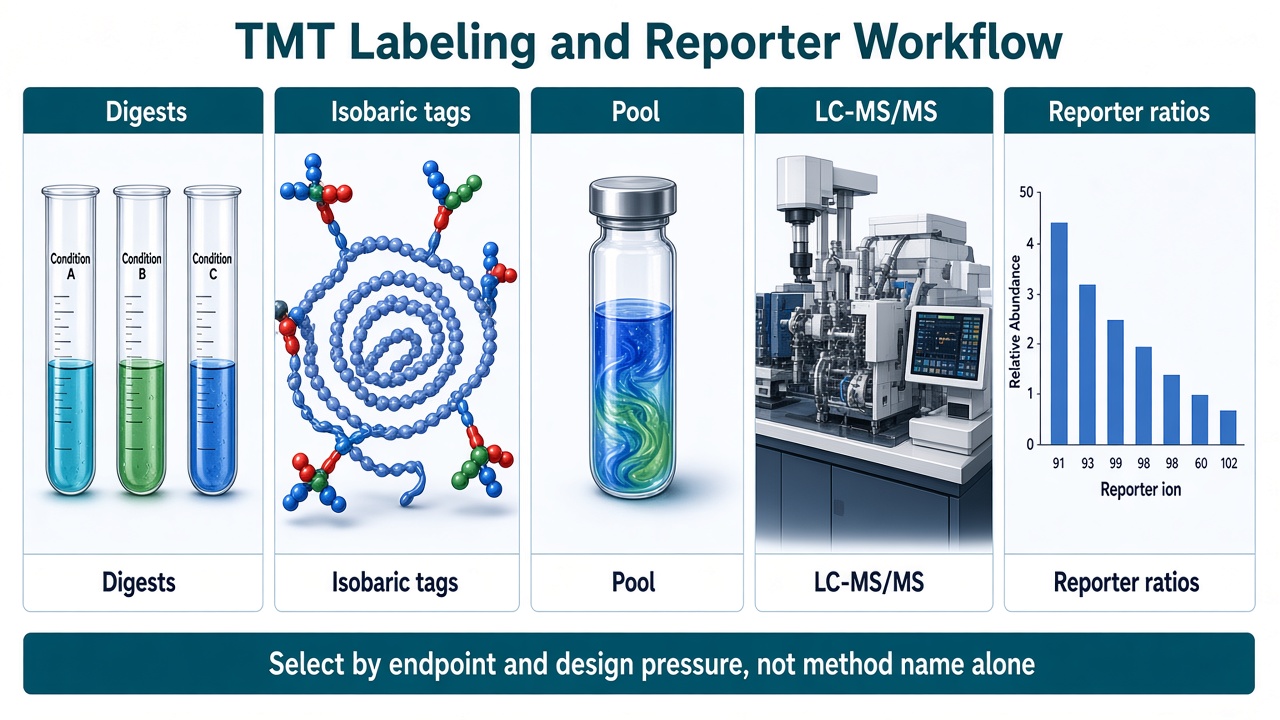
Figure 1. TMT encodes samples with isobaric tags, pools channels into one LC-MS/MS analysis, and derives relative ratios from reporter ions.
Designing a TMT Multiplex Comparison
A complete TMT comparison is often planned within one plex of 10 samples or fewer so that the intended contrast stays inside one coordinated labeling and acquisition block. Larger studies can still be considered when multi-plex bridging controls are designed in advance. Channel assignment should follow the group and replicate map rather than collection order alone. Randomizing biological conditions across channels reduces the chance that a technical channel effect becomes the same variable as the scientific contrast.
Typical planning amounts are more than 50 ug protein per channel, with 100 ug commonly used. Concentration is typically planned above 1 ug/uL, and detergent is typically kept below 0.1%. These figures help size extraction, digestion, and labeling. They are planning guides, not acceptance or rejection gates. Matrix, degradation, contaminants, and buffer chemistry still need joint review.
If samples become available over a long period, decide before the first plex whether later samples will form a new plex with bridging controls or whether an unlabeled independent-injection route fits better. Late redesign after labeling has started is harder to defend.
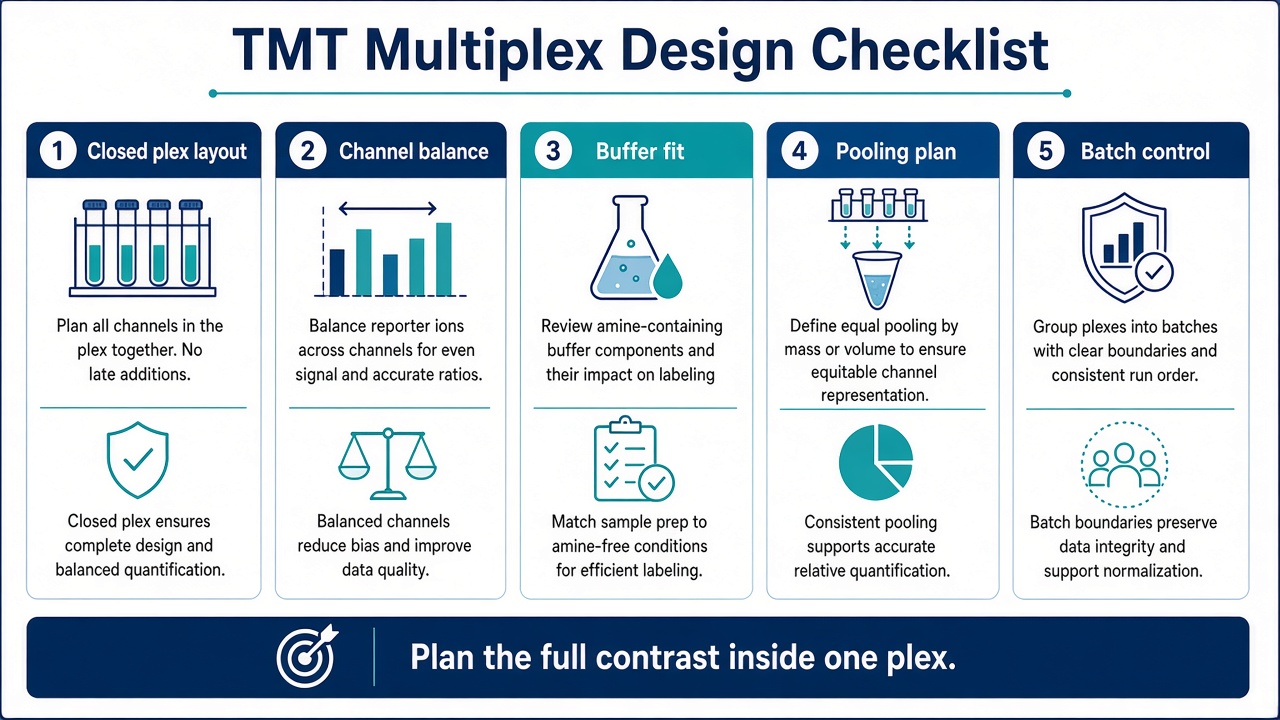
Figure 2. TMT design pressure centers on closed plex layout, channel balance, buffer compatibility, pooling, and batch control.
TMT Data Analysis and Interpretation
TMT deliverables usually include protein or protein-group tables with channel intensities or ratios, quality summaries, and differential results for predefined contrasts. Interpretation should read ratios together with peptide support, labeling QC, co-isolation risk, and replicate behavior.
Reporter-based values support same-protein relative comparison within the multiplex design. They do not by themselves prove causation, clinical utility, or absolute concentration. Candidate lists remain working shortlists for biological follow-up or targeted verification.
Co-isolation can mix reporter contributions from co-fragmented peptides and compress or distort ratios. Channel imbalance and incomplete labeling create related artifacts. These issues are design and QC topics, not reasons to treat every large ratio as biology.
When TMT Fits a Study Plan
TMT often fits when relative discovery is the endpoint, amine-reactive labeling is chemically practical, and the cohort can be coordinated into a planned plex. It is less natural when labeling chemistry is awkward, material is too limited for balanced channels, labeling cost is not justified, or enrollment cannot be bounded without uncontrolled batches.
When sample number, multiplexing requirements, cost constraints, or targeted follow-up make the choice less straightforward, researchers can refer to How to Choose a Quantitative Proteomics Strategy for a more detailed strategy-selection framework.
| Planning consideration | TMT is often useful when | Reconsider TMT when | Alternative strategy |
|---|---|---|---|
| Quantitative endpoint | Relative protein abundance comparison within predefined groups | Absolute protein amount is required | Targeted quantification with standards |
| Sample design | Multiple samples can be organized into a multiplexed comparison | Samples require flexible independent analysis | LFQ/DIA |
| Sample compatibility | Samples are compatible with TMT labeling chemistry | Labeling requirements cannot be met | Label-free quantification |
| Experimental design | Groups, replicates, and batches can be planned together | Study requires focused measurement of predefined targets | PRM/MRM |
| Quantitative objective | Broad protein comparison across experimental conditions | Only selected proteins need measurement | Targeted proteomics |
Theme-level orientation across strategies, workflow, and outputs remains in Quantitative Proteomics: Methods, Strategies, Workflow, and Applications.
Frequently Asked Questions
1. Does TMT report protein concentration?
No. Routine TMT reports relative ratios or related within-multiplex quantities for the same protein across channels. Concentration requires a separately designed targeted method with standards and calibration.
2. How many samples can one TMT comparison include?
A complete comparison is often planned in one plex of 10 samples or fewer. Larger studies need an explicit multi-plex batch plan rather than informal expansion.
3. Why review primary-amine buffers before TMT?
Labeling targets peptide amines. Incompatible buffers can reduce labeling completeness and weaken reporter-based ratios.
4. Is TMT the same as DDA?
No. TMT is a labeling and quantification strategy. DDA is an acquisition mode. In MtoZ offerings, TMT is typically acquired in DDA, which is a service configuration of those two axes together.
5. When should TMT candidates move to targeted follow-up?
When a shortlist is defined and the next claim needs focused measurement of named peptides or calibrated amount. Discovery ranking and targeted assays are complementary designs and need not follow a fixed sequence if the panel was defined from the start.
Conclusion
TMT proteomics supports tightly coordinated relative comparisons by labeling channels, pooling digests, and reading reporter-ion ratios within a planned multiplex. Design quality depends on plex layout, chemistry, channel balance, and batch control. Once those inputs are defined, researchers can review the MtoZ Biolabs TMT Quantitative Proteomics Service for project-specific sample evaluation, feasibility assessment, and workflow planning.
Reference
- A. Thompson, J. Schafer, K. Kuhn, S. Kienle, J. Schwarz, G. Schmidt, T. Neumann, C. Hamon (2003). Tandem Mass Tags: A Novel Quantification Strategy for Comparative Analysis of Complex Protein Mixtures by MS/MS. Anal. Chem., 75, 1895-1904. https://doi.org/10.1021/ac0262560
How to order?




