






Tandem Affinity Purification | TAP-MS | Technique to Study Protein-Protein Interactions
Introduction
Protein-protein interaction projects often struggle with background binders. A single affinity purification can recover the bait and true partners, but sticky proteins may dominate the eluate and obscure interpretation. A discovery team may need cleaner enrichment before LC-MS/MS. A complex biology group may want higher-confidence candidate interactors around a tagged bait without relying only on one capture step.
Tandem affinity purification coupled to mass spectrometry, commonly called TAP-MS, addresses this problem by purifying a tagged bait through two sequential affinity steps before protein identification. The tandem design aims to reduce non-specific binders while retaining proteins that remain associated with the bait through both captures. This article explains what TAP-MS is, how the technique works, where it adds technical value for protein-protein interaction studies, and what limitations teams should plan for before starting a project.
What TAP-MS Means
TAP-MS is an affinity purification-mass spectrometry strategy in which a bait protein is engineered with a tandem affinity tag and purified through two consecutive affinity steps, followed by LC-MS/MS identification of co-purified proteins.
The defining feature is the dual-capture workflow. After the first affinity step, a specific cleavage or release step typically exposes or enables the second affinity handle. The second purification then recovers the bait and remaining associated proteins under a second selection condition. Mass spectrometry identifies the recovered proteins and supports ranking of candidate interactors relative to controls.
TAP-MS sits within the broader AP-MS family. The practical distinction is purification stringency architecture. Classic single-step AP-MS uses one enrichment handle. TAP-MS uses two sequential handles to improve specificity for interaction proteomics when background reduction is a priority.
Why Tandem Affinity Purification Matters for PPI Studies
Protein-protein interaction studies depend on distinguishing specific partners from proteins that bind beads, tags, or abundant lysate contaminants. A single purification can be sufficient when controls are strong and background is manageable. In more congested lysates, residual non-specific proteins can inflate candidate lists and weaken follow-up decisions.
Tandem affinity purification matters because the second selection step can remove proteins that survived only the first capture. Partners that remain associated through both steps are more likely to reflect stable bait-linked recovery under the tested conditions. For interaction discovery, that cleaner enrichment can improve the usefulness of MS identification tables and reduce time spent validating obvious background proteins.
TAP-MS does not prove direct binary binding by itself. It improves the enrichment logic used to generate interaction candidates for downstream validation.
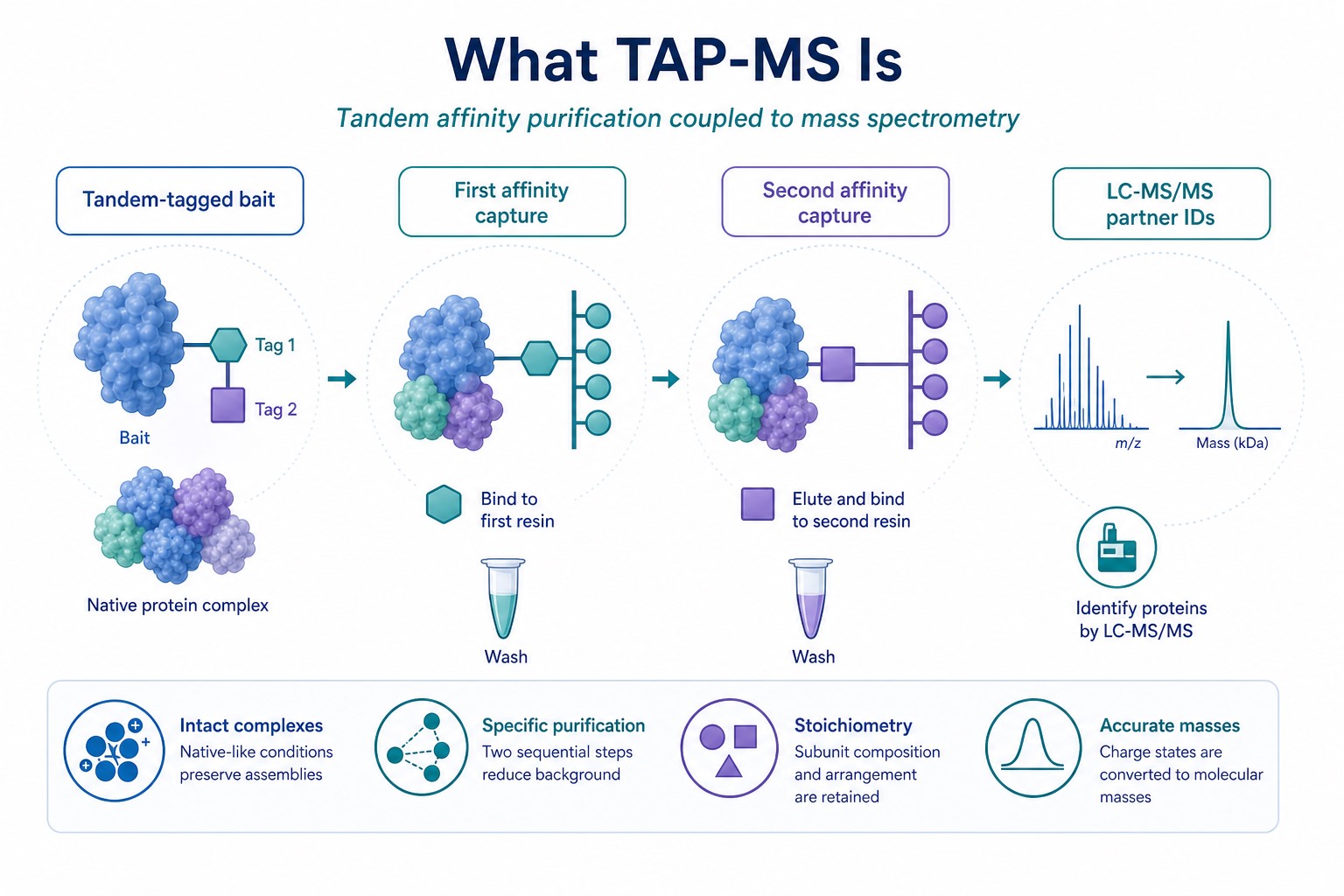
Figure 1. TAP-MS uses two sequential affinity purification steps on a tandem-tagged bait before LC-MS/MS identification of co-purified proteins.
How TAP-MS Works
A TAP-MS project follows a defined sequence from bait design to interaction candidate reporting.
Tandem tag design and bait expression
The bait is fused to a tandem affinity tag that supports two independent capture chemistries. Classic TAP designs historically combined IgG-binding and calmodulin-binding modules with an intervening protease cleavage site, and many modern variants use alternative dual-tag architectures. Tag choice should consider organism, expression system, and whether the tag position affects bait function.
First affinity purification
Lysate containing the tagged bait is incubated with the first affinity resin. The bait and associated proteins are captured, while unbound material is washed away under defined stringency.
Specific release or cleavage
A controlled cleavage or elution step releases the bait complex in a form compatible with the second affinity handle. This intermediate step is central to the tandem logic because it separates the two selection chemistries.
Second affinity purification
The released material is captured on the second affinity resin. Proteins that were non-specifically carried through the first step are more likely to be reduced here, while bait-associated proteins that survive both steps remain for analysis.
LC-MS/MS identification and control comparison
Eluted proteins are digested and analyzed by LC-MS/MS. Candidate interactors are interpreted against negative controls such as empty-tag, non-bait, or related background models. Replicates improve confidence when quantitative or semi-quantitative enrichment comparisons are used.
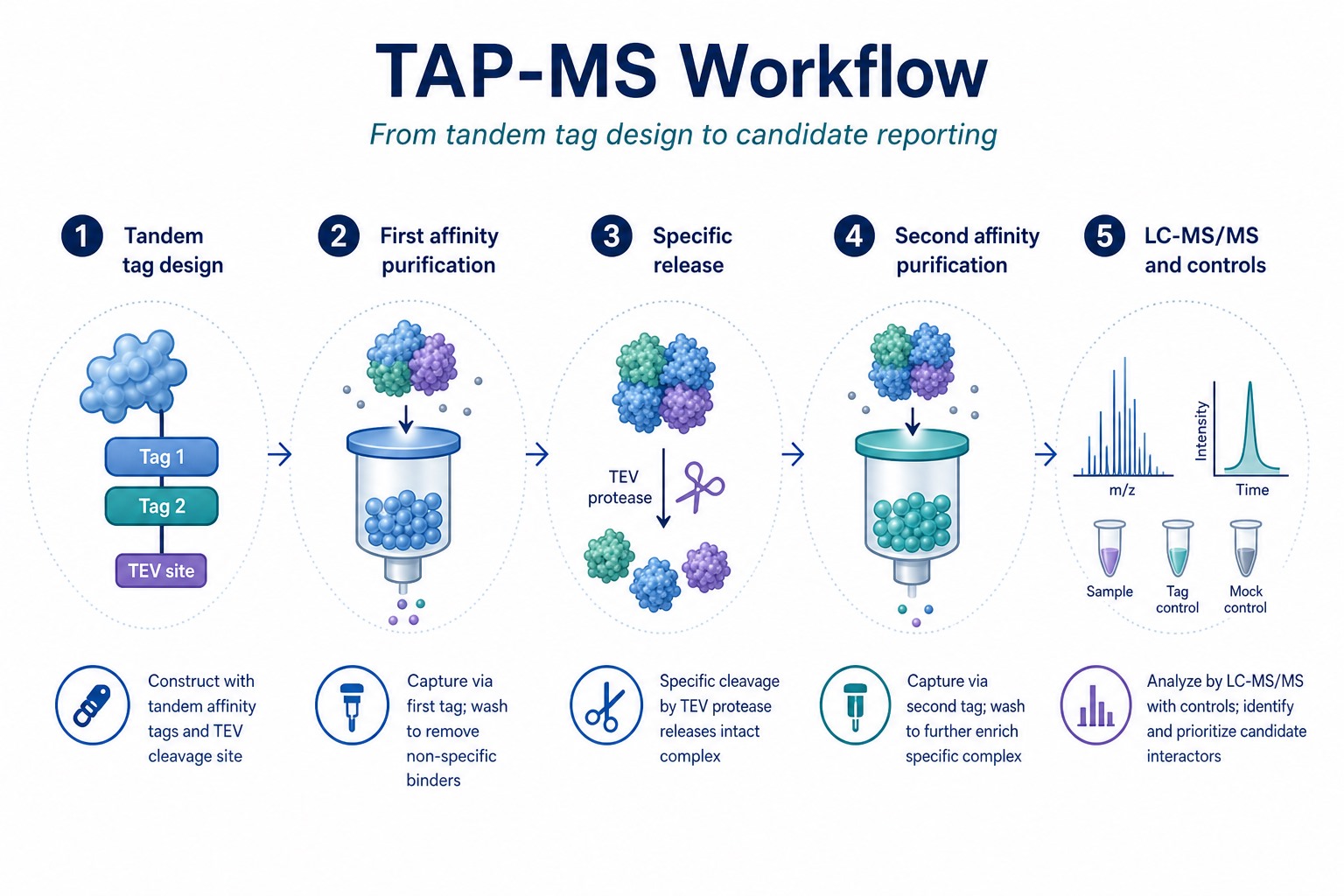
Figure 2. A TAP-MS workflow moves from tandem tag design and dual purification to LC-MS/MS identification and control-based candidate review.
Technical Advantages of TAP-MS
The technical value of TAP-MS for protein-protein interaction studies comes from dual-selection enrichment before mass spectrometry.
TAP-MS can reduce bead-binding and single-step background relative to one-pass affinity capture when both tag steps perform as designed.
TAP-MS supports bait-centered discovery of co-purified proteins without requiring prey antibodies for every candidate.
TAP-MS provides a structured purification architecture that can improve the signal-to-background quality of interaction proteomics samples entering LC-MS/MS.
TAP-MS can be paired with quantitative controls to rank candidate partners more confidently than presence-only lists from a single uncontrolled purification.
TAP-MS remains compatible with orthogonal follow-up such as Co-IP, pairwise binding assays, or functional tests on prioritized interactors.
These advantages are technical capabilities. They do not mean TAP-MS recovers every physiologically relevant interaction or replaces all other PPI methods.
Current Limitations of TAP-MS
TAP-MS also has boundaries that should be stated before project planning.
Tag fusion can affect bait localization, abundance, or interaction competence. Dual purification can lose weak or transient partners that do not survive both capture and wash cycles. Cleavage efficiency and tag accessibility can limit recovery. Sample amount requirements may be higher than for simpler single-step enrichments. Background proteins can still appear and must be filtered with controls. TAP-MS reports co-purification under lysis and wash conditions, not definitive proof of direct contact in living cells.
Recognizing these limits helps place TAP-MS as a high-specificity enrichment strategy within a broader interaction evidence plan.
Related Services
MS-Based Protein-Protein Interaction Analysis Service
Fusion Protein Interaction Analysis Service | Pull-Down and MS
Pull Down based Protein Analysis Service with Mass Spectrometry
Protein Identification Service
Co-Immunoprecipitation Protein Interaction Analysis Service
Teams evaluating TAP-MS or related tandem enrichment designs for protein-protein interaction discovery can consult MtoZ Biolabs to review bait tagging strategy, control setup, and MS identification depth for the current project phase.
Typical Applications of TAP-MS in PPI Research
TAP-MS is applied when cleaner bait-centered enrichment is needed for interaction proteomics.
Interactome discovery around a tagged bait
TAP-MS is used to generate candidate partner lists for transcription factors, signaling proteins, and other baits expressed with tandem tags.
Background reduction in complex lysates
Projects with high non-specific binding risk may use tandem purification to improve the quality of proteins entering LC-MS/MS.
Condition-dependent complex composition review
TAP-MS can compare recovered partners across selected biological conditions when tag expression and purification performance remain comparable.
Shortlist generation before orthogonal validation
Candidate interactors from TAP-MS are commonly advanced to Co-IP, pairwise assays, or functional tests for confirmation.
TAP-MS is often considered when bait-centered discovery needs lower single-step background, when prey antibody coverage is limited, or when a cleaner candidate shortlist is required before validation. Important caveats remain: weak partners may be lost, controls are still required, and direct binding is not proven by co-purification alone.
For programs that need TAP-style enrichment followed by targeted confirmation, MtoZ Biolabs can help connect MS candidate generation with orthogonal interaction assays in a staged plan.
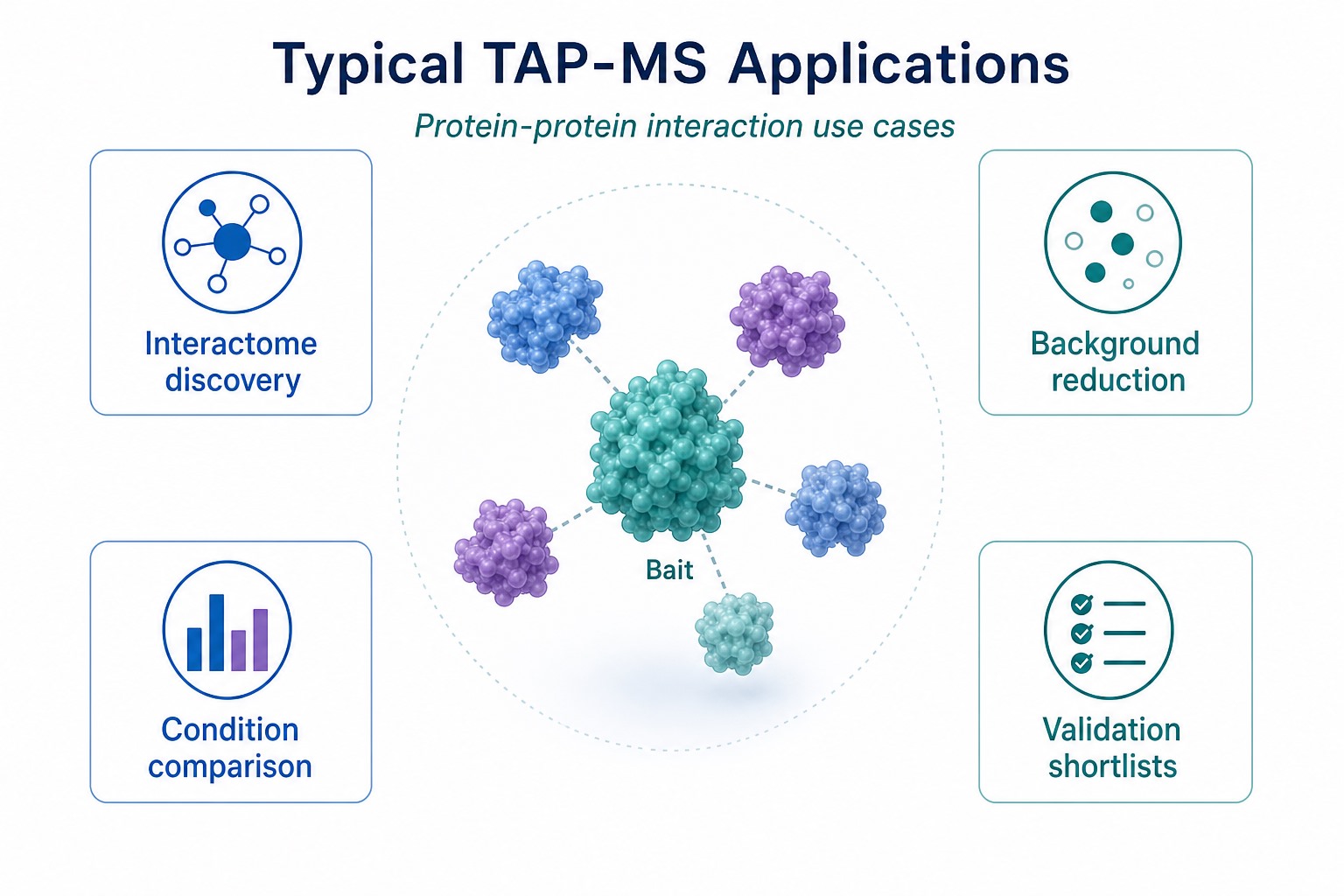
Figure 3. TAP-MS is commonly applied to bait-centered interactome discovery, background reduction, and generation of candidate lists for orthogonal validation.
Outlook for TAP-MS in Interaction Proteomics
TAP-MS continues to evolve through improved tag systems, milder release chemistries, and better quantitative AP-MS controls. Modern dual-tag variants aim to preserve more native interactions while retaining the specificity benefit of two selection steps. At the same time, TAP-MS is increasingly used as one layer in multi-method PPI programs that also include single-step AP-MS, Co-IP, proximity labeling, or crosslinking strategies depending on interaction stability and cellular context.
The practical future of TAP-MS is selective use. When background reduction and bait-centered discovery are both required, tandem affinity purification remains a useful route into LC-MS/MS. When interactions are highly transient or tag fusion is disruptive, alternative PPI methods may be a better lead choice.
Frequently Asked Questions
1. What is TAP-MS?
TAP-MS is tandem affinity purification coupled to mass spectrometry. A tandem-tagged bait is purified through two affinity steps, then co-purified proteins are identified by LC-MS/MS.
2. How is TAP-MS different from single-step AP-MS?
Single-step AP-MS uses one affinity enrichment. TAP-MS uses two sequential affinity selections to reduce proteins that survive only one capture step.
3. Does TAP-MS prove direct protein-protein binding?
No. TAP-MS shows which proteins co-purify with the bait under the enrichment conditions used. Direct binding needs orthogonal validation.
4. What is the main trade-off of tandem purification?
Higher specificity potential comes with greater risk of losing weak or transient interactors during the second purification.
5. Do all TAP-MS projects use the classic dual tag?
No. Many modern tandem systems use alternative dual-affinity designs. The shared principle is two independent selection steps.
6. When should TAP-MS be chosen for PPI studies?
TAP-MS is a strong option when bait-centered discovery is needed and single-step background is expected to complicate interpretation.
Conclusion
Tandem affinity purification-mass spectrometry is a protein-protein interaction technique that combines dual affinity enrichment of a tagged bait with LC-MS/MS identification of co-purified proteins. The tandem design is intended to reduce single-step background and improve the quality of candidate interactor lists entering proteomic analysis. TAP-MS remains part of the broader AP-MS family and works best when bait tagging, controls, and follow-up validation are planned together.
For interaction discovery projects that need cleaner enrichment before mass spectrometry, TAP-MS provides a structured technical path from tagged bait to ranked partner candidates. Researchers planning TAP-MS or related affinity-MS interaction studies can contact MtoZ Biolabs to review tag strategy, control design, and the analytical approach matched to the current project phase.
How to order?




