






SUMOylated Peptide Detection Service
-
Raw data files from LC-MS/MS platforms
-
Processed data tables in CSV or Excel formats containing identified SUMOylated peptides and quantitative results
-
Summary reports in PDF format detailing analytical methods, instrument parameters, and key findings
-
Figures and spectra in high-resolution image formats such as TIFF or PNG
-
Whole-cell lysates or nuclear extracts for intracellular SUMOylation analysis
-
Tissue homogenates for in vivo modification profiling
-
Recombinant or fusion proteins for targeted SUMOylation studies
-
Synthetic peptides for method validation or control experiments
MtoZ Biolabs provides SUMOylated peptide detection service based on high-resolution mass spectrometry and specific enrichment strategies. This service helps researchers comprehensively identify and quantify SUMO modification sites on proteins, enabling a deeper understanding of their roles in signal transduction, stress response, DNA repair, and disease development. The service covers cell, tissue, and recombinant protein samples, providing reliable experimental data and technical support for post-translational modification studies.
What is SUMOylation
SUMOylation (Small Ubiquitin-like Modifier modification) is an important reversible post-translational modification. It covalently attaches SUMO proteins to lysine residues on target proteins to regulate their structure, activity, and localization. This modification is closely associated with cell cycle regulation, gene expression, protein stability, and stress response.
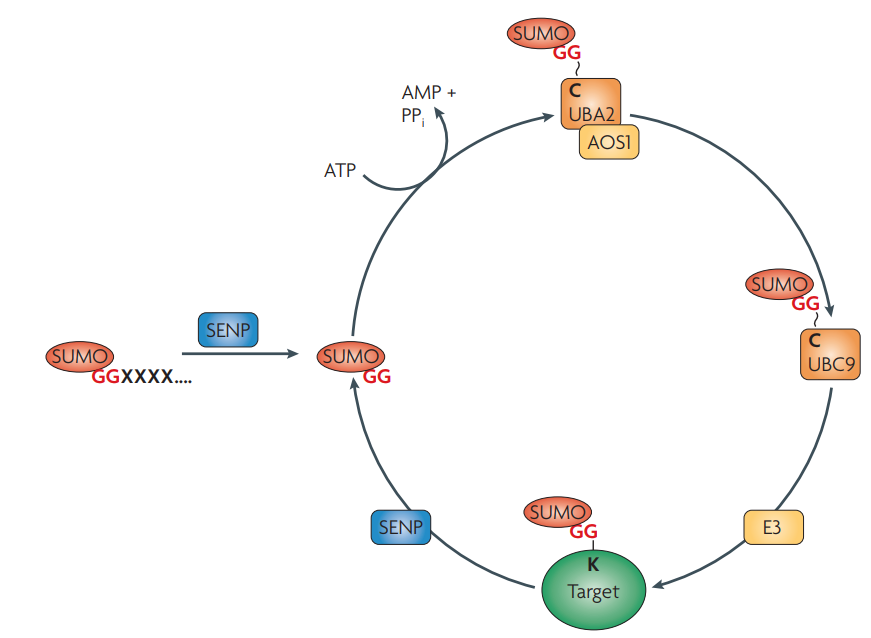
Geiss-Friedlander, R. et al. Nat Rev Mol Cell Biol. 2007.
Figure 1. The Mechanism of Reversible Sumoylation
Abnormal SUMOylation is related to various diseases, including neurodegenerative disorders, cardiovascular diseases, and cancers. Therefore, accurate detection of SUMOylated peptides is of great significance in biomedical research.
SUMOylated Peptide Detection Service at MtoZ Biolabs
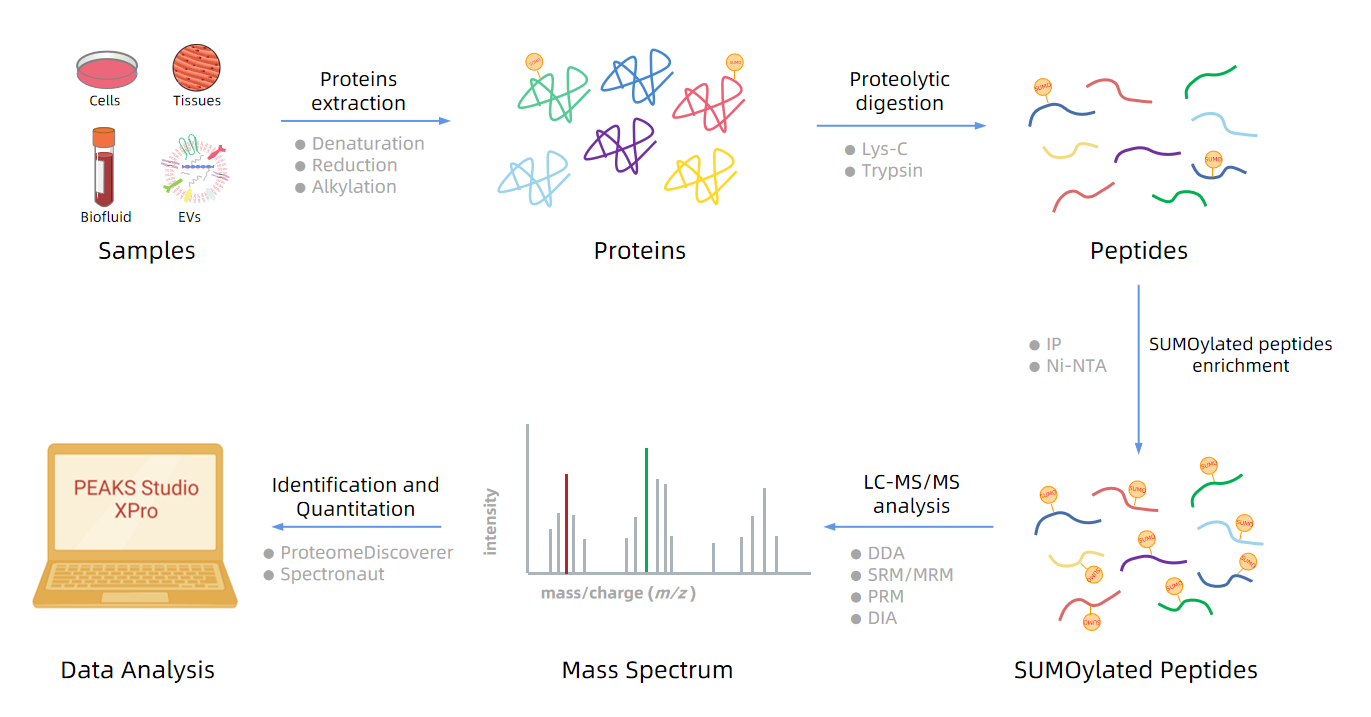
The SUMOylated peptide detection service at MtoZ Biolabs combines mass spectrometry analysis with specific enrichment strategies to accurately identify SUMO modifications in complex biological samples. We provide, but are not limited to, the following services:
1. Identification of SUMOylated Peptides
High-resolution LC-MS/MS systems, including Orbitrap Fusion Lumos and Q Exactive HF, are used with database searching to accurately identify SUMOylated peptides. Modification sites and the types of amino acid residues linked to SUMO can be determined.
2. Quantitative Analysis of SUMOylation Levels
Using various quantitative strategies such as Label-free, TMT, or iTRAQ, the SUMOylation levels under different treatments or biological conditions can be compared to reveal dynamic protein regulation.
3. SUMO Enrichment and Selective Capture
Anti-SUMO antibody immunoprecipitation (IP) or Ni-NTA affinity capture techniques are used to increase detection sensitivity, which is particularly effective for low-abundance proteins or complex samples.
4. Customizable Analysis Plans
Flexible experimental designs are available to meet diverse research needs, including single-protein SUMOylation studies, global SUMO proteome profiling, and multi-omics integration, supporting mechanism studies and drug screening.
Workflow of SUMOylated Peptide Detection Service
Why Choose MtoZ Biolabs
☑️ Advanced Platform: Equipped with high-resolution mass spectrometers such as Orbitrap Fusion Lumos and Q Exactive HF.
☑️ Professional Team: Experienced in post-translational modification research.
☑️ High Sensitivity Enrichment: Specific enrichment methods for low-abundance SUMOylated peptides.
☑️ Flexible Customization: Tailored analytical depth and workflow based on research goals.
☑️ Reproducible Results: Standardized operation ensures stability and reliability.
Applications of SUMOylated Peptide Detection Service
1️⃣ Study protein stability and degradation mechanisms
2️⃣ Analyze SUMOylation dynamics under stress conditions
3️⃣ Investigate transcription factor activity and signaling regulation
4️⃣ Identify SUMOylation targets associated with diseases
5️⃣ Support drug target screening and mechanism studies
Sample Submission Guidelines
| Sample Type | Cell lysate | Tissue sample | Recombinant protein | Synthetic peptide | Plasma or serum | Nuclear extract |
| Recommended Amount | ≥500 µg total protein | ≥50 mg | ≥50 µg | ≥10 µg | ≥200 µL | ≥300 µg |
For special sample types, please contact the MtoZ Biolabs technical team for customized guidance.
Deliverables
1. Experimental workflow and instrument parameters
2. Raw mass spectrometry data files (Raw)
3. SUMOylation site identification tables
4. Quantitative analysis reports and figures
5. Data quality control and evaluation files
FAQs
Q1: What is the service's general workflow?

Q2: What data formats are provided?
MtoZ Biolabs provides results in multiple standardized formats to ensure compatibility with a variety of downstream analytical and visualization tools. Deliverables typically include:
Additional customized file formats or data structures can be provided upon request to meet publication or data integration requirements.
Q3: How should I prepare my samples?
To ensure accurate and reproducible SUMOylated peptide analysis, MtoZ Biolabs recommends the following preparation guidelines:
1. Sample Type: We accept a wide range of biological samples, including cultured cells, tissues, recombinant proteins, and synthetic peptides.
2. Sample Purity: Samples should be free of particulates, detergents, and excessive salts that could interfere with mass spectrometry ionization or chromatography.
3. Protein Amount: Please provide at least 500 µg of total protein or 50 µg of purified protein sample. Additional quantity may be required for replicate or deep profiling analyses.
4. Storage and Shipping: Store samples at −80°C and ship on dry ice in sealed, leak-proof containers to preserve protein integrity.
5. Documentation: Include details such as sample source, buffer composition, digestion status, and intended analysis scope.
For more information, please refer to Sample Submission Guidelines for Proteomics and Sample Submission Guidelines for Metabolomics.
If you are unsure about your sample preparation, our technical team can provide personalized pre-analysis consultation and a sample submission guide to help you optimize preparation and shipping conditions.
Q4: What types of samples are suitable?
This service is suitable for a broad spectrum of biological materials, including:
Our team can assist in selecting the most appropriate preparation and enrichment approach based on sample type and project goals.
Start Your Project with MtoZ Biolabs
SUMOylation is a key mechanism in protein function regulation, and its dynamic changes have profound significance in biological and disease research. MtoZ Biolabs, with its high-precision mass spectrometry platform and optimized analytical workflow, provides a systematic SUMOylated peptide detection service to help researchers explore the molecular mechanisms of post-translational modifications. Contact us to learn more about our services or request a project quote.
How to order?




