






Step-by-Step Glycan Analysis of a Biologic Therapeutic
- biologic class and primary glycosylation sites of interest
- whether site-specific or global glycan data are required
- whether the study is exploratory, development-stage, or comparability-focused
- whether orthogonal methods such as intact mass or peptide mapping are needed in parallel
- sample type and antibody or protein format
- available volume and protein amount
- buffer and excipient composition
- storage and handling history
- whether reference, test, and control lots are available for comparison
- glycopeptide or glycan identification against expected structures
- site localization and occupancy review
- major glycoform quantitation or ranking
- comparison across batches, time points, or process conditions when applicable
- QC review of enrichment efficiency, replicate agreement, and background artifacts
Introduction
Glycan analysis is a common requirement in biologic therapeutic development, yet projects often begin without a clear step order. A monoclonal antibody lot may need Fc glycan profiling before comparability review. A fusion protein may require site occupancy confirmation after a process change. A biosimilar team may need released glycan data, glycopeptide mapping, and intact glycoform review within one characterization package. Without a defined workflow, teams risk repeating sample preparation, choosing the wrong analytical layer, or reporting glycan data that cannot support the intended decision.
Step-by-step glycan analysis of a biologic therapeutic organizes the project from sample feasibility through method selection, enrichment, LC-MS/MS acquisition, data interpretation, and validation planning. The workflow is not identical for every product. Antibody drug substances, fusion proteins, enzymes, and formulated drug products each present different sample constraints and reporting needs. A stepwise plan helps teams define the analytical goal first, then select the route that reports the glycan attribute most relevant to release, comparability, or development review.
For biologics programs preparing glycan analysis, the first practical step is to define whether the project requires released glycan profiling, site-specific glycopeptide mapping, intact glycoform comparison, or a combined package before samples are submitted.
What Glycan Analysis Means for a Biologic Therapeutic
Glycan analysis characterizes carbohydrate structures attached to a therapeutic protein and, when site-specific methods are used, identifies which residues carry those glycans. For biologics, glycosylation is often a critical quality attribute because glycan composition can influence stability, clearance, aggregation, and biological activity.
A biologic therapeutic rarely exists as a single glycoform. Mammalian expression systems produce mixtures of N-linked and, in some products, O-linked glycans across one or more sites. Glycan analysis therefore reports distributions, site occupancy, and major glycoform populations rather than a single uniform structure.
The analytical question determines the workflow. Released glycan analysis answers which glycan structures are present after cleavage from the protein. Glycopeptide LC-MS/MS answers which sites carry which glycans. Intact mass analysis answers how glycoforms contribute to overall molecular heterogeneity. Step-by-step planning ensures the chosen route matches the decision the project must support.
Step 1: Define the Analytical Goal and Product Context
The workflow begins with project scoping rather than sample submission. Teams should define the biologic type, glycosylation sites of interest, and the decision the data must support.
Common goals include characterizing a monoclonal antibody Fc glycan profile, comparing glycan distribution between reference and test lots, monitoring process change impact, documenting site occupancy, or supporting stability and comparability review. Each goal favors a different analytical emphasis.
Product context also matters. IgG antibodies, Fc fusion proteins, bispecific formats, and glycoengineered variants may require different digestion, enrichment, and reporting strategies. Expression system, cell line, and manufacturing stage should be documented because they strongly influence glycan distribution.
At this step, teams should confirm:
Clear scoping prevents downstream rework when the initial method cannot answer the actual question.
Step 2: Review Sample Feasibility and Submission Readiness
Sample quality determines whether glycan analysis can proceed efficiently on the first attempt. Biologic therapeutics are often submitted as drug substance, research material, reference standard, or formulated drug product. Each matrix presents different constraints.
Purity, concentration, buffer composition, excipients, detergents, and storage history can affect digestion, glycan release, enrichment, and LC-MS performance. Highly formulated samples may require additional cleanup. Low-concentration material may limit glycopeptide recovery. Repeated freeze-thaw cycles can introduce variability before analysis begins.
Feasibility review should confirm:
When sample information is incomplete, a feasibility consultation before method lock-in often saves time and material.
Step 3: Select the Glycan Analysis Route
Biologic glycan analysis usually follows one or more of three routes. The stepwise workflow branches here based on the goal defined in Step 1.
Released glycan analysis cleaves glycans from the protein and profiles glycan compositions. It is useful when detailed glycan class distribution is needed and site linkage is not the primary focus, or when it complements site-specific mapping.
Glycopeptide LC-MS/MS digests the protein, enriches glycopeptides, and assigns glycan structures to specific peptide sequences and residues. It is the primary route for site-specific glycan identification and occupancy review on biologics.
Intact or subunit mass analysis measures glycoform distributions on the intact biologic or major subunits. It is useful for rapid comparability screening and for documenting global heterogeneity before deeper site mapping.
Many biologics projects combine two routes. For example, intact screening may identify a glycoform shift, followed by glycopeptide mapping to localize the change.
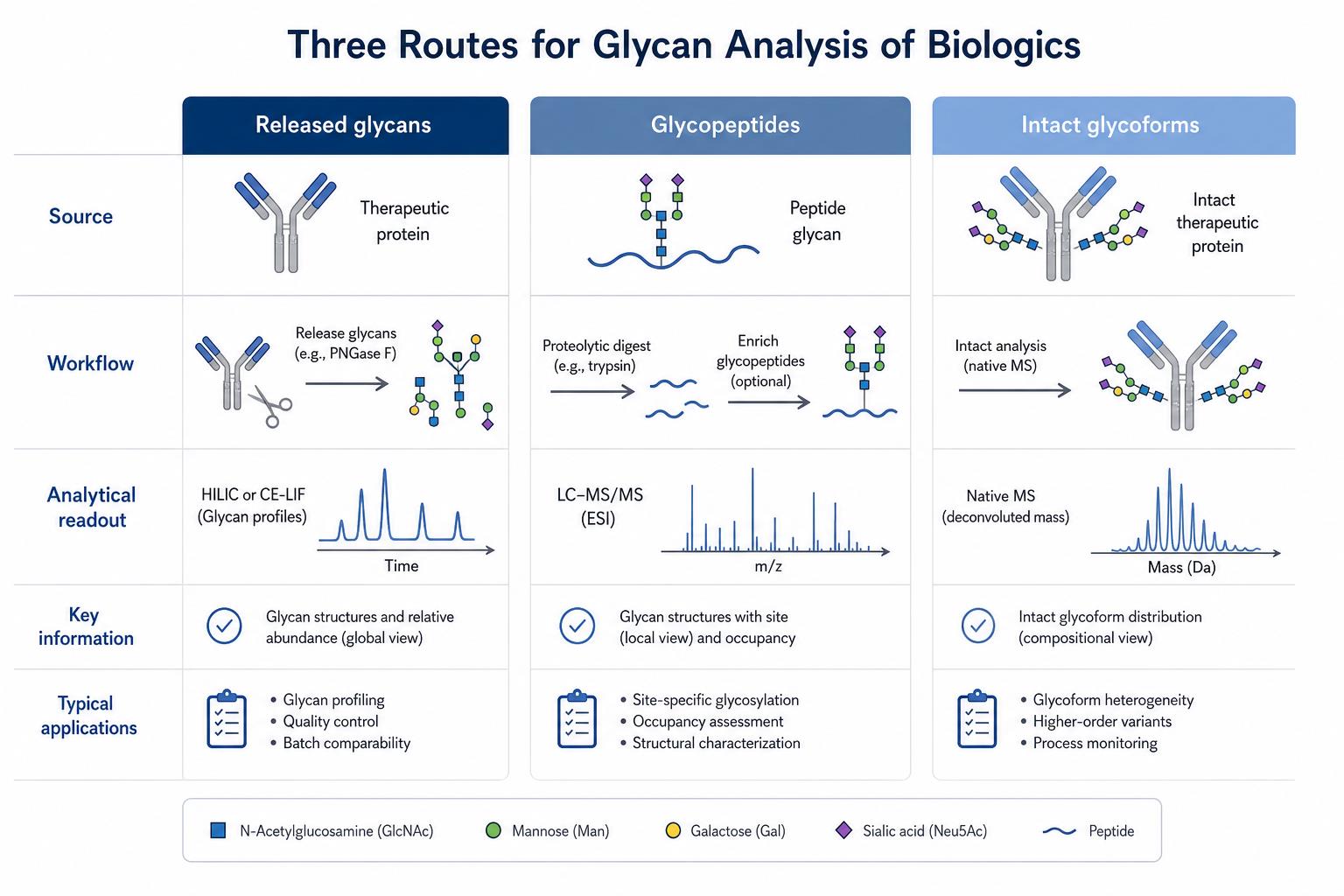
Figure 1. Biologic glycan analysis may use released glycan profiling, site-specific glycopeptide mapping, or intact glycoform analysis depending on project scope.
Step 4: Prepare the Sample and Perform Glycan Release or Digestion
Sample preparation must match the selected route.
For released glycan analysis, glycans are typically released from asparagine-linked sites using PNGase F or through appropriate workflows for other glycan classes when applicable. Released glycans may be labeled or analyzed directly depending on the detection platform.
For glycopeptide analysis, proteolytic digestion generates peptides that retain glycans at occupied sites. Enzyme choice affects peptide size, recovery, and compatibility with LC-MS/MS. For antibodies, workflows often target Fc glycopeptides while supporting review of additional sites when present.
For intact analysis, minimal manipulation is preferred so glycoform populations remain representative of the submitted material. Buffer exchange or desalting may still be required before mass spectrometry.
Preparation conditions should be standardized across compared samples so batch differences reflect product differences rather than handling variability.
Standard Step-by-Step Workflow Overview
A complete biologic glycan analysis project can be summarized as a six-stage path from intake to reporting.
Step 1 defines the analytical goal and product context. Step 2 confirms sample feasibility and submission readiness. Step 3 selects released glycan, glycopeptide, intact, or combined analysis routes. Step 4 performs sample preparation, digestion, or glycan release under standardized conditions. Step 5 executes enrichment when required, LC-MS/MS or intact mass acquisition, and data processing. Step 6 delivers interpreted results with QC summary, glycan profile tables, site occupancy notes, and validation recommendations when needed.
This sequence keeps method selection tied to the biologic decision rather than to instrument availability alone.
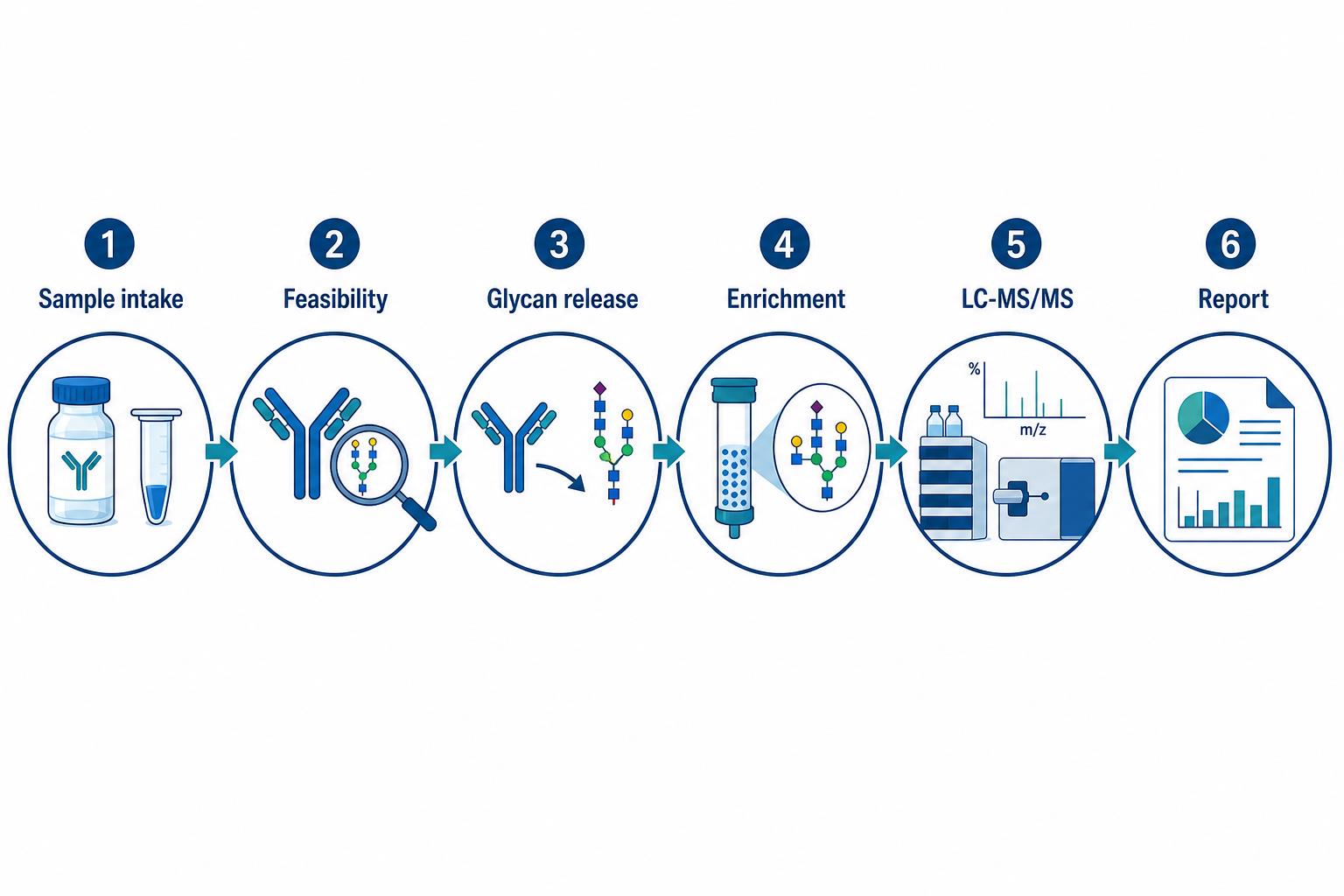
Figure 2. Step-by-step glycan analysis of a biologic therapeutic moves from sample intake and feasibility review through analytical execution to interpreted reporting.
Related Services
Protein Drug Glycosylation Analysis Service
Protein Glycosylation Analysis Service
Glycosylation Site Analysis Service
Comprehensive Glycosylation Analysis Service
Researchers planning glycan analysis for a biologic therapeutic can consult MtoZ Biolabs to review sample status, route selection, and reporting depth before analysis begins.
Step 5: Enrich, Acquire, and Process Glycan Data
When glycopeptide mapping is performed, enrichment improves detection of low-abundance glycopeptides in complex digests. HILIC, lectin affinity, and graphitized carbon workflows are common depending on sample and platform.
LC-MS/MS acquisition for glycopeptides often uses high-resolution instruments with fragmentation modes that preserve peptide backbone information while defining glycan composition. Released glycan workflows may use LC-MS, fluorescent detection, or MALDI-based profiling depending on project design. Intact mass acquisition requires sufficient resolution to distinguish major glycoforms.
Data processing should include:
Raw instrument output should be translated into decision-ready tables and interpreted summaries rather than delivered as unannotated data alone.
Step 6: Interpret Results and Plan Validation
The final step converts analytical output into a report that supports the project decision. A useful glycan analysis package for a biologic therapeutic should explain both findings and limits.
Interpretation should address which sites were observed, which glycan classes dominated, whether occupancy varied, and whether batch or process differences exceeded expected variability. When comparability is the goal, similarity of major glycoforms and monitored glycan attributes should be discussed explicitly.
Validation planning depends on project stage. Early development may require only ranked glycan profiles and site confirmation. Late-stage comparability may require tighter review against predefined acceptance criteria. Functional follow-up may be needed when glycan changes could affect effector function, clearance, or stability.
|
Reporting Element |
What It Provides |
Common Use |
|---|---|---|
|
QC summary |
Method performance and sample suitability |
Confirm data reliability |
|
Released glycan profile |
Glycan class and composition distribution |
Global glycan review |
|
Glycopeptide table |
Site-specific glycan assignments |
Site occupancy and localization |
|
Intact glycoform summary |
Major mass variants on intact biologic |
Comparability screening |
|
Batch comparison |
Differences across lots or conditions |
Process or biosimilar review |
|
Validation recommendation |
Suggested follow-up assays |
Link glycan data to next steps |
Core Technical Considerations Across the Workflow
Several technical factors affect every step of biologic glycan analysis.
Expression system influences baseline glycan distribution and must be documented for interpretation. Enrichment strategy determines whether low-abundance sites are detected. Fragmentation mode affects confidence in site localization. Comparator design determines whether observed differences are meaningful. Orthogonal methods such as intact mass, peptide mapping, or functional assays may strengthen conclusions when glycan changes are central to the review.
Teams should also distinguish discovery-stage flexibility from quality-stage documentation needs. A exploratory glycan screen may accept broader method variation. A comparability or control strategy package usually requires tighter method definition and clearer acceptance logic.
Applications in Biologic Development
Step-by-step glycan analysis supports multiple biologics scenarios.
Monoclonal antibody characterization.
Fc glycan profiling documents major glycoforms during candidate development and lot review.
Fusion protein and glycoprotein review.
Multi-site products may require combined released glycan and glycopeptide analysis.
Biosimilar comparability.
Reference and test products are compared for glycan profile similarity alongside other quality attributes.
Process change assessment.
Manufacturing changes are evaluated for glycan shifts before functional or stability impact is observed.
Stability and forced degradation studies.
Glycan profile changes may be monitored when glycosylation is relevant to shelf-life or stress behavior.
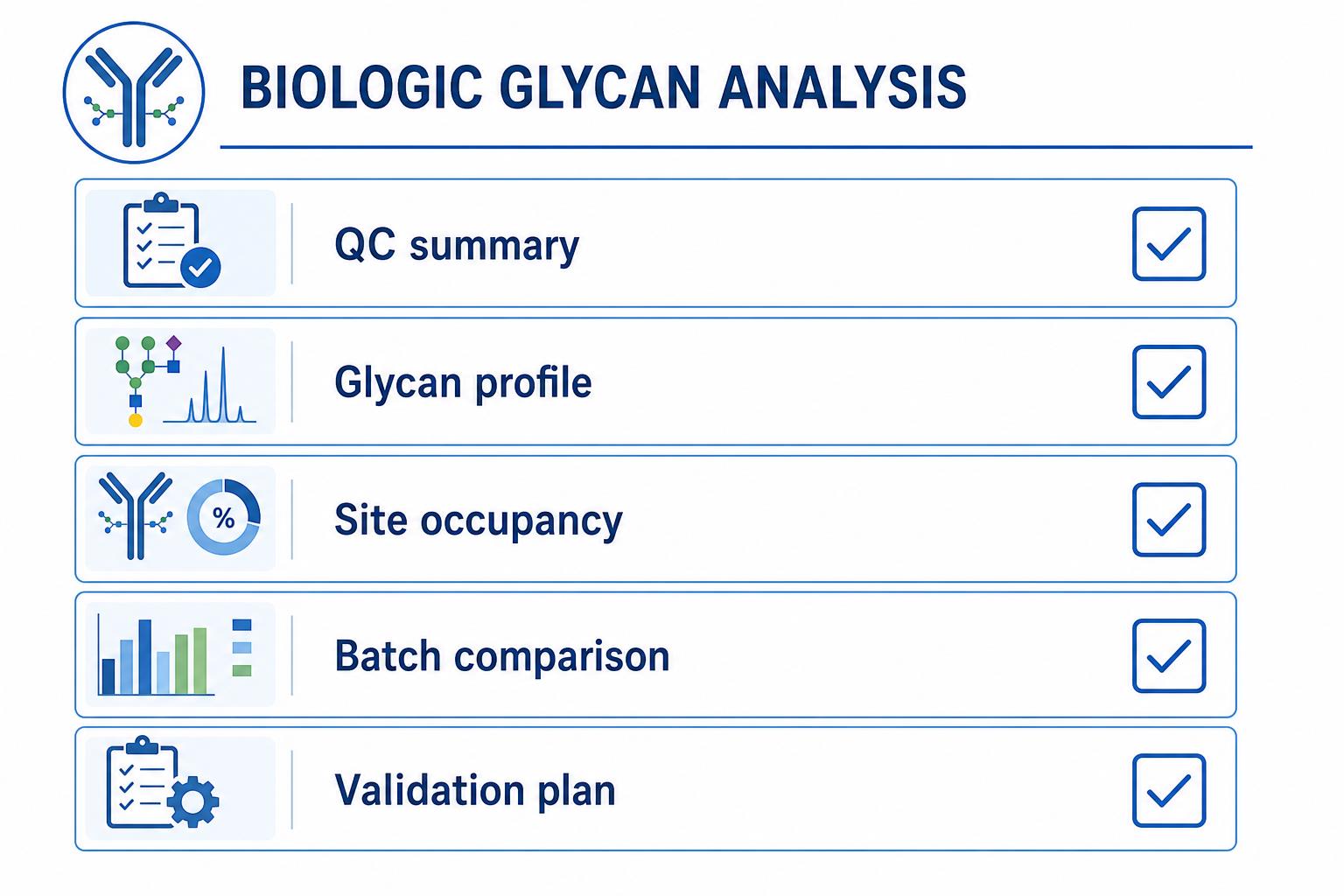
Figure 3. A complete biologic glycan analysis report should include QC context, glycan profiles, site occupancy notes, comparability review, and validation planning when required.
Frequently Asked Questions
1. What is the first step in glycan analysis of a biologic therapeutic?
The first step is to define the analytical goal, product type, and whether site-specific, released glycan, or intact glycoform data are required for the decision under review.
2. Which method is best for antibody glycan analysis?
There is no single best method. Released glycan profiling, glycopeptide LC-MS/MS, and intact mass analysis answer different questions and are often used together for antibodies.
3. Why is sample feasibility review important?
Buffer composition, excipients, purity, and storage history can affect digestion, enrichment, and LC-MS performance. Feasibility review reduces repeat analysis risk.
4. Can glycan analysis support biosimilar comparability?
Yes. Glycan profile comparison between reference and test biologic lots is a common use of stepwise glycan analysis workflows.
5. Does glycan analysis alone confirm functional impact?
No. Glycan analysis characterizes structure and distribution. Functional or stability follow-up may still be required when glycan changes could affect product behavior.
Conclusion
Step-by-step glycan analysis of a biologic therapeutic provides a structured path from project scoping to interpreted reporting. By defining the analytical goal, reviewing sample feasibility, selecting the appropriate released glycan, glycopeptide, or intact route, and processing data with clear QC and validation logic, teams can generate glycan evidence that supports development, comparability, and quality review.
Biologic glycan analysis is most effective when the workflow matches the product and decision rather than when a generic method is applied without context. Reliable outcomes depend on early scoping, standardized sample handling, route selection aligned to the question, and reporting that connects glycan findings to next-step validation. Researchers planning glycan analysis for a biologic therapeutic can contact MtoZ Biolabs to review sample readiness, method selection, and the reporting package best suited to the program stage.
How to order?




